
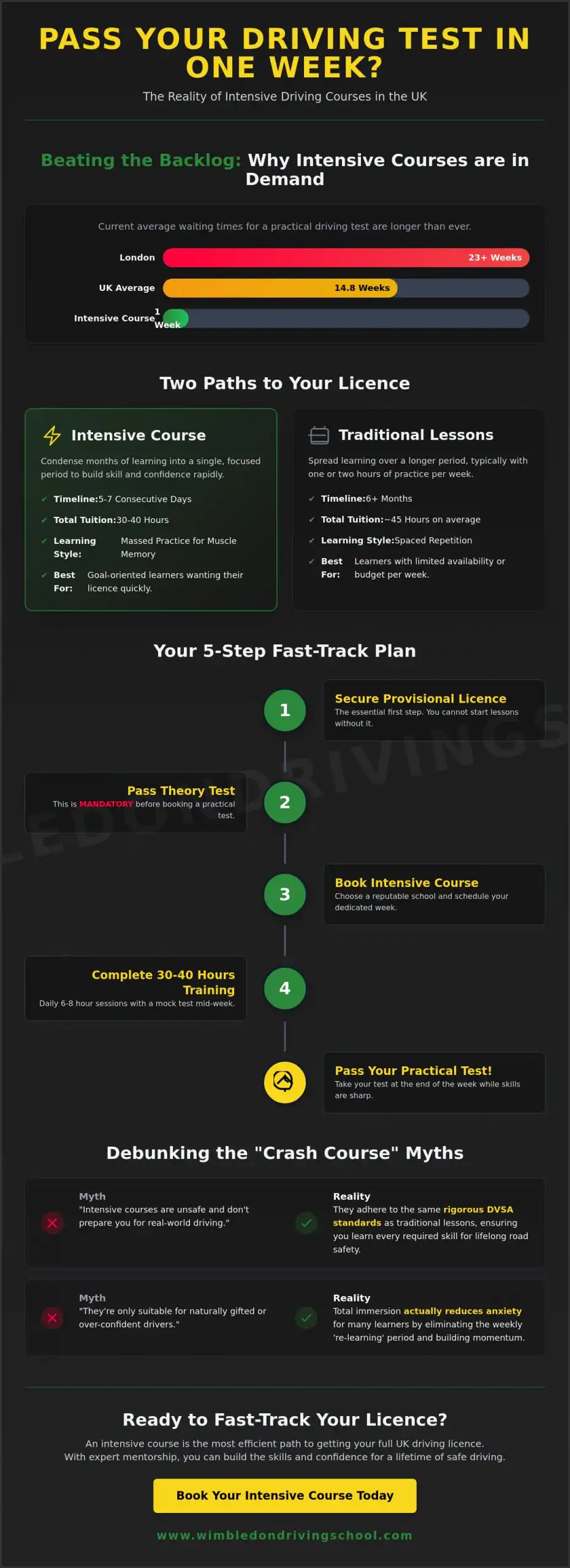
Could you really transform from a nervous beginner to a qualified driver in just seven days, or is the dream of a fast-track licence just clever marketing? With average waiting times for a practical test now stretching to 14.8 weeks across the UK, and over 23 weeks in parts of London, the appeal of a driving lessons one week intensive course has never been higher. You’ve likely heard conflicting advice about “crash courses” or felt the sting of disappointment when looking at the DVSA booking system. It’s completely understandable to feel frustrated by the backlog, yet anxious about whether a condensed timeline provides the depth of skill you need to stay safe on the road.
We agree that the current landscape for learners is more challenging than ever. This guide will help you navigate the noise by debunking common myths and revealing the reality of intensive training in 2026. You’ll gain a clear understanding of the intensive process, learn how the May 2026 DVSA regulation changes regarding booking control impact your journey, and discover how to choose a reputable school that prioritises your safety. We’re going to break down exactly how these courses work so you can create a definitive plan to secure your full UK driving licence this year.
Key Takeaways
- Distinguish between “miracle cures” and professional immersion by understanding the 30-40 hour commitment required for genuine success.
- Harness the science of accelerated learning to build vital muscle memory through a structured driving lessons one week intensive course.
- Debunk safety stigmas by discovering how intensive tuition adheres to the same rigorous DVSA standards as traditional weekly lessons.
- Master the essential prerequisites, including securing your provisional licence and passing your theory test, to ensure a seamless experience.
- Learn how professional mentorship ensures your fast-track journey results in lifelong road safety rather than just a test pass.
The Reality of a One Week Intensive Driving Course: Miracle or Myth?
A driving lessons one week intensive course is a high-performance immersion programme designed to condense months of learning into a single, focused burst. Typically, this involves 30 to 40 hours of professional tuition delivered across five to seven consecutive days. It represents a significant departure from standard driver’s education, which often stretches the learning process over half a year. However, it’s vital to understand that these courses aren’t miracle cures. They don’t magically bestow skills upon a student who isn’t ready to work; instead, they provide the optimal environment for rapid skill acquisition.
Success in this format depends heavily on your starting point and preparation. We find that students with a high aptitude or some previous experience tend to thrive best in this environment. Crucially, you must have your Theory Test pass secured before your intensive week begins. Without this prerequisite, you cannot book a practical test, which essentially renders the “one week” timeline impossible. Think of the intensive course as the final, powerful push toward your licence rather than a substitute for basic legal requirements.
To help you visualise the commitment and structure required for this path, watch this helpful breakdown:

What Does a Typical Intensive Week Look Like?
Expect a demanding schedule. Most students undergo six to eight hours of in-car instruction daily, punctuated by structured breaks to prevent mental fatigue. We focus heavily on “active” driving hours. This means we choose routes that challenge your skills rather than wasting time sitting in stationary traffic. By Wednesday or Thursday, you’ll likely sit a Mock Driving Test. This benchmark is essential to gauge your exam readiness and identify any lingering habits that could result in a fault during the real assessment.
Myth: Intensive Courses are Only for Naturally Gifted Drivers
There is a common misconception that fast-track learning is too stressful for anyone but the most confident individuals. In practice, our instructors adapt their behaviour and teaching style to suit nervous learners perfectly. Many students find that total immersion actually reduces anxiety. It eliminates the “reset” period that usually happens at the start of a weekly lesson where you have to spend ten minutes remembering what you learned seven days ago. We organise the week to build your confidence step-by-step, ensuring you feel like a safe, competent driver whilst moving toward your goal. You can learn more about our tailored approach on our intensive course page.
Can You Really Learn to Drive in Seven Days? The Science of Accelerated Learning
Learning to drive is far more than a physical exercise; it’s a complex cognitive achievement that requires the brain to process multiple streams of data simultaneously. While traditional methods rely on the “Spacing Effect,” where information is absorbed in small doses over months, a driving lessons one week intensive course utilises “Massed Practice.” This educational strategy focuses on high-frequency repetition to move skills from your conscious thought into your subconscious muscle memory. By performing the same physical actions, such as gear changes and mirror observations, hundreds of times in a single day, your brain hardwires these movements much faster than it would during a solitary hour once a week.
Critics often suggest that rapid learning leads to rapid forgetting, but evidence suggests otherwise. A scientific study on driving course effectiveness indicates that intensive learners often demonstrate equivalent, if not superior, retention rates compared to those on traditional paths. This is largely due to the immediate feedback loops created during intensive tuition. When you make a mistake, your instructor corrects it instantly, and you have the opportunity to repeat the manoeuvre correctly just moments later. This prevents dangerous habits from becoming “baked in” to your driving style, ensuring your technique remains polished and precise.
The Spacing Effect: Why Daily Lessons Stick
Consider the logistical advantage of a condensed timeline. In a standard weekly lesson, there is a 167-hour gap between sessions, during which skills often stagnate or regress. An intensive week reduces this gap to just 16 hours. This continuity ensures that your working memory remains primed and ready for the next challenge. Cognitive load refers to the total amount of mental effort used in your working memory whilst processing complex stimuli like London’s busy road networks. By maintaining a high frequency of practice, you reduce this load, allowing you to focus on advanced hazard perception rather than basic vehicle control.
Building Reflexes in South West London Traffic
Navigating the intricate road layouts of Wimbledon, Morden, or Tolworth requires more than just theoretical knowledge; it demands local familiarity. Seeing the same complex roundabout five days in a row builds a level of superior local knowledge that weekly learners struggle to match. You don’t just learn “how” to drive; you learn the specific rhythm of South West London’s traffic. For those seeking a structured programme tailored to the unique demands of this area, our intensive driving course south west london fast-track guide covers everything you need to conquer local roads and pass your test efficiently. For those looking to supplement their in-car experience with technical theory, our learning centre offers a wealth of resources to deepen your understanding. If you feel ready to put this science into practice, you can reserve your assessment lesson to determine which course length suits your aptitude.
Debunking the Crash Course Stigma: Safety, Retention, and Test Standards
A common concern amongst prospective students is whether a condensed timeline compromises road safety. Some worry that a driving lessons one week intensive course prioritises speed over skill. This couldn’t be further from the truth. The DVSA driving test standard is identical for every candidate in the UK, regardless of whether they spent six months or six days preparing. There are no “easy” routes or “shortened” tests for intensive learners. To earn your licence, you must demonstrate the same high level of competence, hazard perception, and vehicle control as any other driver on the road.
Choosing an intensive path actually offers unique safety benefits. Because you spend more consecutive hours behind the wheel, you develop a deeper level of focus and situational awareness. At Wimbledon Driving School, we elevate these standards further. Many of our instructors hold prestigious RoSPA Gold or IAM (Institute of Advanced Motorists) certifications, ensuring you receive tuition from the most qualified professionals in the industry. We don’t just aim for a pass; we aim for excellence.
The “Crash Course” Label vs. Professional Intensive Tuition
The term “crash course” is a persistent misnomer that suggests a reckless approach to education. In reality, professional intensive tuition is a comprehensive journey. Our syllabus covers every essential skill, from complex junction management to the basics of motorway and night driving. We organise our courses to produce safe, confident drivers who are prepared for the realities of modern traffic, not just students who can tick boxes on an examiner’s clipboard. It’s about building a foundation for a lifetime of safe driving behaviour.
Safety Standards and Instructor Qualifications
Every instructor we employ is a fully qualified ADI (Approved Driving Instructor), meeting the rigorous standards set by the UK government. Our “Confident Mentor” philosophy ensures that even the most nervous learners feel supported whilst being challenged to improve. We believe that high-quality instruction is the cornerstone of road safety. You can see our commitment to these benchmarks in our expert manual driving lessons, which serve as a quality pillar for all our training programmes. This professional oversight ensures that your fast-track experience is as safe as it is efficient.
- Intensive Pros: Rapid skill acquisition, maintained momentum, and a faster path to independence.
- Intensive Cons: Requires high mental stamina and a significant upfront time commitment.
- Weekly Pros: Spreads the financial cost and allows more time for theoretical reflection between sessions.
- Weekly Cons: Higher risk of skill regression and significantly longer waiting times for completion.
Preparing for Success: How to Organise Your Intensive Week in London
Mastering the road in a condensed timeframe requires more than just determination; it demands a strategic roadmap. While the driving lessons one week intensive course offers a high-performance route to your licence, the foundation of your success is built long before you turn the ignition. Preparation is the bridge between a nervous start and a confident pass. To ensure your week runs smoothly, you must approach the logistics with the same precision you’ll apply to your steering.
Your journey begins with four essential steps. First, you must secure your provisional driving licence. Without this legal document, professional tuition cannot commence. Second, you must pass your Theory Test. This is a non-negotiable prerequisite; the DVSA booking system will not allow you to reserve a practical slot without a valid theory certificate. Third, choose a strategic location that aligns with your commute and comfort. Finally, always book an assessment lesson. This professional evaluation ensures that a one-week timeline is appropriate for your current skill level and learning pace.
The Theory Test: Your First Major Milestone
You cannot book a practical driving test without a theory certificate. We recommend using dedicated mobile apps to study whilst travelling across London, turning your commute into a productive learning session. Focus heavily on the Hazard Perception element. The Hazard Perception test is vital for intensive learners because it develops the rapid scanning skills needed for South West London’s high-density traffic. Mastering this theory ensures your brain is already primed for the fast-paced environment of an intensive week.
Choosing Your London Test Centre Wisely
South West London offers several distinct testing environments, each with its own unique challenges. Morden is famous for its intricate one-way system and high-volume pedestrian areas, whereas Tolworth often involves navigating the high-speed entries and exits of the A3. Mitcham provides a mix of residential narrowings and complex mini-roundabouts. Understanding these local nuances is essential for your preparation. For a comprehensive overview of how to select the right training package and navigate transparent pricing across London’s busy test centres, our intensive driving course London 2026 buying guide covers everything you need to make an informed decision. We suggest reviewing the areas we cover to match your location with an instructor who possesses deep local expertise. This ensures you aren’t just learning to drive; you’re learning to dominate the specific roads where you’ll be examined.
Ready to begin your transformation? Book your initial assessment lesson today to determine your fastest route to success.
The Wimbledon Driving School Approach: Why Expert Mentorship Matters
At Wimbledon Driving School, we believe that the highest industry standard is only achieved when professional competence meets genuine empathy. Choosing a driving lessons one week intensive course is a significant decision. It isn’t merely a transaction; it’s a transformative journey toward a vital personal milestone. Our philosophy is rooted in the conviction that we don’t just teach you to pass a test. We teach you to drive for life. This commitment to excellence is reflected in our consistently high pass rates across South West London and Surrey, where our students benefit from the wisdom of some of the most highly qualified instructors in the country.
The flexibility of our intensive driving courses allows us to adapt to your specific needs. We understand that every learner is unique, with different anxieties and learning speeds. By providing a structured yet adaptable environment, we ensure that your intensive week is productive, safe, and ultimately successful. Our role as your “Confident Mentor” is to guide you through the complexities of the road with professional authority and encouraging warmth, making the student feel that they are making the safest and most effective choice for their education.
Tailored Instruction for Every Personality
A vital part of our success involves matching the right instructor to your personality. Whether you are a first-time driver or someone feeling nervous about returning to the wheel, we select mentors who specialise in your specific requirements. We offer both manual and automatic options to suit your preference. For those seeking a simpler fast-track experience, our automatic driving lessons remove the complexity of gear changes. This allows you to focus entirely on hazard perception and road positioning, a choice that often proves popular amongst those wanting to maximise their progress during a condensed timeline.
Your Journey Starts Here
By choosing Wimbledon Driving School, you are making a definitive investment in your future independence. We take pride in our status as a premier provider, and we are ready to help you achieve the freedom that comes with a full UK licence. Don’t let long waiting lists or conflicting advice hold you back from your goals in 2026. Your path to success is clear, organised, and within reach. We frame this learning process as a transformative experience, ensuring you feel supported at every stage of the decision-making process.
Take the final step toward your achievement today by exploring our fast-track intensive driving course options. When you are ready to commit to your success, book your assessment lesson and let us guide you to the finish line with confidence.
Secure Your Freedom on the Road
Achieving your driving licence in 2026 doesn’t have to be a marathon. By choosing a driving lessons one week intensive course, you’re opting for a scientifically backed immersion method that builds muscle memory and confidence faster than traditional weekly sessions. We’ve explored how debunking the “crash course” myth reveals a high-standard, professional path to success, provided you arrive prepared with your theory test certificate and a committed mindset. Safety remains the absolute priority. With the right mentorship, your fast-track journey becomes a permanent foundation for a lifetime of competent driving.
Wimbledon Driving School brings over 20 years of local London expertise to your education. Our team includes RoSPA Gold and IAM Certified Instructors, contributing to one of the highest pass rates in the UK. We take pride in being more than just a school; we are your partners in reaching this transformative milestone. You’ve discovered the reality behind the myths. Now it’s time to take control of your journey. Book Your Fast-Track Intensive Course Today and join the thousands of successful drivers who started their journey with us. We can’t wait to see you succeed.
Frequently Asked Questions
Is a one week intensive driving course enough for a total beginner?
A one week course is rarely sufficient for a total beginner with zero previous experience. The DVSA reports that the average learner requires approximately 45 hours of professional tuition to reach test standards. While a 40-hour intensive week provides a massive boost, most beginners benefit from an initial assessment lesson first. This ensures you have the foundational coordination required to handle the high-pressure environment of a seven-day timeline safely and effectively.
Can I take an intensive driving course without passing my theory test first?
You cannot book a practical driving test without a valid theory certificate, making it the essential first step for any fast-track plan. While you can technically start your driving lessons one week intensive course without it, we strongly advise against this. Securing your theory pass beforehand allows us to schedule your practical exam for the end of your training week, ensuring your momentum leads directly to a full UK licence.
What happens if I fail my driving test at the end of the intensive week?
If you don’t pass, you’ll need to book a new test slot using the DVSA system. As of May 2026, new regulations require learners to manage their own bookings, and you are limited to only two amendments per booked slot. You can only move your test to one of the three nearest driving test centres. We recommend taking a few refresher lessons or a mock driving test before your next attempt to polish any specific faults identified.
How many hours a day will I be driving during an intensive course?
Expect to spend between five and six hours behind the wheel each day during your course. This time is carefully structured with regular breaks to maintain your concentration levels and prevent mental fatigue. We focus on active driving time in various road conditions across London to ensure you build muscle memory. This intense repetition is exactly what helps students reach the required standard in such a compressed period.
Are intensive driving courses more expensive than weekly lessons?
The upfront cost of an intensive course is higher than a single weekly lesson, but it often proves more economical in the long run. Because you learn in a condensed timeframe, you don’t waste the first portion of every lesson refreshing your memory from the previous week. This efficiency often reduces the total number of hours required to reach test readiness, making it a cost-effective choice for many modern learners. For a detailed breakdown of what to expect when comparing packages and pricing, our guide to choosing an intensive driving course in London will help you avoid hidden fees and make the most informed investment.
Will I be able to drive safely on motorways after just one week?
You will gain a solid foundation in high-speed driving, but true motorway confidence often requires additional specialist training. While our courses cover high-speed dual carriageways like the A3, we recommend a dedicated motorway driving lesson or a Pass Plus course after you pass. These sessions allow you to focus specifically on complex lane changes and high-speed merging without the pressure of the practical test looming over you.
Which London test centre has the best pass rate for intensive learners?
Pass rates vary across London centres like Tolworth, Morden, and Mitcham, each presenting different local challenges. Rather than chasing a specific statistic, it is more effective to train in the area where you intend to take your test. Local knowledge of specific junctions and roundabouts is far more valuable than a minor difference in pass rates. Our instructors provide expert mentorship tailored to the specific nuances of your chosen centre.
Can I choose between manual and automatic cars for my intensive course?
Yes, you can choose between manual and automatic driving lessons for your intensive training. Automatic cars are increasingly popular for a driving lessons one week intensive course because they remove the complexity of gear changes and clutch control. This allows you to focus entirely on hazard perception and road positioning. However, if you want the flexibility to drive any vehicle in the future, our manual intensive courses provide comprehensive instruction in vehicle mechanics.