

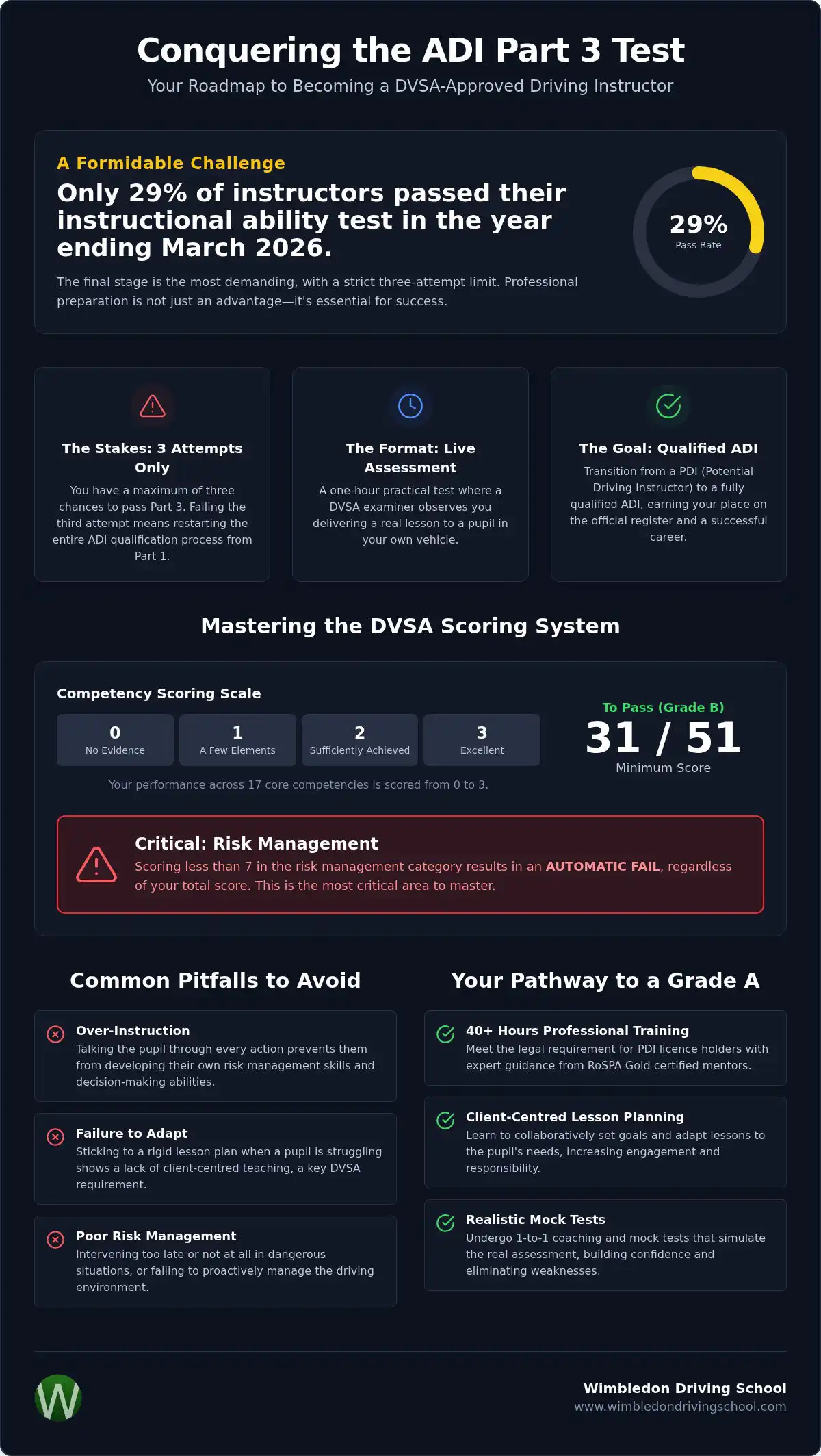
Did you know that only 29% of aspiring instructors successfully passed their instructional ability test in the year ending March 2026? This statistic is a sobering reminder that the final step toward becoming a fully qualified professional is often the most challenging. You’ve likely felt the pressure of the three-attempt limit, perhaps worrying that a single slip in risk management or a misunderstanding of the 17 core competencies could end your career before it truly begins. It’s natural to feel apprehensive when your PDI status and your future livelihood are on the line, especially whilst trying to source a suitable pupil for the big day. Choosing the right adi part 3 training course is the most decisive action you can take to move from uncertainty to absolute professional mastery.
Our comprehensive guide is designed to help you conquer this final hurdle and transition into a successful career in South West London. You’ll learn how to navigate the £111 assessment with the poise of a seasoned expert, ensuring you meet the rigorous DVSA standards for client-centred learning. We will explore the nuances of lesson planning, explain how to avoid the automatic fail triggers, and provide a clear roadmap to achieving a Grade A. By the end of this article, you’ll have the confidence to adapt your teaching to any learner behaviour and the practical knowledge to secure your place on the official register.
Key Takeaways
- Understand the DVSA framework for the one-hour practical assessment and why professional observation is the definitive standard for qualifying as an instructor.
- Master the 17 core competencies by learning how to set clear goals and balance pupil independence with proactive risk management.
- Identify and avoid the common pitfalls that lead to failure, such as over-instruction and failing to adapt your teaching style to unexpected pupil behaviour.
- Discover how a specialist adi part 3 training course provides the mock tests and 1-to-1 coaching required to pass your final hurdle with absolute confidence.
- Learn how training with RoSPA Gold and IAM certified mentors can accelerate your journey from a trainee licence holder to a successful franchise member.
What is the ADI Part 3 Test and Why is Training Essential?
The ADI Part 3 test is the definitive assessment of your instructional ability. It’s not just a box-ticking exercise; it’s a rigorous one-hour examination where a DVSA examiner sits in the back of your car while you teach a real pupil. This is the final stage of becoming a UK Approved Driving Instructor (ADI), and the stakes are incredibly high. You only have three attempts to pass this stage. If you fail the third time, you must start the entire qualification process again from Part 1. This pressure often leads to nerves, which is why relying solely on self-study is a risky strategy that frequently results in disappointment amongst trainee instructors.
The Transition from PDI to Qualified ADI
Being a great driver doesn’t automatically make you a great teacher. Many Potential Driving Instructors (PDIs) struggle because they focus on their own driving standards rather than identifying and correcting the faults of their pupils. To bridge this gap, most candidates apply for a trainee licence, often called the “pink badge.” This permit allows you to gain paid experience for six months before your test. However, simply having the badge isn’t enough. Engaging with a specialist adi part 3 training course ensures you develop the coaching mindset required by the DVSA. Professional mentors help you move beyond giving instructions to facilitating a collaborative learning environment, accelerating your journey toward becoming a successful franchise member.
Key Requirements for the 2026 Exam
Preparation for the 2026 exam starts long before you reach the test centre. You must ensure your vehicle is roadworthy, fitted with dual controls, and displays L-plates. You also need to bring your PDI licence and your pupil’s provisional or full licence. Selecting the right ‘real’ pupil is a critical tactical decision. They shouldn’t be another driving instructor or someone who has already passed their test, unless they are genuinely seeking further training. Whilst teaching on a trainee licence, you have a legal obligation to receive at least 40 hours of professional training from a qualified ADI. Our expert team in South West London and Surrey ensures you meet these requirements while mastering the 17 core competencies that examiners demand.
Mastering the 17 Core Competencies of the DVSA Framework
The DVSA examiner evaluates your performance using a specific marking scale for each competency. You receive a score from 0 to 3; 0 indicates no evidence of ability, while 3 represents an excellent demonstration of the skill. To pass, you need a minimum of 31 out of 51, achieving at least a Grade B. However, the scoring is weighted. If you score less than 7 in the risk management category, you will fail automatically. This rigour is why mastering the DVSA’s 17 core competencies is the cornerstone of any reputable adi part 3 training course.
Lesson Planning and Goal Setting
Setting the right foundations requires more than a generic syllabus. You must identify your pupil’s current skill level within the first few minutes of the lesson through effective questioning and observation. A successful lesson plan is structured enough to provide direction but flexible enough to change if the pupil struggles with a specific task. Client-centred learning is a collaborative process where the instructor adapts the lesson to the pupil’s specific goals and learning style to ensure they take active responsibility for their safety. By involving the pupil in the goal-setting process, you increase their engagement and improve their retention of key safety concepts.
Effective Risk Management in London Traffic
Navigating the complex junctions of South West London requires heightened awareness and precise intervention. During your test, you must balance the pupil’s independence with the need for safety. Using dual controls is necessary when a physical intervention is required to prevent a dangerous situation, but you must avoid “over-instructing.” If you talk the pupil through every gear change or steering movement, you are effectively driving for them. This prevents them from learning how to manage risks themselves. A structured adi part 3 training course will teach you exactly when to step in and when to let the pupil learn from their own minor errors. Encourage your pupil to scan for hazards and verbalise their thoughts. This technique allows you to assess their mental focus without interfering with their physical control of the car. If you feel you need extra support in these high-pressure scenarios, you can book a specialist coaching session with our expert team to refine your intervention techniques.
Common Pitfalls: Why Trainee Instructors Fail Part 3
Understanding why others fail is the first step toward your own success. The DVSA assessment is notoriously difficult, with many trainee instructors struggling to bridge the gap between knowing how to drive and knowing how to teach. It isn’t just about technical knowledge; it’s about your presence in the car. Many candidates fail because they remain in a “driving examiner” mindset rather than becoming a proactive coach. Enrolling in a specialist adi part 3 training course helps you identify these subtle behavioural habits before they lead to a failed attempt on your permanent record.
The ‘Scripted Lesson’ Trap
Rigidity is the enemy of effective instruction. Many PDIs attempt to memorise a strict script for their lesson, which works perfectly until the pupil makes an unexpected mistake. If a cyclist suddenly swerves or the pupil misses a turning in busy traffic, a scripted instructor often freezes or provides irrelevant advice. You must listen to your pupil’s feedback and observe their physical cues to adjust the lesson in real time. Developing the “Confident Mentor” mindset means being comfortable with uncertainty. If the lesson plan needs to change to address a new weakness, change it. The examiner wants to see that you can think on your feet whilst maintaining a supportive environment.
Risk Management vs. Intervention
Failing to identify or address a risk is the most common reason for an automatic failure. There is a fine line between a verbal prompt and a physical intervention. If you use the dual controls too early, you might take away a learning opportunity; if you use them too late, you’ve compromised safety. A serious safety fault must be addressed immediately with a clear explanation of why it was dangerous. Silence following a near-miss is often interpreted by the examiner as a lack of awareness. Maintaining a calm, professional atmosphere amongst the stressful junctions of South West London is essential. If you lose your composure, your pupil will too, leading to a downward spiral in performance.
Poor time management also frequently catches trainees off guard. If you spend forty minutes on a single junction, you won’t have enough time for a meaningful debrief. A rushed conclusion leaves the pupil feeling confused and prevents you from confirming that the lesson goals were met. Over-instruction is another significant hurdle. If you talk for the majority of the hour, the pupil isn’t actually learning through experience. Your role is to facilitate their journey, not to provide a sixty-minute lecture. Striking the right balance between silence and guidance is a skill that only comes with high-quality, professional adi part 3 training course sessions.
How to Organise Your ADI Part 3 Preparation for Success
Success in the instructional ability test requires a structured timeline that balances practical experience with professional critiques. You cannot leave your development to chance, especially when the national pass rate remains challenging. Selecting a partner who understands the unique pressures of the South West London road network is essential. By aligning your preparation with a high-calibre adi part 3 training course, you transform from a nervous trainee into a confident professional ready to manage any classroom on wheels.
Choosing Local Test Routes in South West London
Preparing in the specific environment where you’ll be tested provides a massive psychological and tactical advantage. Areas like Wimbledon and Morden feature unique challenges, from narrow residential streets to high-speed dual carriageways. Local knowledge allows you to identify ‘hot spots’ where pupils typically struggle with lane discipline or observation. When you know exactly where a pupil might hesitate, you can pre-empt the risk and demonstrate superior instructional control. You can explore the areas we cover for ADI training to ensure your practice sessions mirror the actual test conditions.
The Value of Mock Part 3 Tests
A mock test is the only way to truly simulate the examiner’s presence before the day of the exam. It exposes ‘blind spots’ in your instructional behaviour that you might not notice whilst teaching alone. Perhaps you’re missing a verbal prompt or your lesson planning isn’t as client-centred as the 2026 standards require. Receiving honest, professional feedback from a RoSPA Gold or IAM certified trainer allows you to refine these details in a safe environment. This process is just as vital as when you prepare with a practical driving test guide for your own driving skills.
Balancing your trainee licence hours with dedicated coaching is a delicate act. Whilst the “pink badge” provides invaluable experience with real learners, it can also reinforce bad habits if left unchecked. Use your 40 hours of mandatory training to deconstruct your lessons and rebuild them with better strategies. Mental preparation is equally important. Visualise successful interventions and practice breathing techniques to manage test-day nerves. This holistic approach ensures that when the examiner steps into your car, you aren’t just hoping for a pass; you are demonstrating excellence. If you are ready to secure your future, book your ADI training sessions today and start your journey with the best in the business.
The Wimbledon Driving School ADI Part 3 Training Course
Choosing where to complete your adi part 3 training course is the most significant investment you’ll make in your professional life. At Wimbledon Driving School, we provide a personalised 1-to-1 coaching experience that far exceeds the industry standard. We don’t believe in one-size-fits-all training. Instead, we tailor every session to your specific instructional style and the needs of your pupil. Whether you’re currently working on a trainee licence or taking the direct-access route, our programme is designed to fit around your existing commitments with total flexibility. We understand the logistical needs of a modern learner, which is why we offer seven-day-a-week availability to ensure your training never stalls.
Expert Mentorship for Future Instructors
Our trainers aren’t just qualified; they are elite. By learning from RoSPA Gold and IAM certified experts, you gain insights into teaching nervous drivers that most courses simply can’t offer. This high level of proficiency is essential for mastering the instructional ability test. You’ll gain access to our Learning Centre, which is packed with exclusive resources to supplement your practical sessions. We use direct feedback loops to identify your weaknesses instantly. This rigorous approach ensures you’re test-ready in weeks, not months, saving you time and reducing the stress of the three-attempt limit. We focus on accomplishment, framing your education as a transformative journey toward a prestigious career milestone.
Your Journey to a New Career Starts Here
Passing the test is just the beginning. We provide a clear, supported pathway into our prestigious London driving school franchise. Unlike schools that leave you to find your own way, we help you build a full diary of pupils immediately. You’ll benefit from our high pass rates and industry-recognised status, ensuring you’re never alone as you start your new career. Our structure is designed for high readability and tangible outcomes, respecting your time whilst providing the professional knowledge required to excel. This is your chance to make the safest and most effective choice for your education. To secure your future in South West London and Surrey, book your ADI Part 3 training course today and join the premier provider in the market. We are serious about safety and rigorous requirements, but we remain student-centric and dedicated to your individual success.
Launch Your Career as a Fully Qualified ADI
Mastering the instructional ability test is the final, transformative step in your professional journey. By focusing on client-centred learning and precise risk management, you move beyond being a driver to becoming an elite educator. Success requires more than just practice; it demands the professional oversight of those who have reached the highest standards in the industry. Our adi part 3 training course provides exactly that, combining the expertise of RoSPA Gold and IAM certified trainers with a flexible schedule that respects your time.
We are proud to maintain the highest pass rates in London, ensuring that your investment leads to a tangible, prestigious milestone. With our 7-day availability, you can refine your skills at a pace that suits your lifestyle whilst receiving the supportive mentorship needed to overcome test-day nerves. Don’t leave your final attempt to chance. Secure your future as a driving instructor-book your ADI Part 3 training now. You have the talent and the ambition; we provide the definitive roadmap to help you reach your destination with absolute confidence.
Frequently Asked Questions
How many attempts do I get for the ADI Part 3 test?
You are permitted a maximum of three attempts to pass the ADI Part 3 test. If you don’t succeed on your third try, you must wait until two years have passed since you originally passed your Part 1 theory exam before you can restart the qualification process from the beginning. This highlights why professional guidance is essential to ensure every attempt counts toward your professional goal.
What is the pass mark for the ADI Part 3 exam in 2026?
The pass mark for the ADI Part 3 exam in 2026 requires a minimum score of 31 out of 51 to achieve a Grade B. Scoring 43 or above earns you a Grade A, representing the highest standard of instructional ability. You must also score at least 7 out of 15 in the Risk Management section, as falling below this threshold results in an automatic failure regardless of your total score.
Can I use my own car for the ADI Part 3 test?
You can certainly use your own car for the test provided it meets specific DVSA requirements. The vehicle must be fitted with dual controls, display L-plates, and have an extra rear-view mirror for the examiner’s use. It must also be a standard four-wheeled car in good working order. Ensuring your vehicle is compliant is a vital part of your test day preparation and avoids unnecessary stress.
Do I need to have a real pupil for the Part 3 exam?
You are required to bring a real pupil to your Part 3 exam to demonstrate your teaching skills in a live environment. This pupil can be a beginner, a partly trained learner, or even a full licence holder seeking a refresher. However, they cannot be an Approved Driving Instructor or a fellow PDI. Choosing a pupil you’ve already taught during your adi part 3 training course often helps build a comfortable rapport.
What happens if I fail the ADI Part 3 test three times?
If you fail the ADI Part 3 test three times, your current application is terminated and you must re-qualify from the very start. This means retaking the Part 1 theory and Part 2 driving ability tests once the required time period has elapsed. Many candidates find that this setback can be avoided by investing in high-quality coaching before their final attempt to secure their professional future as an instructor.
Is it better to use a trainee licence before taking the Part 3 test?
Utilising a trainee licence is widely considered the most effective way to prepare for your final assessment. It allows you to gain real-world experience and earn an income whilst refining your instructional techniques with actual pupils. This practical exposure is invaluable for developing the adaptability required to pass the test. Our adi part 3 training course provides the mandatory 40 hours of training needed to apply for this badge.
How long does a standard ADI Part 3 training course take?
The duration of a training course depends on your existing experience and how quickly you master the core competencies. Most PDIs complete at least 40 hours of initial training to qualify for a trainee licence, followed by additional coaching sessions to prepare for the test itself. We offer flexible schedules that allow you to progress at a pace that matches your personal commitments whilst ensuring you are test-ready.
What are the 17 competencies the examiner is looking for?
The examiner assesses 17 core competencies grouped into three main categories: Lesson Planning, Risk Management, and Teaching and Learning Strategies. These include skills such as identifying the pupil’s needs, maintaining safety, and providing clear feedback. Mastering these areas ensures you deliver a client-centred lesson that meets the highest UK standards. Our mentors focus on these specific markers to help you achieve a Grade A and start your career.
Disclaimer
This article is provided for general informational purposes only and does not constitute professional driving, legal, or safety advice. While we aim to keep our content accurate and up to date, rules, prices, and DVSA test requirements can change — always check gov.uk or contact us directly at 020 3524 7968 for the latest guidance before making any decisions. Nothing in this article guarantees a specific outcome, including passing your driving test within any stated timeframe. For current pricing, course availability, and instructor details, please visit our Prices page or get in touch.