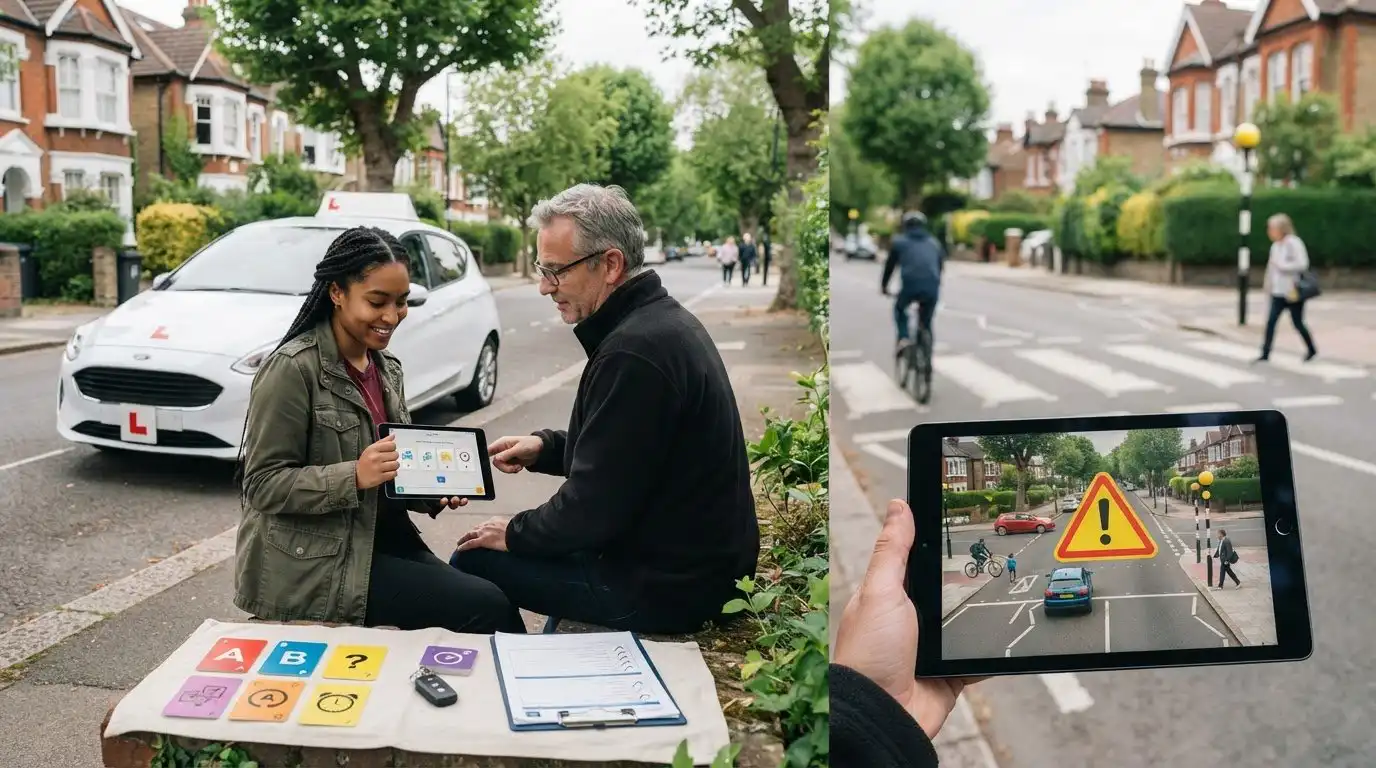
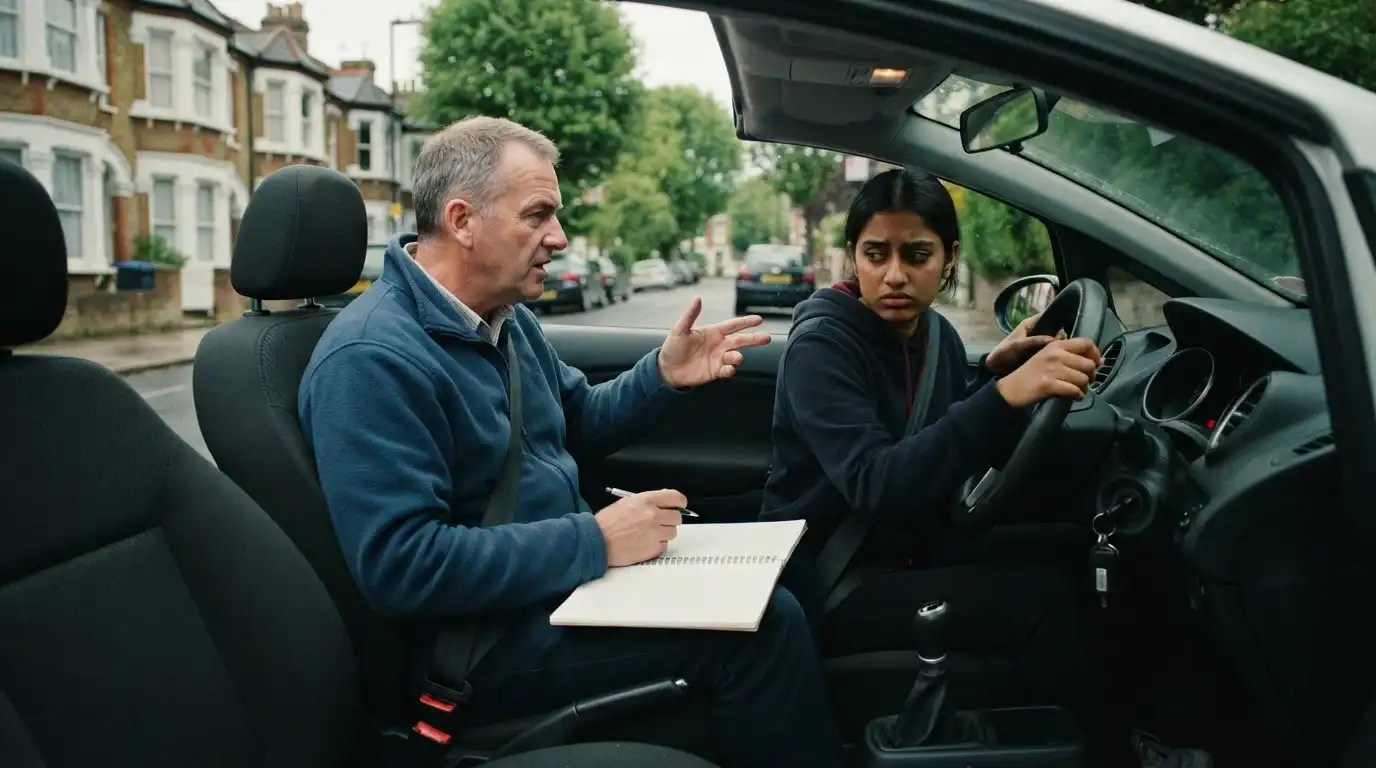
What if a difficult driving lesson isn’t proof that you’re a poor driver, but a sign that the teaching isn’t working for you? The signs of a bad driving instructor are usually patterns, not one awkward lesson. Unclear feedback, repeated criticism or guidance that leaves you feeling unsafe can all make it harder to learn.
It’s normal to feel nervous, make mistakes and need time to master new skills. A challenging lesson alone doesn’t mean your instructor is doing a bad job. What matters is whether they explain what went wrong, help you understand what to practise and treat your concerns with respect.
This guide will help you recognise behaviour that undermines your confidence or road safety, and distinguish it from the ordinary ups and downs of learning. You’ll also find practical ways to raise a concern and assess the response. Clear, supportive instruction can help you take your next steps towards confident driving.
Key Takeaways
- Look for recurring signs of a bad driving instructor, and take any immediate safety concern seriously.
- Separate a one-off misunderstanding from a repeated teaching problem by considering whether instructions and progress are clear over time.
- Notice whether the lesson environment helps you ask questions and understand what to practise next.
- Raise concerns calmly with specific examples, then assess whether the response leads to constructive change.
- Supportive driving lessons across Wimbledon, South West London, South East London, Surrey and Middlesex can help you move forward with clearer guidance.
Signs of a bad driving instructor: behaviours that deserve attention
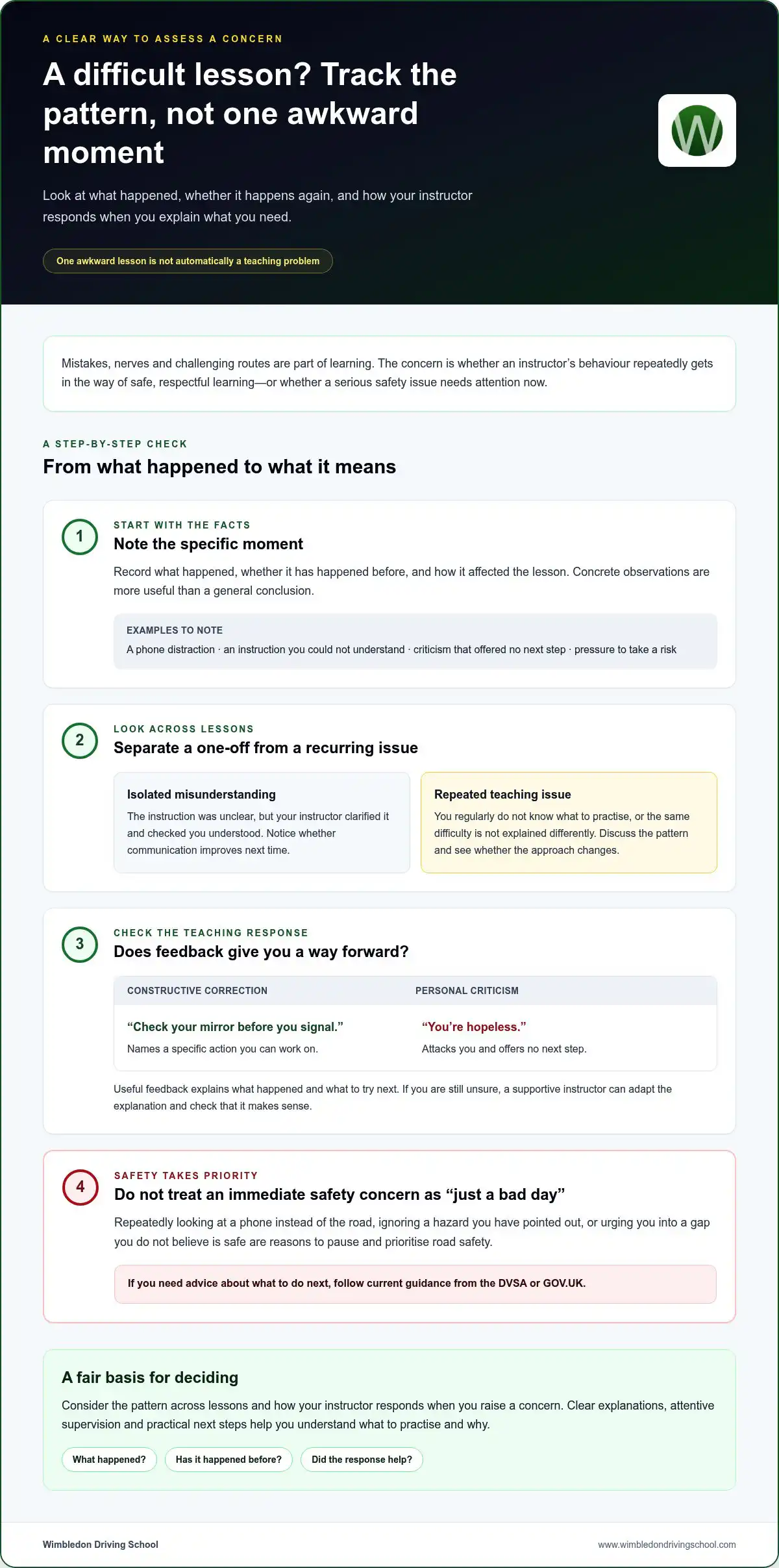
Repeated unsafe, disrespectful or unhelpful conduct is worth addressing. Signs of a bad driving instructor can include being distracted by a phone, shouting or humiliating you, giving instructions you can’t understand, or pressuring you to take a risk on the road. The issue isn’t that a lesson feels difficult. It’s whether the instructor’s behaviour repeatedly gets in the way of safe, respectful learning.
You’ll make mistakes as you learn. Stalling, missing a mirror check or misjudging a gap can all be part of building a new skill, and none justifies insults or ridicule. To assess a concern fairly, note what happened, whether it has happened before and how it affected the lesson. Specific observations are more useful than a general conclusion about the instructor.
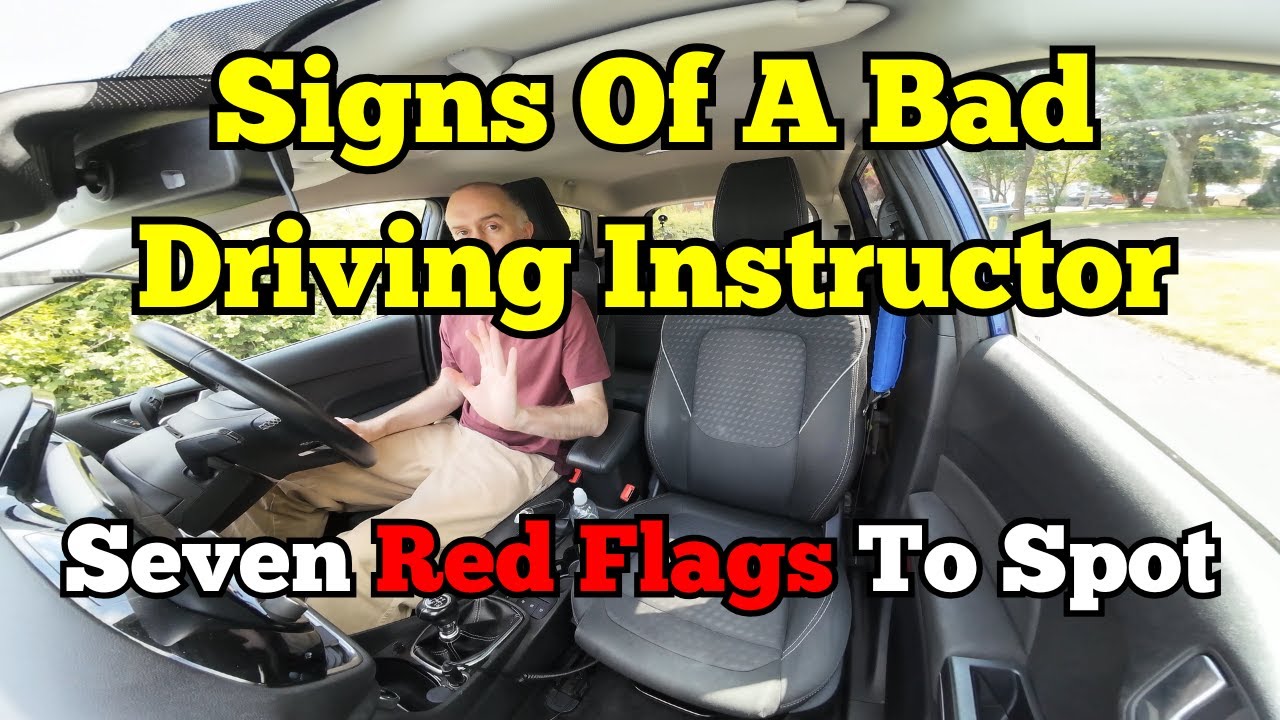
For another perspective on warning behaviours, watch this video:
When an instructor’s behaviour affects safety
An instructor who repeatedly looks at a phone instead of the road, ignores a hazard you’ve pointed out or urges you to pull into a gap you don’t believe is safe gives you reason to pause. Divided attention and pressure can make it harder to judge traffic and respond. Prioritise immediate road safety, and follow current guidance from the DVSA or GOV.UK if you need advice about what to do next.
When feedback becomes personal rather than constructive
“Check your mirror before you signal” identifies a specific action. “You’re hopeless” attacks the learner and offers no way forward. Useful correction explains what happened and gives you a clear next step, even when it’s firm. For a fuller picture of supportive teaching, see what makes a great driving instructor.
Unexplained instructions deserve attention too. If you’re told to turn, change lanes or respond to a sign without enough time or a clear explanation, you may be left guessing instead of learning. Ask for clarification when it’s safe. Clear guidance should help you understand what to observe and why, not leave you trying to decode instructions while managing the car.
That applies to road signs as well. Your instructor should give you time to spot and understand them, rather than criticise you for missing something without explaining it. Wimbledon Driving School’s guide to knowing your road signs can help you build familiarity. A single tense exchange may be a misunderstanding; repeated distraction, humiliation or unsafe pressure is a pattern to take seriously.
Bad day or bad pattern? How to judge an instructor fairly
One awkward lesson doesn’t automatically mean you’re seeing signs of a bad driving instructor. You may have misunderstood an instruction, or a challenging route may have made the lesson feel less smooth than usual. Consider what happened, whether it recurs and whether your instructor responds constructively when you explain what you need.
A serious safety concern is different. Don’t dismiss it just because it happened once. Use this comparison to help identify the type of issue, not to talk yourself out of a genuine concern.
| Situation | What to consider |
|---|---|
| Isolated misunderstanding | An instruction wasn’t clear, but your instructor clarified it and checked you understood. Notice whether communication improves next time. |
| Repeated teaching issue | You’re regularly unsure what to practise, receive feedback without a reason, or find that the same difficulty isn’t explained differently. Discuss the pattern and see whether the approach changes. |
| Immediate safety concern | You feel pressured to do something unsafe, or supervision seems inadequate in a situation that needs attention. Prioritise safety and seek appropriate guidance rather than waiting to see if it happens again. |
What constructive instruction should look like
Constructive instruction connects feedback to what you did and what you can try next. Your instructor should explain calmly, supervise attentively and adapt their explanation if you’re still unsure. The aim isn’t simply to finish a route. It’s to help you make sound decisions with growing independence. That may mean revisiting a skill, changing the explanation or practising in a more manageable situation.
Questions to help you spot a recurring pattern
Think through recent lessons and note concrete moments rather than relying only on a general feeling that something is wrong. Ask yourself:
- Could you understand what your instructor wanted you to do, and was there enough time to respond?
- Did feedback explain why an action needed work and give you a practical next step?
- Have you discussed what’s improving and what you’ll focus on next, or do lessons feel disconnected?
- When you asked for clarification, did your instructor adjust the explanation and check it made sense?
One answer on its own may not settle the question. The pattern across lessons, and how your instructor responds when you raise a concern, give you a fairer basis for deciding. These questions to ask when choosing a driving instructor can also help you identify qualities that support clear, consistent tuition.
Keep your notes factual and brief. A simple record of what happened in each lesson can help you compare experiences and explain your concern clearly if you decide to raise it.
How poor instruction can affect confidence, progress and road safety
Learning to drive asks you to observe, judge and act, often within a short space of time. If explanations are unclear or feedback changes from lesson to lesson, you may be left unsure which hazard to prioritise, when to check your mirrors or what skill to practise next. That uncertainty can make it harder to build consistent habits behind the wheel.
Repeated criticism can affect learning in a different way. If you expect to be mocked for asking a question, you may stay quiet when you don’t understand an instruction. You could then guess what your instructor means instead of checking and learning from the answer. These effects aren’t inevitable, but they’re worth noticing, particularly if you’re already a nervous learner.
Supportive feedback is specific, respectful and actionable: it explains what happened and gives you a clear next step.
Why clear feedback helps you improve
Good correction describes an action you can recognise. For example, “You checked the mirror after signalling; next time, check it before you signal so you can assess the traffic first” gives you a reason and something practical to work on. You can try that sequence at the next suitable opportunity and discuss how it went.
Compare that with “You’re not paying attention”. It doesn’t identify what the instructor observed or how you could respond differently. You’re left to guess whether the issue was a mirror check, a road sign or something else. If feedback stays vague, it can be difficult to connect your actions with the outcome, track progress between lessons or prepare for a similar situation next time.
Clear explanations also help you understand the decision, not just follow a command. Over time, this can support safer, more independent judgement. An instructor may need to give a brief direction in a busy moment, then explain the reasoning when it’s safe. You should be able to ask questions and get an explanation that helps you understand the skill.
Why unsafe advice should be treated differently
A learner error is not the same as instruction that appears to encourage unsafe driving. Misjudging a gap or forgetting an observation can be a chance to learn. Pressure to act when you feel a manoeuvre isn’t safe is a separate concern. Mistakes are part of learning, while advice that could put you or other road users at risk needs serious attention.
If you’re concerned while the car is moving, focus on immediate safety rather than arguing or trying to resolve the issue there and then. Raise the matter once the vehicle is stopped and it’s safe to talk. If you need to understand formal options, check current DVSA or GOV.UK guidance rather than relying on assumptions about the process.
What to do if you recognise a bad driving instructor
Recognising signs of a bad driving instructor can leave you unsure whether to speak up or simply try to get through the lesson. Take a measured approach: note what happened, choose a safe moment to raise it, explain how it affects your learning and consider whether the response leads to change. You don’t need to make a personal accusation to be clear about a concern.
- Note the incident. After the lesson, record what was said or done, when it happened and how it affected your ability to learn. Stick to details you remember rather than conclusions about the instructor’s character.
- Choose a safe moment. Raise the issue when the car is parked and you both have time to talk. Don’t try to resolve a disagreement while the vehicle is moving.
- Explain your concern. Give one or two specific examples, then say what would help you learn more effectively.
- Assess the response. Notice whether your instructor listens, takes the concern seriously and agrees a clear way forward.
How to raise a concern calmly
A simple, direct script can make the conversation easier: “When I wasn’t sure what to do at the junction, I felt rushed. Could you explain the instruction earlier and give me a moment to ask questions?” Or: “I find it difficult to learn when feedback feels personal. Could you tell me what I should change and what to practise next?”
A respectful response should make expectations clearer, including what you’ll focus on in the next lesson. Your instructor may explain their point of view, but the conversation should leave you with a practical understanding of what happens next. If the concern relates to safety, put immediate safety first. For questions about formal complaint routes or other procedures, check current DVSA or GOV.UK guidance rather than relying on assumptions.
When changing your learning arrangement may make sense
If disrespect continues, your concern is brushed aside or safety worries remain unresolved, it’s reasonable to reconsider whether the current arrangement is right for you. Continuing with the same instructor isn’t a test of your determination, and choosing a different learning fit isn’t an admission of failure. You deserve instruction that helps you build skills and confidence at a suitable pace.
Clear teaching matters when you’re learning to notice and respond to road information. For instance, instruction on signs should help you understand what you’re seeing and how to respond safely, as explained in this guide to identifying and reacting to road signs during a driving lesson.
Give yourself time to consider what you need from future lessons. A calm, specific conversation can clarify whether the current arrangement can improve. Your notes can help you make a considered decision if it doesn’t.
Find supportive driving lessons in Wimbledon and South West London
A supportive lesson should leave you clearer about what you’re learning, not afraid to ask a question. If you’ve been weighing up the signs of a bad driving instructor, focus on what you need next: attentive supervision, respectful communication and feedback that helps you understand how to improve.
Wimbledon Driving School supports nervous and first-time drivers, with lessons across South West London, South East London, Surrey and Middlesex. Some instructors hold RoSPA Gold and IAM qualifications. Lessons provide clear guidance that takes your experience into account as you develop safe driving skills.
What a more supportive lesson should help you do
You should be able to understand what your instructor is asking, why a particular action matters and what to focus on next. Respectful communication doesn’t mean avoiding correction. It means discussing your driving without personal criticism and making it easier for you to speak up if you’re uncertain.
Lessons can respond to your experience and areas for development. If you’re new to driving, you may need time to become comfortable with the controls before taking on more complex situations. If you’ve had lessons before, you might benefit from choosing a specific skill to practise, such as planning ahead at junctions or managing observations. A clear focus helps you see how each part of a lesson contributes to your learning.
Progress isn’t always a straight line. A supportive instructor can revisit a skill when you need more practice, explain it in a different way or help you reflect on what went well. The purpose is to build confidence and safer, more independent judgement over time, not to promise a particular result or rush you through a route.
Take your next step with Wimbledon Driving School
Judge instruction by its patterns: notice whether explanations help you learn, prioritise safety if something concerns you, and raise issues clearly when appropriate. You don’t have to treat one difficult lesson as proof of a wider problem, but you can expect teaching that takes your questions and learning needs seriously.
Whether you’re starting from scratch or looking for a fresh approach, supportive driving lessons in Wimbledon and nearby areas can give you a clearer next step. Wimbledon Driving School covers South West London, South East London, Surrey and Middlesex, with support for nervous and first-time learners.
Choose a learning path that helps you move forward
Recognising the signs of a bad driving instructor can help you make a more confident choice about what comes next. You’re entitled to instruction that takes your questions seriously and gives you space to develop. If your current lessons have left you doubting yourself, that doesn’t mean driving isn’t for you. A more suitable learning environment may help you rebuild confidence step by step.
Wimbledon Driving School provides manual and automatic driving lessons, including support for nervous and first-time drivers. Some instructors hold RoSPA Gold and IAM qualifications. Your next lesson can be a chance to focus on what you want to learn and move towards greater confidence on the road.
Keep asking questions, take progress one step at a time and remember that learning to drive is a journey you can approach with support.
Frequently Asked Questions
What are the main signs of a bad driving instructor?
The main signs are recurring behaviours that make it harder for you to learn or feel safe, such as being distracted, speaking to you disrespectfully or failing to explain instructions. One poor interaction may have a reasonable explanation, so consider what happened and whether it keeps happening. Keep a brief note after lessons, including the date and details, to help you describe the issue clearly if you decide to raise it.
Is it normal for a driving instructor to shout at you?
An instructor might raise their voice briefly to give an urgent instruction in a noisy or time-critical situation. That’s different from shouting at you in anger or repeatedly raising their voice during ordinary feedback. If it leaves you intimidated or confused, note what happened and consider discussing it when the car is parked. You should be able to ask questions without feeling afraid of the response.
Can I change my driving instructor if I am unhappy?
Yes, you can look for a different instructor if you feel the current arrangement isn’t helping you learn. Before making a change, consider what matters most to you, such as a calmer communication style, more practice on a particular skill or clearer lesson goals. If you’ve paid for lessons in advance, check the terms you agreed about unused lessons or refunds, as arrangements can vary.
How do I complain about a driving instructor in the UK?
For a conduct or service concern, you can first raise it with the instructor or their driving school, unless the matter is serious enough that you feel it needs reporting directly. The DVSA accepts complaints about instructor conduct at instructorconduct@dvsa.gov.uk and may investigate whether an instructor remains fit and proper. The DVSA doesn’t handle disputes over lesson fees or refunds. Check current DVSA guidance for the latest process.
What should a good driving instructor do when you make a mistake?
A good instructor should respond in a way that helps you understand the situation and continue learning, rather than treating an error as a personal failing. For example, after you choose the wrong lane, they can help you review the signs and road markings, then talk through how to plan earlier next time. They should also allow you time to process feedback before moving on to another task.
Should my driving instructor explain what I did wrong?
Yes, feedback is more useful when you understand the reason behind it. If your instructor says you approached a junction too quickly, you can ask which cue you should notice earlier, such as the road layout or a developing hazard. You don’t need a lengthy discussion after every correction, especially during a demanding situation, but you should have a chance to clarify the point when it’s safe.
Is using a mobile phone during a driving lesson a warning sign?
Repeated personal phone use that distracts your instructor from the road or your lesson is a valid concern. Note whether it happens while you’re driving and whether it affects the guidance or attention you receive. If the instructor needs to deal with something, you can ask to pause the lesson safely before discussing it. For concerns about conduct, consult current DVSA guidance on reporting an instructor.
Disclaimer
This article is provided for general informational purposes only and does not constitute professional driving, legal, or safety advice. While we aim to keep our content accurate and up to date, rules, prices, and DVSA test requirements can change — always check gov.uk or contact us directly at 020 3524 7968 for the latest guidance before making any decisions. Nothing in this article guarantees a specific outcome, including passing your driving test within any stated timeframe. For current pricing, course availability, and instructor details, please visit our Prices page or get in touch.