
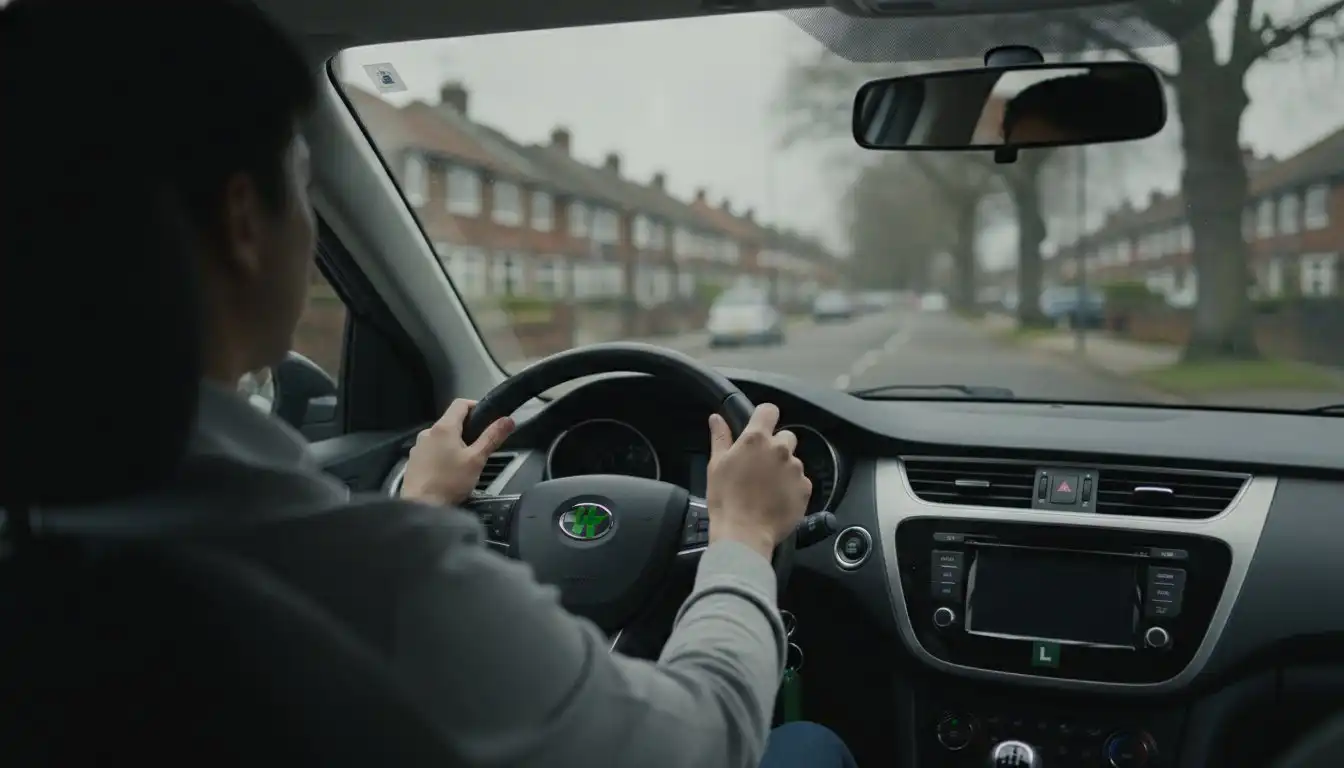
What if those shaking knees and racing heartbeats aren’t signs that you’re going to fail, but actually proof that your body is primed for peak performance? Most learners view the physical symptoms of anxiety as a warning of an impending “fail” result, especially whilst searching for driving test day nerves tips to combat the pressure. You’re likely feeling the weight of the £62 practical test fee and the intense expectations of friends, making that “L” plate feel heavier than ever. It’s a common hurdle, but it doesn’t have to be your story.
We’ve distilled the mental and physical techniques used by London’s top instructors to help you transform anxiety into a confident pass. This guide provides a definitive 24-hour preparation blueprint and tactical recovery techniques to handle small mistakes during your assessment. You’ll learn how to channel adrenaline into focused, elite-level awareness, ensuring you leave the test centre with a pass certificate. Discover how to stay calm, maintain control, and navigate the 2026 driving landscape with absolute certainty.
Key Takeaways
- Understand the biological ‘fight or flight’ response and learn how to reframe the examiner as a supportive professional rather than a threat.
- Utilise expert driving test day nerves tips such as scheduling a mock driving test to simulate assessment conditions and perfect your ‘show me, tell me’ knowledge.
- Master physical rituals, including the ‘banana myth’ for sustained energy and hydration strategies that keep you alert without mid-test distractions.
- Implement real-time techniques like commentary driving and the ‘five-second rule’ to recover instantly from minor errors whilst behind the wheel.
- Discover how professional mentorship from RoSPA Gold and IAM-certified instructors builds the ‘bulletproof’ confidence required for a first-time pass.
The Psychology of Driving Test Day Nerves: Why Your Brain Goes into Overdrive
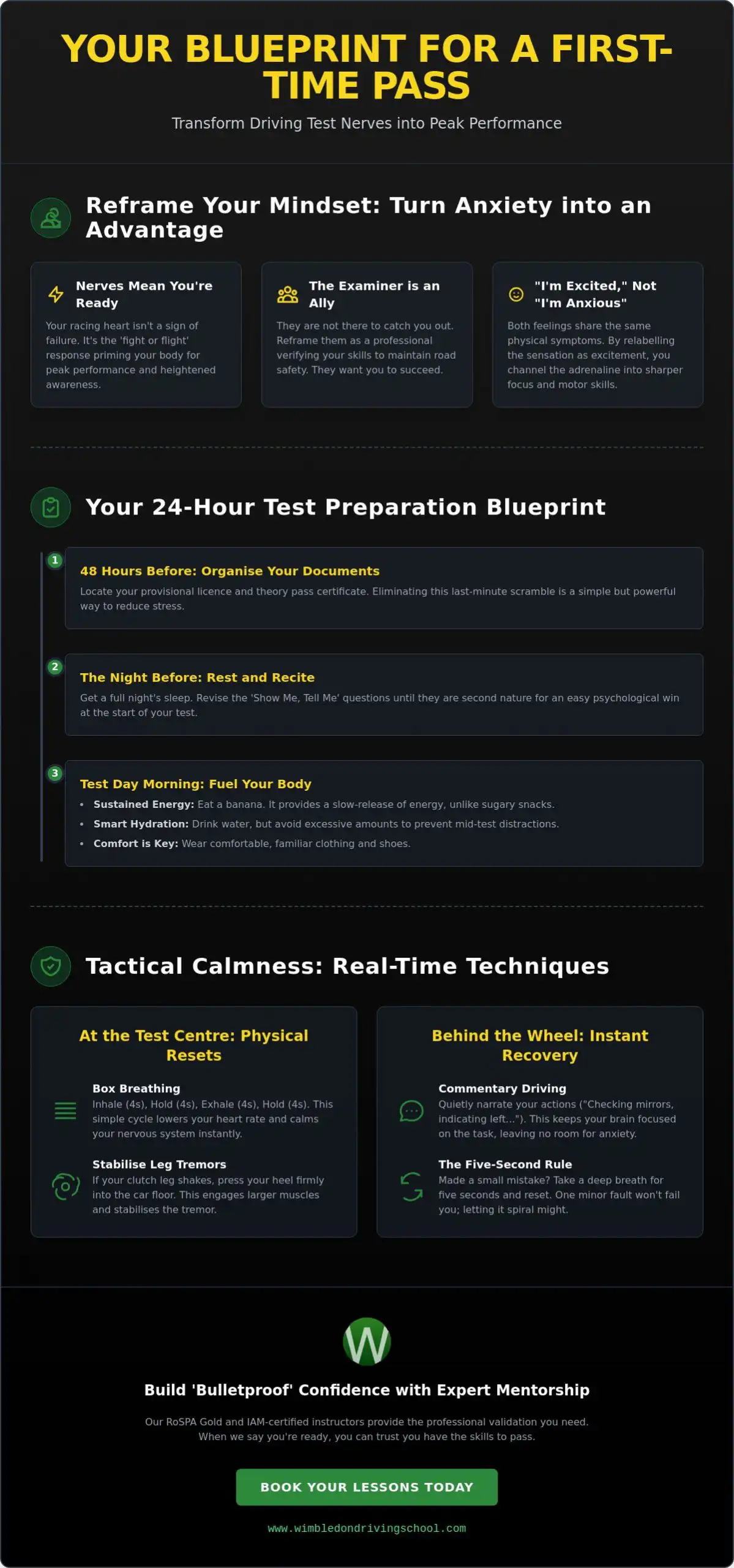
Your brain doesn’t distinguish between a predator in the wild and a DVSA examiner holding a tablet. When you sit in that driver’s seat, your amygdala triggers a “fight or flight” response. This biological surge is why your palms sweat and your heart races. Understanding the psychology of test anxiety helps you realise these aren’t signs of failure. They’re signs of a body preparing for a significant challenge. You’re not losing control; you’re simply “primed” for action.
We often view examiners as cold, robotic figures designed to find faults. In reality, they’re road safety professionals who want you to succeed so they can maintain high safety standards on our streets. Reframing this perceived “threat” as a professional collaboration is one of the most effective driving test day nerves tips. Instead of thinking “they’re watching me fail,” try thinking “they’re here to verify my safety.” Humanising the person in the passenger seat instantly lowers the stakes.
To better understand this concept, watch this helpful video:

Shift your mindset from “I am anxious” to “I am excited.” Both states involve the same physiological arousal. By labelling the feeling as readiness, you sharpen your motor skills rather than dulling them. It’s also vital to ignore the “Spotlight Effect.” You might feel every tiny steering correction is a disaster, but the examiner is looking for overall competence during the 40-minute window. They don’t expect perfection; they expect safety.
Nerves vs. Lack of Preparation
There’s a vital difference between healthy jitters and the gut feeling that you aren’t ready. Natural jitters usually disappear once you start moving. Paralysing anxiety often stems from a skills gap. This is where a Confident Mentor becomes essential. Professional validation from an ADI ensures you aren’t just hoping to pass, but that you possess the verified ability to do so. Their expert nod is the ultimate antidote to self-doubt. If they’ve told you you’re ready, trust their professional reputation.
The Biological Reset: Quick Physical Hacks
You can’t always think your way out of a physical tremor. You have to act your way out. Use these specific techniques whilst waiting at the test centre or sitting at traffic lights:
- Box Breathing: Inhale for four seconds, hold for four, exhale for four, and hold for four. This forces your nervous system to exit “panic mode” and lowers your heart rate.
- The Power Pose: Stand tall with your hands on your hips for two minutes before the test starts. This simple shift in body language can trick your brain into feeling more dominant and less threatened.
- Stabilise Leg Tremors: If your left leg starts shaking on the clutch, firmly press your heel into the floor of the car. This engages the larger muscle groups and physically stabilises the tremor.
Strategic Preparation: How to Organise Your Week Before the Practical Test
Confidence isn’t a feeling you wait for; it’s a state you build through meticulous organisation. The week before your test should be about reducing the ‘unknowns’ that contribute to anxiety. Start by organising your essential documents, including your provisional licence and theory pass certificate, at least 48 hours before the big day. Eliminating the last-minute scramble for a physical card is a simple but effective way to keep your heart rate steady. This logistical clarity allows you to focus entirely on the road ahead.
Alongside this, ensure you’ve memorised the ‘Show Me, Tell Me’ questions until they are second nature. These are the very first tasks you’ll perform, and nailing them provides an immediate psychological win. One of the most powerful mock driving test strategies involves simulating the exact conditions of the DVSA assessment. This isn’t just about checking your mirror work; it’s about acclimatising your brain to the professional silence of an examiner. This is a critical step in mastering driving test day nerves tips, as it highlights any ‘hidden’ jitters that only surface when you feel truly observed.
The Power of the Mock Test
A structured mock test allows you to create a ‘confidence checklist’ for your final 72 hours. Rather than vaguely ‘practising,’ you can focus on specific areas identified during the simulation. If you’re taking your test at Morden or Tolworth, having a professional evaluate your performance on those specific routes is invaluable. It transforms the daunting prospect of the test into a series of manageable, verified skills. This simulation helps you get used to the atmosphere of the car when the radio is off and the conversation is limited to directions.
Visualisation and Route Familiarity
Mental rehearsal is a sophisticated tool used by elite performers to manage stress. Spend time whilst you’re away from the car visualising yourself successfully navigating complex junctions in Kingston or Sutton. Combining this mental work with expert anxiety management techniques, such as positive self-talk, ensures your brain is as prepared as your hands. Review common ‘fail spots’ on local routes whilst in a calm state at home. This pre-emptive strike against doubt means that when you encounter a tricky roundabout on the day, your brain recognises it as a solved problem rather than a new threat. Avoid the temptation to ‘cram’ long lessons the day before. Instead, opt for a light refresher to keep your skills sharp without inducing fatigue. If you want to ensure your preparation is handled by the best in the industry, you can secure your final sessions with our expert team to refine those last few details.
Test Day Rituals: Managing Your Physical and Mental State
Your physical state dictates your mental performance. On the morning of your assessment, your body is already flooded with adrenaline; adding poor nutrition or erratic timing to the mix only heightens the risk of a mistake. One of the most enduring driving test day nerves tips involves the humble banana. This isn’t just folklore; bananas are rich in potassium and vitamin B6, providing slow-release energy that stabilises your blood sugar levels. This prevents the “sugar crash” that often leads to a lapse in concentration during the final ten minutes of the test.
Hydration requires a similar level of precision. Whilst staying alert is vital, you must balance your intake to avoid the anxiety of needing a comfort break mid-test. Sip water steadily throughout the morning rather than gulping a large amount just before you meet the examiner. Similarly, aim for the “Goldilocks Zone” when arriving at the test centre. Arriving 10 to 15 minutes before your slot is ideal. If you turn up 30 minutes early, you’ll likely spend that time stewing in the waiting room amongst other nervous candidates, which can be counterproductive.
Your choice of attire also impacts your performance. Wear flat, comfortable shoes that you’ve used during your lessons to ensure a consistent feel for the clutch and brake. Avoid restrictive clothing that might hinder your ability to perform effective blind-spot checks. Freedom of movement is essential for demonstrating the observant behaviour examiners look for.
Morning-of Routine for Success
A one-hour warm-up lesson immediately before your test is non-negotiable. It allows you to “wake up” your driving muscles and settle into the car’s rhythm. Use this time to practice one last manoeuvre or a tricky junction, but don’t overwork yourself. Crucially, limit your caffeine intake. You already have enough natural stimulants in your system; adding a double espresso can lead to leg tremors on the pedals. You should also decide in advance if you want your instructor to sit in the back. For many, having their mentor present provides a significant psychological safety net.
Managing External Pressure
One of the most effective ways to lower the stakes is the “Secret Test” strategy. You don’t have to tell every friend and family member your exact date. By keeping it private, you eliminate the fear of having to “report back” a result, which significantly reduces the pressure to pass first time. If well-meaning relatives offer conflicting advice, politely filter it out and rely solely on your instructor’s professional guidance. Focus entirely on the process of driving safely for the next 40 minutes, rather than obsessing over the final outcome. If you drive safely, the pass certificate will take care of itself.
In-Car Calmness: Techniques to Use Whilst You Are Behind the Wheel
The moment you close the car door and adjust your seat, the dynamic shifts from preparation to performance. Transitioning from the waiting room to the road requires a sharp change in focus. Implementing practical driving test day nerves tips whilst in motion is the most effective way to maintain your composure and demonstrate your competence. One of the most powerful tools at your disposal is the ‘Sat-Nav with feelings’ reframe. Instead of viewing the examiner as a judge, treat them as a high-tech navigation system that happens to be human. They provide the directions; you provide the safe execution. This mental shift reduces the feeling of being under a microscope and allows you to drive with natural fluency.
Safety is the examiner’s primary concern. To demonstrate this effectively, you should use exaggerated observations. Whilst you should remain relaxed, your head movements during mirror checks and blind-spot scans must be clear and deliberate. If the examiner has to guess whether you’ve looked, they cannot give you the credit you deserve. Make your safety checks obvious without being theatrical. This clear communication of your awareness builds immediate trust between you and the professional in the passenger seat.
The Art of Commentary Driving
Vocalising your thoughts is a professional technique that prevents ‘autopilot’ errors. By quietly narrating your actions, such as “checking centre mirror, slowing for the hazard, selecting second gear,” you keep your brain actively engaged with the task at hand. This prevents your mind from wandering toward ‘what if’ scenarios. Examiners often appreciate this clarity, as it proves you are making conscious, safe decisions. It also serves as a biological regulator; speaking naturally forces you to breathe at a steady pace, which physically prevents the onset of panic and keep your heart rate stable.
Recovering from the ‘Big Mistake’ Mindset
Stalling or clipping a kerb can feel like an immediate disaster, but it rarely is. Use the ‘Five-Second Rule’ for a rapid recovery. If you make a minor mistake, acknowledge it, fix it, and then mentally reset within five seconds. Many learners fail because they obsess over a minor fault, which then leads to a genuine major error later in the session. Remember, the test isn’t over until you’ve secured the car at the end. Use the ‘Reset Button’ technique at every red light: take one deep breath and clear your mental slate for the next segment of the journey.
If you want to practice these high-level techniques with a professional mentor before your big day, book a session with our expert instructors today to build your in-car resilience.
The Wimbledon Advantage: How Expert Mentorship Eliminates Test Day Anxiety
Success on test day isn’t just about technical skill; it’s about the calibre of the mentorship you receive throughout your journey. At Wimbledon Driving School, we recognise that the road to a pass certificate is often paved with apprehension. This is why our team comprises some of the most highly qualified professionals in the industry, including RoSPA Gold and IAM-certified instructors. These elite credentials mean your mentor isn’t just teaching you to drive; they are building ‘bulletproof’ confidence through advanced road safety knowledge. This level of expertise is the ultimate foundation for implementing the driving test day nerves tips we have explored, ensuring your preparation is rooted in professional excellence.
Our commitment to your achievement extends beyond the car. We provide exclusive access to our Learning Centre, a comprehensive hub of theory and practical resources designed to eliminate uncertainty. By mastering the ‘Show Me, Tell Me’ questions and understanding complex road layouts before you even turn the key, you reduce the cognitive load on test day. Our ‘Confident Mentor’ philosophy is the engine behind our industry-leading pass rates, framing every lesson as a transformative step toward your personal milestone. We don’t just offer instruction; we provide a secure environment where you can refine your skills without fear.
Tailored Instruction for Nervous Drivers
We understand that every learner’s emotional journey is unique. Our instructors specialise in manual driving lessons specifically adapted for those who feel the weight of test day pressure. Whether you are navigating the busy streets of South West London or the quieter roads of Surrey, we adapt the pace of instruction to suit your specific needs. This bespoke approach ensures you transition from a hesitant student to a poised, confident driver. We don’t just prepare you for a 40-minute assessment; we coach you for a lifetime of safe, independent travel. Professional coaching replaces the “fear of the unknown” with a verified checklist of competence.
Booking Your Path to Success
Choosing the right format for your education is vital for managing anxiety. For some, our intensive driving courses provide the momentum needed to overcome nerves through immersive, daily practice. This concentrated focus helps keep your skills fresh and your mind sharp. For others, structured hourly tuition allows for a more gradual build-up of confidence. Whatever your preference, we help you secure a test date that aligns with your peak performance period, ensuring you arrive at the centre feeling fully prepared. Your journey toward that pass certificate starts with a single, decisive action. Book your first lesson with Wimbledon Driving School today and take the first step toward mastering the road with absolute certainty.
Take the Driver’s Seat with Absolute Confidence
Mastering the road is as much a mental victory as it is a physical one. By reframing your biological response and implementing structured in-car techniques like commentary driving, you transform anxiety into a sharp, focused readiness. These driving test day nerves tips are designed to give you the tactical edge required to navigate the 2026 testing landscape with ease. Remember that the examiner is a professional partner in road safety, and with the right preparation, that pass certificate is well within your reach.
Wimbledon Driving School specialises in helping nervous and first-time drivers reach their full potential. Our instructors hold prestigious RoSPA Gold and IAM certifications, contributing to one of the highest pass rates in the UK. We don’t just teach you to pass; we mentor you through a transformative journey toward lifelong independence. You have the skills, the knowledge, and now the plan to succeed.
Start your journey with London’s most supportive driving school; book your first lesson today!
You’ve done the hard work, and your destination is finally in sight. We look forward to seeing you on the road as a confident, qualified driver.
Frequently Asked Questions
What should I do if my legs start shaking during my driving test?
If your legs start shaking, firmly press your heel into the car’s floor to engage your larger muscle groups. This physical action provides a stable anchor and helps suppress the involuntary tremors caused by an adrenaline surge. Taking a slow, deep breath whilst focusing on the pressure in your heel can also reset your nervous system and restore your control over the pedals.
Is it true that eating a banana helps with driving test nerves?
Eating a banana is a highly effective way to manage your energy levels and concentration during the assessment. They are rich in potassium and vitamin B6, which provide a sustained release of energy and help prevent the “sugar crash” that leads to lapses in judgment. This is one of the most practical driving test day nerves tips for maintaining peak focus throughout the 40-minute drive.
Can I take my driving instructor with me on the test for support?
You are absolutely permitted to have your driving instructor sit in the back of the car during your practical test. Many learners find that having their mentor present provides a vital psychological safety net and reduces the feeling of being judged by a stranger. Your instructor can also take notes on your performance to provide detailed, professional feedback once the session concludes.
What happens if I stall the car during my driving test?
Stalling the car is typically recorded as a minor driving fault, provided you deal with the situation safely and promptly. If you stall, remain calm, apply the handbrake, restart the engine, and perform all necessary observations before moving off again. It only becomes a serious fault if you fail to secure the car or if the stall occurs in a dangerous location that impedes other road users.
How many minor faults am I allowed to have on my practical test?
You are permitted to have up to 15 minor faults, often called “driving faults,” during your practical test. However, you will fail if you commit a single serious or dangerous fault, or if you repeat the same minor mistake multiple times, as this indicates a persistent habit. This allowance is designed to accommodate the natural pressure of the day whilst ensuring you meet high safety standards.
Should I tell my friends and family when my driving test is?
We generally recommend keeping your test date private to eliminate the weight of external expectations and the pressure to pass first time. By not sharing the date, you remove the anxiety of having to report your result to others, allowing you to focus entirely on your own performance. You can always celebrate with your loved ones once you have the pass certificate in your hand.
How can I calm my nerves if I’m taking an intensive driving course?
To calm nerves during an intensive driving course, trust the momentum of daily practice and the rapid development of your muscle memory. Because you are immersed in the driving environment for several hours each day, your skills become second nature, which naturally builds confidence. Utilising professional driving test day nerves tips like visualisation between your sessions can further solidify your progress and reduce performance anxiety.
What is commentary driving and how does it help with anxiety?
Commentary driving involves narrating your observations and intended actions out loud as you navigate the road. This technique keeps your brain actively engaged with the immediate task and prevents your mind from wandering into anxious “what if” scenarios. Vocalising your decisions proves your competence to the examiner whilst helping you maintain a steady, calm breathing rhythm throughout the test.
Disclaimer
This article is provided for general informational purposes only and does not constitute professional driving, legal, or safety advice. While we aim to keep our content accurate and up to date, rules, prices, and DVSA test requirements can change — always check gov.uk or contact us directly at 020 3524 7968 for the latest guidance before making any decisions. Nothing in this article guarantees a specific outcome, including passing your driving test within any stated timeframe. For current pricing, course availability, and instructor details, please visit our Prices page or get in touch.