By the end of 2026, over a quarter of all UK driving test passes will be in automatic vehicles, a figure that continues to climb as we approach the 2030 ban on new petrol and diesel cars. It’s completely natural to feel torn between the traditional control of a gear stick and the seamless ease of a modern automatic, especially when you’re picturing the stress of stalling at a busy South West London junction. You want to pass your test quickly and feel entirely confident behind the wheel, yet the confusion over long-term costs and licence restrictions can make the first step feel daunting.
This guide provides the definitive breakdown of manual vs automatic pros and cons, weighing up everything from initial lesson costs to long-term licence flexibility. We’ll explore current pass rate realities, the “fast-track” potential of ditching the clutch, and how to future-proof your driving journey for the electric era. Whether you’re looking for the most cost-effective route or the quickest way to ditch the L-plates, we’ll help you make an informed choice that sets you up for a lifetime of safe, successful driving. It’s time to transform your anxiety into achievement and start your journey toward that milestone pass.
Key Takeaways
- Evaluate the essential manual vs automatic pros and cons to determine which transmission style aligns with your personal learning speed and long-term budget.
- Understand how the upcoming transition to zero-emission vehicles makes automatic driving a strategic, future-proof choice for 2026 learners.
- Discover why choosing an automatic can reduce your total training time by up to ten hours, allowing you to achieve your licence with greater efficiency.
- Learn the vital differences in licence flexibility to ensure your qualification supports your future driving goals without the need for additional tests.
- Identify which option provides the greatest boost to your confidence, helping you manage complex road situations with professional poise.
The Great Debate: Understanding Manual and Automatic Transmissions
In 2026, the decision between learning in a manual or an automatic car is no longer just a matter of tradition; it’s a strategic choice for your future on the road. Whilst manual cars have long been the standard in the UK, the rapid rise of electric vehicles and hybrid technology has shifted the landscape significantly. Gaining a clear perspective on the manual vs automatic pros and cons is the first step toward securing your independence. A manual car requires you to use a clutch pedal and a gear stick to change speed, whereas an automatic handles these transitions for you. This fundamental difference dictates your learning curve and your eventual licence restrictions.
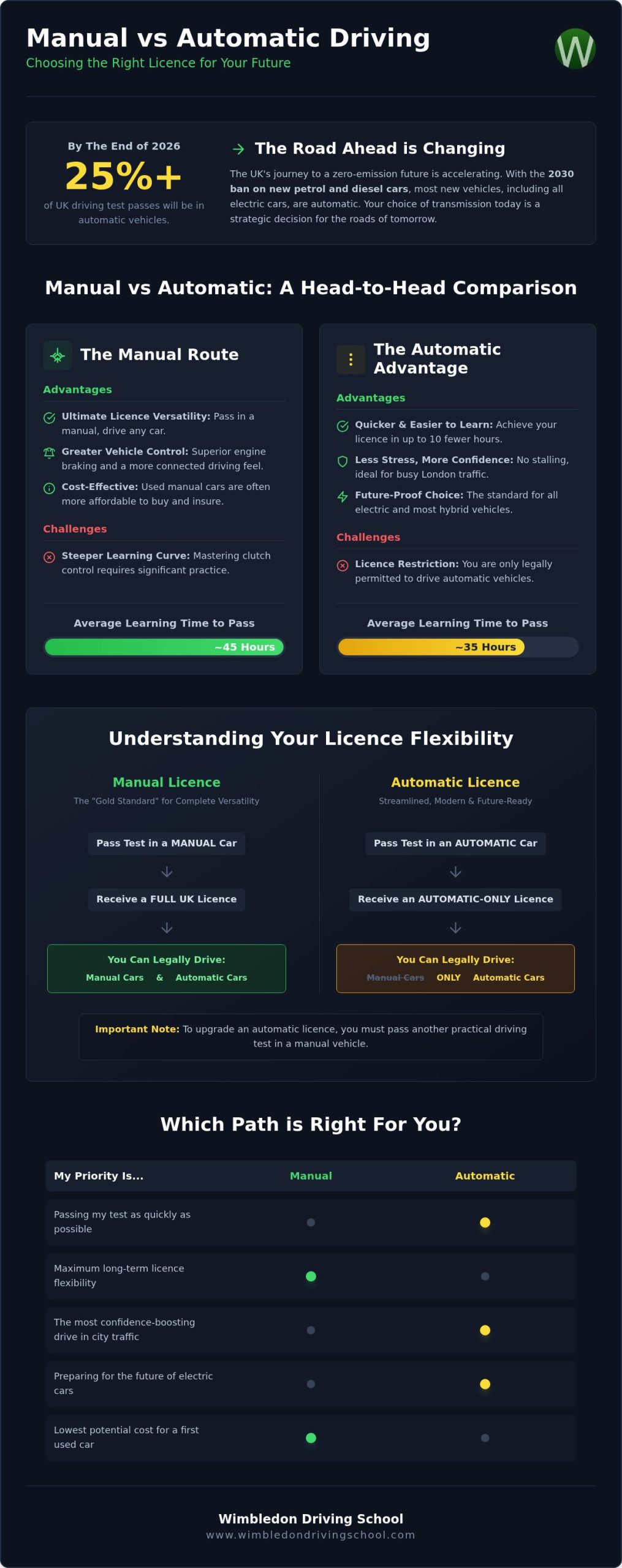
Passing your test in an automatic vehicle grants you an “automatic-only” licence, meaning you’re legally restricted from driving manual cars. To upgrade later, you’d need to sit the practical test again in a manual car. Conversely, a manual licence offers total flexibility, allowing you to drive both types of vehicle. At Wimbledon Driving School, we recognise that every learner has unique goals. Whether you’re aiming for the ultimate versatility of a manual or the streamlined, modern path of an automatic, our RoSPA Gold and IAM certified instructors provide the elite training you need to succeed.
How Manual Gearboxes Work
A manual gearbox puts you in direct control of the vehicle’s power. The clutch pedal acts as the bridge, disconnecting the engine from the wheels so you can select a new gear. Mastering “clutch control” is often the most significant challenge for new students. It requires precise physical coordination between your left foot on the clutch and your right hand on the gear stick. Whilst it takes more practice to perfect, many drivers find this mechanical connection deeply rewarding once they’ve conquered the initial learning curve. It’s about developing a feel for the car that becomes second nature over time.
The Simplicity of Automatic Cars
Automatic vehicles simplify the driving experience by removing the left pedal entirely. You’ll typically find a straightforward “PRND” layout: Park, Reverse, Neutral, and Drive. Because the car manages the gear changes, stalling becomes virtually impossible, even in the challenging stop-start conditions of South West London traffic. This reduced physical workload allows you to dedicate more mental energy to observing road hazards, checking mirrors, and planning your route. For many, this leads to a faster journey from their first lesson to their final test, as the technical barrier of gear synchronisation is removed.
The Manual Route: Control, Tradition, and Versatility
Choosing the manual route is often seen as earning the “Gold Standard” of UK driving qualifications. When you pass in a manual car, your licence future-proofs your driving licence by granting you the legal right to operate any passenger vehicle, regardless of its transmission. This versatility is the primary reason many learners still opt for a gear stick. Beyond the legalities, there’s a distinct psychological connection. Enthusiasts often describe a sense of being “at one” with the machine, where every shift is a deliberate choice. Weighing up the manual vs automatic pros and cons involves looking past the initial challenge to the long-term freedom this licence provides.
Pros of Learning Manual
The advantages of manual instruction extend to your wallet and your control over the vehicle. Manual cars are traditionally more affordable to purchase on the used market, which is a major consideration for first-time buyers. Insurance premiums for manual variants also tend to be lower amongst certain demographics. In terms of handling, manual gearboxes offer superior engine braking. This is particularly useful when navigating the steep inclines of the Surrey hills, allowing you to control your descent without over-relying on the footbrake. You gain a comprehensive understanding of vehicle mechanics that stays with you for life.
Cons of the Manual Choice
Despite the benefits, the manual path isn’t without its hurdles. You should prepare for a steeper learning curve compared to your automatic counterparts. Data from the 2024-2025 period shows a manual pass rate of 48.4 per cent, but this comes at a cost of time. The DVSA suggests an average of 45 hours of professional instruction, whereas automatic learners often reach the same standard significantly faster. Other challenges include:
- Risk of stalling: This remains a primary source of anxiety at busy London junctions.
- Physical fatigue: Constant clutching in stop-start city traffic can be draining during long commutes.
- Complexity: Managing three pedals requires higher levels of initial coordination.
If you’re ready to master the art of the gear shift with a confident mentor, our expert instructors can help you secure your preferred lesson time today. We specialise in helping nervous learners overcome these initial technical barriers with ease.
The Automatic Advantage: Simplicity and Modern Driving
As we move through 2026, the gear stick is rapidly becoming a relic of the past for many new road users. The shift toward automatic driving lessons represents a significant trend, driven largely by the ubiquity of electric and hybrid vehicles which are automatic by default. When evaluating the manual vs automatic pros and cons, the most immediate benefit you’ll notice is the accelerated path to your test date. By removing the technical requirement to synchronise a clutch and gear lever, you can focus entirely on the core principles of safe road positioning and hazard perception from day one.
Removing the physical workload of gear changes frees up vital “cognitive bandwidth.” This extra brain power is essential for navigating the complex, high-pressure environments of South West London. Nervous drivers, in particular, find that their anxiety melts away when the risk of stalling at a busy junction is completely eliminated. Instead of worrying about find the biting point, you can dedicate your full attention to your mirrors and the behaviour of other road users. This creates a sense of calm and control that is often harder to achieve in a manual vehicle during those initial, daunting hours on the road.
Pros of Automatic Lessons
The primary advantage of opting for an automatic is the sheer speed of progress. DVSA data indicates that whilst the average learner requires 45 hours of professional instruction, those learning in automatic cars typically reach test-ready status seven to ten hours faster. This efficiency makes it an ideal choice for our fast-track intensive driving course, allowing you to secure your licence in a fraction of the time. You’ll also find yourself perfectly prepared for the electric vehicle revolution, as the UK moves toward the 2035 ban on new petrol and diesel cars. Stress levels are significantly lower when navigating the intricate roundabouts of Wimbledon or the narrow streets of Kingston, making the entire learning journey more enjoyable.
Cons of the Automatic Licence
Before committing, it’s vital to understand the legal and financial trade-offs. The most significant drawback is the licence restriction; you won’t be legally permitted to drive a manual car without sitting a second practical test. There are also cost implications to consider during your training. Automatic lessons are typically £2 to £5 more expensive per hour than manual ones, reflecting the higher purchase price and maintenance costs of these vehicles. Additionally, some new drivers may find that insurance premiums are slightly higher for certain automatic models amongst younger age groups. However, for many, the trade-off of passing more quickly and with less stress far outweighs these long-term considerations.
Practical Comparison: Costs, Test Pass Rates, and London Traffic
When weighing the manual vs automatic pros and cons, the reality of your local environment plays a decisive role. South West London presents a unique set of challenges, from the tight, affluent streets of Wimbledon Village to the high-speed merges of the A3. Choosing the right transmission isn’t just about the car; it’s about how you interact with these specific conditions. Our instructors see first-hand how the choice of gearbox impacts a student’s ability to process the capital’s dense traffic and complex road layouts. Whilst the technical skills differ, the ultimate goal remains the same: achieving a safe, confident pass that serves you for a lifetime.
Financial Breakdown over 40 Hours
Whilst the hourly rate for automatic instruction is typically £2 to £5 higher than manual in London, the total investment often tells a different story. If you consider that the average learner in an automatic car requires seven to ten fewer hours of professional training, the higher hourly fee is frequently offset by a shorter journey to the test centre. By choosing to block booking driving lessons, you can further reduce this expenditure, making the premium for an automatic car almost negligible over the course of your education. You’re paying for efficiency and a faster route to independence. Over a standard 40-hour period, the reduced physical workload of an automatic allows for more rapid progression through the DVSA syllabus, which can lead to significant savings on the total number of sessions required.
Navigating London and Surrey Roads
The “London Factor” is a significant consideration for any new driver. Navigating the stop-start congestion of the morning commute or the complex lane markings of the Tibbet’s Corner roundabout is objectively simpler without the constant need for gear changes. An automatic car acts as a “sanity saver” in these high-pressure scenarios, allowing you to focus on the road ahead rather than the floor of the footwell. Although national statistics show a manual pass rate of 48.4 per cent compared to 43.1 per cent for automatic, these figures are often skewed by learner demographics. For a nervous driver in London, removing the risk of stalling at a busy junction can actually increase their personal first-time success rate by boosting their composure during the test.
Our instructors provide specialised knowledge for those preparing for Morden or Tolworth test centres, tailoring every session to the specific quirks of these local routes. Whether you prefer the engagement of a manual or the streamlined ease of an auto, we ensure you are test-ready and city-confident. If you’re ready to master the capital’s roads with a professional mentor, book your introductory lesson with our elite team today.
Making Your Decision: Which Licence Future-Proofs Your Driving?
The 2035 ban on new petrol and diesel cars is the single most important factor for any learner in 2026. This hard deadline means that within a decade, the vast majority of vehicles on UK roads will be zero-emission models, which are almost exclusively automatic. When you assess the manual vs automatic pros and cons today, you must look beyond your first car and consider the landscape of the 2030s. Whilst a manual licence offers the most freedom right now, the practical necessity of a gear stick is diminishing every year. Your choice should reflect your personal “coordination comfort zone” and your immediate logistical needs.
If your career requires you to drive older vans or specific classic vehicles, the manual route remains essential. However, if your goal is to transition into the modern motoring era as safely and efficiently as possible, the automatic path is increasingly logical. At Wimbledon Driving School, we specialise in helping you identify which programme suits your learning style. Our RoSPA Gold and IAM certified instructors don’t just teach you to pass; they prepare you for a lifetime of achievement on the road. How our automatic driving lessons prepare you for the EV era is a testament to our position as a forward-thinking, market-leading institution.
The ‘Electric’ Argument
Learning in an automatic car is the most direct way to future-proof your skills for the electric vehicle revolution. Hybrid technology already dominates the UK car market, and these vehicles rely on seamless, computer-controlled transmissions to manage their dual power sources. By training in an automatic now, you’re mastering the exact driving dynamics you’ll encounter for the rest of your life. WDS is leading the way in modern driver tuition by integrating these future-proof techniques into every session. We ensure our students are not just “test-ready” but “future-ready,” providing a sense of security and prestige that comes from being trained by the best in the industry.
Final Verdict: Manual or Automatic?
Making your final choice requires a balance of pragmatism and ambition. Use this quick checklist to determine your path:
- Choose Manual if: You want total licence flexibility, plan to drive older used cars, or enjoy the mechanical engagement of gear shifting.
- Choose Automatic if: You want to pass your test as quickly as possible, experience high levels of driving anxiety, or plan to move straight into a hybrid or electric vehicle.
It’s important to remember that you aren’t locked into your choice forever. Many students start with manual lessons and switch to automatic mid-way through their course if they find the clutch coordination is hindering their progress. Our instructors are highly adaptable and will support your decision to ensure the most effective outcome for your education. Your journey toward this personal milestone starts with a single, confident step. Next steps: Book your first lesson with WDS and start your journey with the highest industry standard today.
Start Your Journey to Independence Today
Navigating the manual vs automatic pros and cons is a vital first step in your driving education. Whether you prioritise the ultimate flexibility of a manual licence or the streamlined, future-proof efficiency of an automatic, your choice marks the beginning of a transformative personal milestone. Your decision should align with your specific learning pace and your long-term goals for the electric vehicle era. By selecting the right path now, you’re setting the foundation for a lifetime of safe and successful motoring across London and beyond.
At Wimbledon Driving School, we provide the elite guidance required to turn your ambition into achievement. Our RoSPA Gold and IAM certified mentors are specialists in nervous drivers, ensuring you feel secure at every stage of your instruction. With some of the highest pass rates in the country, we offer the most effective choice for your education. Book your first lesson with Wimbledon Driving School today and take control of your future on the road. We look forward to helping you reach your destination with confidence and poise.
Frequently Asked Questions
Is it harder to pass a driving test in a manual car?
Technically, the test requirements are identical, but the physical workload is higher. Pass rates for manual tests in 2024-2025 were 48.4 per cent, slightly higher than the 43.1 per cent for automatic. This suggests that while manual has more to learn, the students opting for it may be more prepared. At Wimbledon Driving School, we focus on ensuring you are test-ready regardless of the transmission you choose for your journey.
Can I drive an automatic car with a manual licence?
Yes, a manual licence is the most versatile qualification you can achieve. It grants you the legal right to drive both manual and automatic vehicles without any further testing. This flexibility is a key factor when weighing up manual vs automatic pros and cons. Passing in a manual car ensures you are never restricted by a vehicle’s transmission type, whether you’re hiring a car abroad or buying your first vehicle in South West London.
Why are automatic driving lessons more expensive than manual ones?
The higher hourly rate for automatic instruction reflects the increased costs associated with these vehicles. Automatic cars generally have a higher purchase price and involve more complex maintenance requirements. Additionally, fuel consumption in older automatic models can be higher, though modern hybrids are exceptionally efficient. Our competitive pricing for automatic lessons ensures you receive elite tuition from RoSPA Gold and IAM certified mentors who specialise in these modern systems across Surrey and Middlesex.
Which is better for driving in London, manual or automatic?
Automatic is widely considered superior for navigating the dense, stop-start traffic of South West London and Surrey. Removing the need for constant gear changes and clutch control reduces physical fatigue and mental stress during peak times. It allows you to focus entirely on the complex road markings and hazard perception required in the capital. Many of our students find that automatic lessons provide a much calmer experience when tackling the A3 or the busy streets of Morden.
Will manual cars become obsolete by the time I pass my test?
Manual cars won’t disappear immediately, but they are becoming less common as we approach the 2035 ban on new petrol and diesel sales. Most new cars, especially electric and hybrid models, are now automatic. Whilst manual vehicles will remain on the used market for years, the industry is clearly shifting toward a two-pedal future. Learning in an automatic now prepares you for the standard technology you’ll likely use for the rest of your driving life.
How many more lessons does it take to learn manual vs automatic?
On average, learning to drive a manual car requires an additional seven to ten hours of professional instruction. This extra time is dedicated to mastering clutch control, gear synchronisation, and hill starts. Automatic learners often reach a test-ready standard faster because they don’t have to overcome the technical hurdle of the biting point. This efficiency makes automatic courses a popular choice for those looking to secure their licence through our fast-track intensive options in South East London.
Can I switch from manual to automatic lessons if I’m struggling?
You can certainly switch transmissions at any point during your training. If you find that gear changes are hindering your progress or causing significant anxiety, moving to an automatic car can often provide an immediate boost to your confidence. Our instructors are highly adaptable and will support your transition to ensure you achieve the best possible outcome. We prioritise your progress and mental comfort above all else during your learning journey across Wimbledon and Kingston.
Does insurance cost more for automatic cars in the UK?
Historically, insurance premiums for automatic cars have been slightly higher, but this gap is narrowing. The cost depends largely on the specific vehicle model, your age, and your location in London or Surrey. Some insurers view automatic gearboxes as more expensive to repair if involved in an accident. However, as automatics become the national standard, these price differences are becoming less significant for new drivers who hold a full licence from a reputable school.