

What if choosing the right exit wasn’t a last-second decision, but the result of a calm routine you repeat every time? The key to how to master roundabouts uk is to observe, decide and position yourself without rushing.
It’s understandable to worry about picking the wrong lane, judging a safe gap or feeling pressured by traffic behind you. A clear plan helps you make considered decisions and keep your attention on the road around you.
This guide covers each stage: preparing on approach, choosing a lane, judging traffic from the right, signalling and leaving safely. You’ll also learn what to watch for around cyclists and how to adapt your approach to different layouts, including mini-roundabouts. The aim isn’t to memorise one route, but to build a reliable routine you can practise until it feels familiar.
Key Takeaways
- Learn why how to master roundabouts uk starts with timely decisions, not memorising every layout.
- Use a repeatable approach routine to plan your route, read signs, position safely and reassess as you approach.
- Adapt to mini, multi-lane and unfamiliar roundabouts by following signs and road markings rather than guessing.
- Build confidence gradually by focusing each practice session on one skill, such as observation or lane planning.
- Learn how instructor-guided practice can help you apply your routine in real traffic.
Why UK roundabouts feel difficult, and what mastering them really means
Mastering roundabouts means making safe, timely decisions, not memorising every layout. You’re learning to notice what is happening, understand the information in front of you and choose a sensible next action. That approach is more reliable than trying to recall a fixed rule for every roundabout.
The pressure comes from several tasks happening together. You may be checking traffic from the right, reading direction signs, following lane markings and managing your speed, all while keeping an eye on the vehicle behind. If the exit isn’t obvious or the road feels busy, it can seem as though you need to decide everything at once.
What makes roundabouts challenging for learner drivers?
Each approach asks you to gather information and plan ahead. A sign may show several destinations, while road markings give more specific guidance about which lane serves each one. Traffic may be approaching from different directions, and your intended exit can become clearer only as you get closer.
Feeling watched by a driver behind can narrow your attention. You might focus on moving forward quickly instead of assessing the junction properly. Take the time you need to observe and make a safe decision. Confidence builds through deliberate, supported practice, not by acting before you’re ready.
The principle that keeps decisions clear
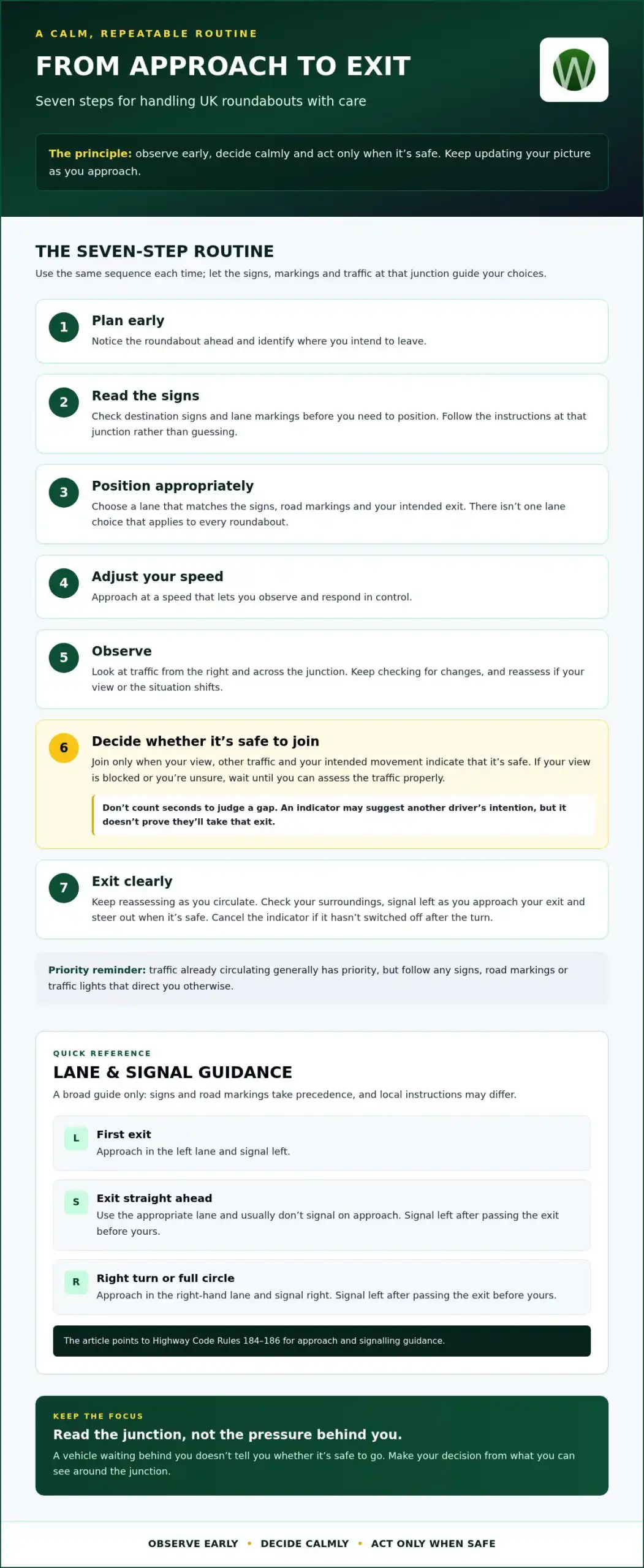
Use one steady principle: observe early, decide calmly and act only when it’s safe. Take in the signs, road markings and shape of the junction, then keep updating your picture as you approach. Don’t stick to a plan if the information in front of you changes.
There isn’t one lane choice that applies to every exit at every roundabout. The layout, signs and markings guide you. This guide to choosing a roundabout lane explains why reading the junction matters more than relying on a memorised default.
A safe, well-planned approach gives you time to read the junction, choose a suitable position and respond to traffic without rushing.
You don’t need to enter simply because someone is waiting behind you. Their presence doesn’t tell you whether it’s safe to go. Keep your attention on the junction and make your decision based on what you can see, not pressure to please another driver.
Roundabouts differ in shape, size and layout. You can read a general overview of their forms and background in Roundabout (Wikipedia), but when driving, the signs and markings at the particular junction are what matter to your decision.
To practise how to master roundabouts uk, focus on the decision-making process instead of trying to make every junction feel identical. Notice what information you need, allow time to interpret it and be ready to adjust your plan as the situation changes. With patient, instructor-guided practice, the different tasks can become a more manageable routine.
How to approach, join and leave a UK roundabout safely
Use the same sequence each time, but let the signs, markings and traffic at that junction guide your choices. Traffic already circulating generally has priority, but follow any signs, road markings or traffic lights that direct you otherwise. The Highway Code sets out approach and signalling guidance in Rules 184-186.
- Plan early. Notice the roundabout ahead and identify where you intend to leave.
- Read the signs. Check destination signs and lane markings before you need to position.
- Position appropriately. Choose a lane that matches the instructions and your intended exit.
- Adjust your speed. Approach at a speed that lets you observe and respond in control.
- Observe. Look at traffic from the right and across the junction, and keep checking for changes.
- Decide. Join only when your view, other traffic and your intended movement indicate that it’s safe.
- Exit clearly. Keep reassessing as you circulate, then signal and leave when it’s safe.
Plan early, read the junction, choose safely and keep observing from approach to exit. That’s the practical rhythm behind how to master roundabouts uk, without relying on a fixed timing rule for every gap.
Choose your lane and signal from the information available
Signs and road markings take precedence over general lane conventions. As a broad guide, the Highway Code advises approaching in the left lane for the first exit and signalling left. For an exit straight ahead, use the appropriate lane and usually don’t signal on approach. Signal left after passing the exit before yours. For a right turn or full circle, approach in the right-hand lane and signal right, then signal left after passing the exit before yours. Follow local instructions where they differ. This guide to choosing a lane at a roundabout explains how to read the approach.
Judge the gap, keep moving safely and exit clearly
A safe gap depends on what you can see, how quickly other vehicles are moving and where you intend to go. Don’t judge it by counting seconds or assume a gap is suitable just because another driver has entered. If your view is blocked or you’re unsure, wait until you can assess the traffic properly. An indicator can suggest a driver’s intention, but it doesn’t prove they’ll take that exit.
Once you’ve joined, keep checking what’s happening around you. Before leaving, check your surroundings, signal left as you approach your exit and steer out when it’s safe. Cancel the indicator if it hasn’t switched off after the turn. At every stage, reassess and respond to the traffic around you.
Mini, multi-lane and unfamiliar roundabouts: adapt instead of guessing
Not every roundabout gives you the same view or the same amount of room. A mini-roundabout may appear with little warning and leave limited space to steer, while a larger or multi-lane junction can have more signs, lane arrows and traffic to assess. Notice what’s different, then use the information on the road rather than assuming your usual lane choice will fit.
Mini-roundabout
Layout cue: A compact junction with a painted central marking and limited manoeuvring space.
What to check: Traffic approaching from the right, the central marking and the road you need to take.
Safe planning response: Slow as needed, steer smoothly and follow the route around the central marking where your vehicle’s position allows.
Multi-lane or spiral roundabout
Layout cue: Several lanes, directional arrows or markings that guide traffic towards particular exits.
What to check: Signs and lane arrows early, then the position of traffic around you as you proceed.
Safe planning response: Choose a suitable lane in good time and follow the markings. Don’t make a sudden lane change to reach an exit.
Unfamiliar layout
Layout cue: An arrangement or exit pattern you haven’t encountered before.
What to check: Direction signs, road markings and how the available lanes continue through the junction.
Safe planning response: Base your decision on what’s visible. If you can’t reach your intended exit safely, take a safe alternative route.
Mini-roundabouts need early observation and controlled steering
The compact layout can make a mini-roundabout feel abrupt, so look ahead and begin assessing it as soon as you can. Keep your steering smooth, and don’t aim over the central marking as a shortcut. Rule 188 of the Highway Code says vehicles must pass around the central markings unless they’re physically incapable of doing so. Follow the give-way signs and markings, and consult the current guidance if you’re unsure how the rule applies.
Multiple lanes and missed exits
At a multi-lane roundabout, read overhead or roadside signs early and match your position to the lane arrows. Spiral markings may guide a lane through the junction, so watch how the markings continue rather than making a last-second move. If you realise you’re not positioned for your exit, don’t cut across another lane or force your way out. Continue safely and follow a suitable alternative route.
This is an important part of learning how to master roundabouts uk: adapt your plan to the junction you’re actually approaching. Instructor-guided practice can help you recognise different layouts and make measured decisions, especially when a junction looks unfamiliar.
How to practise roundabouts and build confidence without rushing
Roundabout confidence grows through practice with a clear focus. Rather than trying to tackle every layout or skill at once, build your experience in stages with an instructor. You can start by thinking through a familiar junction, practise the decisions with guidance, then work towards different layouts or traffic conditions when you’re ready.
For each practice session, choose one main skill. A specific goal makes the session manageable and helps you notice progress:
- Observation: Focus on gathering information early and moving your attention between relevant areas.
- Lane planning: Practise spotting signs and road markings in good time.
- Exiting: Concentrate on recognising your exit and preparing to leave smoothly.
After each attempt, name one thing that went well and one specific adjustment for next time. For example, you might have read the direction signs clearly but left lane planning too late. That’s more useful than deciding you’re simply “bad at roundabouts”, because it identifies a skill you can work on deliberately.
Turn a difficult roundabout into a manageable practice goal
Be precise about what feels difficult. Is it spotting the correct lane, judging whether you can join or keeping track of your exit? Share that concern with your instructor and agree on a suitable practice goal and conditions. Calm feedback can help you distinguish between a planning step you can refine and nerves that made a familiar task feel harder.
Review the experience soon afterwards, while you can remember what you noticed and when. If your plan changed, talk through what prompted the change. That reflection helps you carry a useful lesson into your next attempt instead of repeating the same worry.
Use local lessons to practise real decisions
Driving lessons in Wimbledon and nearby areas give you the chance to apply your developing skills in real traffic, with an instructor guiding practice to suit your confidence and ability. As you gain experience, you can work on interpreting unfamiliar signs and responding to changing traffic instead of relying on one familiar layout.
Progress doesn’t mean choosing the busiest or most complex junction straight away. Your instructor can help you build from manageable practice towards greater variety as your skills develop. Take one learning point from each session and use it to guide your next practice.
Learning how to master roundabouts uk means applying what you know, reviewing what happened and adapting your next decision. Give yourself room to improve without rushing the steps.
You can find lesson times and make arrangements through the Wimbledon Driving School booking page.
Take your roundabout skills onto the road with guided driving lessons
You can bring the skills from this guide together with a simple cycle: observe early, interpret the signs, choose a safe position and keep reassessing as the situation changes. It’s not about getting every decision right by memorising a route. It’s about noticing what’s happening and responding safely, even when the layout or traffic feels unfamiliar.
With instructor-guided practice, you can work on the parts that feel hardest at your current stage. Your instructor can help you build on what you already do well, then focus on areas such as observation, lane planning, signalling or recognising when to leave. You’ll have space to understand the decisions behind each action rather than trying to learn one route by heart.
What instructor-guided roundabout practice can develop
Practice can help you bring several skills together without feeling that you need to tackle everything at once. You might first work on reading signs early, then pay closer attention to traffic and your position, before putting those actions together during a complete approach and exit. Calm feedback helps you see what you noticed, what you missed and what you could do differently next time.
That feedback matters. If you feel uncertain, an instructor can help separate a practical planning point, such as identifying the correct lane, from nerves that make it harder to act on what you know. Wimbledon Driving School instructors include RoSPA Gold and IAM-qualified professionals, bringing experienced road knowledge to learner-focused tuition.
Choose a clear next step
If roundabouts make you nervous, you don’t need to wait until you feel completely confident before practising. Confidence develops through supported experience, with practice shaped around your current skills and built up at a manageable pace. Each lesson gives you an opportunity to reflect, strengthen a particular skill and apply it to real traffic.
Wimbledon Driving School provides driving lessons across South West London, South East London, Surrey and Middlesex. Whether you’re starting out or want to feel more assured at junctions, learning how to master roundabouts uk is a gradual process: practise, understand your decisions and build on them. Your instructor can help you apply the same careful approach to different layouts without promising a particular outcome or timeframe.
For lesson information and booking, visit the Wimbledon Driving School booking page.
Take your next step towards roundabout confidence
Roundabouts don’t have to feel like a test of memory or nerve. With practice, you can treat each one as a chance to apply your judgement, learn from the experience and strengthen your confidence. That’s the aim of learning how to master roundabouts uk: not perfection on every approach, but safer, calmer decisions as you gain experience.
If you’d value patient, instructor-guided practice, Wimbledon Driving School’s lessons can be tailored to your current skills and goals. You can find booking details on the lesson booking page.
Take it one junction at a time. Each thoughtful decision is another step towards feeling more at ease on the road.
Frequently Asked Questions
Do you give way to the right at every UK roundabout?
Usually, you should give way to traffic approaching from your right, but don’t treat this as an unconditional rule at every junction. Signs, road markings or traffic lights may direct you differently, so read them as you approach and respond to the junction in front of you. If your view is restricted, take care to assess approaching traffic. The Highway Code on GOV.UK has the current guidance.
Should I signal when going straight ahead at a roundabout?
Usually, you don’t signal as you approach if you’re taking an exit straight ahead. As you pass the exit before the one you want, signal left to show that you’re leaving. Check your mirrors and surroundings as you prepare to exit. This is general guidance, so read the signs and road markings at the junction, which may indicate a different route or lane arrangement.
Can I change lanes while driving around a roundabout?
You can change lanes only when it’s safe and the road layout allows it. Check the markings and traffic around you before moving, and avoid drifting across a lane because you’ve spotted your exit late. If another vehicle is alongside, don’t force your way across its path. Keep a safe position and follow the route your lane indicates rather than making a sudden correction.
What should I do if I miss my exit on a roundabout?
Continue around safely and choose another route rather than cutting across traffic or stopping abruptly. Missing an exit can feel frustrating, particularly if you’re following directions, but a navigation mistake is easier to manage than an unsafe manoeuvre. Once you’re clear of the junction, find a suitable place to review your route or follow your navigation system’s updated directions. Don’t make a sudden turn or reverse to get back.
Is a mini-roundabout different from a normal roundabout?
Yes. A mini-roundabout is more compact and uses a painted central marking, so there’s less room to manoeuvre and the junction may be harder to read at a glance. The Highway Code’s Rule 188 says vehicles must pass around the central markings unless they’re physically incapable of doing so. Check the current official Highway Code guidance for precise rules.
How can I stop panicking when approaching a busy roundabout?
Prepare before the approach: look for direction signs early, decide which information you need and give yourself time to assess traffic. Focus on one task at a time rather than thinking about every possible mistake. If nerves make busy junctions difficult, practise with a driving instructor who can help you work at a manageable pace. Supported practice can help you become more familiar with the process.
Can I fail my driving test for hesitating at a roundabout?
A pause doesn’t automatically mean you’ve failed. Waiting because you can’t yet see a safe opportunity is different from hesitating when it’s safe to proceed and allowing uncertainty to affect other traffic. No one can guarantee a test outcome, as your driving is assessed overall. Focus on making a considered decision, not on moving simply because you feel pressured to go quickly.
Disclaimer
This article is provided for general informational purposes only and does not constitute professional driving, legal, or safety advice. While we aim to keep our content accurate and up to date, rules, prices, and DVSA test requirements can change — always check gov.uk or contact us directly at 020 3524 7968 for the latest guidance before making any decisions. Nothing in this article guarantees a specific outcome, including passing your driving test within any stated timeframe. For current pricing, course availability, and instructor details, please visit our Prices page or get in touch.