Qualifying as a driving instructor is a staged DVSA assessment, not simply a teaching certificate. If you’re asking what qualifications do you need to be a driving instructor, start by checking the eligibility rules: you must be at least 21 and have held a full UK or EU/EEA driving licence for at least three years.
It’s natural to want to understand the preparation involved before committing. In Great Britain, you need to pass three qualifying tests in order: the ADI Part 1 theory test, Part 2 driving ability test and Part 3 instructional ability test. You must also meet other DVSA requirements, including an enhanced DBS check and the eyesight standard.
This guide explains the entry requirements, what each test assesses and how the stages fit together, helping you decide whether you’re ready to begin and identify a practical next step. Wimbledon Driving School provides ADI training across South West London, South East London, Surrey and Middlesex. Some of its instructors hold RoSPA Gold and IAM qualifications, which are additional credentials, not entry requirements for ADI registration.
Key Takeaways
- To understand what qualifications do you need to be a driving instructor, separate the eligibility checks from completing the full DVSA qualification process.
- Each ADI test assesses a different skill, from road knowledge and driving ability to teaching learners effectively.
- Experienced driving alone isn’t enough to qualify, and advanced-driving credentials such as RoSPA Gold or IAM are separate from ADI requirements.
- Check the latest GOV.UK guidance, then organise your preparation around theory, driving and instruction practice.
- Explore ADI training with Wimbledon Driving School if you’re planning your next steps in South West London, South East London, Surrey or Middlesex.
Driving Instructor Qualifications in Great Britain
If you’re asking what qualifications do you need to be a driving instructor, the key credential is registration as an Approved Driving Instructor (ADI). To qualify, you must meet the entry requirements and complete the DVSA’s qualifying process. Being an experienced or confident driver can give you a useful foundation, but it doesn’t by itself qualify you to teach learners professionally.
The Driver and Vehicle Standards Agency (DVSA) oversees the ADI register and qualification process. An ADI is an instructor who has met the required standards and is registered with the DVSA. A general teaching qualification is a separate credential: it doesn’t replace the DVSA assessments or, on its own, qualify you for ADI registration. You can read a broader overview of the Approved Driving Instructor (ADI) role, then use current GOV.UK guidance for the official requirements.
What does ADI mean, and who oversees qualification?
ADI stands for Approved Driving Instructor. The register gives learners a way to identify instructors who have completed the recognised qualification route. Treat it as a professional status with defined entry and assessment requirements, rather than a certificate awarded simply for having taught someone to drive informally. Check the latest DVSA guidance before you make plans, as it is the definitive source for current rules.
Do you meet the basic eligibility requirements?
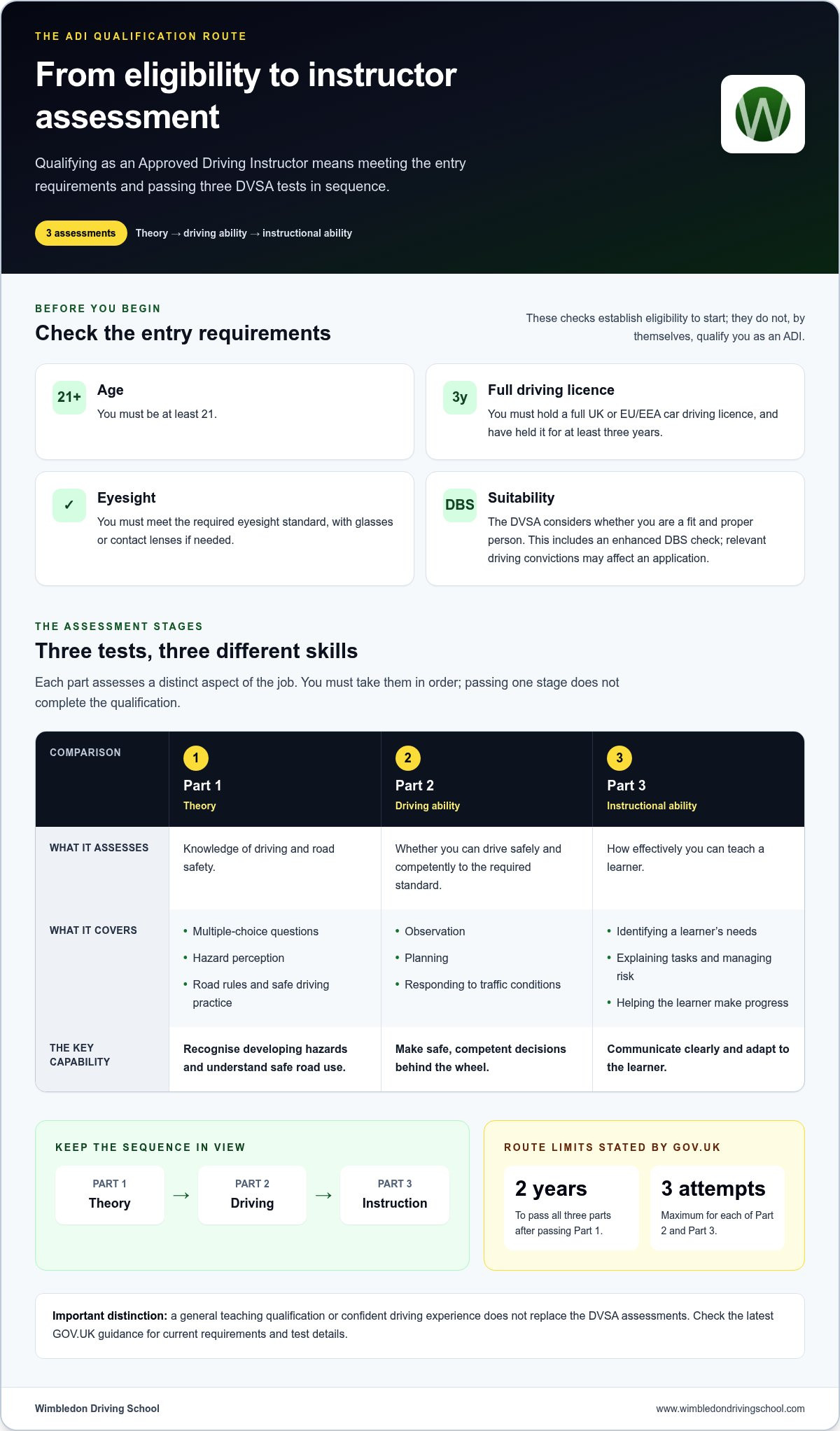
Before preparing for assessments, check that you’re eligible to begin. Current GOV.UK guidance sets out the age, licence and suitability requirements. These checks are a starting point, not proof that you’ve qualified: you must still complete the DVSA process and meet its standards.
- Age: You must be at least 21.
- Licence: You must hold a full UK or EU/EEA car driving licence and have held it for at least three years.
- Eyesight: You must meet the required eyesight standard, with glasses or contact lenses if needed.
- Suitability: The DVSA considers whether you’re a fit and proper person to be an instructor. This includes an enhanced DBS check, and relevant driving convictions may affect your application.
A conviction doesn’t necessarily mean every application receives the same outcome. The DVSA assesses suitability under its current rules, so don’t assume you’re automatically eligible or automatically disqualified based on one detail. Review the official criteria and follow the guidance for your circumstances before investing time in training.
Keep the distinction clear: meeting the age and licence conditions may let you start the route, but only completing the qualification requirements leads to ADI registration. A teaching certificate may develop useful skills, yet it isn’t a substitute for the DVSA process. Check the official requirements as you plan your next steps towards instructor training.
How the three DVSA driving instructor qualification tests work
The DVSA qualification route has three assessments, taken in order: Part 1 theory, Part 2 driving ability and Part 3 instructional ability. Each checks a different part of the job, so passing one stage doesn’t complete your qualification. In short, you must demonstrate road-safety knowledge, strong driving ability and effective instruction to qualify as an ADI.
Use the GOV.UK official guide to becoming a driving instructor to check current test details and application rules. The sequence matters: build the relevant knowledge and skills for each assessment rather than treating the process as one general driving test.
What happens in the ADI Part 1 theory test?
Part 1 assesses your knowledge of driving and road safety through a theory test with multiple-choice questions and a hazard perception section. The first tests your understanding of topics such as road rules and safe driving practice; the second assesses how well you recognise developing hazards in moving traffic.
Structured study helps you learn the principles behind the answers, not just memorise them. Use the current DVSA materials to organise revision by topic, practise hazard perception regularly and note where you hesitate or miss developing risks. Check the official test guidance for the current format, pass requirements and rules for booking another attempt, as these details matter when you plan your preparation.
What do Parts 2 and 3 assess?
Part 2 is the driving ability test. It assesses whether you can drive safely and competently to the required standard, including how you observe, plan and respond to traffic conditions. Practise identifying weaknesses in your own driving, such as late decisions at junctions or inconsistent observation, then work on them deliberately.
Part 3 assesses instructional ability. You teach a learner while an examiner observes how you identify their needs, explain tasks, manage risk and help them make progress. Strong driving alone won’t demonstrate that you can communicate clearly or adapt your approach when a learner is uncertain. Prepare to explain decisions calmly and keep the lesson focused on the learner’s development.
The DVSA’s current rules set time and attempt limits for the qualification route. GOV.UK states that you must pass all three parts within two years of passing Part 1, and that you can take Part 2 and Part 3 a maximum of three times each. Check the latest guidance before booking, and plan for the full process rather than assuming an early pass means you’re qualified.
Keep separate notes for theory topics, driving habits and teaching practice. That makes your next preparation step clear and helps you focus effort where it will make the biggest difference. If you’re considering professional preparation, you can explore Wimbledon Driving School’s ADI training.
ADI qualification requirements: common misconceptions and practical realities
Years behind the wheel can help you build confidence, but experience alone doesn’t qualify you to teach. Becoming an Approved Driving Instructor involves meeting the DVSA’s requirements and demonstrating the standards expected across its assessments. The answer to what qualifications do you need to be a driving instructor is not simply “a full licence” or “good driving skills”: you need to complete the recognised ADI route.
It also helps to separate three different things: permission to start the process, passing the DVSA assessments and holding other professional credentials. They may support your development in different ways, but they aren’t interchangeable.
| Area | What it means |
|---|---|
| Eligibility | Entry conditions set by the DVSA, including age, licence history and suitability. |
| ADI assessment | The DVSA’s qualifying tests, which assess your knowledge, driving and instructional ability. |
| Additional credentials | Advanced-driving awards can demonstrate further skills, but they don’t replace ADI registration. |
Is a teaching qualification or advanced-driving award required?
A general teaching certificate is not the same as DVSA qualification and registration as an ADI. The DVSA route assesses the specific knowledge, driving and instructional ability needed for this role; a separate general teaching qualification doesn’t stand in for those assessments. Check the latest GOV.UK guidance for driving instructor requirements for definitive information before you commit to training.
Advanced-driving awards are distinct too. They may recognise additional driving skills, but they aren’t entry requirements for ADI registration and don’t substitute for completing the DVSA process.
What can affect your route to qualification?
Your preparation needs depend on your starting point. You might be comfortable discussing road-safety principles but need more practice explaining a manoeuvre clearly, or drive confidently yet need structured revision for theory and hazard perception. Take stock of each skill separately rather than assuming strength in one area means you’re ready across the board.
Licence history and suitability questions deserve careful attention. If something in your driving record or circumstances may affect eligibility, use the current official guidance to understand the criteria rather than relying on informal advice. That gives you a clearer basis for deciding what to do next.
Timing can also vary. Test availability, your progress between assessments and the preparation you need all shape the journey. Build a realistic plan, allow room to strengthen weaker areas and avoid treating any training schedule as a guaranteed pass timeframe. Good preparation can make your next step clearer, but the assessment outcome is never certain.
How to prepare for ADI qualification and plan your next steps
Once you understand what qualifications do you need to be a driving instructor, turn the requirements into a plan you can manage alongside work and personal commitments. There’s no single preparation schedule that suits everyone. Start by identifying what you need to learn, the areas where you need practice and how much time you can set aside consistently.
Build a realistic preparation plan for each test
Work through the stages in order and keep your preparation needs separate. A simple tracker can show what you’ve covered, what still feels uncertain and what you’ll practise next.
- Check your eligibility. Review the current DVSA criteria, including licence history and suitability requirements. Resolve questions using official guidance before committing to a training plan.
- Plan your theory study. List topics that need revision and keep a separate note of hazard perception practice. Review errors to understand why you missed a point, rather than simply repeating questions.
- Assess your driving. Record habits or situations that need attention, such as observation, planning or responding calmly to changing traffic. Use feedback to choose specific areas for practice.
- Develop your teaching. Practise explaining driving tasks in clear steps, checking understanding and adapting your explanation when someone is unsure. Keep notes on where your instructions could be clearer.
- Review before booking. Check the latest DVSA test arrangements and guidance, then decide whether your preparation is ready for the next assessment.
Regular review is more useful than relying on a last-minute push. After each study session or practice opportunity, write down one thing you’ve improved and one question to revisit. This keeps your effort focused and makes it easier to spot when you need more support in a particular area.
Protect realistic study time in your week. If your work pattern changes, adjust the plan rather than trying to follow a schedule designed for someone else. Leave room for revision, practice and test arrangements, which can affect how your progress unfolds. A steady plan gives you direction without promising a fixed qualification date.
Consider the work involved after qualification
Qualifying is the start of a professional role, not just the finish line for a set of tests. Think about the kind of working pattern you want, how you’ll organise your time and the responsibilities involved in supporting learners. Instructors’ working arrangements can differ; Wimbledon Driving School discusses flexible working hours for driving instructors for candidates weighing up the career.
As you approach qualification, start considering how you’ll make the transition into teaching. Build practical habits early: keep learning, reflect on feedback and plan how you’ll manage your professional responsibilities. Your route will depend on your preparation and circumstances, so use the stages as checkpoints rather than assuming every candidate progresses at the same pace.
ADI training in South West London: turn the qualification route into a plan
Knowing what qualifications do you need to be a driving instructor gives you a clear starting point. The next step is turning the DVSA stages into a practical preparation plan that fits your skills, circumstances and career goals. Wimbledon Driving School provides ADI training for candidates across South West London, with coverage that also includes South East London, Surrey and Middlesex.
What to look for in structured ADI preparation
Useful preparation should relate directly to the three parts of the qualification route. Theory study, driving practice and instructional skills each need attention, but your starting point may differ across them. A clear plan helps you see what to work on next rather than treating all preparation as one general task.
Feedback can help turn broad concerns into specific priorities. For example, you might be confident discussing road-safety principles but need to develop how you explain them to a learner. Or you may want to focus on a driving habit that needs greater consistency. Review what is going well, identify what needs more work and use that information to guide your practice.
Wimbledon Driving School’s ADI training offers a locally relevant way to explore preparation for the qualification route. As you consider training, keep the DVSA’s assessment requirements as your reference point. The aim is to build the knowledge and skills each stage assesses, not to rely on a one-size-fits-all plan or assume that any course can guarantee a result.
Take your next step towards becoming an ADI
Make your next move straightforward: confirm that you meet the current eligibility requirements, review official DVSA guidance and decide what preparation you need for each assessment. Then consider how training could help you work towards those priorities. This gives you a clear route from initial checks to purposeful preparation without assuming that every candidate will progress at the same pace.
Choosing a local training option can also make it easier to explore the career pathway in the area where you hope to work. Wimbledon Driving School supports ADI candidates in South West London and nearby parts of the region. Its instructors include people with RoSPA Gold and IAM qualifications. These are additional credentials held by some instructors, not requirements for ADI registration or a promise of a particular test outcome.
Becoming an instructor takes commitment, but you don’t need to have every detail mapped out before you take the first practical step. Start with the eligibility checks and the stage where you need the most guidance. Build from there, keeping the official requirements and your own development priorities in view.
Take the next step towards your instructor career
Knowing what qualifications do you need to be a driving instructor is a strong start. The next step is to turn that understanding into a career plan that suits your circumstances. You don’t need to have every detail settled today. Focus on the first action you can take, then build momentum as you learn more about the route.
Wimbledon Driving School has been established since 2006 and has received ThreeBestRated’s Best Driving School in London recognition across multiple years. That experience provides a local setting to explore ADI training as you consider your next move. Training can help you work towards the required standards, but your progress will depend on your preparation and assessment outcomes.
Give yourself permission to begin with questions. A clear conversation about your goals and preparation needs can help you decide how to move forward with confidence. Your instructor career starts with one considered step.
Keep your goal in sight, stay focused on steady progress and take that first step when you’re ready.
Frequently Asked Questions
Do you need a teaching qualification to become a driving instructor?
To answer what qualifications do you need to be a driving instructor, you don’t need a separate general teaching certificate as an entry credential. You must meet DVSA eligibility rules and pass its instructor qualification process. Teaching experience may still help you explain tasks, give clear feedback and adapt your approach to a learner. Check GOV.UK guidance before enrolling, particularly if a course describes an additional certificate as essential.
Can you become a driving instructor if you have penalty points?
Penalty points don’t automatically determine whether you can qualify. The DVSA considers driving convictions as part of its suitability assessment, so the type and circumstances of an offence may matter. Don’t assume that a particular number of points guarantees either acceptance or refusal. Check the current GOV.UK criteria and provide accurate information when required, especially if you have a recent conviction or are unsure how it affects your application.
Can you teach learners while you are training to become an ADI?
You may be able to give paid instruction during training if you obtain a valid trainee driving instructor licence. GOV.UK guidance says you must have passed Part 2 and completed at least 40 hours of training with a qualified ADI before applying. The licence is optional, not automatic permission to teach after Part 2. Review the current application conditions before making plans to instruct learners.
How long does it take to qualify as a driving instructor?
There’s no fixed qualification timeframe. Your preparation needs, progress through each assessment and test availability all affect how long your route takes. You must pass all three parts within two years of passing Part 1, so plan your study and practice with that limit in mind. Allow time to strengthen weaker skills, and check current DVSA rules as you organise test bookings.
Can you qualify as an automatic driving instructor?
Yes, you can work towards instructing learners in automatic cars. The vehicle you use for an assessment and the entitlements on your driving licence may affect what you’re permitted to teach, so don’t assume an automatic qualification covers manual instruction. Check current DVSA guidance and your licence conditions when planning your training. This helps you understand the scope of instruction you can offer once qualified.
Does a driving instructor need to renew their ADI registration?
Yes. ADI registration must be renewed every four years to remain on the register. Qualified instructors also have to meet ongoing DVSA requirements, including a standards check at least once every four years. Keep track of your renewal date and read the latest official guidance as it approaches, since the requirements and application process are the most reliable basis for planning continued registration.
Can an overseas driving licence count towards ADI eligibility?
Eligibility guidance specifies a full UK or EU/EEA driving licence held for at least three years. If your licence was issued elsewhere, don’t assume that its history will meet this condition or count in the same way. Your circumstances may depend on the licence and any exchange process, so review the current GOV.UK requirements before starting ADI training or booking an assessment.
Disclaimer
This article is provided for general informational purposes only and does not constitute professional driving, legal, or safety advice. While we aim to keep our content accurate and up to date, rules, prices, and DVSA test requirements can change — always check gov.uk or contact us directly at 020 3524 7968 for the latest guidance before making any decisions. Nothing in this article guarantees a specific outcome, including passing your driving test within any stated timeframe. For current pricing, course availability, and instructor details, please visit our Prices page or get in touch.