What if the secret to securing your Grade A isn’t about performing for the examiner, but about finally letting go of the control you’ve held behind the wheel for years? You’ve spent a career building your reputation, yet the thought of a DVSA examiner sitting in the back can make even the most seasoned professional feel like a trainee again. It’s completely natural to worry about “bad habits” or the pressure of demonstrating client-centred learning under a microscope. Investing in professional adi standards check training is the most effective way to turn that anxiety into a definitive Grade A result while protecting your livelihood.
We recognise the weight of that green badge and the pressure to maintain the highest industry standards. This guide will show you how to master the 17 competencies and eliminate the risk of an automatic fail. We will explore the specific coaching techniques required for 2026 and how to transition seamlessly to a client-centred approach. You’ll learn to deliver lessons that satisfy the examiner and produce safer, more confident drivers, ensuring your registration remains secure for years to come.
Key Takeaways
- Understand the 2026 DVSA assessment criteria, including the shift towards data-driven triggers and the essential four-year renewal cycle.
- Master the 17 competencies on the SC1 form to secure a Grade A and avoid the critical risk management pitfalls that lead to an automatic fail.
- Learn how to select the most appropriate pupil and lesson topic to showcase a truly client-centred learning environment during your assessment.
- Refine your professional coaching techniques with bespoke adi standards check training to eliminate long-term habits and protect your registration.
- Transform your teaching style from traditional instruction into a high-level coaching journey that improves both your grading and pupil success rates.
Understanding the DVSA ADI Standards Check in 2026
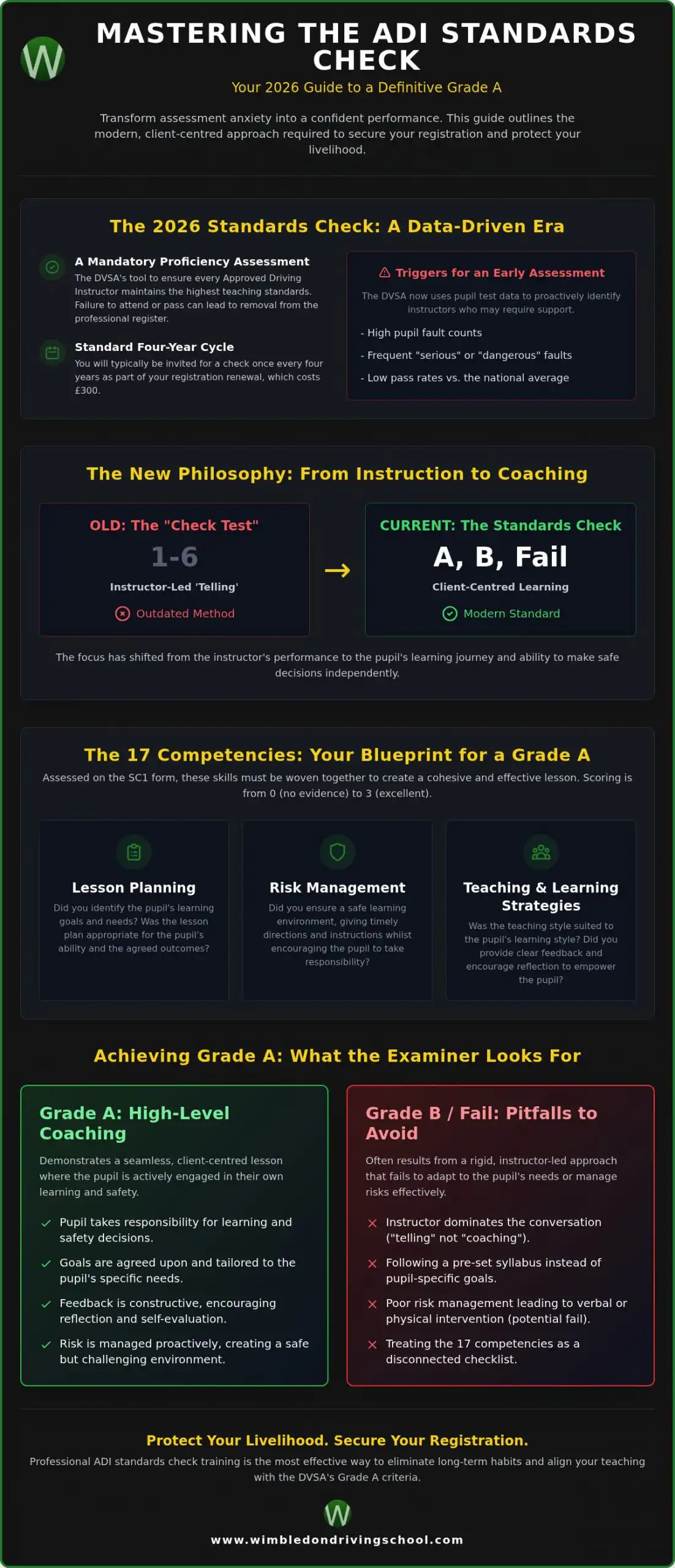
The Standards Check is the DVSA’s primary tool for ensuring every Approved Driving Instructor (ADI) maintains the highest level of teaching proficiency. It isn’t just a performance; it’s a mandatory assessment of your ability to facilitate safe, effective, and purposeful learning. Failing to attend your scheduled check or failing the assessment itself puts your livelihood at risk, as it can lead to your removal from the professional register. Maintaining your status requires more than just years of experience; it demands a commitment to current best practices.
To better understand how these assessments are structured in 2026, watch this helpful video:
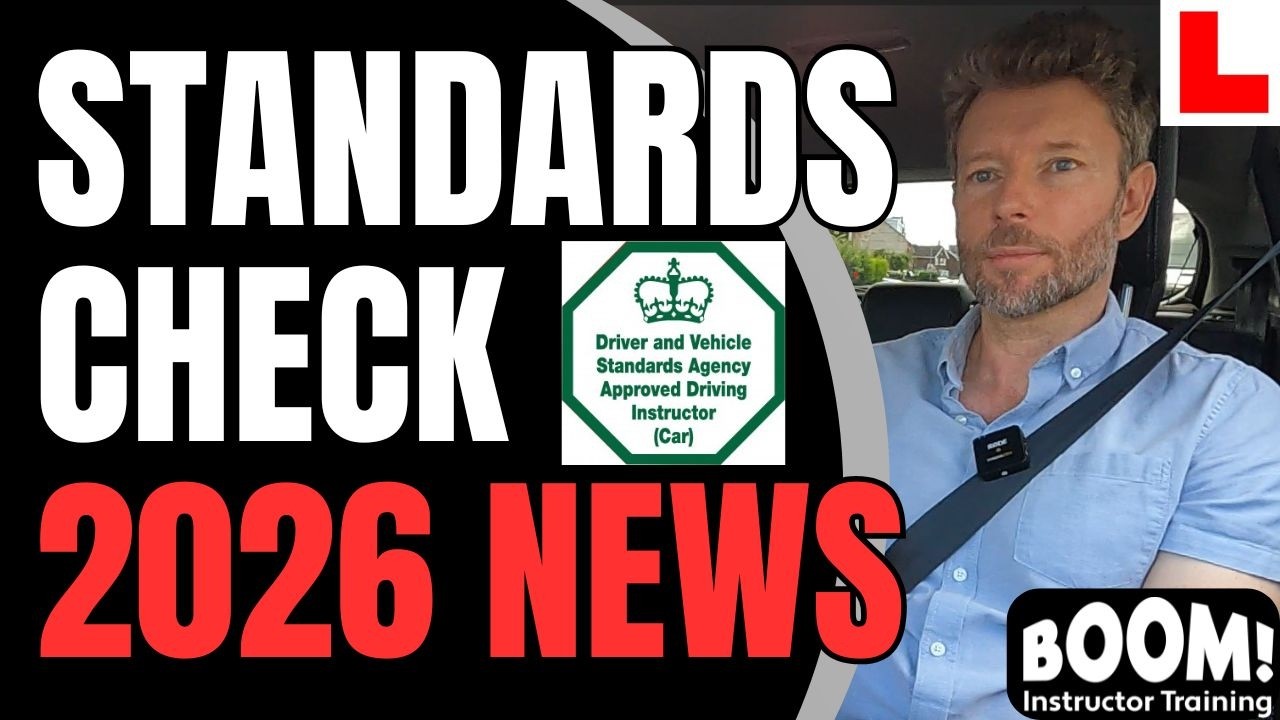
In 2026, the DVSA has significantly increased the volume of checks. They’ve moved toward a more rigorous, data-led oversight model. You’ll typically be invited once every four years as part of your registration renewal, which costs £300. However, the modern system allows the DVSA to be far more proactive than in previous years. They are no longer just waiting for your renewal date to arrive before checking your standards.
The Shift from ‘Check Test’ to Standards Check
The transition from the old “Check Test” to the current Standards Check replaced the confusing 1-6 grading system with a clearer A, B, or Fail structure. This change wasn’t just cosmetic; it reflected a total shift in teaching philosophy. The DVSA now prioritises client-centred learning over traditional, instructor-led “telling.” You’re expected to follow the National Standard for Driving and Riding, which emphasises coaching pupils to take responsibility for their own learning and safety decisions.
Triggers: Why You Might Be Called Early
The DVSA is increasingly using pupil driving test data to identify instructors who may need support. If your pupils consistently show high fault counts, or if “serious” and “dangerous” faults are frequent occurrences during their practical tests, you’re likely to receive an invitation earlier than expected. Low pass rates relative to the national average are also a major trigger for an early assessment.
Investing in professional adi standards check training is the best way to stay ahead of these triggers. Rather than waiting for a letter that suggests your performance is under scrutiny, proactive coaching helps you refine your teaching style. It ensures you’re meeting the 2026 requirements for risk management and lesson planning before the examiner ever steps into your car. Our training turns a potentially stressful event into a confident validation of your professional expertise.
The 17 Competencies: A Deep Dive into Grading
The SC1 form is the blueprint of your professional assessment. Each of the 17 competencies is evaluated on a scale of 0 to 3, where a score of 3 represents excellent evidence of that skill. However, focusing solely on ticking these boxes often leads to a disjointed lesson. The key to a Grade A is understanding how these elements weave together to create a cohesive, safe, and productive learning environment. Most instructors fail to see the pedagogy behind the form, treating it as a checklist rather than a philosophy of instruction.
Within the three main categories, Lesson Planning, Risk Management, and Teaching and Learning Strategies, the examiner looks for a narrative of progress. If you’ve spent years teaching independently, you might find that your natural style has drifted away from the specific markers the DVSA requires. Our bespoke adi standards check training helps you bridge that gap by aligning your experience with the modern SC1 criteria, ensuring your teaching is as sharp as your driving knowledge.
Lesson Planning and Risk Management
Every successful Standards Check begins with a clear, achievable goal established within the first few minutes. You must agree on this objective with your pupil, ensuring it meets their specific needs rather than following a rigid, pre-set syllabus. Risk Management is the proactive process of identifying potential hazards and ensuring the safety of the vehicle and its occupants through timely intervention whilst encouraging the pupil to take increasing responsibility.
The examiner assesses how you balance intervention with pupil autonomy. If you jump in too early, you stifle their learning; if you wait too long, you fail on safety. It’s a delicate dance that requires high-level situational awareness and the ability to adapt the lesson plan when real-world conditions change. You must demonstrate that you can manage risks in real-time without shattering your pupil’s confidence.
Teaching and Learning Strategies
Effective coaching relies on high-quality Q&A. You shouldn’t simply provide answers; you should ask questions that lead the pupil to their own realisations. This approach aligns with Level 3 of the GDE matrix, which focuses on the pupil’s self-evaluation and their personal goals for life and driving. It’s about helping them understand why they make certain choices, not just how to move the car. This deeper level of instruction is what separates a Grade A coach from a standard instructor.
Timely feedback is essential, yet it’s easy to fall into the trap of over-coaching. Your feedback should be constructive and specifically designed to encourage self-reflection. If you’re unsure how your current feedback loop compares to the Grade A standard, arranging a professional assessment of your teaching can provide the clarity you need to proceed with confidence. This allows you to refine your adi standards check training before the day of the actual test.
Grade A vs. Grade B: What the Examiner Looks For
The difference between a Grade A and a Grade B often comes down to the subtlety of your coaching. Whilst a Grade B instructor is competent, they often lean too heavily on prescriptive instructions that don’t challenge the pupil to think for themselves. To secure a Grade A, you need a score between 43 and 51 points. A Grade B requires 31 to 42 points. Anything below 31 is a fail. It’s vital to remember that regardless of your total score, you’ll automatically fail if you score 7 or less in the Risk Management category. This rule exists because the DVSA views safety as the non-negotiable foundation of all instruction.
Grade A instructors don’t just teach; they facilitate. They encourage self-discovery by allowing the pupil to take the lead in their own learning journey. If you’re aiming for that top tier, your adi standards check training should focus on refining your ability to step back and observe rather than constantly intervening with verbal instructions. Grade B instructors often play it too safe. They stick to a rigid plan even when the pupil is clearly ready for more autonomy or, conversely, when they’re struggling with a specific task.
Client-Centred Learning (CCL) Explained
CCL isn’t just a buzzword; it’s a fundamental shift in how we deliver road safety. You’re moving away from the old “tell-show-do” model toward a collaborative partnership. This involves using techniques like “scaling” to ask a pupil how confident they feel on a scale of one to ten, or using open questions to explore why a specific hazard was missed. By engaging the pupil’s critical thinking, you ensure the learning sticks long after the lesson ends. See our Learning Centre for more on modern coaching techniques that go beyond basic instruction.
Why Experienced Instructors Often Fail
Longevity in the industry can sometimes be a hurdle. Experienced instructors often suffer from the “curse of knowledge,” where they subconsciously assume a pupil understands complex concepts without explicit exploration. When the pressure of the examiner’s presence mounts, it’s easy to fall back into a comfortable “lecturing” mode. This instructor-led behaviour is exactly what the DVSA is looking to discourage in 2026. It suggests a lack of adaptability and a failure to meet the pupil’s individual needs.
Many seasoned professionals also neglect to re-evaluate the lesson goal when things go wrong. If a pupil makes a significant error, a Grade A instructor pauses to discuss it and adapts the plan. A struggling instructor might simply correct the mistake and carry on as if nothing happened. Our adi standards check training identifies these deep-seated habits. We replace them with the agile, responsive coaching styles required for a successful assessment, ensuring you remain at the top of your profession.
Preparing for Your Standards Check: A Strategic Approach
Success is built on strategic choices made weeks before the examiner steps into your vehicle. Your choice of pupil, route, and topic forms the foundation of your Grade A attempt. Professional adi standards check training often highlights that the most technically gifted instructor can still struggle if they choose a lesson that offers no room for meaningful coaching. You need a scenario that allows you to demonstrate the 17 competencies in a natural, fluid way. This isn’t just about showing what you know; it’s about showing how well you facilitate another person’s learning.
Pupil Selection and Lesson Topic
Many instructors mistakenly believe that taking a “test-ready” pupil is the safest option. This is a high-risk strategy. A pupil who is too proficient may leave you with very little to actually teach, making it difficult to score highly in the “Teaching and Learning” category. Instead, aim for a “mid-syllabus” learner. These pupils have enough skill to keep the car safe but still possess clear areas for development. Ensure they are comfortable with an observer. If they are prone to panic, they aren’t the right choice for this specific day.
Match your topic to the local environment. If you are operating in South West London, focus on complex urban junctions or busy roundabouts in Wimbledon. Avoid “boring” routes like long stretches of dual carriageway where the pupil is simply following the road for ten minutes. The examiner needs to see you identifying and managing risks whilst adapting your plan to real-time events. A route with frequent decision-making points is your best friend during the assessment.
Managing ‘Test Day’ Nerves
Your pupil’s psychology is just as important as your own. If you appear stressed, your pupil will mirror that anxiety, potentially leading to uncharacteristic mistakes. Brief them clearly. Explain that the examiner is there to watch you, not them. Maintain a professional, “business as usual” atmosphere. If the examiner remains silent, don’t over-compensate by filling the air with unnecessary chatter. Stick to your coaching plan and trust the adi standards check training you’ve received.
Your vehicle must be spotless, and your paperwork must be organised. This projects a professional image before the lesson even starts. Check your tyres, lights, and dual controls. Ensure your ADI certificate is displayed correctly. These small details contribute to the professional first impression that sets the tone for a Grade A result. If you want to ensure your preparation is flawless, book a 1-2-1 coaching session with our senior trainers today to iron out any final concerns.
Bespoke ADI Standards Check Training with Wimbledon Driving School
Our “Confident Mentor” approach to professional development recognises that even the most experienced instructors benefit from a fresh, expert perspective. We don’t just offer generic advice; our specialised adi standards check training is designed to refine your unique teaching style whilst aligning it with the DVSA’s 2026 requirements. By working with trainers who hold RoSPA Gold and IAM certifications, you gain insights from the highest tier of road safety professionals. This level of expertise ensures you aren’t just meeting the standard, you’re setting it.
We provide intensive in-car coaching sessions that offer real-time feedback on your instructional techniques. These sessions are supplemented by mock Standards Checks, which act as a simulated assessment to identify any lingering weak spots or “bad habits” before they can impact your grading. This proactive identification is the most effective way to secure your Grade A. We transform the anxiety of the unknown into a structured journey toward professional excellence, ensuring you feel entirely prepared when the examiner joins your lesson.
Local Expertise for South West London Instructors
Navigating the specific challenges of local test routes requires more than just general knowledge. We understand the unique complexities of the routes around Morden, Tolworth, and Mitcham, from difficult multi-lane roundabouts to restricted residential zones. You can view our areas we cover to see where we can conduct your local training. We offer flexible scheduling that works around your existing pupil diary, making it easier than ever to prioritise your own professional growth without disrupting your business.
The Wimbledon Driving School Advantage
Since 2006, we’ve built a network of high-performing instructors who lead the industry in pass rates and instructional quality. We don’t believe in one-size-fits-all workshops. Instead, our effective adi standards check training focuses exclusively on the specific competencies you need to improve, whether that’s risk management, lesson planning, or client-centred coaching. This bespoke approach respects your time and targets your development where it matters most for your registration.
Your green badge is your livelihood. Don’t leave your 2026 grading to chance when you can train with the premier provider in South West London and Surrey. Our legacy of success and commitment to the highest standards makes us the safest choice for your career advancement. Book your ADI Standards Check Training with the experts today and secure the Grade A your hard work deserves.
Master Your Professional Future
Your Grade A is more than just a certificate; it’s a definitive testament to your commitment to road safety and instructional excellence. By mastering the 17 competencies and embracing a truly client-centred approach, you transform the Standards Check from a daunting hurdle into a triumphant career milestone. Success in 2026 requires a proactive strategy that combines precise lesson planning with the psychological management of your pupil. Investing in professional adi standards check training ensures you’re prepared for the data-driven triggers and rigorous grading criteria of the modern DVSA landscape.
Since 2006, we’ve helped instructors across South West London and Surrey achieve their highest potential. Our RoSPA Gold and IAM certified trainers provide the sophisticated perspective needed to refine your coaching and eliminate long-term teaching habits. Don’t leave your registration to chance when you can train with the region’s premier provider. Secure Your Grade A with Expert ADI Training today. Your journey toward the highest industry standard is within reach, and we’re proud to support you in achieving this significant milestone.
Frequently Asked Questions
How long does the ADI standards check last?
The assessment lasts approximately one hour in total. This includes about 45 minutes of observed instruction with your pupil and roughly 15 minutes for the examiner to provide your grade and feedback. You should arrive at the test centre at least 15 minutes early to organise your paperwork and ensure your pupil is settled before the assessment begins. This punctuality reflects the professional standards expected of a high-level instructor.
What happens if I fail my standards check twice?
If you fail your standards check twice, you’re permitted a third and final attempt to demonstrate your competence. Should you fail this third attempt, the DVSA will remove you from the ADI register, and you’ll lose your professional licence. To avoid this outcome, many instructors seek bespoke adi standards check training after a first failure to identify and rectify specific weaknesses in their coaching style before their final attempt.
Can I take a different pupil if my original one cancels?
You can certainly take a different pupil if your original one cancels at the last minute. The only restriction is that the replacement pupil cannot be a qualified ADI or a PDI currently in training. It’s often wise to have a “backup” pupil who is comfortable with the examiner’s presence. This ensures your assessment goes ahead as planned and protects you from the logistical stress of a late cancellation.
Do I have to use my own car for the standards check?
You must use a car that meets the standard requirements for driving lessons, which is typically your own tuition vehicle. The car must be fitted with dual controls, be properly insured for the purpose of the test, and display your ADI certificate clearly. Ensuring your vehicle is clean and well-maintained is a vital part of your professional preparation, as it contributes to the examiner’s first impression of your standards.
Is the standards check the same as the ADI Part 3 test?
The standards check isn’t the same as the ADI Part 3 test, although they use the same SC1 marking form and grading criteria. Whilst the Part 3 test is the final hurdle to becoming an instructor, the standards check is a periodic assessment for qualified professionals. It’s designed to ensure you continue to meet the National Standard for Driving and Riding throughout your career, rather than just on your qualifying day.
What documents do I need to bring to the standards check?
You need to bring your current driving licence and your ADI certificate to the assessment. The examiner will also check that your vehicle is roadworthy and that you have the correct insurance in place for professional instruction. Having these documents organised in a professional folder demonstrates the high level of competence the DVSA expects from a Grade A instructor and helps you start the assessment with confidence.
Can I choose the lesson topic myself?
You have the freedom to choose the lesson topic, provided it meets the specific learning needs of your pupil on that day. A successful approach involves discussing the goals with your pupil at the start of the lesson to demonstrate client-centred learning. Selecting a topic that allows for real-time risk management is essential for a high score, as it provides more opportunities to showcase your coaching skills.
How much does ADI standards check training cost?
The cost of adi standards check training varies depending on the duration of the coaching and the expertise of the trainer. Investing in professional development is a strategic choice to protect your livelihood and your reputation. We provide bespoke 1-2-1 coaching tailored to your specific needs, focusing on the competencies required to secure your Grade A registration while ensuring you remain a leader in the competitive South West London market.
Disclaimer
This article is provided for general informational purposes only and does not constitute professional driving, legal, or safety advice. While we aim to keep our content accurate and up to date, rules, prices, and DVSA test requirements can change — always check gov.uk or contact us directly at 020 3524 7968 for the latest guidance before making any decisions. Nothing in this article guarantees a specific outcome, including passing your driving test within any stated timeframe. For current pricing, course availability, and instructor details, please visit our Prices page or get in touch.