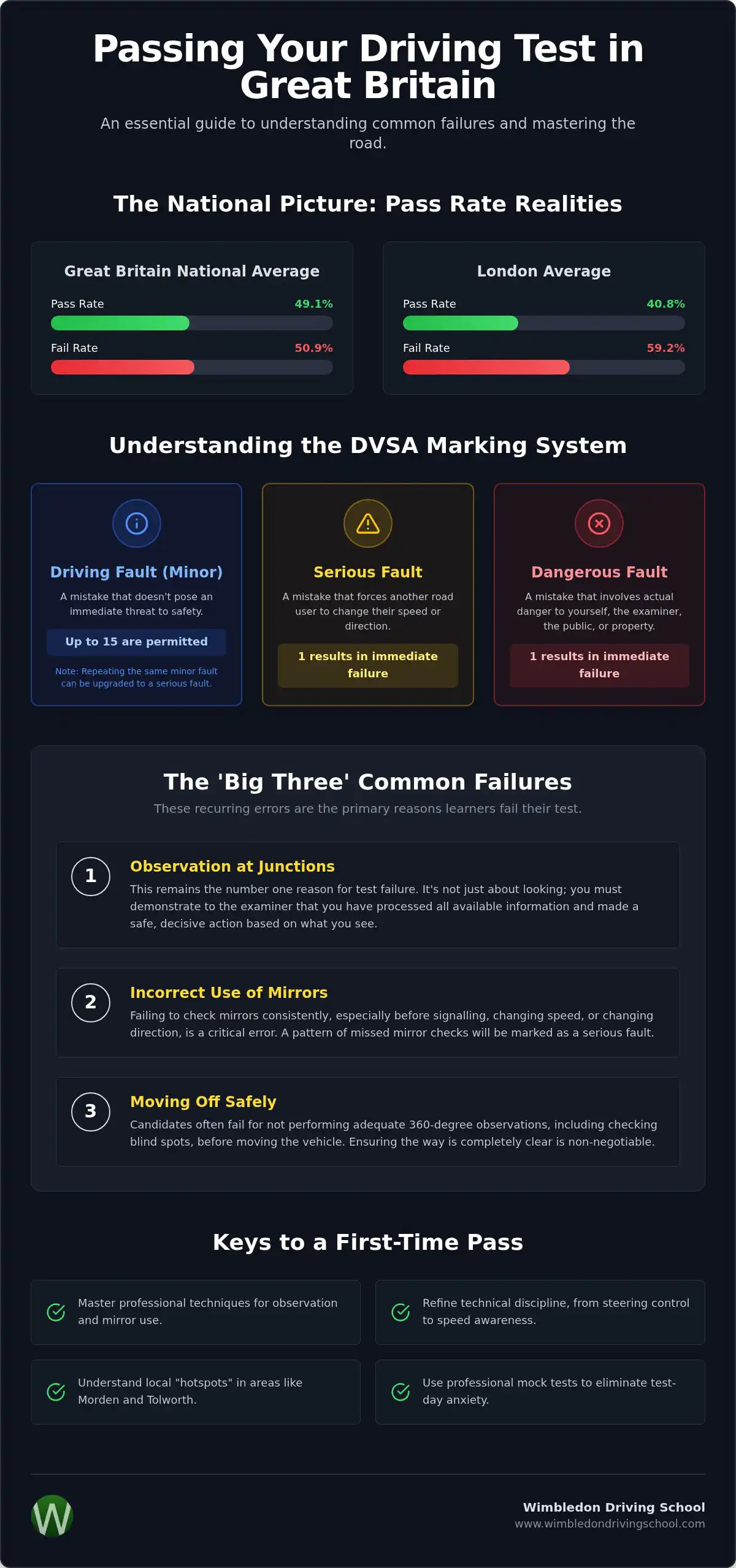
With the national pass rate currently sitting at just 49.1%, nearly half of all learners in Great Britain will walk away from the test centre without a licence this year. In London, that figure is even more challenging, as the average pass rate drops to 40.8%. It’s understandable if you feel a sense of dread when thinking about the specific demands of local routes in Morden or Tolworth. You aren’t alone in feeling confused by the fine line between a minor fault and a serious error that ends your day early. We know that common driving test failures are often the result of nerves or simple lapses in observation rather than a lack of technical skill.
You deserve to feel completely confident when you slide into the driver’s seat. In this guide, we’ll share the professional strategies our RoSPA Gold-certified instructors use to help nervous learners succeed. You’ll discover the exact reasons why candidates fail and learn how to master the “Big Three” mistakes that catch most people out. By understanding precisely what the examiner is looking for, you can transform your test day from a source of anxiety into a milestone of personal achievement. Let’s ensure you’re prepared to pass the first time.
Key Takeaways
- Understand the DVSA marking system to effectively manage the 15-fault limit and avoid the serious errors that result in immediate failure.
- Master professional techniques for observation and mirror use to overcome the most common driving test failures recorded in 2026.
- Refine your technical discipline, from steering control to speed awareness, to ensure you meet the highest industry standards for road safety.
- Gain the confidence to navigate local “hotspots” in Morden and Tolworth by learning the specific challenges of South West London’s trickiest routes.
- Discover how professional mock driving tests can eliminate test-day anxiety and prepare you for a successful first-time pass.
Understanding the DVSA Marking System: Dangerous, Serious, and Driving Faults
Modern examiners use a digital tablet-based system to record your performance in real-time. This provides instant clarity on your results, but it also means every error is logged with precision. The examiner marks each fault as they occur, ensuring a transparent and objective assessment of your skills. It’s a sophisticated process that leaves little room for ambiguity.
To succeed, you must understand how the DVSA categorises errors. The UK driving test is designed to assess your ability to drive safely and independently whilst following the Highway Code. Faults are split into three distinct levels: driving faults, serious faults, and dangerous faults. Knowing the difference between these can help you stay calm if you make a small mistake during the test.
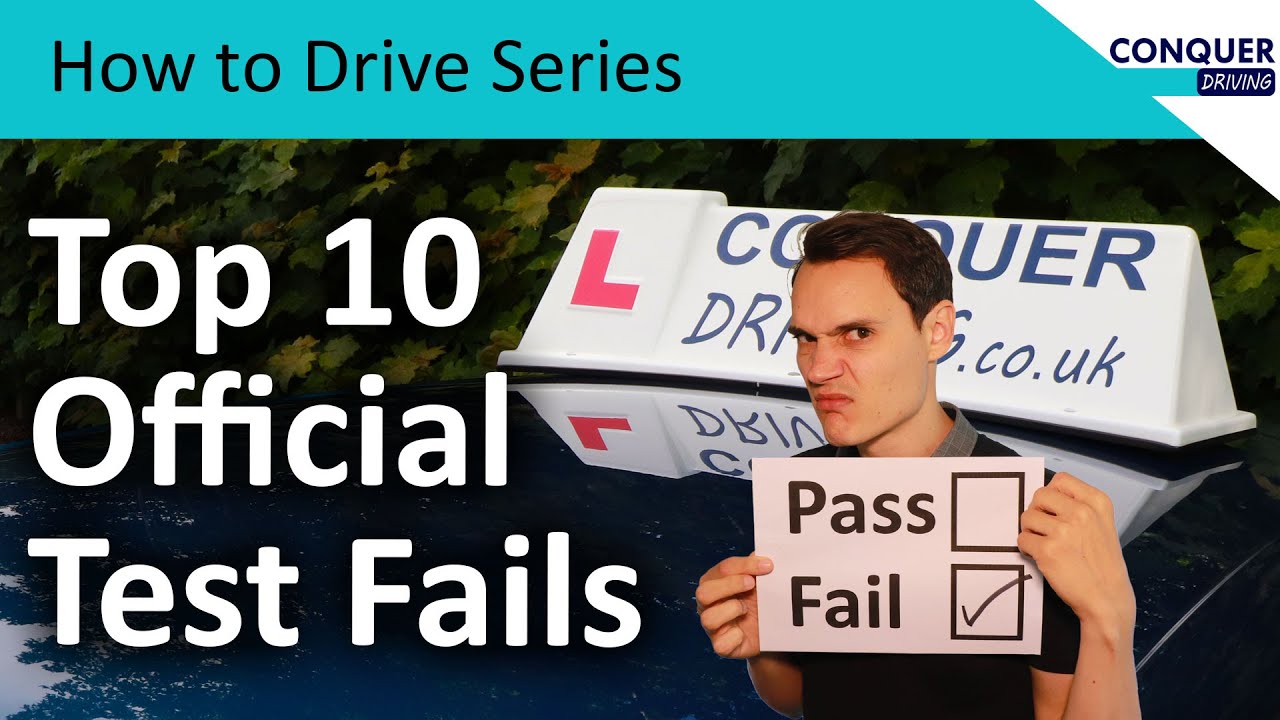
To better understand how these categories translate to real-world scenarios, watch this helpful video:
The Threshold: When Minor Mistakes Become a Major Problem
A driving fault, often called a “minor”, is a mistake that doesn’t pose an immediate threat to safety. You’re allowed up to 15 of these, yet many common driving test failures occur because a learner repeats the same minor error. This is known as a habitual fault. If you show a pattern of failing to check your mirrors before signalling, the examiner will upgrade those minors to a serious fault. Consistency is your greatest ally here. A serious fault is a mistake that forces another road user to change speed or direction. This represents a significant lapse in safety. A dangerous fault is even more critical, involving actual danger to yourself, the examiner, the public, or property. Either a serious or dangerous fault results in an immediate fail, regardless of how well you drive for the rest of the session.
Pass Rates and the Impact of Test Day Nerves
Data from the DVSA indicates that 48% of learners failed their practical assessment in June 2026. This high figure isn’t always down to poor technique. Frequently, it’s the result of test day nerves causing a sudden lapse in concentration. Anxiety can make even the most skilled driver overlook a road sign or hesitate at a junction. We see this often amongst learners who are technically ready but mentally overwhelmed. Building mental resilience is a core part of the learning centre experience at Wimbledon Driving School. Professional tuition doesn’t just teach you how to steer; it prepares your mind for the 40-minute pressure of the test environment. Understanding common driving test failures helps you visualise success and maintain focus whilst under the examiner’s watchful eye. Our instructors focus on creating a supportive atmosphere that mirrors the actual test, helping you habituate to the pressure before you even arrive at the centre.
The ‘Big Three’ Common Driving Test Failures: Junctions, Mirrors, and Moving Off
Statistics consistently highlight three recurring errors that prevent learners from gaining their full licence. These common driving test failures aren’t just about technical inability. They are often about failing to demonstrate safe habits under the scrutiny of an examiner. According to the DVSA, observation at junctions remains the primary reason for failure in Great Britain. It isn’t enough to simply turn your head; you must show the examiner that you’ve processed the information and made a safe decision based on what you see. Understanding these Top 10 reasons for failing is the first step toward securing your independence on the road.
Observations at Junctions: Why ‘Looking’ Isn’t Enough
There is a significant difference between a quick glance and effective observation. When emerging from a junction, you must accurately judge the speed and distance of approaching traffic. Roundabouts in South West London, particularly those near the Morden Test Centre, require precise judgement of vehicles approaching from the right. If you hesitate too long or pull out when a car is too close, it results in a serious fault. We teach our students the ‘Look-Wait-Look Again’ method at closed junctions. This disciplined approach ensures you never pull out into a hazard that was obscured during your first check, providing the safety margin examiners look for.
Mirror Management: Changing Direction and Speed
The ‘Mirror-Signal-Manoeuvre’ (MSM) routine is the bedrock of safe driving, and examiners expect to see it executed perfectly every time. You must check your interior mirror followed by the appropriate exterior mirror before you signal or change your path. A frequent mistake that leads to failure is checking mirrors whilst braking or already turning. Mirrors must be checked ‘well before’ any change in direction, not whilst doing it. This timing is crucial because it allows you to cancel a manoeuvre if a cyclist or another vehicle has moved into your path. Failing to check your mirrors before slowing down is another common area for serious faults, as it ignores the potential impact on following traffic.
Moving off safely is the final pillar of the ‘Big Three’. Many learners focus so much on the clutch and gears that they forget the vital blind spot check, also known as the ‘life-saver’ look. If you move away from the kerb without a full 360-degree awareness check, the examiner will mark it as a serious error. Similarly, your road positioning when turning right must be deliberate. Cutting corners or sitting too far over the centre line blocks oncoming traffic and demonstrates a lack of road discipline. Mastering these habits requires consistent practice with an expert who can identify these errors before they become ingrained. If you want to refine your technique, you can book a professional assessment with our highly qualified team to ensure you’re test-ready.
Technical Control and Road Discipline: Steering, Speed, and Markings
Beyond the ‘Big Three’ observational errors, your ability to maintain technical control of the vehicle is under constant scrutiny. Examiners look for smooth, deliberate movements that demonstrate you’re in complete command of the car. According to official DVSA data on test failures, steering and speed awareness are consistently amongst the top reasons for a result. If you over-steer on a sharp turn or fail to follow the natural curve of the kerb, it suggests a lack of fundamental control. In the narrow, hazard-rich streets of South West London, your road positioning is everything. Stopping even slightly over the line at ‘Stop’ signs or traffic lights is a clear breach of road discipline that can lead to an immediate fail.
Steering and Vehicle Control Errors
A common myth amongst learners is that crossing your hands on the steering wheel results in an automatic fail. In 2026, examiners prioritise safety and vehicle stability over rigid, old-school techniques. Whilst the ‘push-pull’ method is still recommended for maximum control, crossing your hands is acceptable as long as you maintain full authority over the car. However, mounting the pavement during a manoeuvre is an immediate serious fault. When navigating the tight side streets of Morden or Tolworth, you must maintain a steady course whilst passing parked cars. If your steering is erratic or you drift too close to the kerb, the examiner will intervene. Whilst modern vehicles often include lane-keep assist, you cannot rely on these systems during the test; the examiner needs to see your manual input and awareness of road markings. If you’re looking to refine these technical skills quickly, our intensive driving courses provide the focused practice needed to iron out these habits.
Responding Correcty to Traffic Signs and Lights
Speed awareness and sign recognition are critical components of road discipline. Driving too slowly for the conditions can be just as dangerous as exceeding the limit, as it frustrates other road users and disrupts the flow of traffic. The ‘Amber Light’ dilemma is a frequent source of common driving test failures. You should stop at an amber light unless you’ve already crossed the stop line or are so close that stopping might cause a sudden collision. Misinterpreting ‘One Way’ or ‘No Entry’ signs in complex urban environments remains a major hurdle for many. To avoid this, adopt the strategy of scanning at least two lamp posts ahead. This simple habit allows you to anticipate upcoming signage changes and adjust your speed or position well in advance. By looking further ahead, you give yourself the time needed to make calm, safe decisions that prove to the examiner you’re a competent, thinking driver.
South West London Failure Hotspots: Morden, Tolworth, and Mitcham
Passing your test in South West London requires more than just general competence. It demands an intimate understanding of specific road layouts that catch out even the most confident learners. Whilst national statistics provide a broad overview, local common driving test failures are often tied to the unique geometry of our suburban junctions. Understanding the nuances of your chosen test centre can be the difference between a pass certificate and a re-test. Local knowledge isn’t just helpful; it’s your secret weapon for navigating high-pressure environments like the Morden Hall Road roundabouts or the A3 interchanges.
At the Morden Test Centre, which has a pass rate of approximately 46% to 47.5%, candidates frequently struggle with the complex roundabouts and the busy St Helier’s area. These routes are notorious for high traffic density and rapid lane changes that require split-second decision-making. Similarly, the Tolworth Test Centre presents a different set of challenges, specifically the A3 slip roads. Entering high-speed dual carriageways requires precise acceleration and perfect mirror timing. The infamous ‘Scilly Isles’ roundabout near Tolworth is another frequent failure site due to its multi-lane entry points and deceptive exits. This is why Wimbledon Driving School’s local experts focus so heavily on these specific routes during your training.
In Mitcham and Sutton, the obstacles shift toward urban congestion. Here, you must manage heavy pedestrian activity near shopping parades and strictly enforced bus lanes. One moment of distraction in these areas can lead to a positioning fault or a serious error. Our instructors ensure you’re familiar with the specific timing of these hazards so they don’t catch you off guard on the day.
Urban Driving: Positioning and Bus Lanes
Positioning in narrow residential roads, such as those found in Wimbledon and Raynes Park, is a frequent pitfall. You must balance the need to stay left with the requirement to give adequate clearance to parked cars. Bus lanes add another layer of complexity to your test. You must read the time restrictions carefully. Failing to use a bus lane when it’s permitted can be marked as a positioning fault, whilst entering one during restricted hours is a serious breach of road discipline.
‘Yellow Box’ junctions also require immense discipline. You must only enter the box if your exit is clear, unless you’re turning right and are only prevented from doing so by oncoming traffic. Mastering these local quirks is essential for success. To ensure you’re fully prepared for these specific challenges, book a professional assessment with an instructor who knows every inch of your local test route.
The Wimbledon Way: How to Ensure a First-Time Pass
Achieving a first-time pass isn’t just about avoiding common driving test failures; it’s about mastering the mindset of a safe, independent driver. At Wimbledon Driving School, we frame your learning as a transformative journey toward a significant life milestone. Our instructors, many of whom hold elite RoSPA Gold or IAM certifications, possess a high level of proficiency that goes beyond standard tuition. They don’t just teach you to drive. They identify and rectify the “hidden” faults that examiners at centres like Morden or Tolworth are trained to spot. This professional authority creates a sense of security, ensuring you feel like the most prepared person on the road.
This commitment to excellence is shared by leading institutions globally; to see how these professional standards are applied by Seattle Driving Academy, you can read more about their curriculum.
Mock Tests: The Ultimate Reality Check
Professional mock driving tests are the cornerstone of our high success rate in South West London. These sessions simulate the exact conditions of the 2026 DVSA assessment, including the independent driving section and the pressure of examiner silence. A mock test provides a vital reality check, revealing errors you might be making unconsciously whilst under stress. By acclimatising to the 40-minute observation period, you build the mental resilience needed to stay calm on the actual day. We use these results to organise a bespoke pre-test lesson plan that targets your specific weaknesses, turning potential failures into strengths.
Fast-Track to Success: Intensive and Refresher Options
For many busy learners, an intensive driving course in London is the most effective way to consolidate knowledge. These programmes prevent “skill fade” by keeping your learning momentum high, ensuring you’re at your peak performance for the test. We also offer refresher lessons for those holding an overseas licence or anyone who has faced a previous failure. Our focus remains on building confidence alongside technical skill, particularly for nervous drivers who may find the prospect of the test overwhelming. This disciplined yet accommodating approach ensures that every student, regardless of their starting point, reaches the highest industry standard.
Before you head to the test centre, ensure you have completed this final administrative checklist to avoid an immediate cancellation:
- Provisional Licence: You must have your physical photocard licence with you.
- Theory Certificate: Keep your theory test pass certificate or at least the number handy.
- Eyesight Check: Ensure you can read a number plate from 20 metres; bring your glasses if required.
- Vehicle Requirements: Confirm your instructor’s car is clean, taxed, and meets all DVSA safety standards.
Preparation is the ultimate antidote to nerves. By combining local expertise with rigorous professional standards, we ensure you don’t just take the test; you conquer it. Take the first step toward your full licence today and experience the difference that elite instruction makes. Secure your future on the road with confidence.
Take the Final Step Toward Driving Independence
Mastery of the road requires more than technical knowledge; it demands a disciplined approach to observation and an unwavering focus on safety. By understanding the common driving test failures highlighted in this guide, you’ve already taken a significant step toward success. Remember that consistent mirror work, precise junction management, and local route familiarity are the pillars of a first-time pass. These habits don’t just help you pass a test; they ensure you remain a safe driver for life.
At Wimbledon Driving School, we specialise in transforming nervous learners into confident, licenced drivers. Our RoSPA Gold and IAM certified instructors offer a level of expertise that’s unmatched in the market, resulting in the highest pass rates in South West London. Whether you need to refine your skills on Morden’s complex roundabouts or build resilience through a professional mock test, we provide the elite guidance you deserve. We understand the unique pressures of the 2026 testing environment and adapt our instruction to meet your individual needs. For those interested in how these professional standards are applied in the transport sector globally, you can discover Dandenong Taxi Day and Night and their range of specialised vehicle solutions.
Don’t leave your success to chance. Book your first lesson with Wimbledon Driving School today and start your journey with the industry’s finest mentors. Your full licence is within reach, and we’re here to ensure you achieve it with absolute confidence.
Frequently Asked Questions
How many minor faults are allowed on the driving test in 2026?
You can make up to 15 driving faults, commonly known as minors, and still pass your practical test. However, if you commit a 16th minor fault, you will unfortunately fail. It is also vital to understand that repeating the same minor mistake multiple times can lead the examiner to upgrade it to a serious fault, resulting in an immediate failure for that category.
What is the most common reason for failing the driving test?
Inadequate observation at junctions remains the most frequent reason for failing the driving test across Great Britain. This usually involves a candidate failing to judge the speed of approaching traffic correctly or emerging when it isn’t safe to do so. Mastering effective observation is the most impactful way to avoid common driving test failures and demonstrate your competence to the examiner.
Does stalling your car result in an automatic failure?
Stalling does not result in an automatic failure provided you deal with it safely and it doesn’t happen in a dangerous location. If you stall, you should stay calm, apply the handbrake if necessary, and restart the engine whilst maintaining full observation. It only becomes a serious fault if you stall repeatedly or if the stall creates a hazard for other road users.
Can I fail my driving test for driving too slowly?
You can fail for driving too slowly if your speed is inappropriate for the road conditions and impedes the flow of traffic. Examiners expect you to make progress and drive at or near the speed limit when it’s safe. Undue hesitation at junctions or driving significantly below the limit without a clear reason, such as poor weather, is often marked as a serious fault.
What happens if I make a mistake during a manoeuvre like parallel parking?
Making a mistake during a manoeuvre isn’t an immediate fail if you recognise the error and correct it safely. You can even ask the examiner for permission to pull forward and try again if you’re out of position. However, you will fail if you mount the pavement, hit a parked car, or fail to carry out all-round observations whilst adjusting your vehicle.
How do I know if I am ready to book my practical driving test?
You’re ready for your test when you can drive independently without any verbal or physical help from your instructor. A high level of performance in a professional mock test is usually the best indicator of readiness. If you can handle complex junctions and follow sat nav directions whilst remaining calm and observant, you’ve likely reached the required standard for a first-time pass.
Are the driving test failure reasons different for automatic cars?
The core reasons for failure are nearly identical for automatic cars, as the focus remains on safety, observation, and road discipline. Whilst you won’t encounter common driving test failures related to clutch control or manual stalling, you’re still judged on the same strict criteria for mirror use and junction safety. The examiner’s expectations for hazard perception and vehicle positioning remain exactly the same.
What should I do if I fail my driving test?
If you fail, you must wait at least 10 working days before you can take another practical test. Use the feedback provided on your digital results form to identify the specific areas that need improvement. Focus your next few lessons on those specific faults to ensure you’re fully prepared. Remember that in 2026, you must manage your own booking, as third-party services are no longer allowed to book on your behalf.
Disclaimer
This article is provided for general informational purposes only and does not constitute professional driving, legal, or safety advice. While we aim to keep our content accurate and up to date, rules, prices, and DVSA test requirements can change — always check gov.uk or contact us directly at 020 3524 7968 for the latest guidance before making any decisions. Nothing in this article guarantees a specific outcome, including passing your driving test within any stated timeframe. For current pricing, course availability, and instructor details, please visit our Prices page or get in touch.