What if the biggest obstacle to your driving licence isn’t your coordination, but simply the way you’re being taught? For many, the thought of tackling London’s complex junctions and high-speed roundabouts feels like a recipe for sensory overload. If you’ve struggled with spatial awareness or left-right confusion, you’ve likely felt the frustration of standard instruction that doesn’t account for how your brain processes movement. Securing the right driving lessons for people with dyspraxia London has to offer is about more than just passing a test; it’s about gaining the freedom you deserve without the burnout of traditional methods.
We understand that your journey is unique. You need a mentor who replaces pressure with patience and breaks down complex manoeuvres into manageable, logical steps. This 2026 success guide reveals how specialist techniques and modern vehicle choices can reduce your cognitive load and build genuine confidence. You’ll discover how to leverage test accommodations, why automatic cars are often the superior choice for neurodiverse learners, and how our expert instructors use their local knowledge of South West London test routes to ensure you’re prepared. Let’s turn your driving goals into a tangible achievement.
Key Takeaways
- Understand how spatial awareness impacts lane positioning and learn specific strategies to navigate London’s busiest junctions with total control.
- Discover why opting for automatic driving lessons for people with dyspraxia London helps reduce cognitive load, allowing you to focus entirely on road safety rather than gear changes.
- Identify the value of elite instruction by seeking out mentors with RoSPA Gold or IAM certifications, ensuring you receive the highest standard of professional support.
- Master practical techniques like ‘Commentary Driving’ to break down complex manoeuvres into manageable, repeatable micro-steps that build lasting muscle memory.
- Learn how a structured, patient approach tailored to your pace can transform the challenge of driving into a proud milestone of personal independence.
Understanding Dyspraxia and the Challenge of Driving in London
Dyspraxia, or Understanding Dyspraxia as it is formally known, is a condition that affects physical coordination and makes everyday tasks feel like a complex puzzle. When you’re behind the wheel, this often translates to difficulty with fine motor skills, such as smooth pedal control or precise steering. For those seeking driving lessons for people with dyspraxia london, the first step is recognising that your brain simply processes spatial information differently. It isn’t a lack of ability; it’s a difference in wiring that requires a specific, tailored approach to instruction.
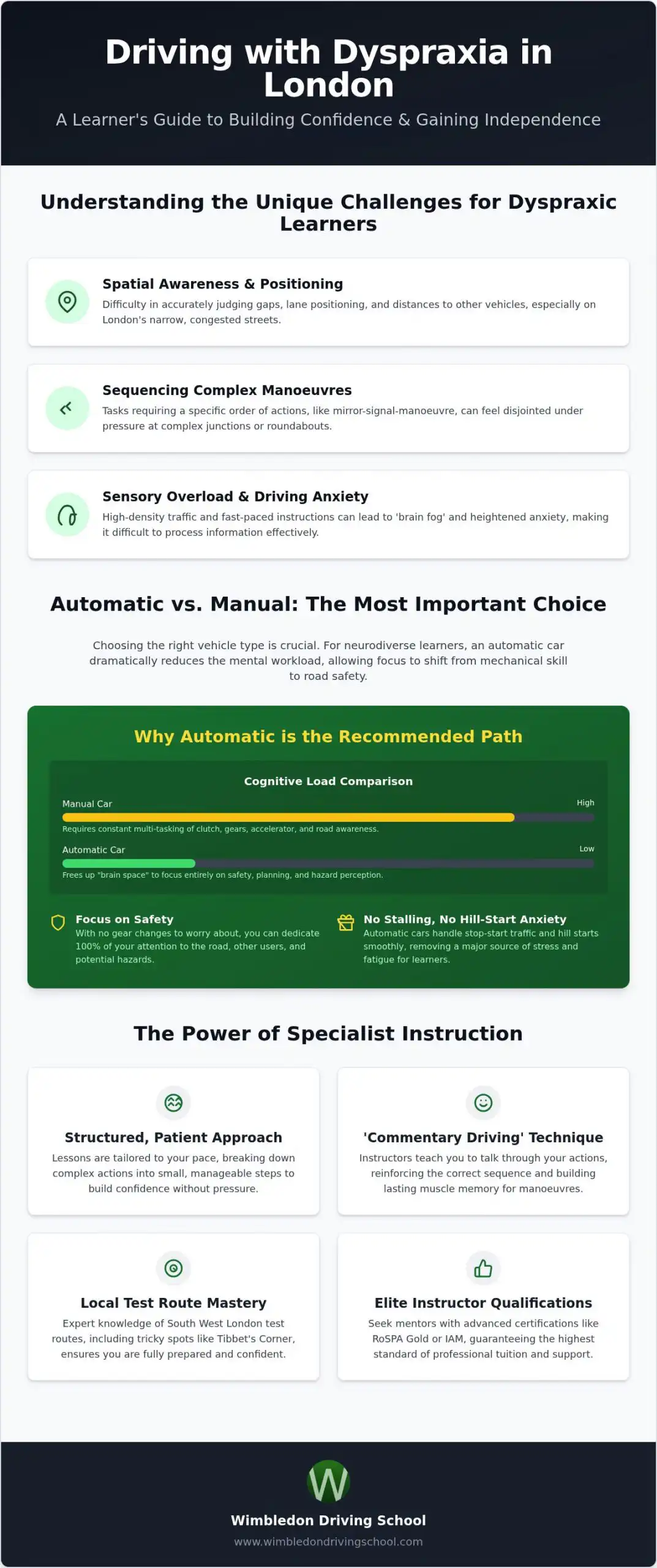
London presents a unique theatre of challenges that can heighten these difficulties. High-density traffic and narrow Victorian streets demand constant, minute adjustments to your lane positioning. If you struggle with spatial awareness, judging the gap between your wing mirror and a parked car in Putney or Wimbledon can feel overwhelming. This increased cognitive load is exactly why specialist instruction is vital. We move you away from the ‘I can’t do this’ mindset by creating a structured learning journey that respects your pace and builds your skills incrementally.
Spatial Awareness and Sequencing on London Roads
Effective driving requires rapid sequencing. You must mirror, signal, and manoeuvre in a fluid, almost instinctive motion. For a dyspraxic learner, this ‘chain’ of actions can break down under pressure. Merging onto a fast-moving road requires you to judge the speed and distance of others whilst simultaneously managing your own vehicle’s controls. Complex London landmarks, such as the Tibbet’s Corner roundabout, require extra preparation because they demand multiple decisions in seconds. We focus on pre-visualising these routes to reduce the surprise factor and give you the ‘brain space’ needed to react safely.
The Emotional Journey: Managing ‘Driving Anxiety’
It’s common to experience ‘brain fog’ when a standard instructor gives orders too quickly. This sensory overload leads to frustration and a feeling that progress has stalled. London drivers are often impatient, and their aggressive behaviour can heighten your anxiety if you feel you’re holding up the flow. Our approach centres on building resilience against these external pressures. We act as a ‘Confident Mentor’, providing a calm environment where you can process instructions without feeling rushed. You aren’t just learning a mechanical skill; you’re embarking on a transformative journey toward independence. You can find more advice on managing these challenges in our learning centre.
Automatic vs Manual: Making the Right Choice for Dyspraxia
Choosing between a manual and automatic gearbox is perhaps the most significant decision you’ll make when starting driving lessons for people with dyspraxia london. While the traditional route has often been manual, modern learners are increasingly recognising that the mechanical simplicity of an automatic car aligns perfectly with neurodivergent learning styles. According to DVLA guidelines, you aren’t required to notify them of your dyspraxia unless it significantly affects your safe control of the vehicle. Opting for an automatic is a proactive way to ensure that control remains precise and stress-free.
At the heart of this choice is Cognitive Load Theory. In a manual car, your brain must constantly manage the coordination of the clutch, gear stick, and accelerator whilst simultaneously scanning for hazards. For a dyspraxic driver, this multi-tasking can lead to rapid mental fatigue. By removing the clutch, you free up vital “brain space” to focus entirely on road positioning and safety. It’s about working smarter, not harder, to achieve your goal of independence.
The Benefits of Learning in an Automatic Car
London’s unique topography and traffic patterns make automatic vehicles particularly advantageous. If you’re navigating the stop-start congestion of South West London or pulling away on one of the capital’s many hills, the lack of a clutch pedal eliminates the risk of stalling. This reduces the physical fatigue that often plagues longer lessons, allowing you to maintain focus throughout the session. Looking ahead, the UK’s move toward electric vehicles and the 2035 ban on new petrol and diesel cars means that automatic driving is becoming the industry standard. You can explore our specific Automatic Driving Lessons to see how this transition supports your journey.
When to Persist with Manual Lessons
Some learners still prefer the challenge of a manual gearbox, perhaps for specific career requirements or a personal sense of achievement. If you choose this path, success relies on breaking down gear sequencing into repeatable patterns. We often recommend intensive driving courses for manual learners with dyspraxia. The higher frequency of lessons helps build muscle memory faster, preventing the “reset” that can occur with weekly tuition. Whether you opt for the simplicity of an automatic or the engagement of a manual, the goal remains the same: safe, independent travel. If you’re unsure which vehicle suits your coordination style, you can book an initial assessment with one of our specialists to find your perfect fit.
Finding the Best Specialist Driving Instructor in London
Success on the road depends heavily on the quality of your mentorship. When searching for driving lessons for people with dyspraxia london, you shouldn’t settle for a standard instructor. You need a professional who holds a high ADI (Approved Driving Instructor) grade, preferably Grade A, which indicates a superior ability to adapt teaching styles to the pupil’s needs. Many of our instructors hold RoSPA Gold or IAM (Institute of Advanced Motorists) certifications. These accolades aren’t just badges; they represent an elite level of instructional skill and a commitment to safety that goes far beyond the basic requirements.
Finding a mentor who understands neurodiversity is about more than just patience. It’s about finding someone who can translate complex mechanical actions into a language that works for you. Before you commit to a long-term course, it’s vital to vet your potential instructor with specific questions:
- How do you adapt your teaching for learners with spatial awareness challenges?
- Do you have experience helping students manage left-right confusion?
- Are you comfortable breaking down manoeuvres into smaller, repeatable steps?
A confident mentor will welcome these questions, as they demonstrate your commitment to a structured, professional learning journey.
Vetting Your Instructor for Patience and Adaptability
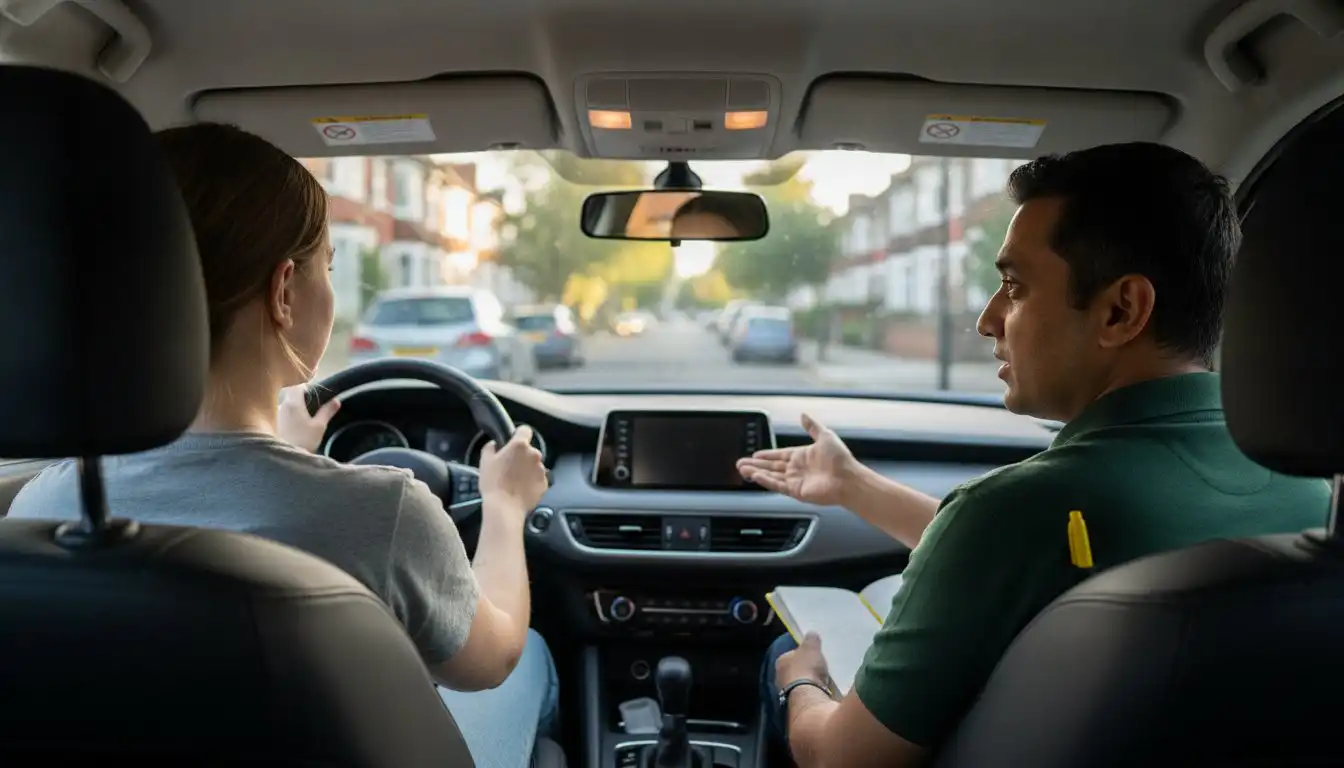
A specialist mentor understands that dyspraxic learners often require a multi-sensory approach. Ask if your instructor uses visual aids, tablets, or physical diagrams to illustrate complex junctions. It’s also worth discussing lesson frequency. Shorter, more frequent sessions can often be more effective than two-hour blocks, as they help prevent the mental fatigue that leads to sensory overload. We frequently utilise ‘Commentary Driving’, a technique where you vocalise your observations and planned actions. This process helps reinforce sequencing and ensures that the mirror-signal-manoeuvre routine becomes second nature.
The Advantage of Local Expertise in South West London
London’s test centres each have their own unique challenges. Whether you’re heading to Morden, Tolworth, or Mitcham, having an instructor who knows every ‘quirk’ of the local test routes is invaluable. They can identify the specific roundabouts where lane positioning is most difficult and help you prepare through tailored mock driving tests. This local knowledge reduces the surprise factor on test day, allowing you to focus on your performance with total confidence. Explore the Areas We Cover to find a specialist who knows your local test routes inside out.
Practical Strategies for Success on the Road
Overcoming coordination challenges during your driving lessons for people with dyspraxia london requires a specialised toolbox of actionable strategies. We move beyond basic instruction by implementing techniques that specifically address sequencing and spatial awareness. One of the most effective methods is ‘Commentary Driving’. By vocalising every action—such as saying “I am checking my interior mirror, signalling left, and slowing down for the junction”—you reinforce the neural pathways required for complex tasks. This verbal loop prevents the ‘sequence breaks’ that often occur when a learner feels overwhelmed by the pace of London traffic.
We also utilise the ‘Micro-Step’ approach. Instead of attempting a complete manoeuvre like a parallel park in one go, we break it down into tiny, repeatable segments. You might spend a portion of your lesson simply mastering the initial alignment before moving on to the steering lock. This method ensures that each component becomes part of your muscle memory, reducing the cognitive load on your brain when you eventually combine them into a single, fluid motion.
Visual Aids and Multi-Sensory Learning
In addition to practical driving drills, improving your general physical coordination at a premium fitness centre like Gym n Go Forest Hill can be a valuable way to build the core strength and stamina required for longer sessions behind the wheel.
Similarly, focusing on your fine motor skills through private sessions with master physio-Pilates instructors at pilatesvita.com can provide the targeted coordination training that directly benefits your steering and pedal control.
Our instructors utilise 2026-standard visual tools to bridge the gap between theory and physical execution. Before you even turn the key, we use iPad apps and 3D diagrams to help you visualise spatial relationships at complex junctions. This pre-visualisation is a cornerstone of the ‘Over-Learning’ method, where we repeat successful actions until they become automatic. Some learners find it helpful to use subtle ‘left’ and ‘right’ markers on the dashboard or colour-coded stickers to distinguish between controls. These small, practical adjustments provide immediate physical cues that bypass the frustration of left-right confusion.
Leveraging 2026 Car Technology
Modern vehicle technology has become a transformative ally for dyspraxic drivers. In 2026, many of our training vehicles are equipped with 360-degree cameras and advanced lane-keep assist systems. These features act as a safety net, helping you maintain perfect lane positioning even when your spatial awareness feels taxed.
- Heads-Up Displays (HUDs): Projecting speed and navigation directly onto the windscreen ensures your eyes stay on the road.
- Blind-Spot Monitoring: Provides an audible or visual alert when vehicles are in your periphery, assisting those with limited peripheral awareness.
- Parking Sensors: These are a dyspraxic learner’s best friend, providing clear, rhythmic feedback that simplifies the most daunting manoeuvres.
By integrating these technologies, we ensure you feel supported at every stage of your development. If you are ready to apply these strategies in a real-world setting, secure your initial assessment with one of our specialist mentors today.
Why Wimbledon Driving School is the Premier Choice for Dyspraxic Learners
Wimbledon Driving School stands as a beacon of excellence for those navigating the complexities of neurodiversity behind the wheel. We don’t just provide standard instruction; we offer a transformative journey led by a “Confident Mentor.” Our team consists of elite professionals, many of whom hold RoSPA Gold and IAM certifications. This level of expertise ensures that your driving lessons for people with dyspraxia london are delivered with a precision and empathy that standard schools simply cannot match. We’ve built our reputation on achieving high pass rates across South West London test centres, specifically for learners who require a more nuanced, patient approach to master the road.
Our instructors are serious about safety and rigorous requirements. However, they remain deeply empathetic to the logistical and emotional needs of a modern learner. We understand that dyspraxia affects everyone differently. Whether you struggle with the physical coordination of a manual car or the spatial awareness required for London’s narrow streets, we adapt our curriculum to fit you. This student-centric philosophy has established us as a premier provider in a competitive market, making us the safest and most effective choice for your education.
Tailored Intensive and Block Booking Options
Consistency is the primary ally of coordination. To help you build and maintain vital momentum, we offer specialised Intensive Courses. These programmes condense the learning process, ensuring that the skills you acquire on Monday are reinforced by Tuesday. This prevents the “skill fade” that often hampers traditional weekly tuition for neurodivergent students. For those who prefer a steadier, long-term approach, our Block Bookings provide both a financial benefit and a structured commitment to your success. We work with you to create a bespoke schedule that respects your energy levels, preventing the sensory burnout that can occur in high-pressure traffic environments.
Your Journey Starts Here
At Wimbledon Driving School, we specialise in turning the stress of the road into a skill for life. We understand the unique challenges you face, from spatial awareness to sequencing. Our goal is to guide you toward a proud milestone of personal independence. Your journey begins with a comprehensive assessment lesson. This session allows you to meet your specialist instructor and experience our adaptive teaching style firsthand. Don’t let coordination challenges hold you back from the freedom you deserve. Secure your place with London’s premier provider and take the first step toward gaining your licence with total confidence.
Master the London Roads with Confidence
Gaining your driving licence is a transformative milestone that offers unparalleled freedom. By choosing specialist driving lessons for people with dyspraxia london, you’re opting for a method that respects your unique learning style. We’ve explored how reducing cognitive load through automatic vehicles and mastering sequencing with commentary driving can turn a daunting challenge into a manageable, rewarding journey. You don’t have to face London’s traffic alone when you have an elite mentor by your side.
Wimbledon Driving School is proud to be voted the Best Driving School in South West London. Our instructors hold prestigious RoSPA Gold and IAM certifications, ensuring you receive the highest standard of professional tuition. With the highest pass rates in London, we provide the security and prestige you need to feel safe behind the wheel. We’re ready to help you overcome coordination hurdles and achieve your goals at a pace that prevents burnout. The road to independence is open; let’s navigate it together.
Book Your Specialist Dyspraxia Driving Lesson in London Today and take the first step toward a lifetime of safe, confident driving.
Frequently Asked Questions
Can I get extra time for my driving theory test if I have dyspraxia?
Yes, you can request reasonable adjustments for your theory test, including extra time and a headset to listen to the questions. You must provide evidence of your needs, such as a letter from a doctor or a diagnostic report, when booking your appointment. This support ensures you can process information at your own pace without the pressure of the standard time limit, making this first milestone of your driving journey more accessible.
Should I tell the DVLA that I have dyspraxia before I start lessons?
You aren’t legally required to notify the DVLA of your dyspraxia unless the condition significantly affects your ability to drive safely. Most learners find that with the right instruction, their coordination challenges don’t constitute a reportable medical condition. However, it’s vital to be honest with yourself and your mentor. If you’re in doubt, consulting your GP before starting driving lessons for people with dyspraxia london is a sensible, professional step to take.
Is it harder for people with dyspraxia to pass the driving test?
Passing the test may require more preparation, but it isn’t inherently harder when you have specialist support. While the national pass rate was 50.0% in the year ending March 2026, success depends on your individual resilience and the quality of your tuition. By focusing on muscle memory and using modern vehicle technology, you can achieve the same standard of safety and proficiency as any other driver on the road today.
Which is better for dyspraxia: manual or automatic driving lessons?
Automatic lessons are generally the superior choice for learners with coordination challenges. By removing the need to manage a clutch and gear stick, you significantly reduce your cognitive load. This allows you to dedicate your full attention to road positioning and hazard perception, which are critical in busy London traffic. Most students find that learning in an automatic car accelerates their progress and builds confidence much faster than the manual alternative.
How many driving lessons does a person with dyspraxia typically need?
The DVSA recommends an average of 45 hours of professional tuition and 22 hours of private practice. For those with dyspraxia, you might find that you require additional hours to ensure manoeuvres become instinctive. There is no correct number; the focus should be on reaching a level of safety where you feel confident. Our instructors prioritise a pace that prevents burnout, ensuring every hour spent behind the wheel is productive and encouraging.
Are there specialist driving test centres in London for disabilities?
There are no specific disability only test centres, but all DVSA examiners are trained to accommodate candidates with additional needs. You can request that the examiner uses hand signals alongside verbal directions to assist with left-right confusion. We often recommend test centres like Morden or Tolworth for our South West London learners, as our instructors have extensive local knowledge of the specific routes and challenges you’ll face during your practical assessment.
Can I use my own car for driving lessons if it has specific adaptations?
You can use your own vehicle for lessons, provided it’s properly insured and meets DVSA requirements for the test. If your car has specific adaptations, such as steering aids or modified pedals, learning in that environment can be highly beneficial for building consistent muscle memory. However, most students prefer using our dual-controlled cars for safety during the initial stages of their driving lessons for people with dyspraxia london to ensure total peace of mind.
What happens if I struggle with left and right directions during the test?
Struggling with directions won’t cause you to fail the test, as long as your driving remains safe. You should inform your examiner about your dyspraxia before the test begins. They can then provide clear hand gestures to supplement their verbal instructions, helping you navigate junctions without the stress of immediate left-right processing. This simple adjustment allows you to focus on your technical skills and road safety, which are the primary areas being assessed.
Disclaimer
This article is provided for general informational purposes only and does not constitute professional driving, legal, or safety advice. While we aim to keep our content accurate and up to date, rules, prices, and DVSA test requirements can change — always check gov.uk or contact us directly at 020 3524 7968 for the latest guidance before making any decisions. Nothing in this article guarantees a specific outcome, including passing your driving test within any stated timeframe. For current pricing, course availability, and instructor details, please visit our Prices page or get in touch.