The driving theory test pass mark 2026 has two separate thresholds, not one combined score. For the car test, you need at least 43 out of 50 in the multiple-choice section and 44 out of 75 in hazard perception. Passing one part won’t make up for falling short in the other.
If you’ve been revising hard, it’s understandable to worry that one tricky section could undo your preparation. The key is to know how each part is assessed and practise both, rather than relying on a strong score in just one.
This guide explains the pass marks, how the multiple-choice questions and hazard-perception clips are scored, and what happens if you don’t meet both thresholds. You’ll also learn what the 2026 CPR and AED questions mean for the test, whether the format or pass marks have changed, and how passing fits into your next steps towards the practical driving test. With a clear plan for each section, you can focus your revision and approach test day with greater confidence.
Key Takeaways
- Understand why the driving theory test pass mark 2026 requires you to meet each component’s threshold separately.
- See how multiple-choice questions and hazard-perception clips assess different skills, so you can target your revision.
- Use mock-test results to spot weaker areas and plan your next revision session.
- Check that your practice materials reflect the current test format, including updated road-safety content.
- Know how passing theory fits into your journey towards practical lessons and your driving test.
Driving theory test pass mark 2026: the short answer
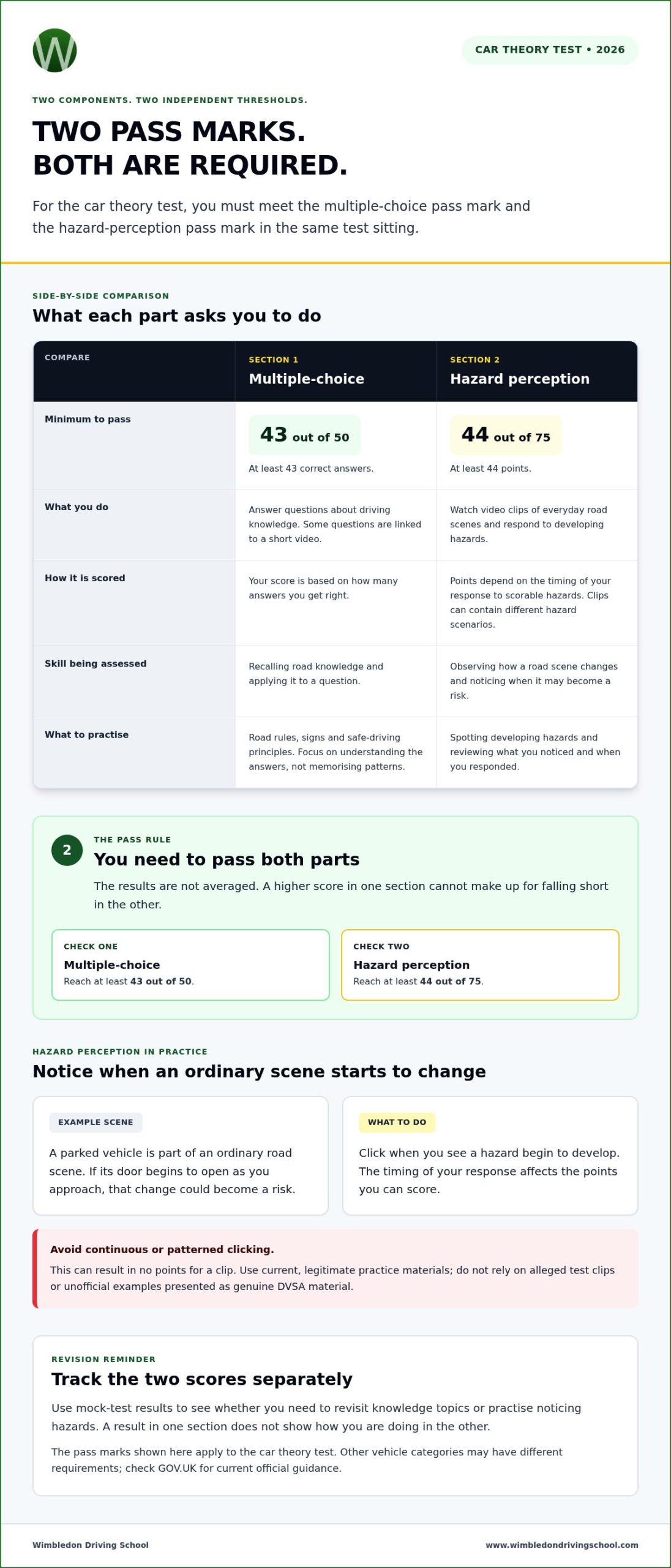
For the car theory test in 2026, you need at least 43 correct answers out of 50 in the multiple-choice section and 44 points out of 75 in hazard perception. GOV.UK lists these as separate pass requirements, so you must reach both thresholds in the same test sitting. Your results aren’t averaged, and a higher score in one part can’t make up for a lower score in the other.
These thresholds apply to the car test. Different vehicle categories may have different requirements, so check the relevant GOV.UK guidance if you’re taking another type of theory test.
Each component checks a different part of your road-safety knowledge. Treat them as two goals in your preparation, rather than aiming for one overall mark. That makes it easier to assess your readiness and see where your revision needs more attention.
The multiple-choice pass mark for the car theory test
You need to answer at least 43 of the 50 multiple-choice questions correctly. Your result is based on how many answers you get right: each correct answer counts towards the threshold, while an incorrect answer does not.
Use 43 as the minimum, not as a reason to neglect any topic. Your multiple-choice result stands on its own, so even a high score here won’t compensate if you fall short in hazard perception. GOV.UK’s current car theory test guidance sets out the official pass mark and test details.
The hazard-perception pass mark
For hazard perception, you need at least 44 points out of a possible 75. This score is separate from your multiple-choice result, with its own pass threshold. You must meet it as well as the multiple-choice requirement to pass the car theory test.
Hazard perception focuses on recognising developing hazards in road scenes, rather than recalling the rules tested by multiple-choice questions. Give this skill dedicated practice and review how you respond to hazards, not just your overall mock-test result. For focused guidance, use these hazard perception test practice tips.
Keep the two scores separate when you review practice results. If one component is consistently below its threshold, focus your revision there while continuing to practise the other skill. The aim is to be ready for both parts, not to depend on one strong result to carry the other.
The theory test is one step in the wider process of learning to drive. For background on how it fits into the United Kingdom driving test, you can read this general overview. Use GOV.UK for current official pass marks and test guidance.
How the two driving theory test components are assessed
The car theory test assesses road knowledge and hazard awareness in different ways. In the multiple-choice section, you select answers to questions. In hazard perception, you watch road scenes and respond to developing risks. Keeping these abilities distinct in your revision helps you see which one needs more attention.
| Component | Task | Scoring approach | What to practise |
|---|---|---|---|
| Multiple-choice | Answer questions about driving knowledge, including questions linked to a short video. | Your score is based on the number of correct answers. | Understanding road rules, signs and safe-driving principles, then applying them to questions. |
| Hazard perception | Watch video clips of everyday road scenes and respond to developing hazards. | Points depend on the timing of your response to scorable hazards. Clips can contain different hazard scenarios. | Observing how a situation changes and recognising when it may become a risk. |
For current details on how the components are assessed, refer to the official GOV.UK theory test guidance. When you review practice results, record each component separately. This shows whether you need to revisit knowledge topics or work on noticing hazards sooner.
Keep the results separate: knowing what the rules say and recognising a developing hazard test different skills. Progress in one doesn’t show how you’re doing in the other.
What the multiple-choice section measures
The questions assess your understanding of the knowledge that supports safe road use, including rules and signs. You read a question, consider the options and choose the answer that best fits. This calls for recall and judgement. Hazard perception is different: you watch a changing scene and judge whether a situation is developing into a risk.
Use practice questions to find topics that need another look, rather than memorising answer patterns without understanding them. These common driving theory test questions offer examples of the question style. Treat them as a way to test your knowledge, not as a prediction of the exact questions you’ll receive.
What the hazard-perception section measures
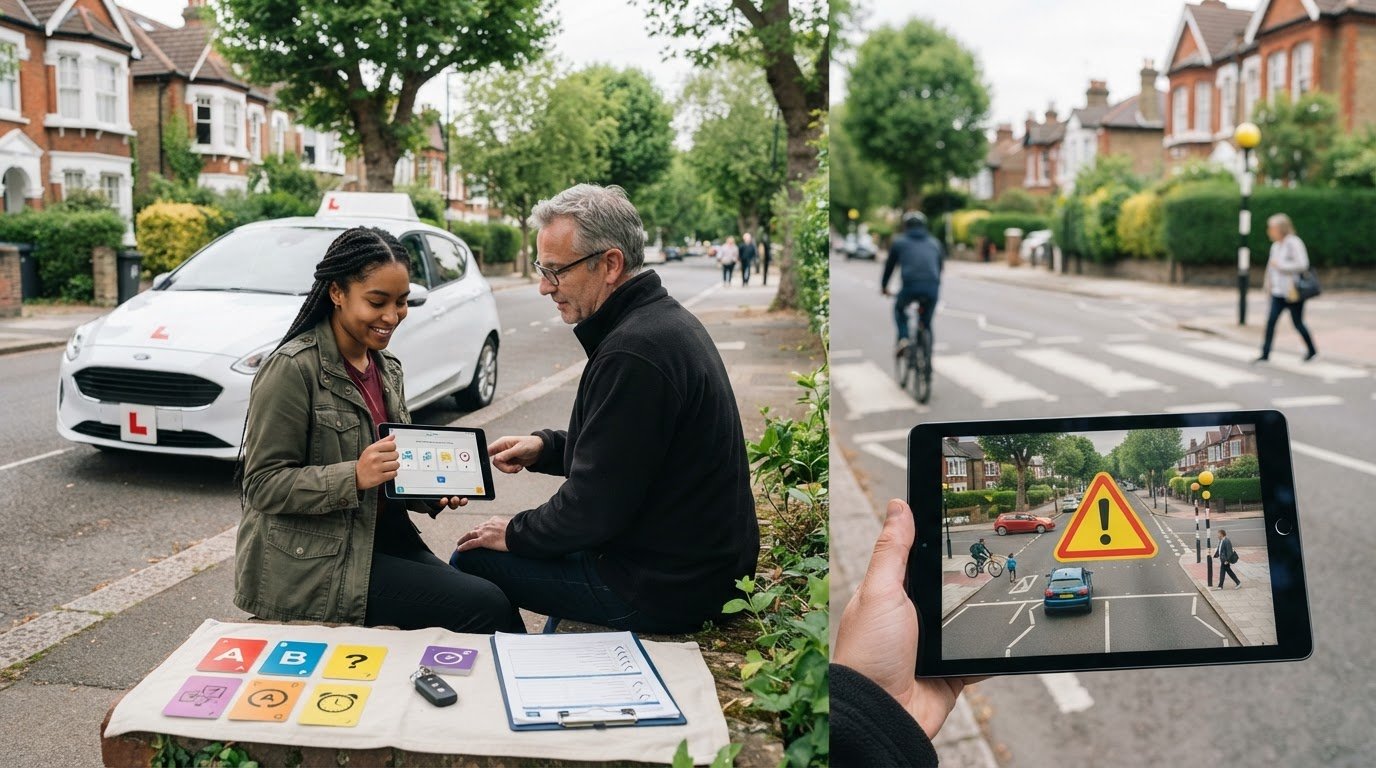
A developing hazard is a situation that may require you to change speed or direction. For example, a parked vehicle is part of an ordinary road scene. If its door begins to open as you approach, that change could become a risk. The skill is noticing when a scene shifts from routine to something that may affect your progress.
During the clips, click when you see a hazard begin to develop. Scoring depends on response timing, and continuous or patterned clicking can result in no points for a clip. Use current, legitimate practice materials to understand the task. Don’t rely on alleged test clips or unofficial examples presented as genuine DVSA material.
After practice, review what you noticed and when you responded. This can help you distinguish a gap in observation from a lack of familiarity with a particular road scene.
Does a high score offset a lower score in another part?
No. Each component has its own pass requirement, and you must meet both. Results aren’t combined into an overall average, so a very high score in one part cannot make up for missing the threshold in the other. That’s the key point about the driving theory test pass mark 2026.
Illustrative example, not an official result: imagine you score 49 out of 50 in multiple choice but 43 out of 75 in hazard perception. The high multiple-choice score doesn’t turn the hazard-perception result into a pass. The reverse is also true: a strong hazard-perception score can’t make up for a multiple-choice result below its required mark.
A near miss is still different from meeting the pass mark. That can feel frustrating after a lot of revision, but it gives you useful information: identify which component needs attention and make your next practice session specific to it. One weaker result doesn’t mean you can’t succeed.
Why each component needs its own preparation
Road knowledge and hazard awareness rely on different skills. Multiple-choice practice helps you learn and apply rules, signs and safe-driving principles. Hazard-perception practice asks you to watch a changing scene and recognise when a situation begins to develop into a risk.
Because the tasks differ, revising one skill won’t automatically strengthen the other. After a mock test, record each component’s result separately and note the question topics or hazard responses that caused difficulty. This makes it easier to choose what to practise next, rather than relying on a single total that could hide an uneven result.
- Review missed questions and group them by topic.
- For hazard perception, note which developing risks you noticed late or overlooked.
- Track each component across practice attempts to see where you need to focus.
What to do if your result is close to the pass mark
If you fall just short, pause before repeating the same revision routine. Identify the specific gaps first: perhaps a rule still feels unclear, or you’re spotting a developing hazard too late. Then plan a focused session around that area and check your progress under realistic practice conditions.
Test nerves can make it harder to concentrate, but they don’t mean your preparation has been wasted. Try a calm routine before practice, read questions carefully and give yourself time to review what happened afterwards. For more support, see these theory test nerves and staying calm tips.
No revision method can guarantee a result, but a clear review gives you a practical next step. Focus on building confidence in the weaker component while keeping the other one fresh.
How to prepare for both driving theory test pass marks
Prepare for each component as a separate skill, then bring them together with realistic mock tests. Start by checking the current test format and revision materials on GOV.UK or from the DVSA. From early 2026, car theory test content includes questions on CPR and AEDs, so make sure your learning resources cover these topics as well as established road-safety knowledge.
Use this sequence to keep your preparation focused:
- Check the format. Know what each component asks you to do and how your performance is assessed.
- Revise road knowledge. Study rules, signs and safe-driving principles, then use questions to identify topics that need more attention.
- Practise hazard perception. Work on noticing when a road situation begins to develop into a hazard and responding at the right time.
- Review mock results. Record multiple-choice and hazard-perception performance separately, then plan your next session around the weaker areas.
This gives your preparation a clear direction. Rather than treating practice as a single pass-or-fail check, use each result to decide what to work on next and what knowledge to keep fresh.
Build knowledge before relying on mock-test scores
Understanding why a rule or sign matters is more useful than memorising an answer without context. If you get a practice question wrong, revisit the subject it tests and work out why the correct answer applies. Then try a different question to check your understanding, rather than repeating the same one until you remember its wording.
Mock tests can show you where gaps remain, but a score alone won’t explain them. Keep a simple note of topics that catch you out, such as interpreting a sign or applying a road rule to a scenario. Use those notes to choose your next revision task. These structured theory test study tips can help you organise your study without setting an arbitrary number of hours or predicting a pass date.
Practise hazard perception deliberately
For hazard perception, don’t just replay clips and hope your timing improves. After each practice attempt, consider what changed in the scene, when it began to present a potential risk and whether you noticed that change promptly. This builds observation and judgement, not just familiarity with a clip.
Use current, legitimate practice materials, and make sure they explain the task accurately. Avoid alleged test clips presented as genuine DVSA content. If you’re considering practical lessons before passing theory, this guide explains how to start driving lessons before passing theory.
Keep a separate progress note for each component. A pattern of missed question topics calls for knowledge revision; late hazard responses call for closer attention to how situations develop. Adjust your practice as you learn, and give both skills regular attention.
After passing the theory test: plan your next driving step
Passing the theory test is an important milestone, but it doesn’t prove you’re ready to drive independently or prepared for the practical test. It shows you’ve met the theory requirements; practical driving skills still need to be developed and assessed on the road. Use the result as a step forward in your learning journey, not as a finish line.
GOV.UK states that your theory test pass certificate is valid for two years from the date you pass. You must pass your practical test within that period, or you’ll need to pass the theory test again before you can take the practical test. Check the latest GOV.UK theory test guidance and practical-test booking information as you plan your next steps.
Move from theory knowledge to practical driving
Knowing road signs and rules gives you useful context behind the wheel, but applying that knowledge in traffic takes practice. In lessons, you’ll build skills such as observation, vehicle control and responding safely to changing road conditions. Your instructor can help you develop these at a pace suited to your experience and confidence.
Think about what will help you learn comfortably. You might prefer regular lessons that build skills steadily, or an intensive course if concentrated learning suits your circumstances. Choose manual or automatic tuition based on the type of car you want to learn in and your own needs. For a clearer picture of the next stage, use this practical driving test preparation guide.
Build confidence with local instructor support
A theory pass can feel like a big achievement, but it’s normal to feel uncertain about getting behind the wheel. Patient instruction can help nervous and first-time learners build confidence through practical experience, with feedback focused on the skills they’re working on. You don’t need to know everything before your first lesson; learning is a process, and each session can build on what came before.
Wimbledon Driving School offers learner lessons across South West London, South East London, Surrey and Middlesex. Consider where lessons fit into your routine and what you’d like to work towards. Practical learning can help turn road-rule knowledge into safer driving habits, though progress and test readiness depend on your individual skills and experience.
Use the driving theory test pass mark 2026 as a clear checkpoint, then focus on building the practical skills you’ll need for the next stage. Give yourself time to learn, ask questions during lessons and review your progress with your instructor. You can find details and arrange practical tuition on the driving lessons booking page.
Take your next step towards confident driving
Your theory result is a starting point for applying road knowledge in real situations. Use what you’ve learnt as you begin practical tuition, and give yourself space to build confidence through experience. The driving theory test pass mark 2026 is one checkpoint on a longer journey towards safe, independent driving.
Wimbledon Driving School provides manual and automatic lessons, refresher tuition and intensive courses across South West London, South East London, Surrey and Middlesex. Some instructors hold RoSPA Gold and IAM qualifications. Lessons focus on developing practical skills, with guidance suited to your experience and goals rather than promises of a particular test result.
When you’re ready to put your theory knowledge into practice, book a lesson with Wimbledon Driving School.
Frequently Asked Questions
How long does the car theory test take?
Allow around 1 hour and 20 minutes for the full car theory test. The multiple-choice section has a 57-minute time limit, followed by the hazard-perception section. Arrive with enough time for check-in and instructions at the test centre, and plan your journey so you’re not rushing beforehand. Check your booking confirmation and GOV.UK guidance for the latest details about your appointment.
Can I take my theory test before I start driving lessons?
Yes, you can take your theory test before starting driving lessons. Some learners prefer to build their road knowledge first, whilst others begin lessons and revise alongside them. Choose the order that suits you. As you study, try connecting signs and road situations to places you know around SW London, SE London, Surrey or Middlesex. Practical lessons can then help you apply that knowledge on the road.
What happens if I fail one part of the theory test?
If you don’t pass both components, you’ll need to book and take the full theory test again. You can’t retake only the part you didn’t pass, so use your result to identify which skill needs more practice before rebooking. For example, if road-rule questions went well but hazard clips were difficult, focus your next revision sessions on observing developing risks and responding at the right moment.
How long is a car theory test pass valid for?
A car theory test pass certificate is valid for two years from the date you pass. You need to pass your practical test within that period; otherwise, GOV.UK says you’ll need to take and pass the theory test again. Keep a note of the certificate date and check current GOV.UK guidance as you plan practical lessons and your test, especially if your learning plans change.
Can I review my answers during the multiple-choice test?
Yes. During the multiple-choice section, you can flag questions to return to and review your answers before finishing. If you’re unsure, choose your best answer, flag the question and move on, so you can use the remaining time sensibly. Leave time to revisit flagged questions and check that you haven’t overlooked one. Follow the on-screen instructions at the test centre if you’re uncertain about the controls.
What should I do if test anxiety affects my revision?
Make revision manageable by working on one topic or a short set of questions at a time, then take a break and note what still feels uncertain. Try practice tests in a calm setting before adding realistic timing. If nerves make it hard to concentrate, speak to someone you trust or your instructor about a routine that helps you settle. You can build confidence gradually, without expecting every session to feel perfect.
Disclaimer
This article is provided for general informational purposes only and does not constitute professional driving, legal, or safety advice. While we aim to keep our content accurate and up to date, rules, prices, and DVSA test requirements can change — always check gov.uk or contact us directly at 020 3524 7968 for the latest guidance before making any decisions. Nothing in this article guarantees a specific outcome, including passing your driving test within any stated timeframe. For current pricing, course availability, and instructor details, please visit our Prices page or get in touch.