Applying for a provisional licence at 16 is possible for a car if you receive the higher rate mobility component of Disability Living Allowance or the enhanced rate mobility component of Personal Independence Payment, according to the Driver and Vehicle Licensing Agency (DVLA). Otherwise, you can apply for your first provisional licence from 15 years and 9 months, but you’ll normally need to be 17 to hold a provisional car licence.
A provisional licence is the starting point for learning to drive, but getting one doesn’t mean you can begin car lessons straight away if you’re under the usual minimum age. This guide explains who can apply at 16, what you’ll need for an application, and how to apply online or by post. You’ll also find out what needs to be in place before you start lessons or practise, so you can plan your next step with confidence.
Key Takeaways
- In Great Britain, you can apply for a first provisional licence from 15 years and 9 months, according to the Driver and Vehicle Licensing Agency (DVLA). Holding a provisional car licence at 16 depends on qualifying mobility benefits.
- Before applying online, prepare your identity details, National Insurance number, address history and a suitable photo.
- You can apply online or use a D1 form by post; the route you choose affects what you need to submit and how long the application takes.
- Before driving lessons or practice, make sure you meet the age and eyesight requirements and understand the rules for learner drivers.
- When you’re ready to learn, Wimbledon Driving School offers manual driving lessons to help you build your skills on the road.
Why do I need a provisional driving licence?
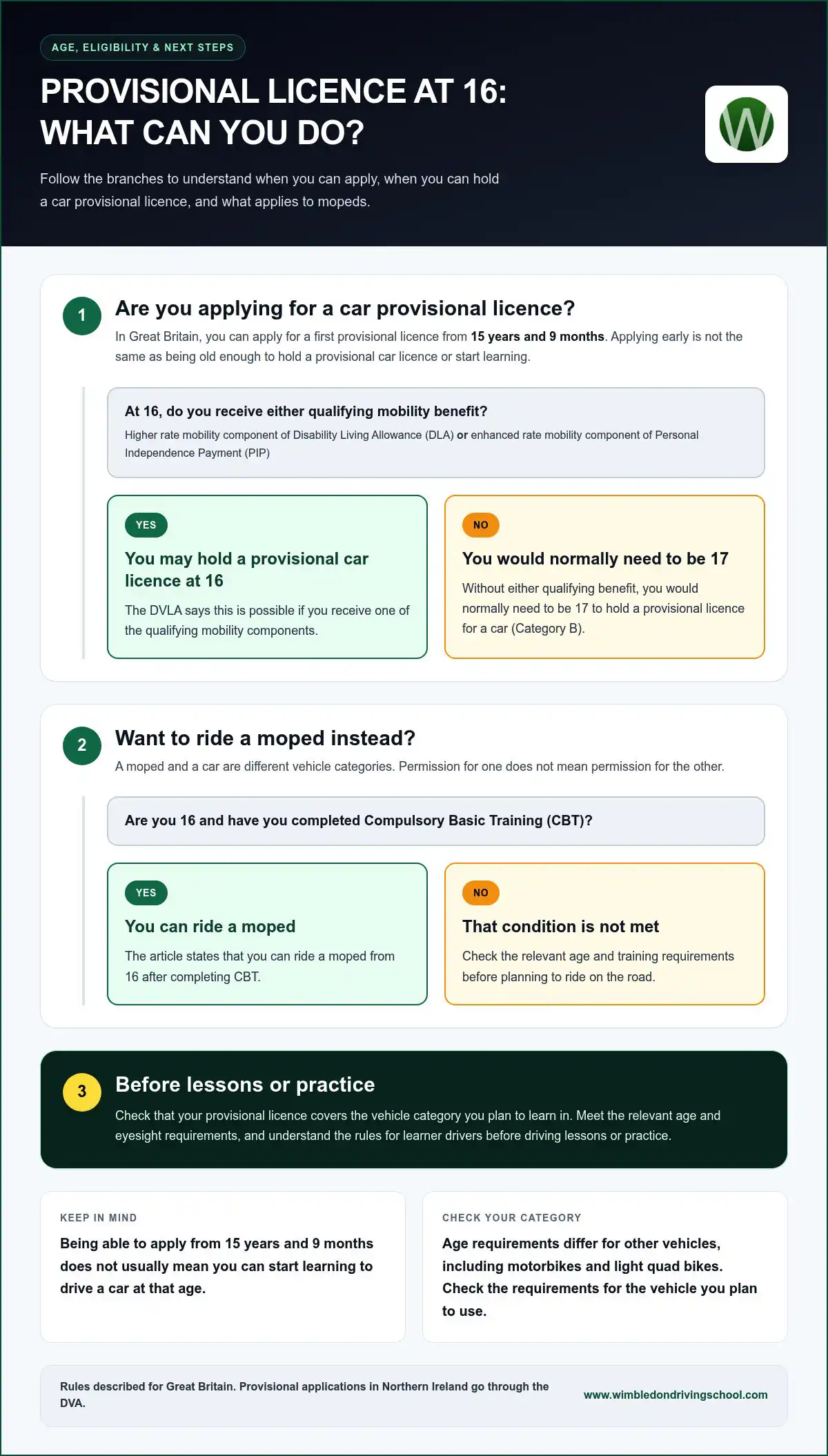
1. Check the age for the vehicle you want to drive. In Great Britain, you can apply for a first provisional driving licence from 15 years and 9 months, according to the Driver and Vehicle Licensing Agency (DVLA). Applying early lets you prepare for learning, but applying age and driving age are different. A provisional licence gives you the legal starting point for learning only for the vehicle categories it covers.
- Check whether you qualify to hold a car licence at 16. The Driver and Vehicle Licensing Agency (DVLA) says you may hold a provisional car licence from 16 if you receive the higher rate mobility component of DLA or the enhanced rate mobility component of PIP. If neither applies, you would normally need to be 17 to hold a provisional licence for a car, Category B, according to the DVLA. So, applying for a provisional licence at 16 does not usually mean you can start driving a car at that age.
- Separate the application date from the date you can begin car lessons. You can apply for a first provisional licence at 15 years and 9 months in Great Britain, but most people can start learning to drive a car at 17. A provisional licence is needed for learning, whether lessons are with an instructor or practice with an eligible supervisor. Use the time before your eligible starting age to understand the application steps and organise the information you’ll need.
- Consider a moped if you’re 16 and want to ride rather than drive a car. In the UK, you can ride a moped from 16 after completing Compulsory Basic Training, known as CBT. A moped and a car fall under different vehicle categories, so don’t treat permission for one as permission for the other. Check which category your provisional driving licence covers before you arrange training or ride on the road.
- Identify the vehicle category before planning for other vehicles. Motorbike age requirements vary by vehicle category, so check the relevant requirements before planning a ride. Vehicle age requirements vary by category, so check the requirements for the vehicle you plan to drive. Light quad bikes also have category-specific requirements, so don’t assume the moped age applies to them.
- Use the correct licensing authority for where you live. In Great Britain, provisional licence applications go through the DVLA; in Northern Ireland, applications go through the Driver & Vehicle Agency (DVA). Learners in Great Britain or Northern Ireland must hold a provisional driving licence when learning to drive or ride. For a step-by-step overview of the application, see this guide to applying for your provisional licence.
Online provisional licence application requirements
Apply online with your identity and address details ready. An online application usually takes about 15 minutes; a provisional licence should arrive within one week, unless additional checks take longer.
-
Prepare documents and payment for a D1 application
Gather the documents before you complete a postal D1 form. You’ll need a passport-style photo, identity documents and the application fee. You can collect the form from participating Post Office branches and use its INF1D guide to help complete it correctly.
For a D1 application, cheques and postal orders are the payment methods stated by the Post Office. The amount payable appears on the back of the form, and current costs can be checked on the GOV.UK licence fees page. Keep the form, photo, payment and identity documents together before posting.
-
Choose the application form and method
Choose online or post based on the documents you can provide. An online application requires your National Insurance number, a passport-style photo and the addresses where you’ve lived for the last three years.
You can use a UK passport that expired within the last 12 months to confirm your identity online. If you apply by post, use the D1 form. In Northern Ireland, applications go through the Driver & Vehicle Agency (DVA), rather than the DVLA. Select the route for where you live before sending documents or paying.
-
Submit the provisional licence application
Complete the health declaration and disclose any medical conditions that could affect your fitness to drive. Apply through GOV.UK and enter your details carefully. Online payment accepts MasterCard, Visa, Electron, Maestro or Delta debit or credit cards. Check your name, addresses and answers before submitting.
Postal applications can take up to three weeks. Send your D1 form with the photo, identity documents and fee; the Post Office recommends Special Delivery, particularly when valuable documents are enclosed. For applications using UK documents, the postal address is DVLA, Swansea, SA99 1AD. If any identity documents are from outside the UK, use SA99 1AF.
If your licence hasn’t arrived within the expected delivery period, check your application correspondence for updates or instructions. If your application is refused, read the reason carefully and follow the licensing authority’s instructions, such as providing requested information or correcting an error. Additional checks can extend online processing beyond one week.
Provisional licence requirements for lessons and practice
Before booking lessons or practising, check your age, eligibility, eyesight and supervision arrangements. These requirements determine when you can learn to drive and who can accompany you.
-
Check the age and eligibility requirements
Check that you can hold a provisional licence for the vehicle you want to learn in. Most people in Great Britain can start learning to drive a car at 17. The minimum age is 16 for people receiving the qualifying higher-rate DLA or enhanced-rate PIP mobility component.
For a first application, you must have permission to live in Great Britain for at least 185 days. If you live in Northern Ireland, apply through the Driver & Vehicle Agency instead. A provisional licence must cover the vehicle category you intend to use; a car entitlement doesn’t automatically cover a moped or another vehicle.
-
Meet the eyesight requirement
Test your eyesight before you arrange your first lesson. Applicants for a first provisional driving licence in Great Britain must be able to read a number plate from 20 metres away, according to the Driver and Vehicle Licensing Agency (DVLA).
The driving eyesight standard applies to number plates made after 1 September 2001, read from 20 metres in good daylight. You must declare whether you need glasses or contact lenses to meet that standard. If you use corrective lenses, wear them when checking your sight and whenever they’re needed for driving.
-
Arrange suitable supervision for practice
Choose an approved driving instructor or an eligible supervising driver for car practice. A supervising driver must be over 21 and have held a full driving licence for at least 3 years. They must also hold the correct type of licence for the car being used, such as a manual licence when supervising in a manual car.
Before setting off, make sure the car displays L plates and its insurance covers learner drivers. Check this whether you practise in a family car or another vehicle. In England, Scotland and Wales, learners may use a motorway only with an approved driving instructor and a car fitted with dual controls.
Don’t drive alone on a provisional licence. Plan each practice journey with your instructor or supervisor, including the route and the vehicle’s controls. For example, in a manual car, your supervisor must be entitled to drive a manual car. Check the licence category and supervision arrangements before every lesson or practice drive.
Applying by post using a D1 form
Choose the postal route if you’re completing a paper application. A D1 form lets you submit the required photo, identity documents and payment together, but check every detail before posting.
- Collect a D1 application form from a participating Post Office branch. Use the accompanying INF1D guide leaflet as you complete it, and follow its instructions for each section. Check that your personal details are accurate and that you’ve answered every relevant question. A missing answer or document can slow down the application.
- Prepare the documents required for a first provisional licence application, including a passport-sized photo, identity documents and the application fee. Check that your photo and documents are ready to submit with the form. Don’t send unrelated paperwork, and keep a record of what you’ve enclosed.
- Arrange payment using a method accepted for the D1 application. The Post Office states that cheques and postal orders are the accepted payment methods for applications sent by post. Check the amount shown on the back of the D1 form before preparing payment, and make sure it matches your application.
- Address the envelope according to the identity documents enclosed. Applications with documents from the UK should go to DVLA, Swansea, SA99 1AD. If any identity documents are from outside the UK, send the application to DVLA, Swansea, SA99 1AF. Use the correct address before sealing the envelope; the two addresses aren’t interchangeable.
- Choose how to send your completed form and documents. Postal applications can take up to three weeks. The Post Office recommends Special Delivery, particularly when valuable documents are enclosed. Keep your proof of posting and tracking details together in case you need to follow up.
- Wait for your provisional driving licence before arranging car practice. Postal applications can take longer than online applications, so allow for the stated processing period when planning lessons. You can take a theory test once you have a provisional licence, but submitting a paper application doesn’t mean you have received one.
- Check your application papers before sending them. Confirm that the D1 form is complete, the photo and identity documents are enclosed, payment is included, and the envelope uses the correct DVLA address. This final check helps prevent avoidable errors and keeps your application organised while it’s being processed.
Applying for a first provisional licence online
Apply through GOV.UK for an online application in Great Britain, or complete a D1 form by post. The online route usually takes about 15 minutes; prepare your details first so you can complete each step accurately.
- Check that you’re applying for the right licence and at the right time. Most people need to be 17 to hold a provisional car licence. At 16, you may qualify if you receive the enhanced mobility component of Personal Independence Payment or the higher rate mobility component of DLA. An application doesn’t change the age when you can start car lessons.
- Gather your identity and contact details before opening the online form. You’ll need your National Insurance number and the addresses where you’ve lived for the last three years. A UK passport that expired within the last 12 months can be used to confirm your identity. Keep your details consistent with your identity documents.
- Prepare a passport-style photo and complete the health declaration. Declare medical conditions that could affect your fitness to drive. You must meet the eyesight standard: applicants for a first licence need to read a number plate from 20 metres away. Include whether you need glasses or contact lenses to meet that standard.
- Complete the application and pay online through GOV.UK. You can pay by MasterCard, Visa, Electron, Maestro or Delta debit or credit card. Review your answers before submitting, especially your address history and health information.
- Allow time for your licence to arrive before planning lessons or a driving test. DVLA says an online licence should arrive within one week, unless additional checks take longer. You can take the theory test once you have your provisional licence, but you must pass it before booking a practical driving test.
- Use the postal route if you prefer a paper application. Get a D1 form from a participating Post Office, include the required photo, identity documents and payment, then send it to DVLA. Follow the D1 guidance and use the correct postal address for your documents.
Wimbledon Driving School: Manual Driving Lessons
Once you’re eligible to begin learning and have your provisional car licence, Wimbledon Driving School can help. Manual driving lessons provide structured practice with an instructor, helping you build the skills and confidence for everyday driving.
If you’re still 16 and don’t meet the mobility-benefit exception, use this time to prepare; you’ll usually need to be 17 to hold a provisional car licence. When you’re ready, choose manual lessons to learn in a car with a clutch and gears, or consider automatic lessons if you prefer a car without them.
Plan your first steps towards driving
Your next step is to turn eligibility into a practical learning plan. If you’re applying for a provisional licence at 16, use this stage to think about the driving skills you want to build and the support that will help you feel prepared. You don’t need to rush into lessons before you’re legally able to start; you can use the time to get ready and discuss your goals with family.
When you’re eligible, Wimbledon Driving School offers manual and automatic driving lessons, as well as intensive driving courses across South West London, South East London, Surrey and Middlesex. Consider which learning format suits your circumstances and preferred car. A clear plan gives you a focused start, whether you want steady practice or a more concentrated course.
Take the next step at a pace that feels right, building towards greater independence with care and confidence. For those whose ambitions extend beyond the road into aviation, training providers such as 2FLY Airborne offer structured flight courses for aspiring commercial pilots.
Frequently Asked Questions
What is the eyesight requirement?
You must be able to read a vehicle number plate from 20 metres in good daylight. The standard applies to number plates made after 1 September 2001. If you need glasses or contact lenses to meet it, declare this and wear them when driving. For example, check your sight using a suitable plate in daylight before starting lessons, rather than relying on how clearly you see road signs.
What’s the minimum age you can start to learn to drive in the UK?
Most people in Great Britain can start learning to drive a car at 17. If you receive the higher rate mobility component of DLA or enhanced rate mobility component of PIP, you may hold a provisional car licence from 16. You still need the relevant provisional entitlement before learning. This age rule concerns car driving; moped riding has a separate minimum age and training requirement.
Which vehicles can I apply to drive and how old do I need to be to apply?
Apply for the provisional category that matches the vehicle you intend to learn in. You can normally hold a provisional car licence from 17, or from 16 if you receive qualifying mobility benefits. Moped riding is possible from 16 after CBT; motorbike age limits vary by engine size, starting at 17 for bikes up to 125cc. Check the category carefully before submitting your application.
How do I fill out my D1 form?
Complete each relevant section of the D1 form, using the INF1D guide leaflet to help you. Check your personal details and answers before signing, then enclose a passport-sized photo, identity documents and payment. For example, compare your written address with your identity paperwork to catch discrepancies. Use a cheque or postal order for the fee, and send the application to the correct DVLA address for your documents.
How long until I receive my licence?
An online application should result in delivery within one week, unless additional checks take longer. A postal application can take up to three weeks. Allow for these timings when planning lessons, and don’t arrange practice on the assumption that your licence has arrived. If the expected delivery period passes, check your application correspondence for next steps and respond to any requests for further information.
Can you apply for a UK provisional driving licence at 16?
Yes, you can apply for a provisional car licence at 16 if you receive the higher rate mobility component of DLA or enhanced rate mobility component of PIP. Without either qualifying benefit, you’d normally need to be 17 to hold a provisional car licence. The application age and the usual age for starting car lessons are separate considerations, so confirm which applies to your circumstances before making plans.
What vehicles can you drive with a provisional licence at 16 in the UK?
At 16, a qualifying learner may hold a provisional car licence if they receive the specified mobility benefit. You can also ride a moped from 16 after completing CBT, subject to the relevant licence entitlement. These permissions aren’t interchangeable: a provisional car licence doesn’t automatically authorise riding a moped. Check the category shown on your licence and follow the training and supervision requirements for that vehicle.
What are the eligibility requirements for a UK provisional licence at 16?
For a provisional car licence at 16, you must receive the higher rate mobility component of DLA or the enhanced rate mobility component of PIP. You also need to meet the application requirements, including the eyesight standard and the residency requirement for a first Great Britain application. If you don’t meet the mobility-benefit condition, the normal minimum age for holding a provisional car licence is 17.
Disclaimer
This article is provided for general informational purposes only and does not constitute professional driving, legal, or safety advice. While we aim to keep our content accurate and up to date, rules, prices, and DVSA test requirements can change — always check gov.uk or contact us directly at 020 3524 7968 for the latest guidance before making any decisions. Nothing in this article guarantees a specific outcome, including passing your driving test within any stated timeframe. For current pricing, course availability, and instructor details, please visit our Prices page or get in touch.