

A driving instructor’s standards should be clear before you get behind the wheel. The updated driving instructor code of practice in the UK gives learners clearer expectations about instructor behaviour, advertising and how to raise concerns, with guidance organised into three plain-English tiers: Must, Should and Could.
It’s reasonable to want to know what professional conduct looks like, especially if you’re new to driving or unsure about speaking up. The code provides a practical reference: it explains the standards instructors are expected to follow and the steps you can take if something goes wrong.
This guide explains why the update matters, what it says about advertising and pass-rate claims, and how to raise a complaint. It also covers when an unresolved concern can be referred to the ADI Registrar, so you know what to expect and where to turn for support.
Key Takeaways
- Use the code’s “Must, Should and Could” tiers to understand the standards learners can expect from an instructor.
- Look for clear terms of business covering lesson prices, cancellations and how to make a complaint.
- Assess advertising and pass-rate claims by whether they’re fair, clear and supported by an explained basis.
- If a concern arises, raise it through the instructor or provider’s complaints procedure first; unresolved concerns about professional service can be escalated to the ADI Registrar.
- Knowing the standards and complaint route can help you approach lessons with greater confidence and speak up when needed.
Complaints and escalation to the ADI Registrar
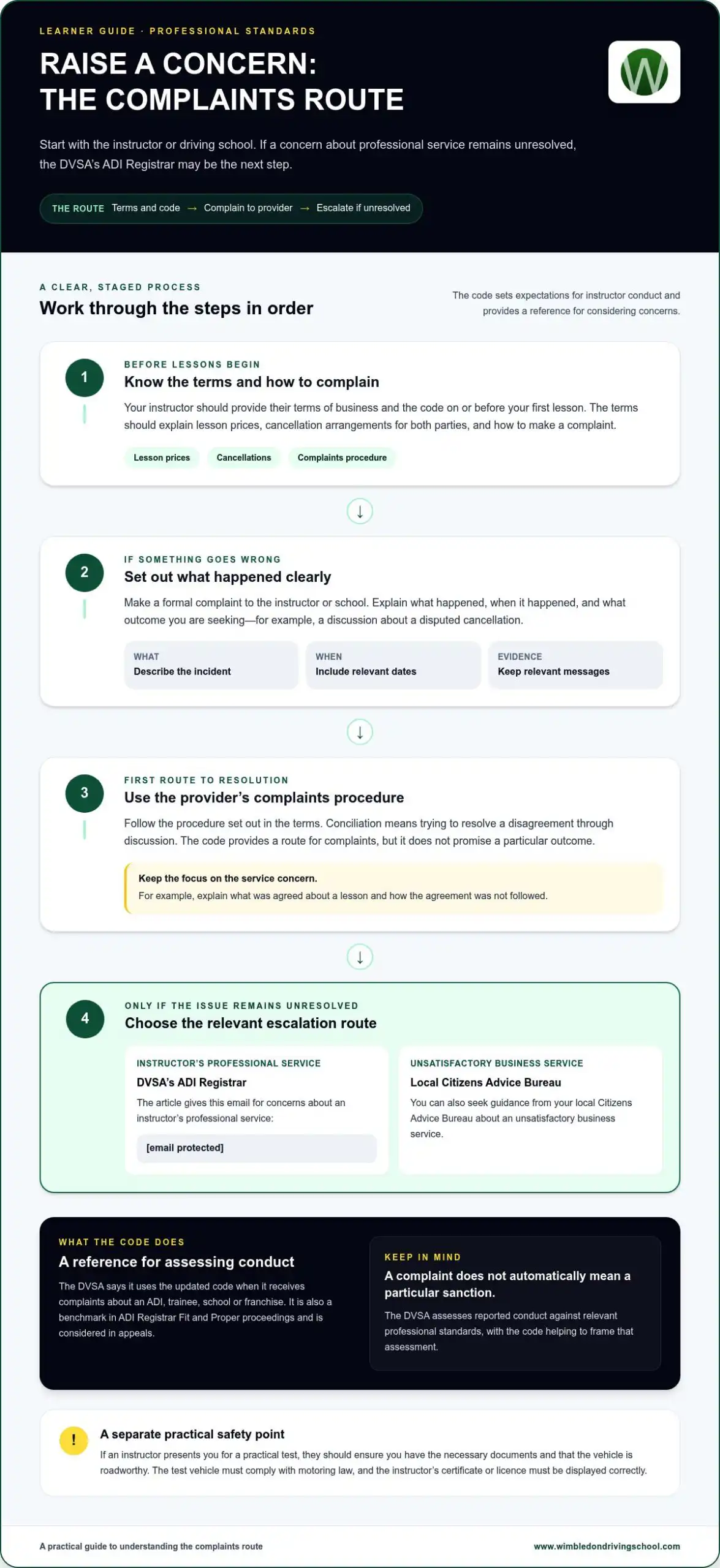
The code sets out standards for instructor conduct and a route for raising concerns. Start with the instructor’s or school’s complaints procedure. If a concern about professional service remains unresolved, you can contact the DVSA’s ADI Registrar.
The guidance below explains how to complain, how the DVSA uses the code, and what learners can expect regarding safety and identification.
Driving School TV’s video discusses learner concerns and ways to raise an issue.
Complaints and dispute resolution
A complaint is a learner’s formal expression of dissatisfaction with an instructor’s service or behaviour. Approved driving instructors should provide their terms of business and the code on or before the first lesson, including details of how to complain.
Use that procedure first. Explain what happened, when it happened, and what outcome you’re seeking, such as a discussion about a disputed cancellation. The terms should explain cancellation arrangements for both parties. Conciliation means trying to resolve a disagreement through discussion; the code provides a complaints route but does not promise a particular outcome.
Disciplinary action for code breaches
The code provides a reference for assessing concerns about an instructor’s professional conduct. The DVSA says it will use the updated code when it receives complaints about an ADI, trainee, school or franchise.
The code is also a benchmark in ADI Registrar Fit and Proper proceedings and is considered in appeals. This does not mean every complaint automatically results in a particular sanction. The DVSA assesses the reported conduct against relevant professional standards, with the code helping to frame that assessment.
Reporting concerns about an instructor
Reporting means taking a concern beyond the instructor or school when its complaints procedure hasn’t resolved the issue. Contact the DVSA at instructorconduct@dvsa.gov.uk about an instructor’s professional service. For an unsatisfactory business service, you can also seek guidance from your local Citizens Advice Bureau.
Describe the incident clearly and include relevant dates or messages. For example, explain what was agreed about a lesson and how the instructor behaved if that agreement wasn’t followed. The DVSA uses the code as a reference when considering a complaint.
For safety, an instructor presenting you for a practical test should ensure you have the necessary documents and that the vehicle is roadworthy. The test vehicle must comply with motoring law, and the instructor’s certificate or licence must be displayed correctly.
Paid lessons in a motor car must be given by a registered Approved Driving Instructor. The code’s test-vehicle rule concerns the correct display of a certificate or licence; it does not establish a separate identification rule for every lesson.
The key distinction is when the Registrar becomes relevant: first use the instructor’s or provider’s complaints procedure, and contact the ADI Registrar only if you remain unhappy. Raise concerns about the instructor’s professional service. This keeps escalation focused on an unresolved service issue, rather than making the Registrar the first step.
Driving tuition advertising and pass-rate claims
The code says advertising for driving tuition should be clear, fair and not misleading. Claims should also be capable of verification, so learners can understand what an advert promises before choosing lessons.
Advertising driving instruction services
Advertising is information used to describe an instructor’s or driving school’s services to potential learners. Under the code, claims should be clear, fair and not misleading.
This applies to the overall impression, not just individual words. For example, an advert promoting flexible lessons should explain what that means in practice. A claim about lesson formats should name the formats offered, rather than imply a wider choice. The code helps you compare an advert’s wording with the service it describes.
Read the wording carefully. Look for a clear description of the instruction, any conditions attached to a claim, and missing context that could change its meaning. If a statement sounds impressive but offers no way to understand or verify it, ask for clarification before relying on it.
Fair advertising and pass-rate claims
A pass-rate claim is an advertised statement about learners passing driving tests after instruction. The code says instructors who advertise pass rates should explain how they calculated them, so learners can interpret the figure accurately.
A percentage without its calculation basis tells you little. Consider which learners and tests were counted, and the period covered. These details can affect how a rate is understood, but they are not a prescribed calculation formula. The important point is transparency about the basis used.
For example, a claim might refer to learners presented for a test or to another group defined by the advertiser. Different groups can create different impressions. Don’t assume an advertised rate predicts your own result. It describes the basis stated by the instructor, not a promise about an individual learner’s outcome.
Checking whether an advert is honest
Honest advertising gives learners enough context to understand and assess a claim. For a pass-rate statement, look for an explanation of how it was calculated. For a service claim, check that its meaning is clear.
Compare the advert with the terms and information you receive before lessons begin. Note any unclear wording and ask what it means. For example, ask how a published pass rate was calculated rather than treating the percentage alone as a complete comparison. Keep the advert or a screenshot in case you later need to describe the claim in a complaint.
Clear expectations support a more informed start to learning. If you’re ready to discuss lesson options, find a suitable time for driving lessons.
Learner drivers’ expectations and routes to raise concerns
The code sets out how approved driving instructors should treat learners and support their development. It also gives you clear points to raise if an instructor’s conduct or teaching concerns you.
Professional conduct and respect
Professional conduct means treating learners respectfully and supporting their progress throughout driver training. The code says instructors should help clients work towards the learning outcomes in the National Standard for Driver and Rider Training.
Respect should be part of everyday lessons, not just formal discussions. For example, an instructor should explain a correction calmly and connect it to a driving task, such as observing at a junction. The code also says instructors should avoid physical contact except in an emergency or during a normal greeting. These expectations help define appropriate boundaries during instruction.
If conduct concerns you, use specific examples. Note what was said or done, which lesson it happened in, and how it affected your learning. This gives you a clear basis for discussing the issue or explaining a dispute through the relevant complaints procedure.
Checking your entitlement to drive
An entitlement check confirms whether you’re permitted to drive the vehicle used for your lessons. Under the code, instructors should check your entitlement during the first lesson and regularly throughout training.
The first-lesson checks also include whether you can read a number plate at the statutory distance. These checks are separate from assessing your driving ability: they address whether you can lawfully take part and meet the eyesight check described in the code. If you’re unsure what the instructor is checking, ask them to explain before the lesson continues.
Checking progress during driver training
Progress monitoring means reviewing how your driving develops against the learning outcomes in the National Standard for Driver and Rider Training. An instructor should support you towards those outcomes, rather than treating each lesson as a standalone drive.
Make progress reviews practical by asking which skill you’re working on and what to improve next. For example, after practising junctions, discuss whether your observations and decisions were effective. A clear explanation helps you understand the learning goal and identify what to practise in a later lesson.
Standards and raising concerns
The DVSA and the driver training industry developed the code together, including the National Associations Strategic Partnership. The member groups named in the code are ADI NJC, DIA and MSA GB.
If an instructor’s behaviour appears to conflict with the code, keep your concern specific: describe the lesson, the conduct, and the standard you believe was missed. This makes it easier to explain the issue through the instructor’s or provider’s complaints procedure. If discussion does not resolve the dispute, follow the escalation route in that process.
Under the code, ADIs should check a client’s entitlement to drive the vehicle and ability to read a number plate at the statutory distance during the first lesson and regularly throughout training.
The UK driving instructor code of practice tells learner drivers where to turn if an instructor does not meet the stated standards. Use it to identify the right route for raising a concern, and explain clearly which standard you believe was not met.
Publication of the updated Driving Instructor Code of Practice
The updated code was published on GOV.UK before its implementation date, giving instructors time to read it. Its publication clarifies the standards learners can refer to when considering lesson arrangements and instructor conduct.
Mandatory status of the updated code
A mandatory code sets out standards for instructors to follow. The current industry code is voluntary, while the updated code is intended to become mandatory in England, Scotland and Wales.
The updated code is expected to replace the current code sometime between late 2026 and early 2027. The DVSA says the implementation date will be announced at a webinar about the code. Until then, its publication gives instructors and schools time to understand the forthcoming requirements.
Updating the code and ADI registration
Updating the code means replacing the existing voluntary guidance with revised standards. The DVSA and the driver training industry, including NASP, developed the updated code together.
Approved driving instructors can update their registration to confirm that they agree to follow the code. Once the new mandatory code takes effect, instructors must declare that they have read and agreed to it when applying to become an instructor, renewing their registration or applying for a trainee licence. Agreement will form part of each of these registration steps.
Approved and trainee instructor requirements
The code sets professional standards for concerns involving approved driving instructors or trainees. The DVSA will use it as a reference when it receives a complaint about an ADI, trainee, school or franchise.
Learners can raise concerns about an approved instructor or a trainee, and the code informs the DVSA’s consideration. It also sets standards for instructors’ personal conduct and business dealings. The code does not mean every complaint will receive the same decision; it provides a benchmark for assessing the reported conduct.
Lesson arrangements and punctuality
Lesson arrangements are the practical terms agreed between a learner and an instructor or school. On or before the first lesson, instructors should provide their terms of business, including current lesson prices and duration, cancellation terms, and the complaints procedure.
The terms should explain cancellations by either party. Instructors should not cancel or rearrange a client’s driving test without their agreement. To avoid confusion about punctuality, agree and record the lesson’s start time. Raise repeated lateness through the provider’s complaints process rather than assuming the code specifies a particular rule.
The terms should state the current lesson price and the conditions for using a school car for the practical test. Instructors should safeguard money paid in advance for lessons, test fees or other purposes, and provide details on request. The code requires instructors to account for advance payments, but does not set out a specific refund entitlement.
Purpose of the driving instructor code of practice
The code provides a shared benchmark for professional conduct and business dealings in driving instruction. The UK driving instructor code of practice explains what learners can expect, how instructors should support learning, and how concerns can be considered.
Its purpose is practical: it connects everyday lessons with clear expectations. The code covers instructors’ personal conduct, advertising, business dealings and disputes with pupils. For example, it gives learners a reference point when an advert seems misleading or an instructor’s behaviour causes concern. It also helps instructors understand the standards expected in their work.
The updated code uses three plain-English tiers: Must, Should and Could. These terms distinguish the strength of each expectation, helping readers understand whether a point is a requirement, recommended practice or possible action. The code provides a consistent basis for considering professional conduct, rather than leaving learners to rely only on personal opinion when something feels wrong.
It also links instruction to a national learning framework. Instructors should support clients towards the learning outcomes in the National Standard for Driver and Rider Training. That gives lessons a wider purpose than preparing for a driving test: progress should develop the knowledge and skills needed for safe, responsible driving. A learner can use that focus to discuss lesson goals and understand why a particular skill is being practised.
The DVSA and the driver training industry, including NASP, developed the updated code together. It covers England, Scotland and Wales. The current industry code is voluntary, while the updated code is intended to become mandatory. This change gives the standards a stronger role in professional oversight and makes expectations clearer for instructors, schools and learners.
The DVSA will use the updated code as a reference when it receives complaints about an ADI, trainee, school or franchise. The code will also be a benchmark in ADI Registrar Fit and Proper proceedings and will be considered in appeals. It can therefore inform formal consideration of conduct, as well as discussions between a learner and instructor.
The key point is that the code connects expected behaviour with a route for raising concerns and a standard for assessing them. Treat it as a practical guide to professional instruction, not a promise of a particular outcome in every dispute. Its value is in giving learners and instructors a shared basis for understanding expectations.
Wimbledon Driving School: Manual Driving Lessons
Wimbledon Driving School provides manual driving lessons across South West London, South East London, Surrey and Middlesex. Learn in a manual car with professional instruction designed to help you build your skills and confidence on the road.
If you’re choosing between manual and automatic tuition or prefer a more concentrated schedule, Wimbledon Driving School also offers automatic driving lessons and intensive driving courses. Pass Plus Courses are available after you pass your test. Choose the option that suits your experience and learning goals.
Contact Wimbledon Driving School to discuss the right learning option for your next step.
Take your next step with confidence
Use what you’ve learned to build a positive working relationship with your instructor. Think about how you learn best, then share your preferences clearly as you develop confidence and progress towards your driving goals.
Each lesson is a step towards greater independence on the road. Keep your goals in sight and approach your learning with confidence.
Frequently Asked Questions
Why is the updated code important?
The code gives you a practical way to prepare for a discussion about your tuition. Note the lesson date, the issue you noticed and what you understood would happen. You can then explain your concern with a specific example rather than a general impression. Use the code to frame the conversation around professional expectations and the learning experience you want.
Is the DVSA driving instructor code of practice legally binding or voluntary?
The current industry code is voluntary, while the updated code is intended to become mandatory. For learners, the current code remains a reference when discussing an instructor’s conduct. The planned mandatory framework also affects instructors’ registration declarations when they apply to become an instructor, renew their registration or apply for a trainee licence.
What standards of conduct and professionalism does the code require?
The code also covers practical responsibilities around a driving test. An instructor should not cancel or rearrange your test without your agreement. If you request it, the instructor should accompany you and listen to the test debrief. Discussing this support beforehand can help you understand the instructor’s role on test day and after the test.
Does the code differ for approved driving instructors and trainee instructors in the UK?
The DVSA uses the updated code as a reference for complaints about approved and trainee instructors; the material does not describe separate versions for each.
Disclaimer
This article is provided for general informational purposes only and does not constitute professional driving, legal, or safety advice. While we aim to keep our content accurate and up to date, rules, prices, and DVSA test requirements can change — always check gov.uk or contact us directly at 020 3524 7968 for the latest guidance before making any decisions. Nothing in this article guarantees a specific outcome, including passing your driving test within any stated timeframe. For current pricing, course availability, and instructor details, please visit our Prices page or get in touch.