A US licence can get you on the road in Great Britain, but it won’t give every driver the same window. If you’re asking can i drive in the uk with a us license, the short answer is yes for many visitors: a valid US licence generally lets you drive in England, Scotland and Wales for up to 12 months from your last entry. If you become a UK resident, the next steps are different, and you can’t exchange a US licence for a UK one.
It’s understandable to want a clear answer before you get behind the wheel, especially when visitor and resident rules can be easy to mix up. This guide explains what changes if you stay longer, why Northern Ireland needs separate checking, and what to verify about your licence and insurance before driving. You’ll also find out where to check the latest guidance from GOV.UK and Northern Ireland’s DVA. If you’re adjusting to UK roads, lessons with an instructor can also help you build confidence; they’re optional support, not a legal requirement.
Key Takeaways
- For “can i drive in the uk with a us license”, check the rules for your location and circumstances before setting off.
- Use current GOV.UK or Northern Ireland DVA guidance to confirm which licensing pathway applies if your stay changes.
- Understand the difference between your US licence, an International Driving Permit and a UK licence before relying on any of them.
- Work through the checklist to confirm your licence is valid for the vehicle and that you meet the requirements for driving it.
- Consider lessons with an instructor to practise UK road layouts and conventions and feel more at ease behind the wheel.
Can I drive in the UK with a US licence? The short answer
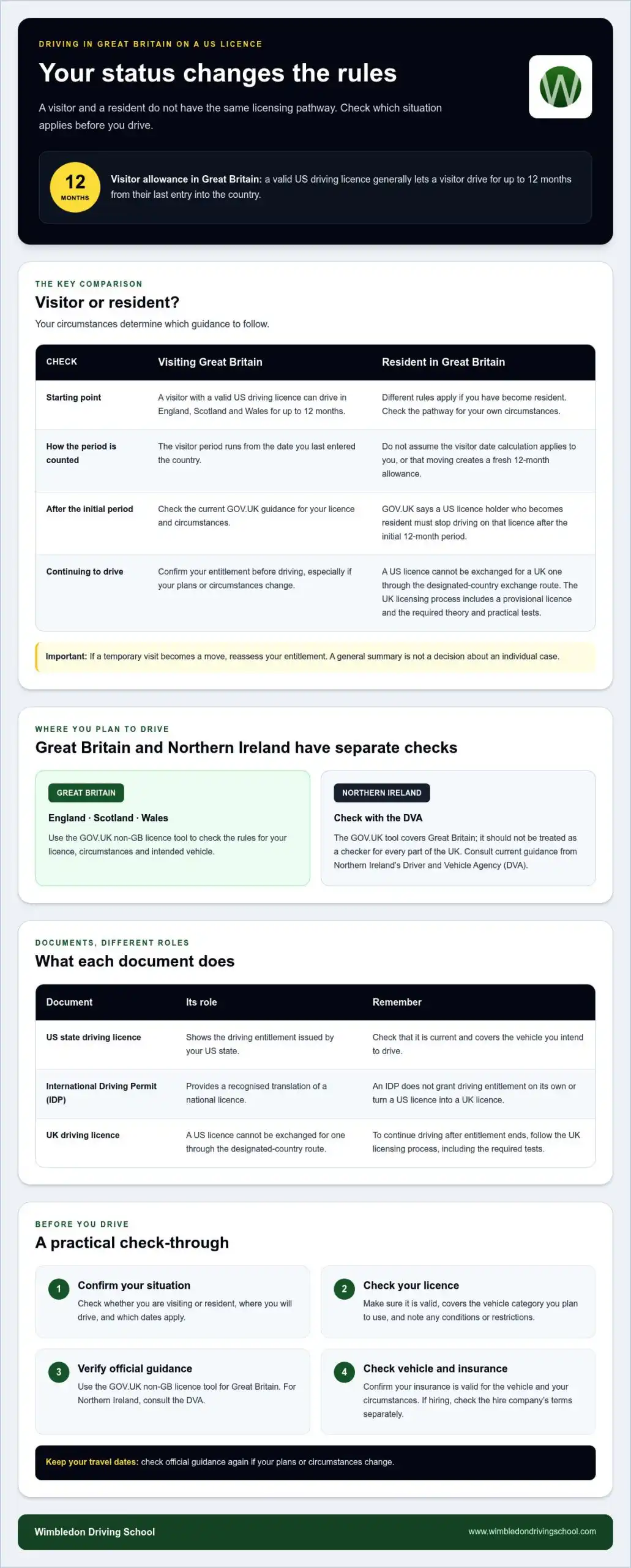
Sometimes. If you’re a visitor with a valid US driving licence, you can drive in Great Britain for up to 12 months from the date you last entered the country. If you’ve become resident, different rules apply, so don’t assume the visitor allowance answers your situation. The question “can i drive in the uk with a us license” depends on where you’ll drive, your status and the dates that apply to you.
Here, Great Britain means England, Scotland and Wales. The United Kingdom also includes Northern Ireland, which has a separate licensing authority. A visitor is someone coming to the UK temporarily; resident refers to someone whose circumstances mean they live here. If you’re unsure which category fits, use the official guidance for your location rather than relying on a general summary.
Why visitor and resident status matters
Your status can change which rules apply and when a time limit starts. For visitors to Great Britain, the GOV.UK guidance uses the date you last entered the country. For people who have become resident, check the relevant pathway in the GOV.UK non-GB licence tool; don’t assume that a visitor’s date calculation applies to you.
For example, a US driver who arrives for a short visit and later moves to the UK may need to reassess their entitlement when their circumstances change. This illustrates why your dates matter; it isn’t a legal determination of an individual case.
Great Britain and Northern Ireland are not interchangeable
The GOV.UK non-GB licence tool covers Great Britain. It can help you check the rules for driving in England, Scotland or Wales, but it shouldn’t be treated as a checker for every part of the UK. If you’ll drive in Northern Ireland, consult current official guidance from the Driver and Vehicle Agency (DVA) there.
Keep the jurisdiction clear when you check: a route that applies in Great Britain may not automatically apply in Northern Ireland. GOV.UK is the place to verify the Great Britain rules, while the DVA is the relevant authority for Northern Ireland. For wider background on how UK licensing is organised, see this overview of UK Driving Licence Regulations, but use the official authority for the decision that applies to you.
If your move means you need to work towards a UK licence, this guide to getting a full UK driving licence explains the learning journey. Check your own entitlement before driving, especially if your location or residency status has changed.
How US licence rules can change if you visit or move to the UK
The answer to “can i drive in the uk with a us license” depends on your circumstances and the details of your licence. GOV.UK’s non-GB licence tool is the official starting point for checking your situation in Great Britain. Use it to confirm the rules for your licence and intended vehicle rather than relying on a general summary.
If you are visiting Great Britain
A visitor with a valid US driving licence can drive in Great Britain for up to 12 months from the date they last entered the country. Before driving, check that your licence is current and covers the vehicle category you intend to use. Don’t assume that entitlement for a car also covers a different type of vehicle.
Check any conditions or restrictions on your licence, then use the GOV.UK non-GB licence tool to verify the requirements for your circumstances, including any supporting documents. If you’re hiring a vehicle, read the hire company’s terms as well. Its conditions and your legal driving entitlement are separate checks, and you should confirm that your insurance is valid for the vehicle and your circumstances.
If you have moved or plan to stay
Becoming resident changes which licensing rules are relevant. GOV.UK guidance for Great Britain says that a US licence holder who becomes resident must stop driving on that licence after the initial 12-month period. Don’t assume that moving creates a fresh 12-month allowance. Check the current GOV.UK non-GB licence tool for your own circumstances and act before your entitlement ends.
The United States isn’t a designated country for licence exchange in Great Britain, so a US licence can’t be exchanged for a UK one through that route. To continue driving after your entitlement ends, you’ll need to follow the UK licensing process, including obtaining a provisional licence and passing the required theory and practical tests. GOV.UK explains the application process for a UK provisional driving licence. This UK driving licence guidance for overseas drivers also outlines the route ahead.
Keep records of your travel dates and check the official guidance again if your plans or circumstances change. For example, if a temporary visit becomes a move, reassess your entitlement rather than assuming the visitor rules continue unchanged.
US licence myths: IDPs, UK licence exchange and driving entitlement
Three documents often get mixed up: your US state driving licence, an International Driving Permit (IDP) and a UK driving licence. They have different roles. An IDP doesn’t grant driving entitlement on its own, and having one doesn’t turn a US licence into a UK licence. To answer “can i drive in the uk with a us license”, check what your licence permits and follow current GOV.UK guidance for your circumstances.
| Document | What it does | What to remember |
|---|---|---|
| US driving licence | Shows the driving entitlement issued by your US state. | Check it’s valid and covers the vehicle you plan to drive. |
| International Driving Permit | Provides a recognised translation of a national licence. | It isn’t a replacement for the original licence or a standalone entitlement. |
| UK driving licence | Records your UK driving entitlement and any applicable conditions. | It’s a separate licence, obtained through the relevant UK process. |
Does a US driver need an International Driving Permit?
For driving in Great Britain, GOV.UK guidance says an IDP isn’t required if your valid US licence is in English. However, this isn’t a reason to leave your original licence behind: an IDP is a companion document, not a substitute. Check the current GOV.UK non-GB licence tool for your exact circumstances, and check any separate document requirements set by a vehicle hire company.
Keep the distinction simple: the US licence is the underlying document showing your entitlement; an IDP translates information from it. Neither document changes the vehicle categories or conditions shown on your licence. If your licence isn’t in English, or your driving situation differs from the usual case, verify the requirements with the relevant official guidance before driving.
Can you exchange a US licence for a UK one?
Don’t assume that a foreign licence can be swapped directly. GOV.UK sets out exchange eligibility by the country or territory that issued the licence, so use its current guidance to check whether an exchange route applies to you. The United States isn’t a designated country for licence exchange in Great Britain, meaning a US-issued licence can’t be exchanged for a UK one under that route. If you need a UK licence, check the steps that apply to your circumstances.
That’s different from simply carrying an IDP, and it’s different from using a valid overseas licence where permitted. An exchange route avoids the process required of someone who must qualify for a UK licence, so confirm eligibility before making plans around it. For an overview of the learning and test pathway, see these steps towards a full UK driving licence.
Before driving in the UK on a US licence: a practical checklist
Before setting off, work through these checks rather than relying on a general answer to “can i drive in the uk with a us license”. Your location, circumstances and the vehicle all matter. Take a few minutes to organise your documents and plan the journey, especially if you’ll be driving an unfamiliar car or travelling through a busy area.
Check your documents and driving circumstances
- Confirm where you’ll drive. Great Britain and Northern Ireland have separate licensing authorities. Use the GOV.UK non-GB licence tool for Great Britain; if driving in Northern Ireland, check current DVA guidance.
- Identify your status. Check the official guidance for your circumstances, particularly if your plans or status have changed since you last checked your entitlement.
- Check your US licence is valid. Look at its expiry date and any conditions or restrictions. Keep the original licence with you and verify whether supporting documents are required for your situation.
- Match your entitlement to the vehicle. Confirm that your licence covers the category you intend to drive. Don’t assume permission for a car applies to another type of vehicle.
- Read the insurance documents. Check that the policy covers you to drive that vehicle on your US licence, and read its conditions and exclusions. Don’t assume cover follows automatically when you borrow or use someone else’s car.
- Review rental terms, if relevant. Read the hire agreement and document requirements before collecting the vehicle. A driving entitlement doesn’t automatically satisfy a rental company’s separate conditions.
- Plan a manageable first route. Check your destination, parking arrangements and any local restrictions before leaving. Allow time to get familiar with the vehicle’s controls while parked, including lights, wipers and indicators.
Prepare for the first drive
Traffic in the UK keeps left, and road layouts may feel unfamiliar even if you’ve driven for years. Before setting off, look over your route and note where you’ll meet roundabouts, complex junctions, bus lanes or restricted streets. This preparation can help you avoid rushed decisions, but it doesn’t replace checking the rules that apply to your journey.
Read signs early and give yourself time to choose a safe lane or turn. If you miss a turn, avoid a sudden manoeuvre; continue safely and let your navigation recalculate. For a refresher on everyday signs and conventions, this guide to UK road rules for new drivers can help you prepare.
Keep your first journey straightforward where possible. Choose a route you can review in advance, allow enough time and avoid adding unfamiliar stops if you’re already concentrating on a new vehicle or road layout. Driving lessons are also an optional way to practise local conditions and build familiarity, not a legal requirement.
Adapting to UK roads: when driving lessons can help
Being legally entitled to drive and feeling comfortable on unfamiliar roads are different things. If you’re confident driving in the US but new to the UK, lessons can help you practise local conventions with an instructor and build familiarity at a pace that suits you. They’re optional support, not a legal requirement.
Once you’ve checked your entitlement, consider which parts of driving here feel least familiar. You may benefit from focused practice rather than starting from scratch. A lesson can give you time to work through specific situations and ask questions as they arise.
What support can lessons provide?
Driving on the left can take concentration, particularly at junctions or when turning into a new road. An instructor can help you practise positioning, observation and decision-making in real traffic, while explaining UK road layouts and conventions as they come up.
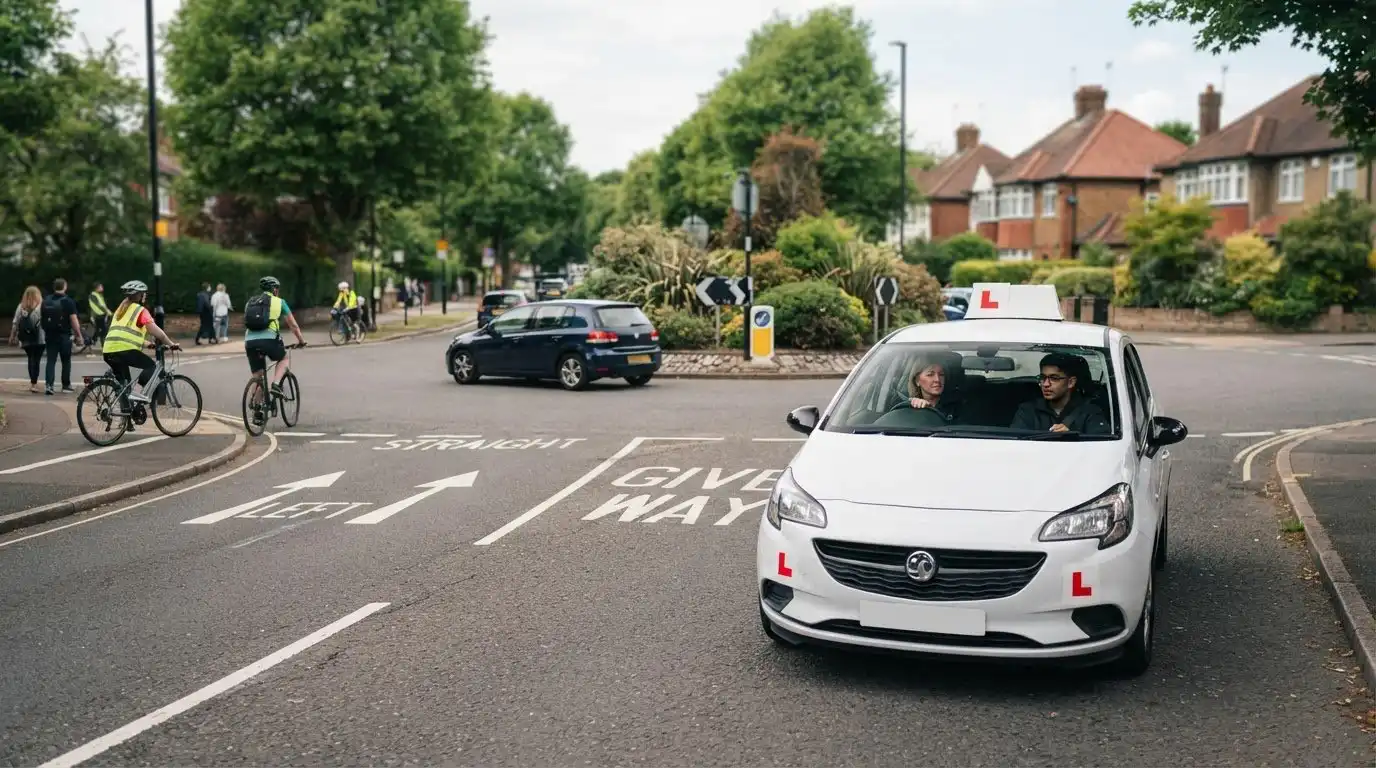
Roundabouts are another useful focus. You can practise reading signs and lane markings, judging gaps, choosing a lane and following your intended route. Lessons can also cover busy junctions, narrower streets, parked vehicles and the changing pace of urban traffic. The aim is to build familiarity and sound habits, not to promise a particular result.
Your previous experience matters. If you drive regularly, you might focus on unfamiliar junctions or adapting to left-side driving. If you feel less confident, you can take a steadier approach and build up to busier routes. Tuition can be tailored to your experience and the situations you want to work on, without setting a fixed learning timeframe.
To make practice purposeful, think about the roads you expect to use and the moments that cause uncertainty. You could focus on lane choice at a roundabout, judging traffic at a junction or keeping a steady position on a narrow street. Clear priorities help you use lesson time well and identify what you’d like to practise next.
Find local support in London, Surrey or Middlesex
Road conditions vary from one area to another. South West London and South East London include busy junctions and varied street layouts, while routes in Surrey and Middlesex bring their own local conditions. Practising in the places you expect to drive can help make those journeys feel more familiar.
Wimbledon Driving School provides lessons for overseas and international drivers adapting to UK roads across South West London, South East London, Surrey and Middlesex. You can work on the particular road layouts and driving conventions you want to understand better, then build confidence through practice. Lessons offer practical support alongside your own experience; they don’t replace checking that you’re entitled to drive.
Make your next drive feel more familiar
The question “can i drive in the uk with a us license” is only the starting point. Once you’ve checked your entitlement, think about what would help you feel composed on your next journey. A little guided practice can help you turn unfamiliar junctions, roundabouts and road positioning into skills you approach with greater confidence.
Choose a practical focus for your first lesson, such as driving on the left, navigating a busy junction or getting comfortable on a route you expect to use regularly. An instructor can adapt the practice to your experience and confidence. Some Wimbledon Driving School instructors hold RoSPA Gold and IAM qualifications, bringing recognised advanced-driving expertise to their work.
You don’t need to master every road type at once. Build familiarity step by step, ask questions as they arise and give yourself time to settle into local driving. Each well-planned journey can help make the next one feel more manageable.
Take the next step at a pace that suits you. With the right preparation and support, you can approach UK roads with growing confidence.
Frequently Asked Questions
Can I drive in Great Britain on a US licence as a visitor?
Eligible visitors can drive in Great Britain on a valid US licence, but your entitlement depends on the licence details and current rules. The answer to can i drive in the uk with a us license depends on your circumstances, not simply your nationality. Check the GOV.UK non-GB licence checker before driving, and make sure the vehicle category you plan to use is covered.
How long can I drive in the UK with a US licence?
In Great Britain, a visitor with a valid US licence can drive for up to 12 months from their last entry. If you become resident, the applicable period is up to 12 months from becoming resident. These time limits are for Great Britain, meaning England, Scotland and Wales, not automatically Northern Ireland. Check the current GOV.UK non-GB licence guidance for your circumstances and the relevant Northern Ireland authority if driving there.
Do I need an International Driving Permit to drive in the UK with a US licence?
For driving in Great Britain, an International Driving Permit (IDP) isn’t required if your valid US licence is in English, according to GOV.UK guidance. An IDP translates licence details; it doesn’t replace your US licence or provide driving entitlement by itself. Check the official guidance for your location and circumstances, and review any separate document requirements from a vehicle hire company before travelling.
Can I exchange my US driving licence for a UK licence?
In Great Britain, the United States isn’t a designated country for licence exchange, so a US licence can’t be exchanged through that route. Check current GOV.UK exchange guidance for the country or territory that issued your licence and your own circumstances before making plans. If you need to qualify for a UK licence, use official guidance to establish the appropriate route and requirements.
Does the Great Britain non-GB licence checker cover Northern Ireland?
No. Great Britain covers England, Scotland and Wales; the United Kingdom also includes Northern Ireland. GOV.UK’s non-GB licence checker is for Great Britain, so don’t rely on it to establish your entitlement in Northern Ireland. If you’ll drive there, check the latest guidance from Northern Ireland’s Driver and Vehicle Agency (DVA) before setting off. The relevant licensing rules and processes may differ.
What happens if my US licence expires while I am in the UK?
Don’t drive unless you’re sure you remain legally entitled to do so. Check whether the issuing US state recognises your licence as valid, then confirm the UK rules with the relevant authority. Licence validity and immigration status are separate matters: permission to stay in the UK doesn’t by itself establish your driving entitlement. Also check your insurance documents, as cover may depend on holding a valid licence.
Can I drive a hire car in the UK with a US licence?
Possibly, but check three things separately: whether your licence entitles you to drive in that part of the UK, whether the hire agreement accepts your documents and circumstances, and whether the insurance covers you for that vehicle. Read the rental terms before collecting the car, including any licence or document conditions. Use the appropriate official guidance to confirm your entitlement; a hire company’s approval isn’t a substitute for it.
Disclaimer
This article is provided for general informational purposes only and does not constitute professional driving, legal, or safety advice. While we aim to keep our content accurate and up to date, rules, prices, and DVSA test requirements can change — always check gov.uk or contact us directly at 020 3524 7968 for the latest guidance before making any decisions. Nothing in this article guarantees a specific outcome, including passing your driving test within any stated timeframe. For current pricing, course availability, and instructor details, please visit our Prices page or get in touch.