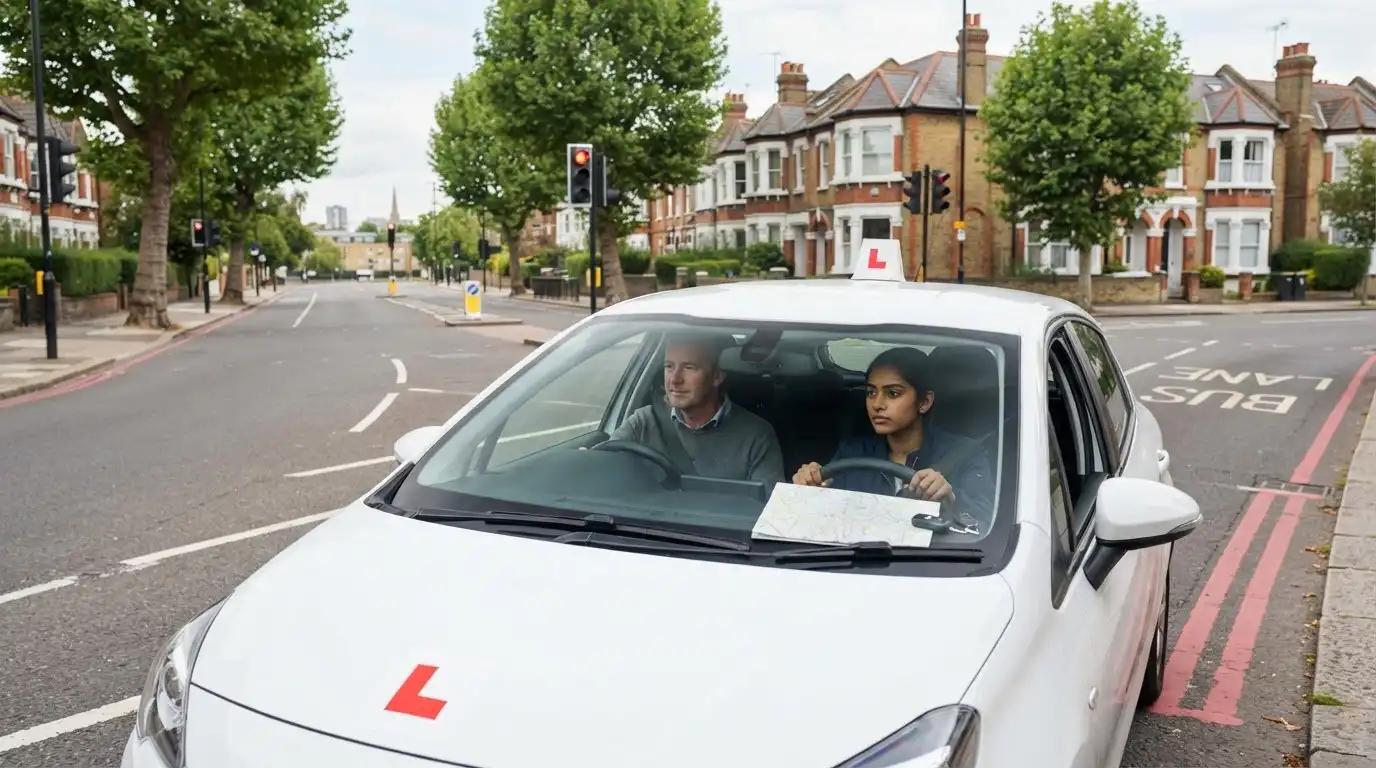
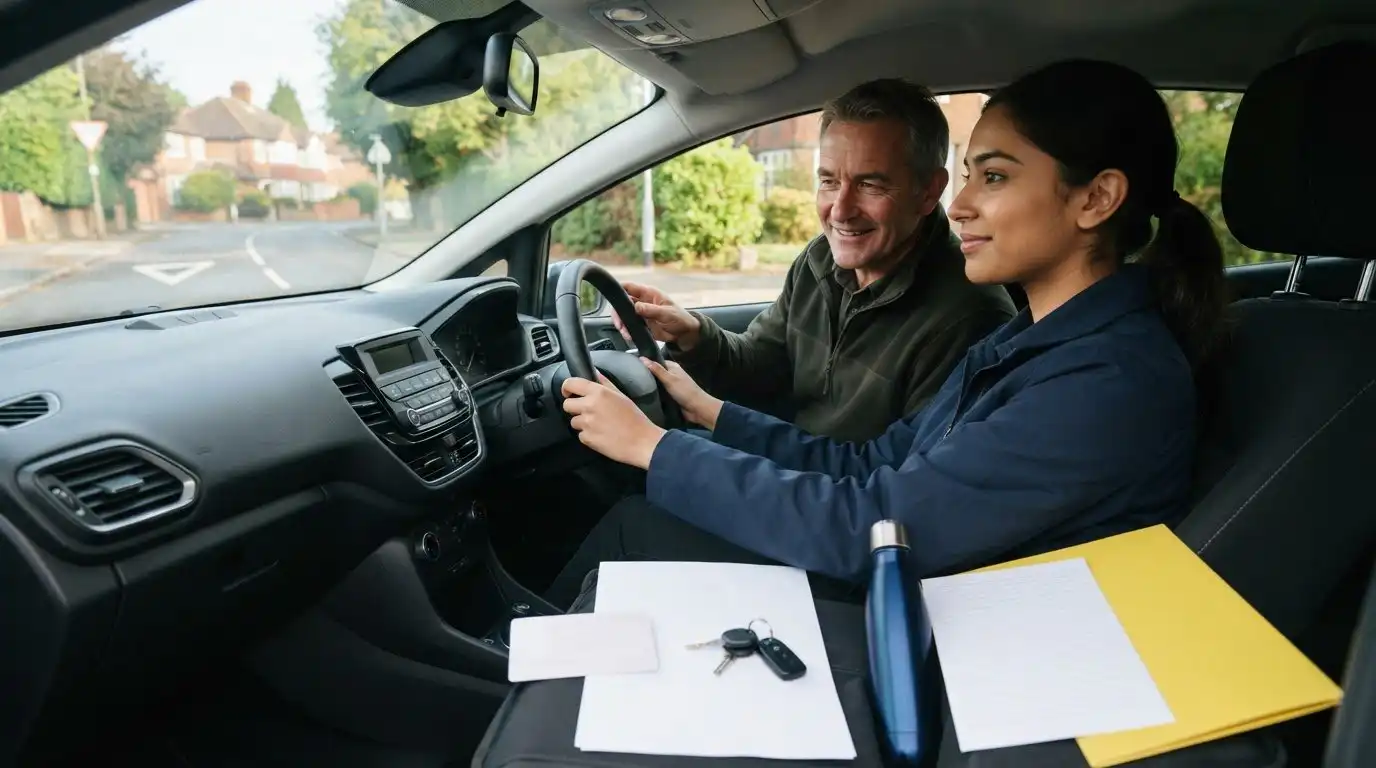
What if the best test-day preparation isn’t more last-minute revision, but a calm plan for the hours around your test? Nerves can make even familiar routines feel uncertain, so a practical driving test day checklist UK learners can follow helps keep the essentials in order. Start with your valid UK provisional photocard licence, the one document you must bring, and check your route and arrangements before you leave.
It’s natural to wonder what happens after you arrive at the test centre. Your examiner will check your eyesight, ask a vehicle safety question, then assess your driving, including a reversing manoeuvre and independent driving. The practical test lasts around 40 minutes. One mistake doesn’t automatically mean you’ve failed, so focus on driving safely rather than trying to be perfect.
This guide takes you through a steady sequence: what to prepare the night before, how to plan the journey and what to expect at the centre, during the test and afterwards. You’ll also find simple ways to settle your nerves and return to the safe, familiar routines you’ve practised. With the practical details taken care of, you can give your attention to the road.
Key Takeaways
- Use a driving test day checklist UK learners can follow to organise the night before, from travel plans to the items you’ll need.
- Know the simple sequence at the test centre, so you can follow the examiner’s instructions without wondering what comes next.
- Skip last-minute cramming and return to familiar routines, focusing on one instruction at a time.
- Use a warm-up to settle into the car and build a calm transition into your test.
- Wimbledon Driving School’s test-day fee includes a 60-minute warm-up, the instructor’s dual-controlled car, insurance, instructor time and the return journey.
Driving test day checklist UK: what to prepare before you leave
Prepare your essentials, travel arrangements and a calm routine before test day. A clear driving test day checklist UK learners can use turns the evening before into a few simple tasks, rather than a late rush to remember everything. For current document and vehicle requirements, follow the latest guidance on GOV.UK; rules can change, so don’t rely on an old checklist or advice passed on by someone else.
The night-before checklist: booking details, route and routine
Check your booking confirmation for the test time and centre address, then plan how you’ll get there. Set aside the items required by current GOV.UK guidance, including your valid provisional photocard licence, and keep your booking details easy to find. The confirmation can be useful for checking arrangements, but don’t assume it replaces a required document.
If you’re taking the test in your own car, review the current GOV.UK vehicle requirements in advance, including any equipment and insurance conditions. If you’re using an instructor’s car, make sure you understand the agreed arrangements. For general background on the test’s purpose and components, see this UK driving test overview, but use GOV.UK for requirements.
- Check the booking: confirm the time, centre location and any travel or pick-up arrangements.
- Prepare essentials: place the required documents and personal items together, ready to take with you.
- Plan the journey: check a reliable route and look for planned roadworks or travel disruption.
- Keep the evening familiar: choose your usual bedtime routine instead of trying to cram theory or practise late.
Before leaving: give yourself time to arrive settled
Allow enough time for the journey to account for local traffic, without treating any particular arrival buffer as an official rule. In busy parts of SW London, for example, traffic conditions can affect how long a trip takes, so check reliable travel information close to departure. If an instructor is collecting you, confirm the agreed pick-up point and time beforehand.
Keep the morning straightforward. Eat and drink as you normally would, dress comfortably for driving and avoid adding unfamiliar tasks to your routine. Last-minute practice can feel tempting, but a rushed session or a new route may add pressure rather than help. If you want to review the sequence of preparations in more detail, the driving test day checklist offers another practical reference.
Before you head out, pause for a final check: booking details, required items, travel plan and pick-up arrangements. That small reset helps you leave home with the practical details organised, so you can focus on the next stage of your test-day journey.
At the test centre: what to expect before the drive begins
At the test centre, take things one step at a time: arrive, follow the examiner’s instructions, complete the required checks and begin driving when directed. The exact sequence can vary, so use the Official UK driving test procedure for current details. Your examiner assesses whether you drive safely and independently, not whether every action is flawless.
- Arrive and get ready. Follow the test-centre instructions and make sure you’re ready to meet the examiner.
- Listen and respond. Pay attention to what the examiner asks you to do. If you haven’t heard or understood an instruction, ask them to repeat or clarify it.
- Complete the checks. Follow the examiner’s directions for the checks and questions that apply to your test.
- Start driving when instructed. Settle into the car, take a breath and focus on the road in front of you.
The first minutes: listen, ask if unclear and settle in
You don’t need to predict every step or rush to fill a pause. The examiner will guide you through what happens next. Listen carefully, and ask for an instruction to be repeated if you’re unsure what you’ve been asked to do. A brief moment of uncertainty is just that: it doesn’t decide how the rest of your drive will go.
Before the car moves, the test includes an eyesight check and vehicle safety questions, as set out in current DVSA guidance. The official DL25 marking sheet shows how the examiner records the test result. Treat it as a reference, not a script to memorise: it records the assessment and any faults, rather than setting out a fixed sequence for every test.
What the examiner is assessing during the drive
The examiner is looking at how you manage the drive as a whole. In everyday terms, that means making appropriate observations, keeping control of the car and responding safely to road conditions and other road users. The assessment covers different aspects of driving, so one awkward moment doesn’t automatically define your performance. Regain your focus and continue safely.
- Look and anticipate: check what’s happening around you and respond to developing situations.
- Stay in control: use the car’s controls smoothly and choose a safe position and speed for the conditions.
- Follow directions safely: listen to the examiner, while keeping your attention on the road and making safe decisions.
For a fuller explanation of the test’s components, the practical driving test guide gives further context. During the test itself, keep returning your attention to the immediate task: observe, decide and act safely.
Driving test day nerves: skip the last-minute cramming
More practice on the morning of your test won’t automatically make you more prepared. A rushed session, a fresh manoeuvre drill or a final attempt to memorise every possible instruction can leave you focused on new information instead of the safe routines you’ve already built. Use your checklist to sort the practical details, then give yourself permission to stop revising and arrive with a clear plan.
A steady routine beats a rushed final practice
Keep preparation familiar. Check your travel and test arrangements, then follow the approach you’ve agreed with your instructor. If you’ve planned a warm-up, use it to settle into the car and practise your usual checks, not to squeeze in unfamiliar manoeuvres. Once your practical preparations are done, avoid turning the remaining time into another lesson unless that’s part of your established plan.
Simple choices can help you feel more settled, but there’s no single technique that works for everyone. You might prefer a quiet few minutes, a short walk or a familiar playlist on the way to the centre. Choose what suits you, and don’t treat any option as a guaranteed way to remove nerves. Explore these practical ways to manage driving test nerves for more ideas.
- Close the revision loop: once you’ve checked your arrangements, put notes and videos away.
- Use familiar cues: rely on the mirror, observation and control routines you’ve practised with your instructor.
- Keep the focus narrow: deal with the next instruction or road situation, rather than trying to predict the whole test.
If something does not go perfectly during the test
A small slip can feel bigger than it is when you’re nervous. Don’t let your mind replay it while the car is moving. Keep your attention on the road, make your next decision safely and listen for the examiner’s next direction. If you’re unsure what they’ve asked, request a repeat rather than guessing or rushing.
Remember, the examiner assesses the drive as a whole against the current DVSA criteria, and a moment of uncertainty by itself doesn’t tell you the result. Readiness means you can consistently demonstrate safe, independent driving in lessons or a mock test; it improves your preparation, but it cannot promise a pass on test day, when your driving is assessed in real time.
During the drive, bring your attention back to what you can control: your observations, your decisions and your response to the road. You don’t need to work out whether a particular moment was a fault while you’re driving. Make the safest choice available and continue with the next part of the test.
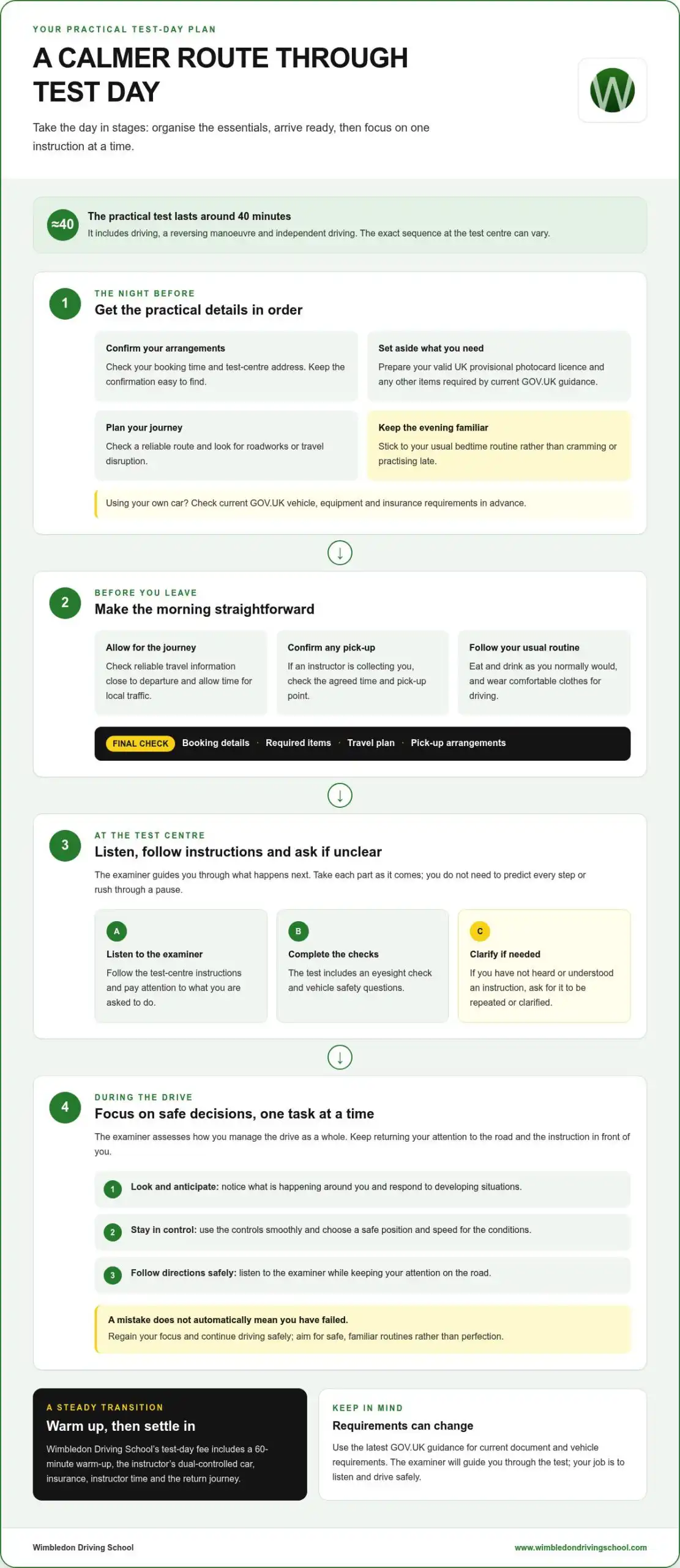
A practical driving test day checklist, from warm-up to test finish
Use this practical sequence to move through the test day without trying to control every detail. Keep the warm-up familiar, give your attention to safe driving during the test, and wait for the examiner’s feedback before deciding how it went.
- Meet your instructor and warm up. Use the time to get comfortable in the car and refresh familiar routines, such as observations and moving off. Stick to the preparation you’ve agreed together rather than trying to learn a new skill at the last minute.
- Arrive and follow the centre’s instructions. Focus on what you’re asked to do next. The examiner will guide you through the checks and questions that apply before the drive begins.
- Drive one situation at a time. Listen to directions, keep checking the road around you and make safe decisions. If you miss or don’t understand an instruction, ask for it to be repeated rather than rushing.
- Listen to the feedback afterwards. Let the examiner explain the result and any points from the drive. Don’t judge your performance based on one moment or a feeling during the test.
Use the warm-up to settle into familiar driving
A warm-up can help you get comfortable in the car and refresh established routines. It can’t guarantee a result, and it shouldn’t become a last-minute attempt to cover everything. Wimbledon Driving School’s test-day fee includes a 60-minute warm-up lesson, use of the instructor’s dual-controlled car for the exam, insurance, instructor time and the return journey. The DVSA test booking fee is separate.
Keep the warm-up purposeful. Follow your instructor’s familiar guidance and focus on settling into the vehicle, rather than adding unfamiliar manoeuvres or changing your usual approach. The aim is to carry your normal safe driving into the test, not to perform a routine you haven’t practised before.
During and after the practical test
Once the test starts, stay with the road situation in front of you. Listen to the examiner, but don’t let a direction pull your attention away from checking that it’s safe to act. If something feels less than perfect, continue driving safely and concentrate on the next decision.
After the drive, listen carefully as the examiner communicates the result and explains any feedback. For a complementary item-by-item review, use this complete driving test day checklist.
Wimbledon Driving School test-day support: make your plan clear
A clear plan can make test day feel more manageable. Once you’ve worked through your driving test day checklist UK preparation, you can decide whether instructor support would help with the practical arrangements and give you a familiar routine before the exam. Wimbledon Driving School supports learners across South West London, South East London, Surrey and Middlesex with a warm-up lesson and use of an instructor’s car for the test.
What the instructor’s test-day support covers
The test-day fee includes a 60-minute warm-up lesson, use of the instructor’s dual-controlled vehicle for the exam, insurance, instructor time and the return journey. The DVSA booking fee is separate. The warm-up is a chance to settle into the car and follow familiar instructor guidance before heading to the test, not a promise of a particular result.
Keep the warm-up focused on the driving routines you already know. For example, use it to get comfortable with the vehicle and practise the checks and observations that are part of your normal driving. Avoid treating the time as a crash course in unfamiliar skills. The aim is to arrive ready to demonstrate safe, familiar driving.
If you’d like more tuition than the included warm-up, that additional tuition is charged separately. Extra travel for tests outside the school’s stated radius may be agreed in advance, so make sure your plan reflects the location of your test centre and the arrangements you’ve made.
Book support for your next step
Structured preparation can help you understand what to expect and make the journey from lessons to test day feel more familiar. Wimbledon Driving School instructors hold RoSPA Gold and Institute of Advanced Motorists qualifications, and the school offers mock tests and test-day preparation support. Use that support to practise consistently, ask questions and build a clear plan, without expecting any lesson or warm-up to guarantee a pass.
Whether you’re still working towards test readiness or want to strengthen a particular part of your driving, choose preparation that fits your current needs. A lesson can help you focus on the areas you and your instructor have identified, so your next steps feel purposeful rather than rushed.
Take your next step with confidence
A driving test day checklist UK learners can rely on is a starting point, not a script for controlling every moment. Your next step is to keep building the judgement and confidence that let you respond safely when the road doesn’t go exactly as expected. Think about the situations where you’d value more practice, then use them to guide a focused conversation with your instructor.
You don’t need to feel completely free of nerves to make progress. Aim to arrive prepared to concentrate, listen and show the safe driving habits you’ve developed. Each lesson is another chance to strengthen those habits and make your own decisions with greater confidence.
Keep moving forward at a pace that supports steady, capable driving. Your test is an important milestone, and the skills you build along the way will stay valuable well beyond the day itself.
Frequently Asked Questions
What should I take with me to my UK driving test?
Check the current GOV.UK requirements and your booking details before travelling, as the official instructions determine what you need for your test. The driving test day checklist UK learners prepare should match that guidance, rather than an old list or someone else’s experience. The night before, set aside anything the current instructions say is required, then check your booking time and test-centre address.
How early should I arrive for my driving test?
Plan your journey so you can arrive settled, without treating a particular arrival time as an official rule. Check the test-centre location and likely local traffic in advance, especially if your route crosses busy roads in South West London or Surrey. Allow enough time to avoid rushing, but don’t add a last-minute practice drive just to fill the wait. A calm arrival gives you space to follow the centre’s instructions and focus.
Can I have a warm-up lesson before my driving test?
Yes. Wimbledon Driving School’s test-day fee includes a 60-minute warm-up lesson, which can help you settle into the car and revisit familiar routines with your instructor. Keep the session focused on your established preparation, rather than trying to learn new skills immediately before the test. If you want tuition beyond the included warm-up, that additional time is charged separately. The warm-up supports preparation, but it can’t guarantee the test result.
What happens if I make a mistake during my driving test?
Don’t assume one mistake has decided the outcome. Continue to drive safely, follow the examiner’s instructions and bring your attention back to the next road situation. Avoid trying to judge the fault yourself while driving, as that can distract you from making safe decisions. The examiner assesses your performance against the relevant criteria; for details of how the test is assessed, refer to current DVSA guidance.
Should I practise right before my driving test?
A familiar, planned warm-up is different from rushed cramming. Use any agreed preparation to get comfortable in the car and refresh routines you already know, such as observations and moving off. Avoid unfamiliar practice or trying to master a new skill just before the test. Follow the plan you’ve discussed with your instructor, and let the warm-up support a steady start rather than treating it as a way to guarantee a better result.
Does a driving test day fee include the DVSA booking fee?
No. Wimbledon Driving School’s test-day fee and the DVSA booking fee are separate charges. The school’s fee covers its test-day arrangements, while the DVSA fee is paid for the practical test booking. Check the current booking information on GOV.UK before arranging your test, as official fees and guidance may change. Keep both charges clear in your plans so you know which payment relates to each part.
Can my instructor’s car be used for the practical test?
Yes. Wimbledon Driving School’s test-day fee includes use of the instructor’s dual-controlled vehicle for the exam, along with insurance and instructor time. This means you can take the test in a car used during your preparation. Vehicle rules still apply, so read the latest GOV.UK guidance on test vehicles for the requirements relevant to the car being used.
Disclaimer
This article is provided for general informational purposes only and does not constitute professional driving, legal, or safety advice. While we aim to keep our content accurate and up to date, rules, prices, and DVSA test requirements can change — always check gov.uk or contact us directly at 020 3524 7968 for the latest guidance before making any decisions. Nothing in this article guarantees a specific outcome, including passing your driving test within any stated timeframe. For current pricing, course availability, and instructor details, please visit our Prices page or get in touch.