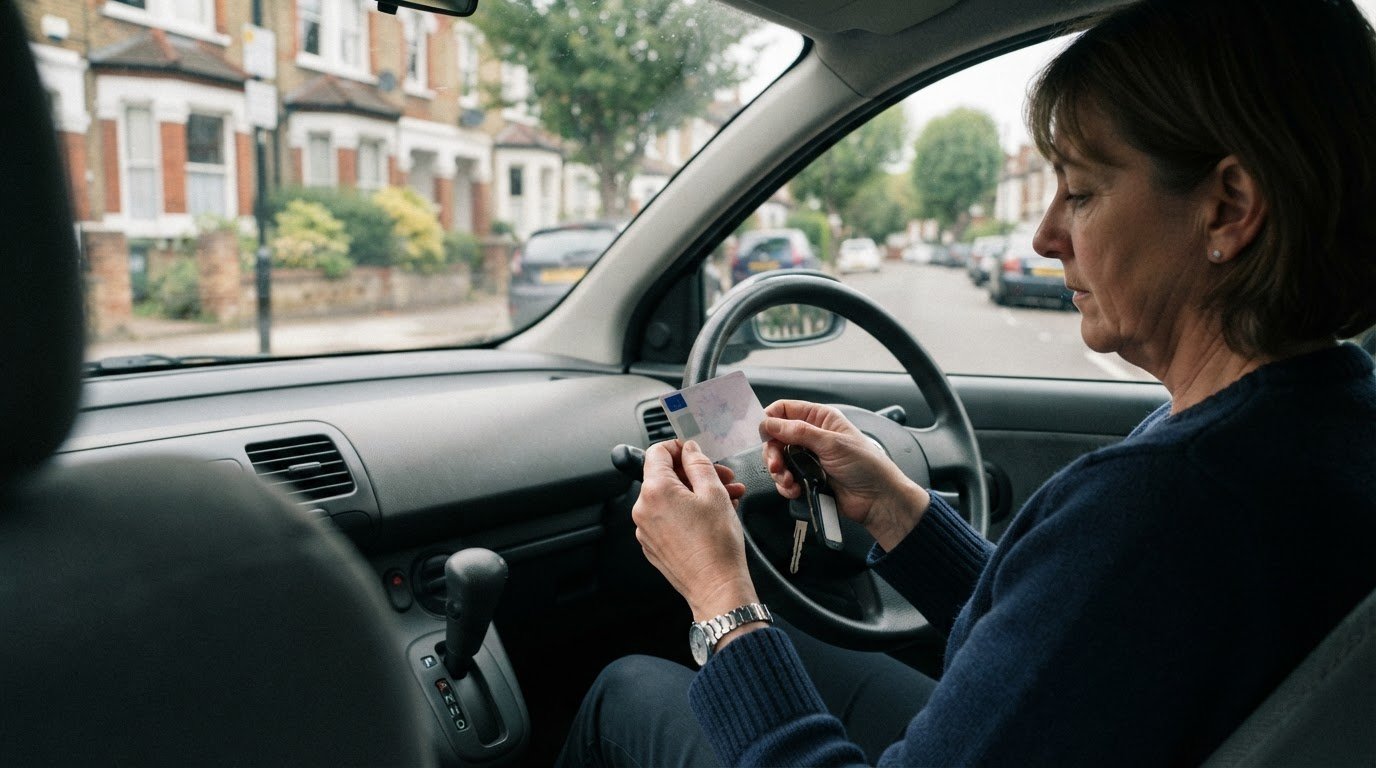
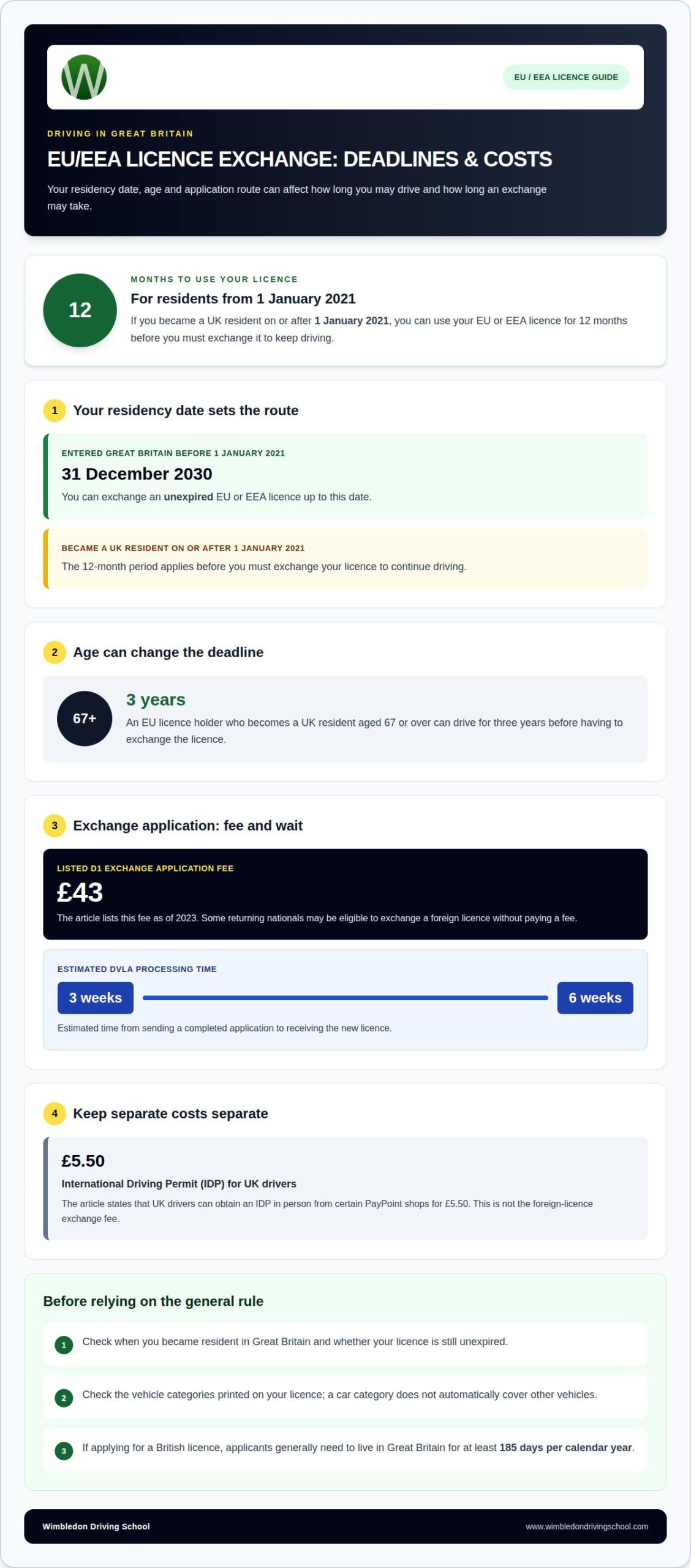
Brexit didn’t make every EU driving licence invalid in Great Britain. European driving licence rules after Brexit in the UK depend on whether you’re visiting or living here: visitors with a valid EU or EEA licence can drive the categories shown on it, while people who became UK residents on or after 1 January 2021 can use their licence for 12 months before they must exchange it to keep driving. Those who entered the UK before that date can exchange an unexpired licence until 31 December 2030.
It’s easy to mix up the rules for visitors, residents and drivers travelling abroad. The listed D1 exchange fee is £43, as of 2023, and DVLA processing is estimated at 3 to 6 weeks.
This guide explains when you can drive in Great Britain with an EU or EEA licence, whether a UK licence is valid in EU countries, and what affects exchange fees and processing times. It also outlines how residency and licence type determine which rules apply to you.
Key Takeaways
- Understand when an EU or EEA licence lets you drive in Great Britain, and why your residency status matters.
- Find out where your UK driving licence is valid in the EU and when an International Driving Permit may be relevant.
- Get a clearer picture of the fee and processing time involved in exchanging a foreign licence.
- Learn what to carry when driving in the EU, including the documents that may apply to your vehicle.
- See how the rules differ for EU and EEA licence holders who became UK residents at different times.
Driving in Great Britain with a valid EU/EEA ordinary licence
An ordinary licence covers non-vocational vehicle categories, such as the car category shown on your licence. A valid full EU or EEA licence lets you drive in Great Britain in the categories it lists. Great Britain means England, Scotland and Wales, and its rules differ from those in Northern Ireland.
Visitors with a valid EU or EEA licence can drive vehicles covered by its categories. You don’t need an International Driving Permit (IDP) to drive in Great Britain on that licence. For example, a licence covering cars lets you drive a car, but it doesn’t automatically entitle you to drive other vehicle categories.
For licence holders living in Great Britain, the permitted period depends on the licence and their circumstances. A full EU or EEA ordinary licence can generally be used until it expires, subject to age-related rules for residents. A full EU-country licence used in Great Britain remains valid until expiry, subject to those rules. After the permitted period ends, you must obtain a British licence to continue driving.
Check the vehicle category, not just the country that issued your foreign licence. Qualifying foreign licence holders may drive small vehicles up to 3,500 kg when their entitlement covers them. A licence covering a car, for instance, does not prove that you can drive a heavier vehicle or a vehicle in another category.
You don’t have to register an EU or EEA ordinary licence in Great Britain, although you may choose to do so. Registration is separate from the right to drive: it doesn’t extend an expired licence or change the vehicle categories it covers. If you apply for a British licence, residency can matter; applicants generally need to live in Great Britain for at least 185 days per calendar year.
An IDP is a document used alongside a driving licence in some countries; it does not replace your licence. UK drivers can obtain one in person from certain PayPoint shops for £5.50, according to the UK Government. That price applies to an IDP for UK drivers, not to an EU or EEA licence or its use in Great Britain.
- Read the vehicle categories printed on your licence.
- Confirm that it remains valid and that your permitted driving period has not ended.
- Separate rules for learner drivers still apply; see the learner-driver passenger rules if you are learning in Great Britain.
Age can change the deadline for residents: an EU licence holder who becomes a UK resident aged 67 or over can drive for three years before having to exchange the licence. If your situation involves residence, an exchanged licence, or a category beyond ordinary car use, identify that detail before relying on the general visitor rule.
UK driving licence validity in EU countries
A UK photocard driving licence is accepted for driving in EU countries, Iceland, Liechtenstein, Norway and Switzerland. Visitors can generally drive the vehicle categories shown on a valid licence. Ireland also accepts a UK licence without an International Driving Permit (IDP).
Countries that do not accept the 1968 Vienna Convention set their own rules for UK drivers. They may require an IDP or other documents, so the requirement depends on your destination and licence type.
An IDP is an official document that accompanies your driving licence, not a replacement for it. UK visitors to the EU generally don’t need one, but exceptions apply to drivers with paper licences or licences issued in Gibraltar, Guernsey, Jersey or the Isle of Man. Some EU countries may require these drivers to carry an IDP.
Before travelling, identify the country where you’ll drive and whether you’ll be visiting or living there. A rule for a short visit may not apply if you move abroad. For example, a UK driver visiting Ireland doesn’t need an IDP, while someone living and driving in Ireland must exchange their licence for a local one.
The same distinction applies across the EU, Iceland, Liechtenstein, Norway and Switzerland. Visitors can use a valid UK photocard licence, subject to the destination’s requirements. If you live and drive in one of these countries, you need to exchange your UK licence for a local one.
- Photocard licence: it remains valid for driving in the EU, Iceland, Liechtenstein, Norway and Switzerland.
- Paper licence: some EU countries may require an IDP from holders of paper licences.
- Licence from a Crown Dependency or Gibraltar: an IDP may be required in some EU countries.
- Residence abroad: exchange your licence for a local one if you live and drive in an EU country, Iceland, Liechtenstein, Norway or Switzerland.
Carry your valid UK licence when driving, and check the requirements for every country on your route. Travelling through several countries can mean dealing with different rules, particularly if your licence is paper-based or was issued in Guernsey, Jersey, the Isle of Man or Gibraltar. Permission to drive in one country doesn’t automatically meet the requirements in the next.
Application fees and processing times
An exchange application replaces an eligible foreign driving licence with a British licence. The fee and waiting time depend on the application route, the issuing country and the documents required.
The listed D1 application process for exchanging a foreign driving licence costs £43, as of 2023. This is the exchange fee, not the cost of driving lessons or an International Driving Permit. Some returning nationals may be eligible to exchange a foreign licence without paying a fee.
Processing time is the period between sending a completed application and receiving the new licence. DVLA processing of a foreign licence exchange application is estimated at 3 to 6 weeks. A Swiss licence exchange can take up to four weeks to become official, so allow time before relying on the new document for travel or work.
Use the appropriate application form for the licence type. Applicants exchanging an ordinary foreign driving licence use a D1 form. The D2 form applies to HGV or PCV licence exchanges, which follow a different route from ordinary car-licence exchanges.
An International Driving Permit (IDP) is a document that accompanies a full UK driving licence for driving in certain overseas countries. UK drivers can get an IDP in person from certain shops that have PayPoint for £5.50, according to the UK Government. You must be at least 18, resident in Great Britain or Northern Ireland, and hold a full UK driving licence.
To apply for an IDP in person, take your full UK licence to a participating PayPoint shop. An IDP cannot be exchanged for a UK driving licence, and it doesn’t replace your full licence. Check whether your destination requires an IDP before travelling. Requirements depend on the country and the licence you hold.
Plan for the full exchange process, not just the fee. Missing documents or a country-specific check can affect how quickly your application is completed. If DVLA holds your only valid licence, don’t drive while it is held unless you have formally applied for its return under the ‘licence not required’ procedure.
- Ordinary foreign licence: use the D1 application route; the listed fee was £43 as of 2023.
- HGV or PCV exchange: use the D2 application route.
- Swiss exchange: allow up to four weeks for it to become official.
- IDP: apply in person at a participating PayPoint shop; the UK Government lists a £5.50 fee.
Keep the distinction clear: an exchange changes your domestic licence, while an IDP supports driving abroad. Neither document entitles you to drive a vehicle category that your full licence doesn’t cover.
Carrying a UK driving licence when driving in the EU
A UK driving licence shows which vehicle categories you may drive. When visiting an EU country, take your valid licence and any other documents required for your journey.
A green card is an international certificate of motor insurance. UK drivers don’t need one when driving in the EU, including Ireland, or in Andorra, Bosnia and Herzegovina, Iceland, Liechtenstein, Norway, Serbia or Switzerland. You still need valid vehicle insurance.
UK vehicle insurance provides the minimum third-party cover required for driving in the EU, including Ireland. Third-party cover relates to damage or injury caused to other people. Policy cover varies, so understand what your insurance protects before setting off. The minimum requirement doesn’t describe every type of cover.
A V5C is the vehicle log book, which records the registered vehicle details. The UK Government advises motorists to carry proof of vehicle registration when driving abroad, such as the V5C. For a UK vehicle taken to the EU for less than 12 months, carry the V5C if you have one.
A VE103 is a vehicle-on-hire certificate for a hired or leased vehicle. If you take a hired or leased UK vehicle to the EU for less than 12 months, carry the VE103 instead of the V5C. This document helps show that you’re authorised to use that vehicle abroad.
A UK identifier shows the vehicle’s registration country when driven abroad. Since 28 September 2021, motorists generally need a UK sticker instead of a GB sticker. In Spain, Cyprus and Malta, display a UK sticker regardless of what appears on the number plate.
Prepare the documents that match your vehicle and journey:
- Your driving licence: take the valid licence that covers the vehicle category you’ll drive.
- Vehicle registration: carry the V5C if you have it for a UK vehicle taken to the EU for less than 12 months.
- Hired or leased vehicle: carry its VE103 when taking it to the EU for less than 12 months.
- Vehicle identifier: display the UK sticker in Spain, Cyprus and Malta, even if your number plate already identifies the UK.
- Insurance: keep valid vehicle insurance in place; a green card isn’t required in the listed countries.
These documents serve different purposes: your licence covers your entitlement to drive, while the V5C or VE103 relates to the vehicle. An International Driving Permit is separate from both. Some EU countries may require one for drivers with paper licences or licences issued in Jersey, Guernsey, Gibraltar or the Isle of Man.
If your route crosses several countries, organise the documents for each vehicle and destination before departure. A rule that applies in Ireland may not cover every detail in Spain, Cyprus or Switzerland. Check that your licence, vehicle papers and insurance relate to the vehicle you’ll actually drive.
EU and EEA licence rules
The rules for using an EU or EEA driving licence in the UK after Brexit depend on licence type, issue history and when you entered Great Britain. Ordinary and vocational licences have different requirements, so identify which categories your licence covers before relying on it.
For EU and EEA licence holders who entered the UK before 1 January 2021, an unexpired licence can be exchanged until 31 December 2030. The exchange deadline applies only while the licence remains valid. An expired licence does not meet that condition, even if its holder entered before the date.
That entry-date provision matters when your UK arrival and later move to Great Britain happened at different times. Keep the relevant travel and residence dates clear when identifying your route. The deadline concerns exchanging an eligible licence; it does not alter the vehicle categories printed on it.
A vocational licence covers professional driving categories, such as lorries and buses. For a holder under 45 living in Great Britain, an EU or EEA vocational licence can be used until age 45 or until five years of residence, whichever is longer. This rule makes both age and the length of residence relevant.
For a vocational licence holder aged over 45 but under 65, the permitted period runs until age 66 or five years of residence in Great Britain, whichever is sooner. The shorter limit is the deciding point. For example, reaching the five-year residence point before age 66 means that limit applies first.
At age 65 or over, a person living in Great Britain can use an EU or EEA vocational licence until they have lived there for 12 months. This is a distinct threshold from the rules for younger vocational holders. The licence category and age group therefore matter before you plan professional driving.
Moving to Great Britain with an EU or EEA vocational licence also requires registration with the Driver and Vehicle Licensing Agency (DVLA). You must register your details within 12 months of moving. Registration records the vocational licence holder’s details; it does not replace any separate exchange requirement or extend the period of use.
Check whether your licence is ordinary or vocational before applying these time limits. A car entitlement isn’t a vocational category, and professional categories have age-based rules that differ from those for ordinary licences. Keep your licence’s issue history and your Great Britain residence dates together, as both can affect the applicable route.
One further distinction concerns how an EU licence was obtained. In Great Britain, an EU driving licence gained by exchanging a non-EU licence is valid for only 12 months. That limit concerns the licence’s origin, not simply the country printed on its face.
Wimbledon Driving School
Wimbledon Driving School can help you build confidence on Great Britain’s roads if you’re new to driving here or want to strengthen your skills. Practical lessons can help you adjust to local road layouts, signs and driving habits, but they don’t replace any licence exchange or legal steps that apply to you.
Choose manual or automatic driving lessons to develop your control and decision-making in the vehicle you intend to drive. Intensive Driving Courses offer focused training, while Pass Plus Lessons can help you continue developing your driving after passing your test.
If you’re unsure which lesson best suits your experience, contact Wimbledon Driving School to discuss your next step.
Take your next step with confidence
Understanding the rules for a European driving licence after Brexit in the UK helps you distinguish licence eligibility from the practical skills needed on local roads. If you’re adjusting to driving here, build familiarity with road layouts, junctions and traffic flow. Confidence comes from applying your skills in real situations, not just understanding the paperwork.
Wimbledon Driving School offers manual and automatic driving lessons, as well as intensive driving courses. Choose the learning format that suits your experience and supports your driving goals. Lessons help you practise and strengthen your decision-making, while licence and exchange requirements remain separate matters.
When you’re ready, take the next step towards greater confidence behind the wheel.
Every journey starts with a clear decision. Move forward at a pace that helps you feel prepared.
Frequently Asked Questions
Can I drive in the UK with a foreign driving licence?
Often, but the answer depends on your licence and circumstances. Start with three details: the country that issued your licence, whether you’re visiting or living in Great Britain, and the vehicle category you intend to drive. A licence covering a car doesn’t automatically cover a lorry or bus. If your circumstances involve Northern Ireland, its process differs from Great Britain’s.
Which country’s driving licences can be exchanged in the UK?
Exchange eligibility depends on the issuing country and the licence holder’s circumstances. Use the GOV.UK driving-licence exchange tool to find the route for a particular country instead of assuming every foreign licence qualifies. Licence type matters too: ordinary car and vocational entitlements follow different application routes. Check your eligibility before applying, especially if your licence has expired or was itself exchanged.
Can UK residents drive in Europe with a UK driving licence after Brexit?
Yes, for a visit, provided your valid licence covers the vehicle you’ll drive and you meet the destination’s requirements. The key distinction is whether you’re travelling temporarily or living abroad. A UK licence doesn’t remove local exchange requirements if you become resident and drive there. Before travelling, consider every country on your route, as requirements may differ.
Do UK drivers need an International Driving Permit in EU countries?
Most UK visitors with a photocard licence don’t need an International Driving Permit in EU countries. The main practical exception depends on your licence’s format or issuing place: some countries may require an IDP for paper licences or licences from certain territories. Check each destination’s requirements before travelling. An IDP supports your licence; it doesn’t replace it or expand your driving entitlement.
What are the post-Brexit rules for using a UK photocard driving licence in Europe?
A valid UK photocard is recognised for driving in EU countries and several associated European countries. Your permitted vehicle categories are determined by the licence itself, not its photocard format. If your trip crosses borders, check each country’s requirements. Rules for visitors may not apply once you live and drive abroad, so plan according to your travel or residence status.
Can UK residents exchange an EU driving licence for a UK licence after Brexit?
Eligible EU licence holders can exchange their licence for a UK one without retaking a driving test. Before applying, distinguish an ordinary car licence from a vocational licence and consider how the EU licence was obtained. A licence issued after exchanging a non-EU licence may follow a different rule. The exchange route also depends on residence history and age, so these details help identify the right application.
How long can visitors from Europe drive in the UK on an EU driving licence?
Visitors can drive in Great Britain with a valid EU or EEA licence for the vehicle categories it covers. The key practical step is to distinguish a temporary visit from becoming resident, as different rules apply to residents. Check the licence’s expiry date and categories before driving. If you’re travelling to Northern Ireland, remember that its licensing process differs from Great Britain’s.
Do UK driving licences need a code or extra documents to hire a car in Europe?
A special code isn’t generally required for a UK photocard to be valid for driving in EU countries. Driving entitlement and a hire company’s rental conditions are separate, so licence validity alone may not meet every booking requirement. Check the documents required for your rental and destination, particularly if you hold a paper licence or one issued outside mainland Great Britain.
Disclaimer
This article is provided for general informational purposes only and does not constitute professional driving, legal, or safety advice. While we aim to keep our content accurate and up to date, rules, prices, and DVSA test requirements can change — always check gov.uk or contact us directly at 020 3524 7968 for the latest guidance before making any decisions. Nothing in this article guarantees a specific outcome, including passing your driving test within any stated timeframe. For current pricing, course availability, and instructor details, please visit our Prices page or get in touch.