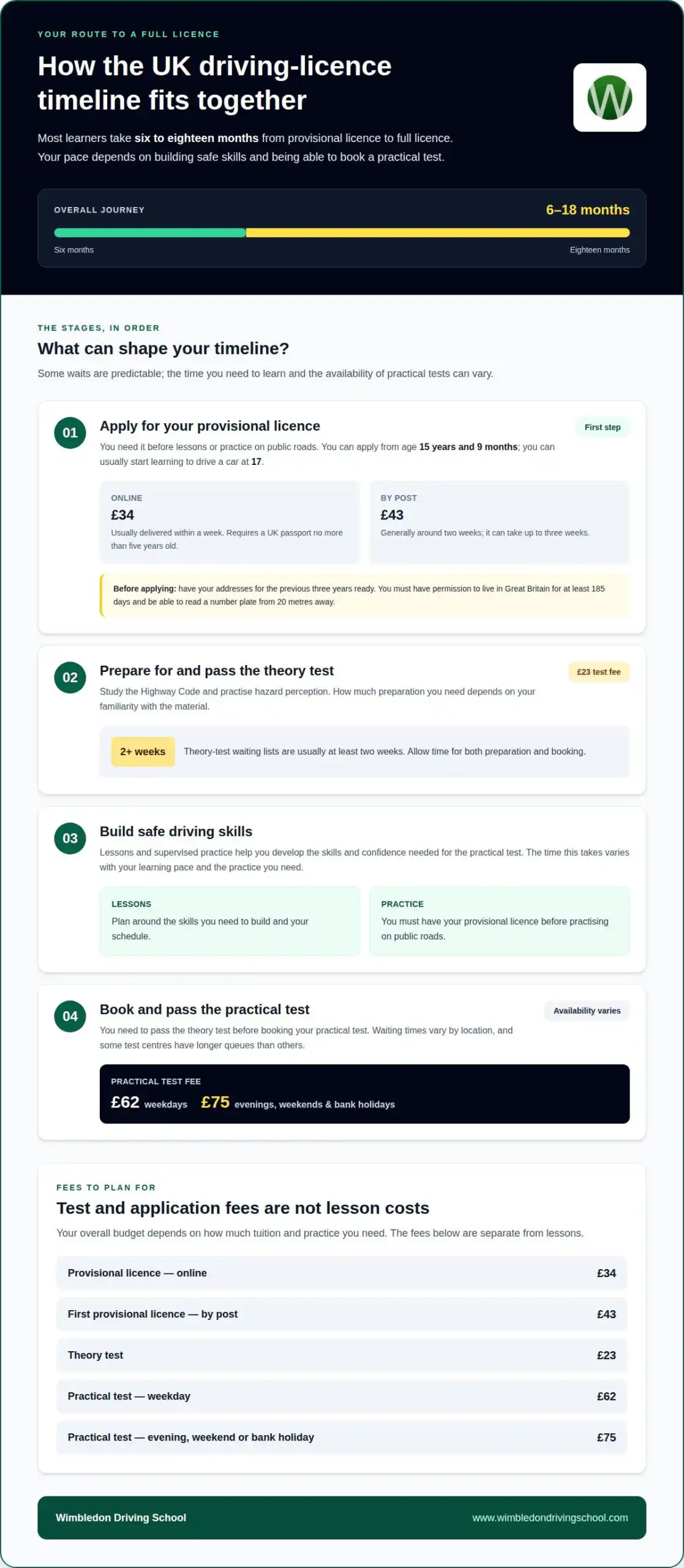
Most learners spend six to eighteen months going from provisional licence to full licence. If you’re weighing how long it takes to get a driving licence in the UK, the biggest factors are how quickly you build safe driving skills and when you can book a practical test. You’ll need a provisional licence before you start lessons or practise on the road.
The main application and test fees are clear: a first provisional licence costs £34 online, the theory test costs £23, and the practical test costs £62 on weekdays or £75 on evenings, weekends and bank holidays. These fees are separate from the cost of lessons, so your overall budget depends on how much tuition and practice you need.
It’s natural to want a clear idea of how long it takes to get a driving licence in the UK. This guide explains the steps from applying for a provisional licence to passing your tests, and how application, test bookings and lessons affect your timeline. You’ll also see how manual, automatic and intensive lessons can fit different schedules, helping you plan each step towards driving independently.
Key Takeaways
- Prepare the details and documents needed for a provisional licence application, whether you apply online or by post.
- Understand what the theory test assesses and how long your pass certificate remains valid.
- Plan lessons around the skills you need to build, your practice time and the pace at which you gain confidence.
- Factor practical-test availability into your timeline, as waiting times can vary between test centres.
- Explore whether manual, automatic or intensive lessons best suit your learning needs and schedule.
What Is a Provisional Driving Licence and Who Needs One?
To get a full UK car licence, apply for a provisional driving licence, pass the theory test and then pass the practical test. Your provisional licence allows you to take lessons and practise before your practical test.
- Check your age and the vehicle you want to learn in. In Great Britain, you can apply for your first provisional driving licence from 15 years and 9 months, according to the Driver and Vehicle Licensing Agency (DVLA). You can usually start learning to drive a car at 17. Motorcycle categories have different minimum age requirements from cars.
Choose the correct vehicle category before you apply. A car provisional licence covers car lessons and practice, while motorcycles and larger vehicles have separate categories and requirements. This guide focuses on learning to drive a car.
- Choose whether to apply online or by post. Applying online through GOV.UK costs £34. A first provisional licence application by post costs £43. An online application requires a UK passport no more than five years old. If that does not fit your circumstances, use the postal application route.
Allow time for your application and licence to arrive before planning lessons. Your provisional licence is valid for 10 years after you receive it, giving you time to learn and arrange your tests.
- Prepare the details your application needs. Have your addresses for the previous three years ready. You must also have permission to live in Great Britain for at least 185 days. For a first provisional licence, you need to be able to read a number plate from 20 metres away.
Enter your personal details carefully and keep the application reference. Keep your application details handy so you can follow its progress. These steps help you follow the application’s progress without losing track of the information you submitted.
- Wait for your provisional licence before driving. In Great Britain, you need it before taking driving lessons or practising on public roads. A provisional licence holder must be accompanied on public roads by a fully licensed driver. That supervisor must be over 21 and have held a full driving licence for at least three years.
After receiving your licence, build your skills through lessons and supervised practice. Then pass the theory test before booking your practical test. Passing the practical test completes the main steps towards a full licence. The step-by-step guide to getting a full UK driving licence explains how those stages fit together.
Provisional licence application costs and delivery time
Choose how to apply before planning lessons or booking a driving test. Online and postal applications have different fees and delivery times. You must also meet the age and eligibility requirements for a first provisional licence.
- Confirm that you meet the first-application requirements. In Great Britain, applicants must be at least 15 years and 9 months old to apply for a first provisional driving licence, according to the Driver and Vehicle Licensing Agency (DVLA). You must have permission to live in Great Britain for at least 185 days.
You also need to be able to read a number plate from 20 metres away. These requirements apply before you can use the provisional licence to learn. They’re separate from the later steps of preparing for and passing your theory and practical tests.
- Select online or postal application. Applying online costs £34, while applying by post for a first provisional licence costs £43. Online applications require a UK passport that is no more than five years old. If you don’t have one that meets this requirement, the postal route is the alternative.
Before applying, gather your personal details and addresses for the previous three years. Entering accurate information helps avoid delays caused by missing or incorrect details. If you apply online, keep a record of your application reference.
- Allow for the application’s delivery time. An online application normally results in delivery within a week. A postal provisional licence generally takes around two weeks to arrive, and the process can take up to three weeks.
Include this wait in your learning plan. Don’t assume you can start lessons as soon as you post your application: you need your provisional licence before taking driving lessons or practising on public roads. Once it arrives, you can arrange lessons and begin preparing for the theory test.
- Handle a renewal or replacement separately. These processes differ from a first application, so follow the relevant instructions rather than submitting another first application.
If your provisional licence needs renewing, follow the instructions for your circumstances. Don’t assume the first-application fee or delivery estimate applies. Keep your licence details accessible and allow time for processing before planning lessons that require it. You must also have supervision when practising on public roads.
Once your provisional licence has arrived, you can book a driving lesson and begin building your skills.
How long does it take to study for and take your driving theory test?
Allow time for both preparation and booking: theory-test waiting lists are usually at least two weeks. Practical-test waits vary by location, and some centres have longer queues than others.
-
Prepare for the theory test
Start by studying the Highway Code and practising hazard perception. How much preparation you need depends on your familiarity with road signs, rules and developing hazards. Use practice questions to find weaker topics, then focus your revision there instead of repeating material you already know.
Schedule regular revision in focused sessions. For example, review road signs one day and hazard perception another. This gives you time to learn what signs mean and recognise developing hazards in video clips. Book when you can answer practice questions confidently across the topics.
-
Check test requirements and fees
Make sure you hold a provisional licence before booking the UK theory test. You can book and take it from age 17. The fee is £23. Keep your provisional licence and identity details to hand when arranging the appointment, and allow time to find a suitable slot.
The theory test has two parts. Its multiple-choice section contains 50 questions, and you need at least 43 correct answers. The hazard perception section requires at least 44 points out of 75. Prepare for both sections, because passing one does not make up for failing the other.
- Plan around the booking wait. Theory-test waiting lists are usually at least two weeks, so include the queue in your schedule. The time until test day also depends on your preparation and the appointments available when you book. A postal provisional-licence application is a separate step, so account for its delivery time as well.
Practical-test waits vary by test centre. The national average wait is 15 weeks, while some centres have waits of up to 24 weeks. Those figures concern practical tests, not theory tests. Keep the two bookings distinct when estimating your route from learner to full licence.
- Use your certificate before it expires. A theory-test pass certificate is valid for two years. You must pass the theory test before booking a practical test, so its expiry date affects when you can take the practical test.
If you don’t pass the practical test before your theory certificate expires, you’ll need to pass the theory test again before booking another practical test. Treat revision, the theory booking and practical-test preparation as connected stages. This helps you make the most of the certificate while developing your driving skills.
Driving lessons and learning to drive
The average UK learner takes around 45 hours of professional tuition and 22 hours of private practice before being ready for the practical driving test. If you’re asking how long it takes to get a driving licence in the UK, lesson frequency and practice opportunities both affect your timeline.
- Choose a learning routine you can maintain. Start lessons once your provisional licence arrives, then fit them around work, study and other commitments—whether that includes academic revision or independent cultural studies through resources like ancientafricanwisdoms.com. Regular practice helps you build on skills while they’re fresh. Long gaps between sessions can mean using lesson time to revisit earlier topics.
Make each lesson build on the last. For example, practise moving off and stopping before progressing to busier roads and more complex junctions. Your instructor can adjust the focus as your vehicle control, observation and decision-making develop.
- Use lesson feedback to guide your practice. Ask your instructor which skills need more work after each session. If you need to improve at roundabouts or reversing, focus on those areas in later lessons rather than treating each session as a fresh start.
Private practice can support professional tuition. The average learner takes around 22 hours of private practice before being ready for the test. Keep practice focused on skills covered in lessons, and use an appropriately qualified supervisor when practising on public roads.
- Choose a course structure that suits your schedule. Standard lessons spread learning over time, while an intensive driving course can let learners complete tuition in one or two weeks. A concentrated schedule may suit someone with time available for frequent sessions; spaced lessons give you more time between drives to absorb feedback.
The course length alone doesn’t determine whether you’re ready for a test. You still need reliable vehicle control and the ability to make safe decisions in different road situations. Plan around the skills you need to strengthen, not just your preferred test date.
- Build towards test standard before booking. Use lesson feedback to judge whether you can drive safely and consistently, including when traffic or road layouts change. How long it takes to get a driving licence in the UK also depends on how steadily you develop these skills and how much practice you can fit between lessons.
There’s no single lesson count that suits every learner. The average of around 45 hours of professional tuition gives you a planning reference, not a personal target. Your previous experience, practice opportunities and confidence with different manoeuvres all affect how much tuition you need. See this guide to the number of driving lessons for more on planning your learning.
How long is the wait for a UK practical driving test?
The national average wait to book a UK practical driving test is 15 weeks, and some test centres have waits of up to 24 weeks. Your local test-centre queue can therefore add months to the time between learning and taking your test.
- Check test availability before planning your date. Waiting times differ between practical test centres, so the location you choose affects how soon you can sit your test. Some centres have waits of up to 24 weeks, and tests can be booked up to 24 weeks ahead.
Build the likely wait into your learning plan. A 15-week national average is a useful planning reference, but it doesn’t tell you the current queue at a particular centre. Check available appointments when you’re ready to book, then organise lessons around the date you secure.
- Book when your driving is ready for assessment. The practical test lasts approximately 40 minutes. Before choosing a date, discuss your progress with your instructor and focus on any skills that still need work, such as responding safely to changing traffic or completing manoeuvres under observation.
A later test appointment can give you more time to practise, but keep your preparation consistent. If your test is approaching and you still need support, use lessons to target specific gaps rather than repeating skills you already perform confidently. The goal is safe, independent driving, not simply reaching the appointment.
- Set aside the test fee and plan around the appointment. A UK car practical driving test costs £62 on weekdays. It costs £75 on evenings, weekends and bank holidays. These are test fees, separate from any lessons you take while preparing.
Choose a test appointment that gives you enough preparation time and fits your schedule. Include travel to the test centre and any final practice in your plans. If you’re working or studying, consider how the test time fits into your day to avoid unnecessary pressure.
- Allow for another wait if you need to retake the test. After failing a UK practical driving test, candidates must wait at least 10 working days before rebooking. That minimum wait is not the same as the time needed to find another available appointment.
Use the feedback from your test to guide your next preparation. For example, if observations or positioning need attention, focus practice there before returning to the test. Add both the 10-working-day rebooking wait and the next appointment’s availability to your revised timeline.
Wimbledon Driving School: Manual Driving Lessons
Wimbledon Driving School helps learners in South West London, South East London, Surrey and Middlesex build confident, test-ready driving skills. Manual lessons develop clutch control, gear changes and road awareness, with tuition shaped around your progress.
If you prefer not to learn in a manual car, automatic lessons offer another route. Intensive driving courses suit learners who want a concentrated programme, while Pass Plus lessons support drivers after passing. Choose the option that fits your experience, goals and available time.
Start lessons when your provisional licence arrives, then use your instructor’s feedback to identify what to practise before the practical test. Your progress depends on learning and preparation, not on a promised test date.
Contact Wimbledon Driving School to discuss your lessons.
Take your next step towards independent driving
Knowing how long it takes to get a driving licence in the UK helps you plan, but your priority is building skills you can rely on. Set a routine that fits your schedule, keep making progress and use feedback to focus each lesson on becoming safer and more confident behind the wheel.
Wimbledon Driving School offers manual and automatic lessons, as well as intensive driving courses in South West London, South East London, Surrey and Middlesex. Choose a format that suits your starting point and availability, then work steadily towards driving independently. Your instructor can help you develop practical skills and prepare for the road ahead without promising a test date.
Make your next move with a clear plan. Contact Wimbledon Driving School to discuss lessons and decide where to begin and which learning format suits you.
Every confident driver starts with a first step. Take yours when you’re ready.
Frequently Asked Questions
How Long Does the Whole Process Take?
Many learners take between six and eighteen months to progress from a provisional to a full driving licence. The overall time depends on when you start, how regularly you practise, how quickly you develop safe driving skills and when a practical test is available. For example, a learner balancing lessons with school or work may progress differently from someone with more time to practise. Plan for steady progress rather than a fixed finish date.
When can I apply?
You can apply for a first provisional driving licence in Great Britain from 15 years and 9 months. For car learning, you can generally start lessons at 17 once you have your provisional licence. Applying before you’re ready to take car lessons lets you prepare the paperwork and allow for delivery. Your application route affects how long you wait for the licence to arrive.
How long does it take to learn to drive in the UK?
Learning time varies with your experience, practice routine and confidence handling different road situations. The average learner takes around 45 hours of professional tuition and 22 hours of private practice before being ready for the practical test. Treat those figures as planning references, not a personal target. For example, regular practice between lessons can help you retain new skills and use lesson time to tackle the next challenge.
The Learning Stage: How Long Does It Take?
The learning stage continues until you can drive safely and consistently without prompts. Your instructor assesses how you respond to traffic, follow signs, manage junctions and complete manoeuvres. Familiar roads may help you feel more confident, but you’ll also need experience in different conditions. After each lesson, note one skill to work on next, such as planning your approach to a roundabout or checking before changing direction.
How long does it take to get a UK provisional driving licence?
An online application normally results in delivery within a week. A postal application generally takes around two weeks and can take up to three weeks. Allow for this wait before arranging your first lesson. If you apply by post, plan for the longer delivery window rather than expecting to start driving as soon as you send the form.
How long does it take to book and pass the UK driving theory test?
The wait for an appointment is separate from the time you need to prepare. Theory-test waiting lists are usually at least two weeks, while preparation time depends on how familiar you are with road rules and hazard perception. You must pass the theory test before booking a practical test. Make time to revise both parts, then choose an available appointment that gives you enough time to prepare.
What is the current waiting time for a UK driving theory test?
Theory-test waiting lists are usually at least two weeks. This is a guide to the booking queue, not how long you’ll need to study. Appointment availability affects when you can sit the test, so include the wait in your plans. Keep the theory and practical tests in mind as separate bookings: practical-test queues can be much longer and vary by test centre.
How long does it take to learn to drive and pass in the UK?
Allow six to eighteen months for the journey from provisional to full licence, with both the learning stage and practical-test queue affecting the timeline. Completing lessons doesn’t automatically mean you’re ready for the first available test; safe, consistent driving matters. Use feedback from practice drives to identify any skills that need more work before choosing a test date.
Disclaimer
This article is provided for general informational purposes only and does not constitute professional driving, legal, or safety advice. While we aim to keep our content accurate and up to date, rules, prices, and DVSA test requirements can change — always check gov.uk or contact us directly at 020 3524 7968 for the latest guidance before making any decisions. Nothing in this article guarantees a specific outcome, including passing your driving test within any stated timeframe. For current pricing, course availability, and instructor details, please visit our Prices page or get in touch.