One bad driving lesson doesn’t mean you’re a bad driver. If you’re wondering what to do if you have a bad driving lesson, give yourself time to settle, think about what went wrong and ask your instructor for clear feedback on what to practise next. If the lesson has left you extremely anxious, taking a few days before getting back behind the wheel can help.
It’s understandable to feel frustrated or embarrassed after a mistake, especially when you’re trying hard to improve. Mistakes are part of learning, and one difficult session doesn’t erase the skills you’ve already developed. If your instructor’s manner is making it harder to learn, tell them what’s not working and explain what would help you feel supported.
This guide explains what to do if you have a bad driving lesson: how to process the disappointment, learn from specific errors and manage nerves next time. You’ll also find practical ways to respond if you feel stuck, rebuild confidence and decide what to do next, so one rough drive doesn’t throw you off course.
Key Takeaways
- Separate one difficult lesson from your overall ability, then give yourself space to process how it felt.
- Explain calmly what isn’t working with your instructor and ask for specific feedback you can use next time.
- Turn a mistake into a practical focus for your next drive, rather than treating it as proof you can’t improve.
- If progress feels slow, ask your instructor to help you identify what’s changing and agree a realistic next step.
- Use steady breathing and a simple focus for the drive to help settle nerves before they build.
1. Why are driving instructors rude?
A sharp tone can stem from impatience, poor communication or a mismatch in teaching styles. Whatever the reason, repeated criticism without clear guidance can make you tense behind the wheel. You may focus on avoiding your instructor’s reaction instead of learning to manage the road. That can slow your progress by making it harder to ask questions, practise calmly and remember feedback.
Look for patterns, not one awkward exchange. A poor or unsafe instructor may shout, mock mistakes, give confusing directions or pressure you into a manoeuvre you don’t understand. Note if they use a phone while you’re driving or fail to explain a safety intervention. If you feel unsafe, ask them to stop somewhere appropriate and end the lesson. Don’t continue just to avoid an uncomfortable conversation.
Progress should be discussed with specific examples. Ask, “What did I do well today, and what should I practise next?” If you’re still repeating the same quiet-road exercises, ask what skill you need before moving on. One learner reported spending 10 hours on quiet roads and empty roundabouts; another said they reached dual carriageways and manoeuvres within three lessons with a different instructor. Those experiences show why clear goals matter, but your next step should match your own skills.
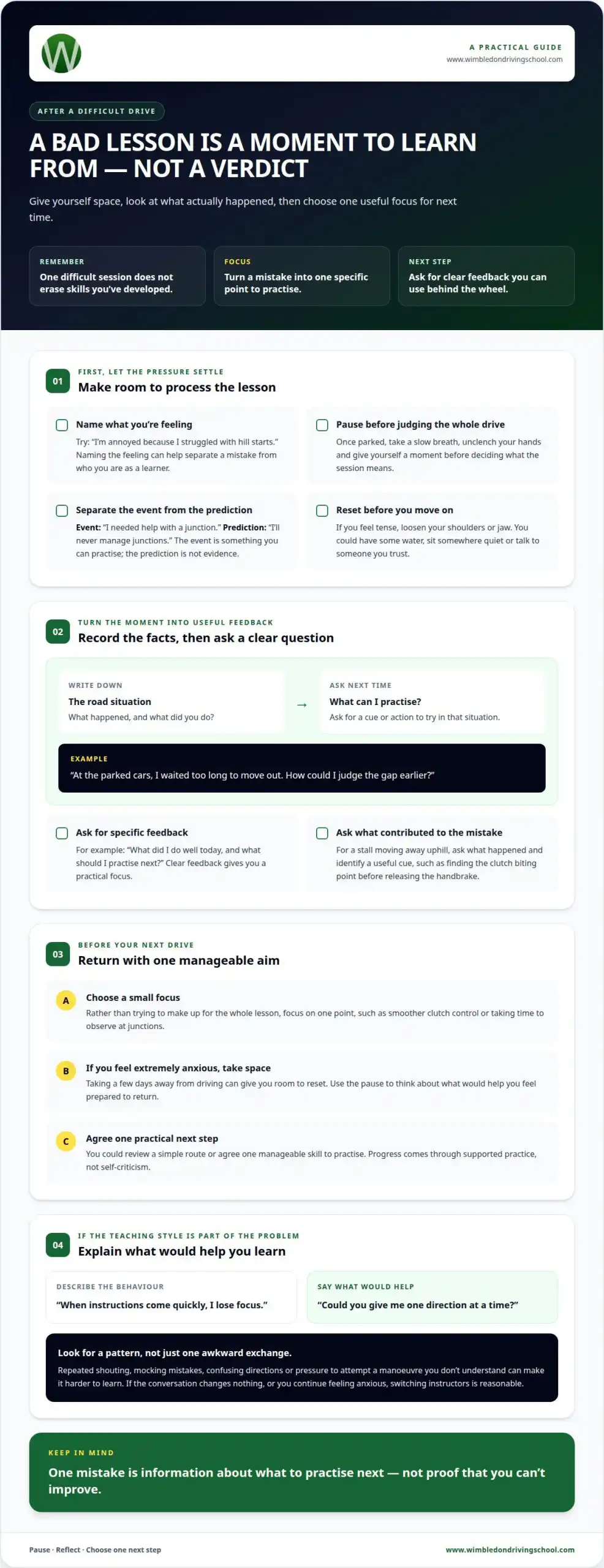
Raise a teaching-style concern directly when you feel able. Explain the behaviour and its effect: “When instructions come quickly, I lose focus. Could you give me one direction at a time?” A professional response should make the next lesson clearer. If the conversation changes nothing, or you continue feeling anxious, switching instructors is reasonable. One learner said it took three instructors to find a suitable fit. If gear changes are adding to your workload, consider whether automatic driving lessons might help you focus on other skills.
An instructor may take control of the wheel to prevent an immediate hazard, such as steering away from a parked car when you haven’t responded. Afterwards, ask what happened and which cue you missed. A clear explanation turns the intervention into useful feedback. If it’s unexplained or repeated, ask for a calm review before continuing so you know what to do next.
For concerns about conduct, first make a factual complaint to the instructor or their driving school. Include the lesson date and what happened. If the issue concerns an Approved Driving Instructor’s conduct or fitness to teach, you can complain to the DVSA, which regulates driving instructors. Keep your account specific, using examples rather than insults.
2. Acknowledging frustration after a difficult lesson
After a difficult drive, frustration can follow you through the rest of the day. You might replay a missed turn, a stalled engine or a moment when you felt rushed. Name the feeling plainly: “I’m annoyed because I struggled with hill starts.” This separates the mistake from your identity as a learner.
Give yourself a brief pause before judging the whole lesson. One learner described wanting to leave 10 minutes into a two-hour session. That reaction shows how quickly pressure can build, not that the learner is incapable. Once parked, take a slow breath, unclench your hands and give yourself a moment before deciding what the session means.
Separate what happened from what you fear it means. Write down one factual event, such as “I needed help with a junction”, then add the conclusion your mind supplied, such as “I’ll never manage junctions”. The first is something you can practise; the second is a prediction, not evidence. This distinction can stop one error from defining the whole drive.
Make a brief, specific note while the details are fresh. Record the road situation, what you did and what you want to ask next time. For example: “At the parked cars, I waited too long to move out. How could I judge the gap earlier?” A clear question gives your next lesson a useful focus.
Notice what your body is doing, too. If your shoulders are tight or your jaw is clenched after a tense drive, loosen them before travelling home. Have some water, sit somewhere quiet or speak to someone you trust. You don’t need to solve every driving concern that evening. Choose one practical point to revisit and leave the rest for later.
If the lesson has left you extremely anxious, taking a few days away from driving can give you room to reset. Use the pause to identify what would help you feel prepared to return, such as reviewing a simple route or agreeing on one manageable skill to practise. If you hold a provisional licence, remember that confidence develops through supported practice, not self-criticism.
When you’re ready, return with a small, clear aim rather than a demand to make up for the whole lesson. You could focus on smoother clutch control or taking time to observe at junctions. If a fresh lesson would help you restart with a practical focus, you can book a driving lesson for your next step.
3. Constructive feedback and learning from mistakes
After a difficult drive, write down the moment that went wrong and choose a question for next time. A missed mirror check, for example, becomes a practical learning point when you identify the situation and the action you want to practise. The aim isn’t to excuse the mistake, but to understand what happened and how to respond differently.
If you’re deciding what to do if you have a bad driving lesson, start with the facts, not a judgement about your ability. “I stalled when moving away uphill” describes an event; “I’ll never drive properly” is a prediction. Ask your instructor what contributed to the stall, then identify a useful cue, such as finding the clutch biting point before releasing the handbrake.
Ask for feedback that’s specific enough to use behind the wheel. Instead of asking, “Was that lesson bad?”, try, “At the junction, what should I have checked before moving?” Your instructor can explain what they observed and what to change. If the answer isn’t clear, ask them to describe the sequence again before practising it.
For a manoeuvre or junction routine, break the task into clear steps. The Mirror-Signal-Manoeuvre sequence gives you a structure: check mirrors, signal when appropriate, then act when safe. If your approach felt rushed, identify which step you missed and practise noticing it earlier. Keep observing the road around you; the sequence doesn’t replace awareness.
Review each session briefly. Note one action that went well, one moment that needs work and one question for next time. You might record that your steering stayed controlled, your position drifted near parked cars, and you want advice on judging a safe passing gap. These details give your next conversation a clear starting point.
Ask for feedback about your actions, not your character. “You didn’t check your left mirror before moving off” identifies something to practise; “you’re careless” doesn’t explain how to improve. If the feedback is vague, ask what your instructor observed and what a better response would look like in that situation.
A lesson can still be useful even if the drive felt disappointing, provided you can identify what happened and a specific next step. Turn one difficult moment into a clear practice goal. For example, ask to focus on earlier observation at junctions next time.
Before your next lesson, agree on one skill to focus on. Afterwards, compare what you noticed with your instructor’s feedback and decide what to practise next. This keeps your learning active and gives each drive a clear purpose.
Feeling stuck or less confident while learning
Feeling stuck can happen when familiar skills meet a new challenge. You might manage a junction on a quiet road, then hesitate when parked cars narrow your view. Compare today’s drive with an earlier lesson: perhaps you now check mirrors before moving off without a prompt. That change matters, even if another skill still needs work.
If you’re weighing what to do if you have a bad driving lesson, look for a practical next step instead of judging your overall ability. Ask your instructor what has changed and where you’re still struggling. For example, “I manage quiet junctions, but busy ones make me rush” gives you both a specific skill to work on.
Set a goal you can observe on your next drive. You could focus on scanning for a safe gap before joining a roundabout, rather than trying to master every roundabout at once. Agree on what successful practice looks like, such as noticing traffic early and responding safely. Clear, achievable goals can make your next steps easier to plan.
Repetition may feel like a lack of progress, but a task can change as conditions become more demanding. Moving from a quiet road to busier traffic means using observation, steering and speed control together. Ask your instructor which skill the new situation is testing. This helps you focus on the challenge instead of assuming you’ve forgotten everything.
If a lesson has caused extreme anxiety, taking a few days off can give you space to reset. Use the pause to decide what would help you return, such as starting on a familiar route or revisiting a difficult junction. Prepare a practical question for your instructor, rather than treating the break as a test of whether you’re ready.
A difficult lesson before your practical test doesn’t, by itself, mean you’re unready. Ask your instructor to review your strengths, recurring errors and the skills you can manage without prompts. Discuss a realistic timeframe for readiness, based on your performance across different situations rather than one stressful drive. That gives you a fuller picture to work from.
Between lessons, practise only skills you’ve already covered, and only when you can do so safely with appropriate supervision. At your next session, begin with a familiar task and build towards harder situations as your confidence grows. A small, steady step can help you regain momentum.
5. Managing stress during a driving lesson
To manage nerves after a difficult drive, slow your breathing, name one manageable goal and tell your instructor what would help. Rebuild confidence through clear, achievable practice, rather than demanding a perfect performance from yourself.
Before starting the vehicle, notice where you’re holding tension. If your hands feel tight on the steering wheel, relax your grip and breathe out slowly. Take another calm breath before moving off, then bring your attention back to the road, mirrors and your instructor’s directions.
Agree on a simple plan before the lesson begins. For example, tell your instructor you want to practise approaching junctions on familiar roads before moving on to busier traffic. Knowing the first focus can ease the pressure to manage every driving skill at once. Ask for directions early and request a pause to discuss anything that feels unclear.
During the drive, focus on the next safe action. If you miss a turn, follow your instructor’s directions instead of trying to correct it suddenly. If you stall, pause, follow the restart steps you’ve been taught and continue when it’s safe. A mistake is something to respond to, not a reason to rush the rest of the drive.
Take a brief reset between challenging situations. Once the vehicle is safely stopped, relax your shoulders, take a steady breath and listen to the next instruction. Ask your instructor to explain the immediate priority, such as checking for a safe gap or controlling your speed. A clear cue gives your attention somewhere practical to go.
If stress rises sharply, tell your instructor before it affects your concentration. Ask to stop somewhere safe and talk through what’s worrying you. If a lesson has left you extremely anxious, a few days away from driving may help you return with a clearer head. Resume with a familiar task, then build towards harder situations at a manageable pace.
UK driving lesson cancellation and refund arrangements depend on the terms agreed when you booked. Check the booking terms for notice requirements, charges and how refunds are handled. If you need to cancel, contact the school promptly and keep its reply. If a lesson went ahead but was poor, explain the specific problem and say what outcome you’re seeking, such as a discussion about the session.
Regular reviews can also help during a structured driving course. After each lesson, note one situation that raised stress and one response that helped, such as asking for clearer directions. Bring your notes to the next session so you and your instructor can shape the practice around specific pressure points.
Wimbledon Driving School: Manual Driving Lessons
Wimbledon Driving School can help you turn a difficult lesson into a clear plan for your next steps. Its manual driving lessons support learners across South West London, South East London, Surrey and Middlesex, with tuition shaped around the skills you want to develop.
If clutch control or gear changes are adding pressure, automatic driving lessons may let you focus more on observation and road decisions. Intensive Driving Courses provide a more concentrated learning route, while Pass Plus Courses help drivers gain further experience after passing.
Choose the lesson type that suits your goals and confidence, then take one practical focus into your next drive.
Make your next drive a fresh starting point
Knowing what to do if you have a bad driving lesson starts with deciding what to take forward. Let the mistake inform your next step, not define your ability. Driving is a practical skill, and your confidence can grow as you build experience in manageable steps.
Before your next lesson, choose one useful intention, such as staying calm when traffic slows or asking for an instruction to be repeated. Treat it as a focus, not a test. Every time you get behind the wheel, you have another opportunity to understand your responses and shape the driver you’re becoming.
You don’t need to feel completely confident before continuing. Take the next step when you’re ready, and let steady practice build momentum. A difficult lesson can be one part of your journey, not the point where it ends.
Keep moving forward at a pace that works for you. Your next drive is another chance to learn.
Frequently Asked Questions
Is it normal to have a bad driving lesson?
Yes, a lesson can feel difficult even when you’re making progress overall. Learning to drive means combining skills in changing situations, so a familiar task may become challenging on a busier road. For example, you might manage your speed well but need more support judging a gap at a junction. Note what felt difficult, then use that detail to guide your next practice.
Why are driving instructors rude?
An instructor may sound impatient because their communication style is blunt or because they’re responding to a safety concern. That doesn’t make personal remarks or repeated shouting helpful teaching. Notice whether the tone is occasional or a pattern, and whether instructions remain clear. If you’re unsure what prompted a sharp comment, ask for an explanation once you’re safely parked and the immediate pressure has passed.
Is it normal to be a bad driver at first?
Yes, beginners won’t yet have the experience to handle every situation smoothly. You may need reminders to check mirrors, coordinate the pedals or position the car, especially when several demands arise together. That doesn’t mean you’re incapable. Focus on a skill you can practise, such as checking mirrors before moving off, and judge progress by how consistently you apply it, not by one perfect drive.
How should you talk to your driving instructor about a bad lesson?
Choose a calm moment and describe one specific event rather than labelling the whole lesson. You could say, “I found the instructions at that roundabout hard to follow. Could we talk through what I should look for next time?” Explain what would help, such as clearer directions or a short review after a manoeuvre. A focused request gives your instructor something practical to respond to.
Can you change driving instructors in the UK, and how?
Yes, you can choose to learn with a different instructor. Before arranging future lessons, check the terms for cancelling existing bookings and any block-booked tuition. Then give the new instructor a useful starting point: describe the skills you’ve covered, the situations you find difficult and the feedback you’ve received. This helps them plan the next session without assuming you need to start again or skip skills that still need practice.
What should you do if your instructor cancels or behaves unprofessionally?
If a lesson is cancelled, keep the message and contact the school to discuss rearranging it or how its cancellation terms apply. For unprofessional conduct, record the date, what was said or done, and how it affected the lesson. Raise those details with the instructor or school. If your concern involves an Approved Driving Instructor’s conduct, you can also contact the DVSA about making a complaint.
Disclaimer
This article is provided for general informational purposes only and does not constitute professional driving, legal, or safety advice. While we aim to keep our content accurate and up to date, rules, prices, and DVSA test requirements can change — always check gov.uk or contact us directly at 020 3524 7968 for the latest guidance before making any decisions. Nothing in this article guarantees a specific outcome, including passing your driving test within any stated timeframe. For current pricing, course availability, and instructor details, please visit our Prices page or get in touch.