
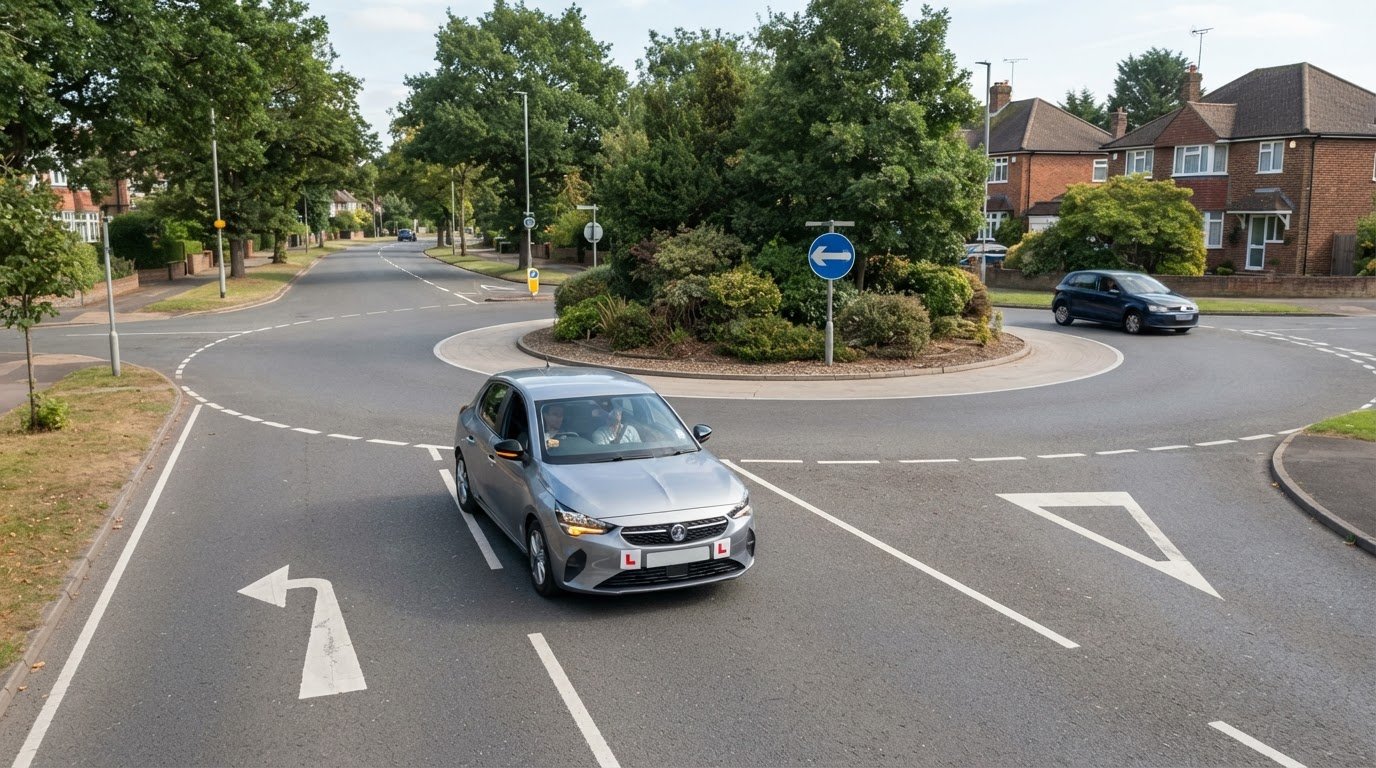
The right roundabout exit indicator tells other road users what you’re about to do, not just where you’re heading. For the first exit to the left, signal left on approach and keep signalling as you leave, unless signs or road markings indicate otherwise, according to the Department for Transport’s Highway Code Rule 186. Choose your lane early and follow the directions shown on signs and road markings.
It’s easy to feel unsure when exits come quickly or the markings look unfamiliar. A clear routine helps you choose your lane in good time, signal without confusing other road users and stay focused on the traffic around you.
This guide explains how to approach, travel around and leave standard and mini-roundabouts, including when to signal for first, intermediate and right-hand exits. You’ll also learn when to signal as you leave, helping you build a calm, consistent approach to everyday driving.
Key Takeaways
- Choose your lane early, then follow the signs and road markings as you approach.
- For the first exit to the left, signal on approach and keep signalling as you leave, unless signs or markings indicate otherwise, according to the Department for Transport’s Highway Code Rule 186.
- At a mini-roundabout, pass around the central markings unless your vehicle is physically incapable of doing so.
- At a double mini-roundabout, treat each roundabout separately and give way to traffic from the right, according to the Department for Transport’s Highway Code Rule 189.
- Build a steady routine: plan your exit, choose the appropriate lane and time your signal so other road users can understand your intentions.
Choosing lanes on approach to a roundabout
Lane choice means selecting a position that matches your intended exit. Identify the exit first, then follow the signs and road markings. Your roundabout exit indicator is one part of that plan; clear positioning also helps communicate your intended route.
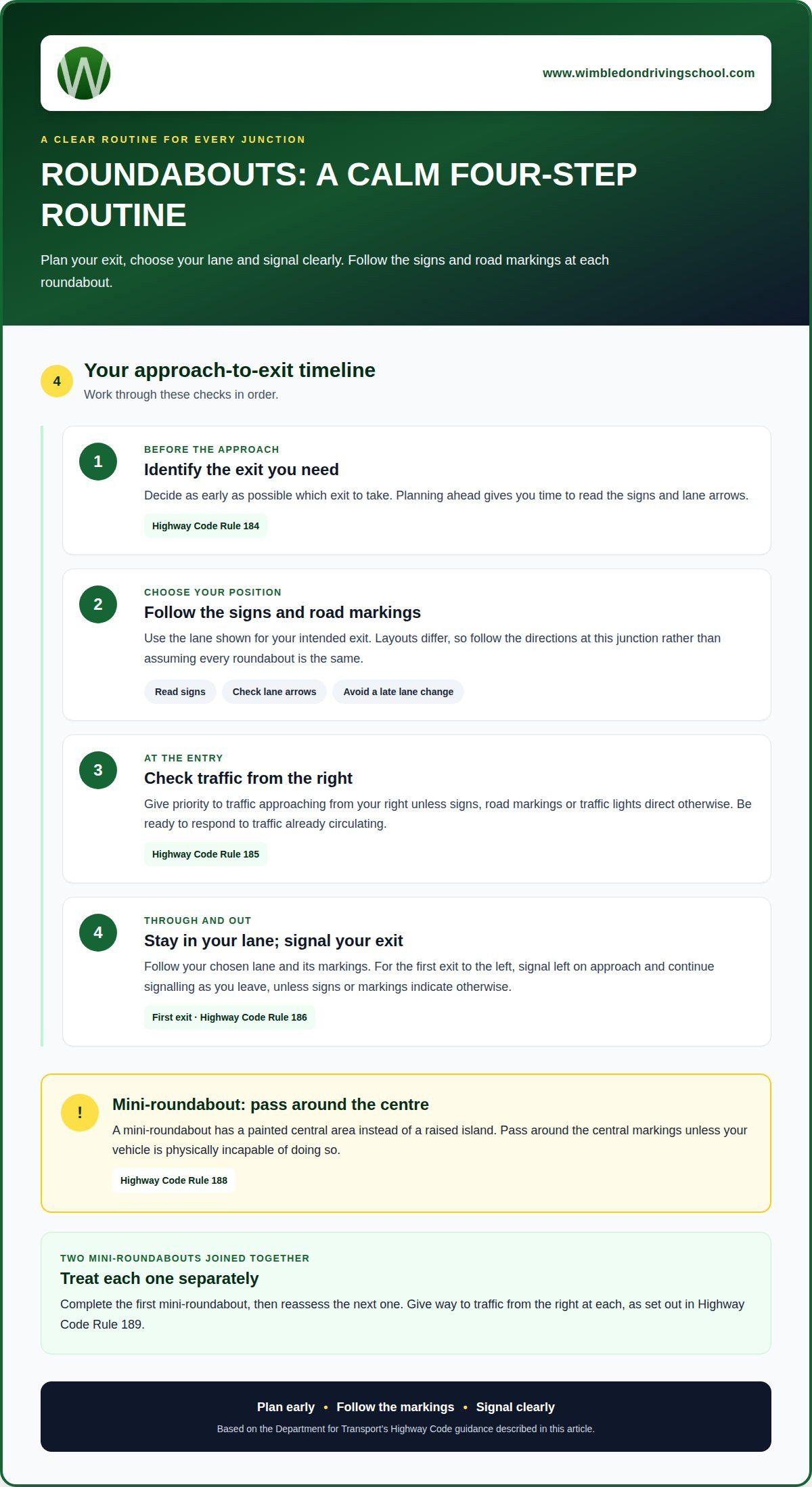
Planning early means deciding which exit you need before reaching the roundabout. Under Highway Code Rule 184, drivers should decide as early as possible which exit to take. For example, if a sign shows your destination at the next left exit, identify it before entering the roundabout area. This gives you time to read lane arrows and adjust safely.
Road signs and markings show which exits each lane serves. Follow their directions rather than assuming every roundabout has the same layout. One junction may show a left-turn arrow above a lane, while another assigns lanes differently. Look ahead for signs, then check the road markings as you approach.
Your intended route helps you interpret those instructions. For a left exit, look for signs or arrows showing which lane to use. For a right-hand exit, check which lane the signs direct you to take. Straight-ahead routes can also have marked lanes. Choose according to the layout shown, not simply the number of exits you can see.
Priority is the order in which road users proceed at an entry. Under Highway Code Rule 185, drivers should give priority to traffic approaching from their right, unless signs, road markings or traffic lights direct otherwise. Scan right as you approach, and be ready to respond to traffic already circulating. Keep your selected lane and follow its markings as you enter.
A lane guide can help you practise reading these choices before a journey. The roundabout lane-choice guide focuses on selecting a suitable position as you approach. Use the same process on the road: read the signs, identify your exit and follow the marked lane. Once your route is clear, use your roundabout exit indicator to communicate your intended movement.
A double mini-roundabout is two mini-roundabouts joined along one route. According to the Department for Transport’s Highway Code Rule 189, drivers should treat each roundabout separately and give way to traffic from the right. Complete the first mini-roundabout, then reassess the next one. Don’t assume your position or the traffic situation remains unchanged between them.
Use this approach sequence as you near any roundabout:
- Identify the exit shown on your route or the direction you need.
- Read signs and lane arrows before choosing your position.
- Check traffic from the right and obey any signals or markings.
- Stay within your chosen lane and reassess at each separate roundabout.
If the markings are difficult to see, slow down early enough to assess them. Avoid a sudden lane change near the entry. At a busy roundabout in South West London, for example, follow a clear lane arrow rather than making a late move to reach an exit. Keep checking the signs, traffic and your chosen road position.
Signalling and lane use at mini-roundabouts
A mini-roundabout has a painted central area instead of a raised island. Read the signs and road markings, then signal according to your exit.
First-exit signalling
First-exit signalling means indicating left before entering when you plan to leave at the first exit. Under Highway Code Rule 186, drivers taking the first exit to the left should signal left on approach and continue signalling left to leave the roundabout, unless signs or markings indicate otherwise, according to the Department for Transport.
As you approach, check the direction of the first exit and position your vehicle as the signs direct. Keep your left signal on while travelling around the painted centre and leaving. If an arrow or sign shows a different lane arrangement, follow it. Don’t signal so early that another road user could misunderstand your intention.
Rule 188 covers how vehicles pass around a mini-roundabout’s central markings. According to the Department for Transport, vehicles must pass around those markings unless they’re large vehicles physically incapable of doing so. At a compact junction, slow down and assess the available space before steering around the painted centre. Don’t treat the marking as a straight-ahead target.
Incorrect roundabout signalling on a driving test
Incorrect roundabout signalling can mislead another road user or fail to show your intended direction clearly. It can contribute to failing a UK driving test if it creates danger or affects another road user. An inaccurate signal doesn’t automatically mean you’ll fail; the examiner considers how your actions affect the situation.
For example, signalling left at a mini-roundabout when you’re continuing past the first exit may confuse a driver waiting to enter. Prioritise safe observation and a clear, timely signal. If you notice an error, don’t correct it suddenly. Continue safely, reassess the road and make your next decision calmly.
Blocked or missed exits
A blocked or missed exit is one you can’t safely take as planned. Don’t force your way through a queue or change lanes abruptly to recover your route. Keep control of your vehicle, follow your lane and continue around the roundabout if necessary.
If traffic blocks your chosen exit, wait for a safe opportunity while staying in your lane and observing nearby vehicles. If you pass the exit, take another circuit where the layout allows, then try again. A sat-nav can recalculate once you’re safely away; don’t look down at it while negotiating the mini-roundabout.
Before entering, identify your exit, read any arrows, check traffic and choose your signal. At a double mini-roundabout, treat each part separately and reassess before entering the next. Practising these decisions can help you handle them confidently on the road.
Signalling when taking a right-hand exit or going full circle
A right-hand exit is reached after travelling around the roundabout towards your right. Going full circle means continuing around until you reach the road you joined from.
For a right-hand exit, signal right as you approach, unless signs or road markings show a different arrangement. This tells other road users that you’re continuing around rather than leaving at an earlier exit. Read the signs before choosing your lane, then follow arrows and markings as you enter.
As you travel around, keep track of the exits and your intended route. Before reaching the exit immediately before yours, check your mirrors and prepare to signal left. After passing that exit, indicate left to show you’re leaving at the next one. For example, if your chosen exit follows the next exit, switch to a left signal after passing it.
Going full circle uses the same basic sequence as taking a later right-hand exit. Signal right on approach, then continue around while watching for the exit before the road you need. After passing it, signal left and prepare to leave. Keep observing nearby traffic throughout; don’t let signalling distract you from your position or surroundings.
Use this sequence to make your intention clear:
- Read the signs and markings to identify your exit.
- Choose the lane indicated for your route.
- Signal right on approach for a right-hand or full-circle route.
- Watch for the exit immediately before your chosen exit.
- After passing it, signal left and prepare to leave safely.
Changing from right to left matters because each signal communicates a different movement. A right signal shows you’re continuing around; a left signal tells others you’re preparing to exit. Don’t change signals early if that could suggest you’re taking an earlier exit. Follow signs and markings if the roundabout’s layout directs traffic differently.
At roundabouts with several exits close together, identify your destination before entering. Track each exit as it passes instead of relying only on memory or a sat-nav instruction. If you miss your exit, don’t cut across another lane to reach it. Continue around if safe, then approach your exit again.
On a full-circle route, the road you joined from becomes your exit after you travel around the junction. Watch for it as you pass each exit, then signal left after passing the exit immediately before it. This tells other road users more clearly that you’re leaving rather than continuing around the roundabout.
Signalling when taking an intermediate exit
An intermediate exit is between the first exit and a later right-hand exit. For a straight-ahead route, identify the exit you need and prepare to signal left after passing the exit immediately before it.
For example, if your route uses the second exit, first identify the first exit. After passing it, indicate left to show you’re leaving at the next exit. Check your mirrors and the traffic around you before leaving the roundabout.
Going straight ahead doesn’t always mean using the same lane. Read signs and road markings as you approach, then follow their directions. A lane arrow might direct straight-ahead traffic into a particular lane, while another roundabout may use a different arrangement. Choose according to the markings, not a junction you know elsewhere.
Use the position of each exit to judge when to signal. Don’t rely only on counting, especially where exits are close together or the road bends around buildings. Look for the road opening and its direction. If you can’t clearly identify your exit, focus on the traffic and avoid a sudden turn or lane change.
For a straight-ahead third exit, note both earlier exits as you travel around. Signal left after passing the exit before the one you want. Before leaving, check your mirrors and make sure your path is clear. If signs or arrows direct you into a different lane, follow them and maintain your position.
A simple sequence can help you stay organised:
- Read the signs and lane markings before entering.
- Identify your chosen exit and the one before it.
- Follow your lane as you travel around the roundabout.
- After passing the preceding exit, signal left.
- Check your mirrors and leave when your path is clear.
At an unfamiliar junction, a sat-nav instruction may name a road without explaining the lane layout. Use road signs and painted arrows to guide your position. Keep checking for cyclists, motorcyclists and vehicles alongside you, especially where lanes curve or separate near an exit.
If you pass your intended exit, don’t cut across another lane to reach it. Continue around when safe and approach the exit again. This gives you time to follow the markings and signal clearly, rather than forcing a late manoeuvre through traffic.
Timing the signal to leave a roundabout
Use your left indicator to show that you’re leaving, and check your mirrors. Your signal should make your intended exit clear without suggesting you’re leaving earlier.
Timing the exit signal
Timing the exit signal means indicating left when your chosen exit is next. For an intermediate or right-hand exit, the Department for Transport’s Highway Code Rule 186 advises signalling left after passing the exit before yours, unless signs or markings indicate otherwise.
Keep watching the exits as you travel around instead of relying only on counting. For example, if your route leaves at the third exit, identify the second exit and signal left after passing it. Check your mirrors as you prepare to leave, and maintain your lane.
For the first exit to the left, the timing differs. According to the Department for Transport’s Highway Code Rule 186, signal left on approach and continue signalling as you leave, unless signs or markings indicate otherwise.
A signal given too early may suggest you’re taking an earlier exit. A late signal may leave nearby drivers little time to understand your intention. Match the timing to the layout, and don’t use sudden steering or braking to compensate for a missed signal.
Choosing an exit signal
An exit signal is the indicator you use to show that you’re leaving the roundabout. Use your left indicator as you prepare to exit; it communicates your intended direction to other road users.
If you’re taking a right-hand exit or going full circle, Rule 186 advises signalling right on approach, unless signs or markings indicate otherwise. Change to a left signal after passing the exit immediately before yours. That change distinguishes continuing around from preparing to leave.
At a straight-ahead exit, follow the signs and lane markings, then signal left at the appropriate point before leaving. Check your mirrors before exiting, especially if another vehicle is travelling alongside you. Don’t move across a lane simply because your exit is approaching.
After leaving, make sure your indicator has stopped signalling. This prevents an unintended signal from confusing other road users as you continue along the road. Keep your attention on the road ahead and nearby traffic as you complete the exit.
Wimbledon Driving School: Manual Driving Lessons
Wimbledon Driving School helps you practise roundabout lane choice, signalling and safe exits during Manual Driving Lessons. If coordinating gears with observations and indicators feels challenging, focused practice can help you build a clear routine behind the wheel.
Choose Automatic Driving Lessons if you want to focus on steering, positioning and signalling without managing gear changes. Intensive Driving Courses suit learners seeking concentrated instruction, while Pass Plus Courses help you continue developing after passing your test.
Driving lessons give you the chance to practise roundabouts in real traffic with an instructor and strengthen the skills covered in this guide. Contact Wimbledon Driving School to discuss the lesson option that suits your learning goals in South West London, South East London, Surrey or Middlesex.
Build confidence through deliberate practice
Make the roundabout exit indicator part of a wider observation routine, not a last-second task. On your next drive, notice how the road layout, traffic and your intended route affect your decisions. Afterwards, reflect on what felt clear and what you’d like to practise again.
That brief review can make each journey a useful learning step. If a busy junction leaves you unsure, practise with support before tackling similar situations alone. A driving instructor can help you work through decisions in real traffic at a pace suited to your experience.
You don’t need to master every roundabout at once. Build consistency through focused practice, and let each new junction strengthen your judgement. Wimbledon Driving School can help you continue with instruction suited to your learning needs.
Take your next drive one decision at a time. You can build confidence with every journey.
Frequently Asked Questions
When should you indicate when exiting a roundabout in the UK?
Signal left after passing the exit before the one you want, so other road users can see you’re leaving at the next exit. For the first exit to the left, signal left on approach and continue signalling as you leave, unless signs or markings indicate otherwise, according to the Department for Transport’s Highway Code Rule 186. Check your mirrors and keep your attention on traffic around you.
When should you signal right when taking an exit to the right?
For a right-hand exit or a route continuing around the roundabout, signal right on approach unless signs or markings direct otherwise. Follow the lane arrows and stay aware of traffic as you travel around. After passing the exit before yours, signal left to show you’re leaving next. For example, if you’re taking a later exit, don’t switch to the left signal before passing the preceding exit.
When should you cancel your indicator after leaving a roundabout?
Cancel your indicator once you’ve left the roundabout if it hasn’t switched off automatically. Check that it’s no longer flashing before continuing, particularly if another turn or junction follows soon after. A left signal that remains on could mislead someone waiting at the next junction. Keep your focus on the road and surrounding traffic as you check the indicator.
Do roundabout signalling rules differ for mini-roundabouts or spiral roundabouts?
The layout affects how you position and steer, so follow the signs and road markings at each junction. At mini-roundabouts, vehicles must pass around the central markings unless they’re large vehicles physically incapable of doing so, according to the Department for Transport’s Highway Code Rule 188. On spiral roundabouts, follow the lane arrows as they guide you towards your exit, and avoid sudden lane changes.
Disclaimer
This article is provided for general informational purposes only and does not constitute professional driving, legal, or safety advice. While we aim to keep our content accurate and up to date, rules, prices, and DVSA test requirements can change — always check gov.uk or contact us directly at 020 3524 7968 for the latest guidance before making any decisions. Nothing in this article guarantees a specific outcome, including passing your driving test within any stated timeframe. For current pricing, course availability, and instructor details, please visit our Prices page or get in touch.