Mastering the parallel park isn’t a matter of luck or natural talent; it’s a precise, repeatable recipe that guarantees success every time. With the national UK driving test pass rate currently at 48.5%, perfecting your manoeuvres is essential to joining the successful half of candidates. You likely feel a spike of anxiety when your instructor asks you to pull up alongside a parked vehicle, fearing you might hit the car or block a line of impatient traffic. It’s a common hurdle, but it shouldn’t stand between you and your full driving licence. This guide provides a definitive how to parallel park uk driving lesson, using our professional 1-2-1 method to turn your most feared manoeuvre into a showcase of technical skill.
We’ll provide the exact reference points the examiner looks for whilst ensuring you understand how to maintain total control on narrow residential streets. You’ll learn how to time your steering perfectly and how to make the calm, safe adjustments that the DVSA permits during the test. By following this expert framework, you’ll gain the confidence to handle modern road complexities and move one step closer to that life-changing milestone.
Key Takeaways
- Master the mechanics of why reversing is the most effective way to pivot into tight spaces using our signature 1-2-1 steering technique.
- Learn how to parallel park uk driving lesson style by utilising precise reference points tailored to your specific vehicle type, from compact hatchbacks to larger saloons.
- Discover the secrets of perfect speed management, whether you are mastering clutch control in a manual or utilising “creep” in an automatic car.
- Understand the official DVSA standards for the practical test, including how to calmly correct your position if you find yourself too far from the kerb.
- Gain the confidence to park on narrow residential streets by identifying the visual cues that guarantee a safe and legal finish every time.
Understanding Parallel Parking in the UK Driving Test
Parallel parking is the art of positioning your vehicle alongside the kerb, typically behind a single stationary car. While it often tops the list of student anxieties, it’s a fundamental skill for any driver navigating the UK’s historic, narrow streets. Many learners wonder why we don’t just drive forward into the gap. The reason is mechanical: modern cars steer from the front wheels. Reversing allows the back of the car to pivot into a tight space first, providing a much tighter turning circle than a forward approach ever could. Mastering how to parallel park uk driving lesson standards is about more than just steering; it’s about total environmental awareness.
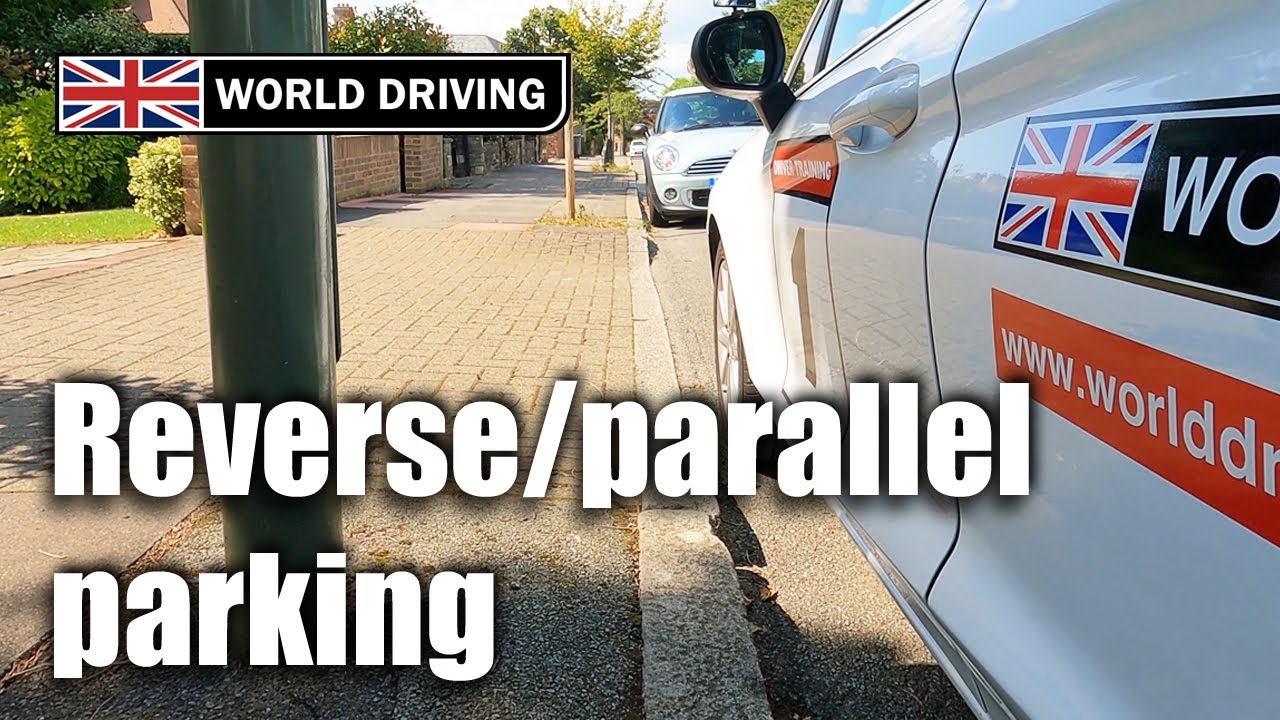
Learning how to parallel park uk driving lesson style means mastering a specific sequence of movements that prioritises control and safety. Our learning centre provides extensive resources to supplement your practice, but understanding the core criteria is your first step toward success. To visualise these movements before we dive into the technical details, watch this helpful video from World Driving:
During your practical test, the examiner expects you to finish the manoeuvre within two car lengths of the vehicle in front. You must be reasonably close to the kerb and parallel to it. Don’t let the pressure of the “perfect park” overwhelm you. Reframe this task as a simple recipe; if you follow the ingredients in the right order, the result is guaranteed. This mindset shift transforms a stressful requirement into a predictable, manageable process.
When Will the Examiner Ask You to Parallel Park?
In the 2026 practical test, parallel parking remains one of three possible reversing tasks you might be asked to perform. Examiners typically select a quiet residential street rather than a bustling high street to ensure you can demonstrate your skills without excessive external pressure. You’ll be asked to pull up alongside a parked car, at which point your mental checklist should begin. This usually happens in the middle of your test route, once you’ve settled into your driving.
The Key to Success: Observation Over Accuracy
Accuracy is important, but your safety behaviour is what truly secures a pass. Examiners prioritise your awareness of the surrounding environment over a perfectly straight finish. Before the car moves an inch, you must perform a full six-point check, scanning from your right blind spot all the way around to your left blind spot to ensure the road is completely clear. If another road user approaches whilst you are mid-manoeuvre, stop the car immediately. Wait for them to pass or for them to stop and signal that they are waiting for you before you continue. This level of caution proves you’re ready for independent driving.
The 1-2-1 Method: A Step-by-Step Parallel Park Guide
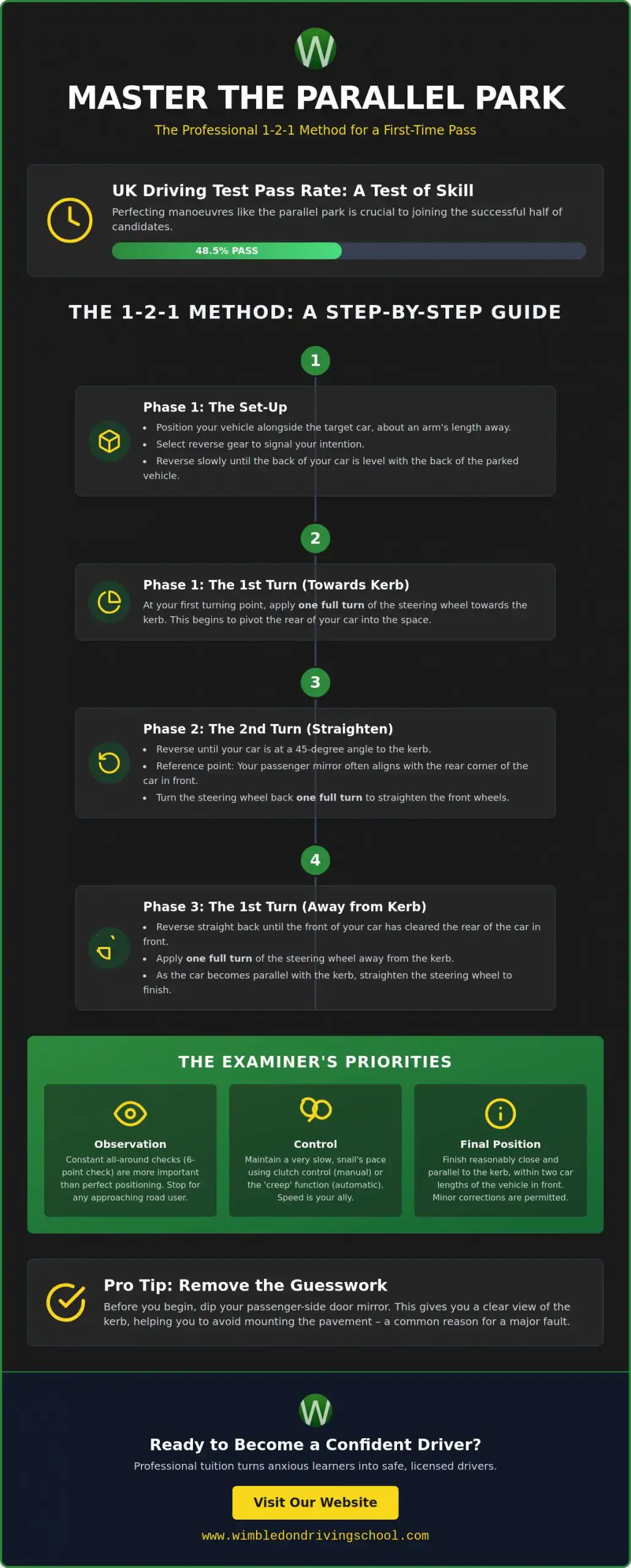
Speed is your greatest ally when learning how to parallel park uk driving lesson standards. The slower the car moves, the more time your brain has to process your reference points and react to the environment. In a manual car, this requires expert clutch control at the “biting point” to maintain a snail’s pace. If you’ve opted for automatic driving lessons, you’ll manage your pace using the “creep” function and the brake pedal. Before you begin, we highly recommend dipping your passenger-side door mirror. This simple adjustment provides a clear view of the kerb, removing the guesswork that often leads to a major fault for mounting the pavement.
Phase 1: The Set-Up and Initial Turn
Position your vehicle alongside the target car, maintaining roughly an arm’s length of space between the two vehicles. Select reverse gear immediately. This action activates your white reverse lights, signalling your intent to any road users behind you. Reverse slowly until the back of your car is level with the back of the parked vehicle. At this first turning point, apply one full turn of the steering wheel towards the kerb. This initial turn begins the pivot that moves the rear of your car into the space. Mastering this set-up is the foundation of a successful how to parallel park uk driving lesson.
Phase 2: The 45-Degree Angle
Maintain a slow, steady pace as you continue to reverse. You’re looking for the car to reach a 45-degree angle relative to the pavement. As you do this, the front of your car will swing out into the road. You must perform a diligent right-hand blind spot check during this phase. If any vehicles approach from either direction, you should stop and wait. Safety is the priority in the official DVSA driving test requirements, and demonstrating this awareness is essential for a pass. Only continue when you’re certain the road remains clear.
Phase 3: Straightening Up and Finishing
Once your angle is correct, apply two full turns of the steering wheel in the opposite direction, away from the kerb. This counter-steer is the “two” in our method; it brings the front of your car back towards the pavement and prevents the rear from hitting the kerb. Continue reversing until the car is parallel with the road. Finally, apply one turn back to the centre to straighten your wheels. This 1-2-1 sequence is a logical, mechanical solution to a technical challenge. If you’re ready to see how this feels in practice, you can book your first lesson with our expert team today and transform your driving confidence.
Mastering Reference Points for Different Car Types
Reference points are the visual anchors that transform a daunting manoeuvre into a repeatable science. In a professional how to parallel park uk driving lesson, these cues act as your internal GPS, telling you exactly when to lock the steering or straighten up. It’s essential to recognise that these points aren’t universal; they shift based on the dimensions of your vehicle. A compact hatchback allows for a later turn because of its shorter wheelbase, whereas a long saloon requires you to start your movements much sooner to avoid clipping the car ahead.
For a deeper dive into these technicalities, RAC’s step-by-step parallel park guide provides an excellent overview of standard positioning. One of the most effective techniques we teach is the “door handle” trick. By observing where the kerb appears to meet your front door handle in the side mirror, you can judge your distance from the pavement with surgical precision. This visual confirmation eliminates the anxiety of hitting the kerb, ensuring you finish within the required distance every time. Our learning centre offers further diagrams to help you visualise these angles before your next session.
Common Reference Points for Learners
Your first turning point typically occurs when the rear of the parked car appears in the middle of your rear side window. Once you’ve initiated the turn, look for the second point: the corner of the parked car aligning with your front passenger pillar. This indicates you’ve reached the correct angle to begin straightening. Finally, check your mirrors for the “triangle of space”, which is the gap between your car’s rear and the kerb. If the triangle is too wide, you’re too far out; if it’s too narrow, you’re heading for the pavement. Identifying these cues early is the hallmark of a confident student.
Using Technology: Sensors and Cameras in 2026
Modern vehicles are equipped with sophisticated aids, but they should never replace your own eyes. In 2026, the DVSA permits the use of reversing cameras and sensors, provided they are treated as secondary tools. You must still demonstrate active, physical observations by looking through the windows and checking your blind spots. Relying solely on a screen is a common reason for a serious fault during a how to parallel park uk driving lesson because technology has its limits. Cameras cannot see the fast-moving cyclist or pedestrian approaching from an acute angle outside the lens’s field of vision.
Fixing Mistakes: How to Correct a Poor Parallel Park
The most important thing to remember during your test is the Golden Rule: you are allowed to adjust your position. Many learners believe that once they’ve started the reverse, any deviation from the perfect line results in an immediate failure. This simply isn’t true. The DVSA examiners are looking for competence and safety, not robotic perfection. If you realise you’re drifting too far from the kerb or your angle is slightly off, don’t panic. Acknowledge the error and take the necessary steps to fix it. This ability to self-correct is a vital part of any how to parallel park uk driving lesson and proves you have the spatial awareness required for independent driving.
To get closer to the kerbside when you’ve finished too far out, use the “forward-and-left” shunt technique. This is a precise correction that competitors often overlook. Select first gear (or Drive in an automatic), steer fully towards the kerb, and move forward a few inches. As the front of the car tucks in, steer quickly back to the right to straighten the wheels. This small “S” movement pulls the car closer to the pavement. If the manoeuvre feels unsalvageable, it’s far better to pull forward, realign with the target vehicle, and start again. Starting over is a safe choice; hitting the kerb hard or mounting it is not.
Dealing with the Kerb: Touching vs. Mounting
Understanding the difference between a minor touch and a major fault is essential for your peace of mind. Gently touching the kerb with your tyre whilst moving at a snail’s pace is usually recorded as a minor driving fault. However, mounting the pavement or hitting the kerb with enough force to jolt the car is a serious fault and will lead to a test failure. Use your dipped passenger mirror to monitor the gap to the centimetre. If the tyre looks like it’s about to make contact, stop immediately and use the shunt technique to create space.
The Observation Trap: Don’t Forget the Road
Learners often fail because they become “kerb-blind,” staring intensely at the pavement and forgetting the world around them. This is the observation trap. If a car pulls up behind you whilst you are mid-manoeuvre, you must stop. Use the “Pause and Check” method: stop the vehicle, perform a 360-degree scan, and assess the other driver’s intent. If they wait, you may continue with caution. If they attempt to overtake, stay stationary until they have safely passed. Safety checks must remain your priority even during the correction phase of your how to parallel park uk driving lesson.
Mastering these technical adjustments is what transforms a nervous student into a confident, test-ready driver. If you want to perfect these “save” techniques under the guidance of a professional mentor, you can book your driving lessons with our premier team today and secure your path to success.
Professional Tuition with Wimbledon Driving School
While a written guide provides the essential blueprint for success, nothing replaces the live, expert feedback of a professional how to parallel park uk driving lesson. Our Approved Driving Instructors (ADIs) specialise in translating technical theory into instinctive, behind-the-wheel habits. We understand that parallel parking remains the most common source of pre-test nerves. By choosing a premier provider, you’re not just booking a service; you’re embarking on a transformative journey toward a significant personal milestone. Our team excels at supporting nervous learners, breaking down complex manoeuvres into manageable steps until they feel like second nature. When researching the market, comparing Driving Lesson Fees from established providers like B Safe Driving Lessons can give you a clearer picture of the investment required for quality tuition.
Local expertise is what sets us apart from national franchises. We possess an intimate knowledge of South West London and Surrey, particularly the challenging test routes around Morden, Tolworth, and Isleworth. This contextual awareness means we don’t just teach you to park in a vacuum. We prepare you for the reality of the road, ensuring you can confidently handle the specific traffic rhythms and kerbside challenges unique to our service areas. This focused, professional guidance is the most effective choice for your education.
Tailored Lessons for London & Surrey Residents
Mastering your vehicle in real-world conditions is essential for long-term safety. We take our students to the narrow residential streets of Putney, Kingston, and Wimbledon to ensure their skills are robust enough for any environment. Our instructors hold prestigious RoSPA Gold and IAM certifications, representing a level of proficiency that far exceeds the industry standard. This elite training ensures that whether you are undertaking manual driving lessons or learning in an automatic, you receive the safest and most comprehensive instruction available in the UK today.
Ready to Pass? Book Your Lessons Today
Every student’s path to success is different. Whether you are a complete beginner requiring an intensive course or an experienced driver seeking a refresher lesson to perfect your parking, we offer the flexibility to suit your needs. We pride ourselves on maintaining a market-leading position through high user satisfaction and transparent service. To help you manage the investment in your future, we offer competitive block booking discounts. You can check our low driving school prices to find the package that best fits your requirements.
Don’t let the anxiety of a single manoeuvre stand in the way of your driving independence. Trust in our established reputation and industry-recognized status to guide you through your practical test with confidence and poise. Your destination is closer than you think. Book your first lesson with Wimbledon Driving School today and experience the gold standard of driver training.
Secure Your Driving Independence Today
Mastering the parallel park is a pivotal milestone in your transformative journey toward a full UK driving licence. By applying the 1-2-1 steering method and identifying vehicle-specific reference points, you transform a common source of anxiety into a predictable technical achievement. Remember that the examiner values your safety checks and calm, controlled corrections above all else. This definitive guide to how to parallel park uk driving lesson standards provides the essential framework, but the final step is professional, behind-the-wheel refinement with a mentor you can trust.
We take pride in our established status as specialists for nervous and first-time drivers, consistently delivering some of the highest pass rates in the country. Our instructors hold elite RoSPA Gold and IAM certifications, ensuring you receive the most prestigious and effective driver education available. Every lesson is a step closer to your personal achievement. Don’t let a single manoeuvre delay your progress any longer. Master your manoeuvres with Wimbledon Driving School – Book Now and turn your driving goals into a tangible reality. You have the skill and the strategy; now it’s time to take the wheel with total confidence.
Frequently Asked Questions
Will I definitely have to parallel park on my driving test?
You won’t necessarily be asked to parallel park, as it is one of three possible reversing manoeuvres selected by the examiner on the day. The other options include bay parking or pulling up on the right and reversing for two car lengths. Since the examiner chooses only one of these tasks, you have a one-in-three chance of performing a parallel park. Regardless of the draw, mastering this skill is vital for your overall confidence and safety on the road.
What happens if I hit the kerb during the parallel park?
Hitting the kerb hard or mounting the pavement results in a serious fault and an immediate test failure. Conversely, a gentle touch whilst moving slowly is typically recorded as a minor driving fault, provided you react correctly. If you feel the tyre make contact, stop immediately and use a shunt to correct your position safely. Demonstrating that you can identify and fix a mistake is a key part of any how to parallel park uk driving lesson.
Is it easier to parallel park in an automatic car?
Many learners find parallel parking easier in an automatic vehicle because you don’t have to manage a clutch pedal. Instead of balancing the biting point, you simply use the brake to control the car’s “creep” speed. This allows you to focus entirely on your steering and observations without the risk of stalling. Whether you choose manual or automatic, the technical reference points and safety requirements remain exactly the same for a successful pass.
Can I use my car’s reversing camera during the test?
You are permitted to use a reversing camera during your test, but you must not rely on it as your primary source of information. The examiner expects to see active, all-around physical observations, including checking your blind spots and looking through the rear window. Using the camera as a secondary aid is helpful for judging distance. However, failing to look around the vehicle whilst reversing will lead to a serious fault and a likely failure.
How many times am I allowed to adjust my position?
Examiners generally allow you to pull forward once or twice to correct your position, provided you do so safely and maintain good observations. There isn’t a fixed numerical limit, but excessive shuffling may suggest a lack of control. If you realise your initial angle is poor, it’s better to calmly shunt forward and realign rather than struggling to finish an inaccurate manoeuvre. This demonstrates the spatial awareness required for independent driving.
How far away from the kerb should I be when finished?
You should aim to be close and parallel to the kerb, ideally within 20 to 30 centimetres. The DVSA requires you to be “reasonably close” without blocking the flow of traffic or being so far out that you create a hazard for other road users. Finishing parallel to the pavement ensures your vehicle is parked legally and safely, reflecting the high standards taught in a professional how to parallel park uk driving lesson.
What is the 1-2-1 method for parallel parking?
The 1-2-1 method is a steering sequence designed to simplify the manoeuvre into three logical steps. You apply one full turn of the wheel towards the kerb to start the pivot, two full turns in the opposite direction to bring the front of the car in, and one final turn to straighten the wheels. This structured approach provides a repeatable “recipe” that works for most modern cars, making the process predictable and manageable for learners.
Do I need to indicate when starting a parallel park?
You don’t usually need to use your indicators when starting a parallel park, as your road position and reverse lights signal your intent to others. However, you must signal if it would help other road users understand your actions in a specific situation. The most important requirement is that you pull up safely and perform a full six-point check before you begin reversing, ensuring the road is clear of pedestrians and cyclists.
Disclaimer
This article is provided for general informational purposes only and does not constitute professional driving, legal, or safety advice. While we aim to keep our content accurate and up to date, rules, prices, and DVSA test requirements can change — always check gov.uk or contact us directly at 020 3524 7968 for the latest guidance before making any decisions. Nothing in this article guarantees a specific outcome, including passing your driving test within any stated timeframe. For current pricing, course availability, and instructor details, please visit our Prices page or get in touch.