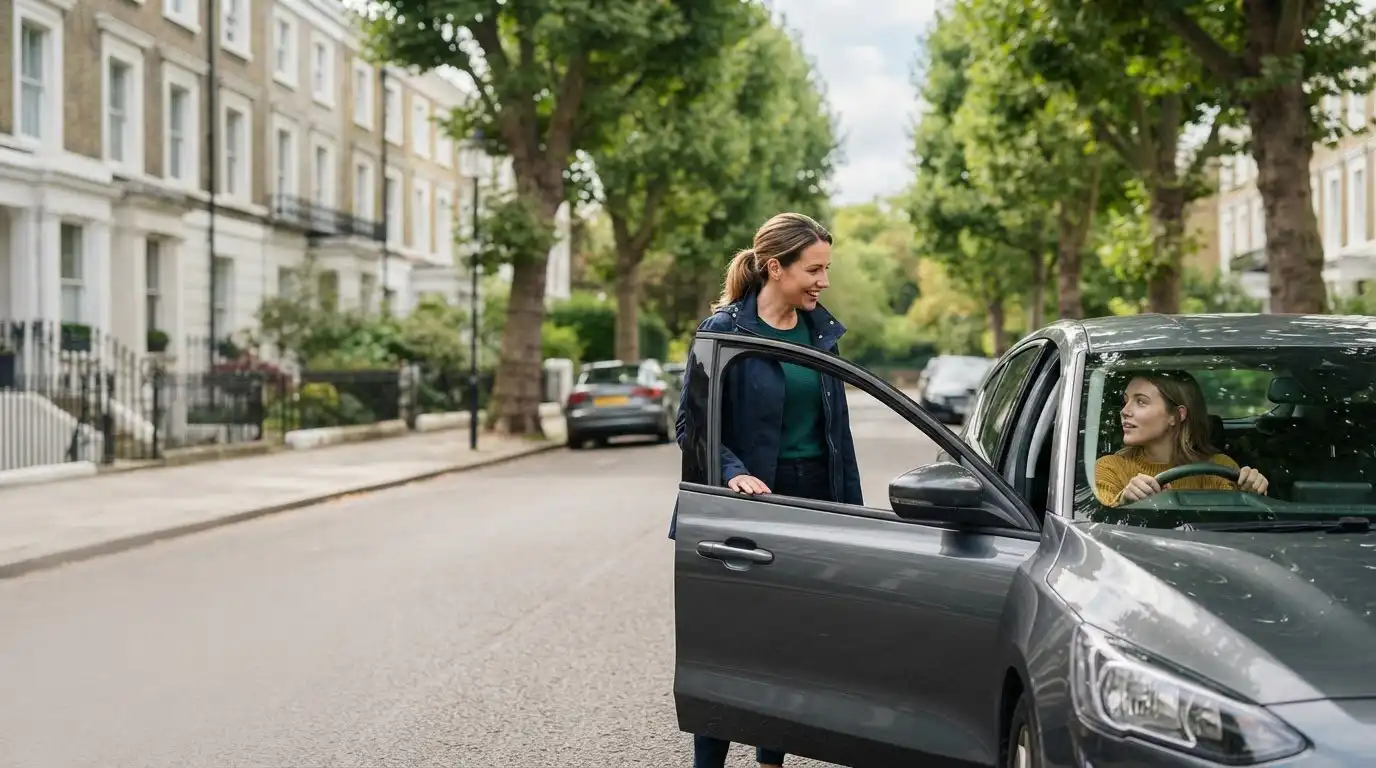

Your decade of driving experience might actually be the biggest hurdle between you and a full UK licence. Whilst you’re likely a confident motorist, the DVSA’s 2026 standards require a specific brand of precision that often contradicts years of global driving. If you’re feeling the pressure of six-month test waiting lists or confusion over how long your current permit remains valid, you’re certainly not alone. Our specialised driving lessons for international drivers london are designed to respect your history whilst refining your technique for the capital’s unique challenges.
We understand that you don’t need to learn how to drive; you need to learn how to pass. This roadmap simplifies the transition, providing legal clarity on EU and non-EU rules and a fast-track strategy to secure your credentials. You’ll gain the specific skills needed to master London’s mini-roundabouts and dense cycle lanes with the poise of a seasoned local. We’ll explore the 2026 theory updates and practical requirements, ensuring your journey to a UK licence is efficient, prestigious, and successful.
Key Takeaways
- Navigate the strict 12-month legal window and 2026 exchange rules to ensure you remain legally mobile whilst living in the UK.
- Learn mental cues to master driving on the left and successfully negotiate London’s evolving Low Traffic Neighbourhoods and Cycle Superhighways.
- Discover why your existing experience might cause a “Major” fault and how driving lessons for international drivers london refine your observation techniques to meet DVSA standards.
- Assess whether an Intensive Driving Course or Refresher Driving Lessons will most effectively eliminate “baked-in” habits and fast-track your success.
- Leverage the expertise of high-calibre instructors with RoSPA Gold and IAM certifications who specialise in transitioning experienced international motorists.
Understanding the Legal Requirements for International Drivers in 2026
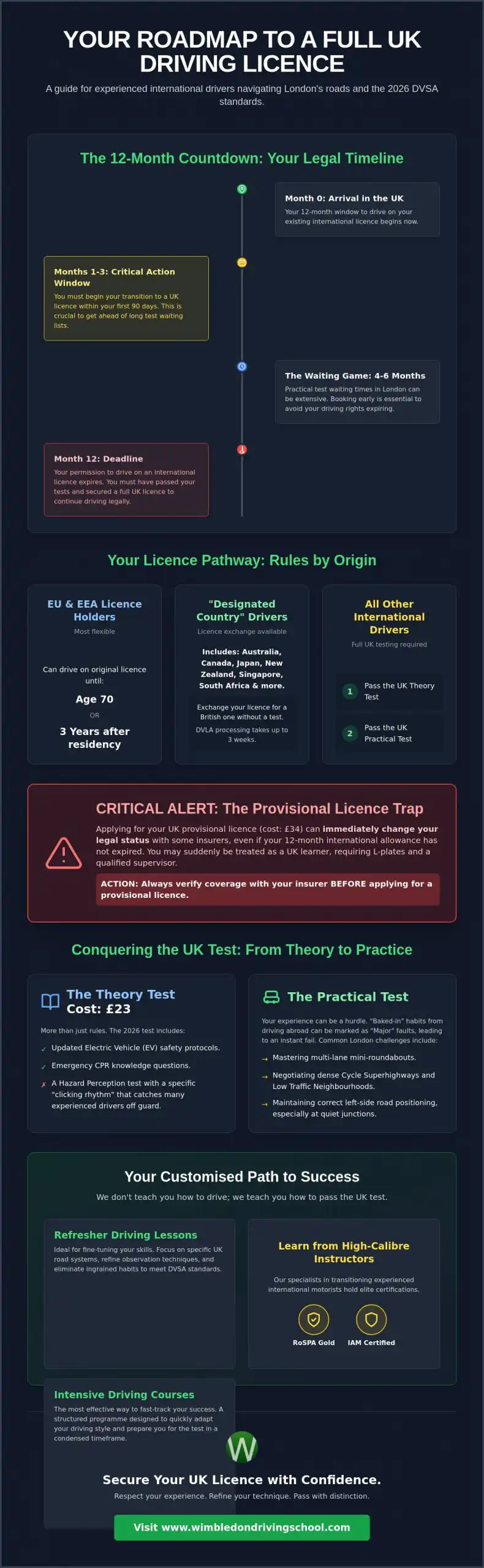
Your international driving permit is a gateway, not a destination. Under current 2026 regulations, most international motorists can drive in the UK for exactly 12 months from the date they last entered the country. However, treating this as a full year of freedom is a strategic error. Because practical test waiting times in London currently span four to six months, you must begin your transition to a UK licence within your first ninety days. The UK driving licence is the official document which authorises its holder to operate a motor vehicle, and securing one requires navigating a strict legal timeline.

The rules shift significantly depending on your country of origin. EU and EEA licence holders enjoy the most flexibility; they can generally drive on their original licence until they reach the age of 70 or for three years after becoming a resident. If you are from a “Designated Country” such as Australia, Canada, Japan, New Zealand, Singapore, or South Africa, you can exchange your licence for a British one without taking a new test. For everyone else, the path requires passing both the theory and practical examinations. You can find more specific guidance on our specialist support page for overseas drivers.
A critical trap awaits the unwary regarding the provisional licence transition. The moment you apply for your UK provisional licence (which costs £34 in 2026), your legal status changes. Many insurance providers will immediately begin treating you as a UK learner rather than an experienced international driver. This means you may suddenly require L-plates and a qualified supervisor, even if your 12-month international allowance hasn’t expired. Always verify your coverage with your insurer before your first session of driving lessons for international drivers london to avoid unintentional legal breaches.
Licence Exchange vs. Taking the Practical Test
If you qualify for an exchange, the process is administrative but slow. You must send your original licence and a completed D1 form to the DVLA; processing times in 2026 can take up to three weeks. Even if an exchange is available, many experienced drivers choose to book a few professional sessions. British road layouts, particularly the complex motorway junctions and urban “Street Furniture” in London, differ vastly from those in North America or Asia. Investing in expert guidance ensures your first solo drive in the UK is safe rather than stressful.
The Theory Test: The First Hurdle for Non-EU Drivers
Don’t underestimate the theory test. In 2026, the exam includes updated sections on electric vehicle (EV) safety and emergency CPR knowledge. Whilst you likely know the rules of the road, the Hazard Perception segment requires a specific clicking rhythm that catches many veterans off guard. The test costs £23, and centres in London book up rapidly. We recommend using the official DVSA revision apps to master the British Highway Code. Securing an early theory pass is the only way to bypass the lengthy queues for your practical test date.
Mastering the “London Factor”: Urban Driving Challenges
London’s road network is a masterclass in spatial awareness and rapid decision-making. For international motorists, the shift isn’t merely about moving to the left side of the road; it’s about processing a dense layer of “street furniture” that rarely exists elsewhere. Our driving lessons for international drivers london provide the mental frameworks needed to navigate this complexity with poise. One of the most common errors occurs at quiet junctions or when exiting petrol stations, where muscle memory might pull you into the right-hand lane. We teach you to use “left-side anchors”—visual cues like the position of the kerb or the flow of parked cars—to ensure your positioning remains flawless even when the roads are empty.
Beyond lane discipline, you must master London’s unique environmental zones. Navigating the Ultra Low Emission Zone (ULEZ) and the Congestion Charge zone requires vigilant observation of camera-monitored boundaries. Whilst these are administrative hurdles, the physical hurdles are found in Low-Traffic Neighbourhoods (LTNs). These zones often use “bus gates” or bollards to restrict through-traffic. Entering an LTN at the wrong point can lead to an immediate fine. Before you get behind the wheel, Understanding the Legal Requirements of your specific licence type is essential to ensure your insurance covers you for these high-density urban environments.
The mini-roundabout remains the ultimate psychological stumbling block for overseas motorists. In many countries, a painted circle on the ground is a suggestion; in London, it’s a formal junction. You must treat the painted centre as a physical island, giving way to the right and avoiding “cutting the corner” at all costs. If you’re ready to tackle these urban hurdles with a professional mentor, you can secure your initial assessment here to begin your journey.
Narrow Streets and Width Restrictions
London’s residential “rat runs” are notoriously tight. You’ll frequently encounter 6ft 6in width restrictions, particularly in South West London, designed to keep heavy vehicles out. We’ll teach you to judge your vehicle’s width accurately and understand “Priority Over Oncoming Vehicles” signs. These blue rectangular signs or red circles dictate who must stop in a “pinch point.” Mastering the art of the “meet”—where you pull into a gap amongst parked cars to let another driver pass—is a vital skill for city survival.
Vulnerable Road Users in the City
Observation in London must be proactive, not reactive. With the rise of Cycle Superhighways, cyclists often have priority at junctions. We emphasise the “Dutch Reach”—opening your car door with the hand furthest from the handle—to force a shoulder check for passing bikes. You’ll also need to distinguish between Zebra, Pelican, and Puffin crossings. Unlike some countries where pedestrian priority is informal, in the UK, failing to stop for a pedestrian on a Zebra crossing is a serious fault that will end a driving test immediately.
Why Experienced International Drivers Fail the UK Practical Test
Securing a UK driving licence is often more about unlearning than learning. Many veterans of global roads arrive with impeccable car control but fail to meet the DVSA’s rigorous safety definitions. With the national pass rate sitting at approximately 49%, success requires a shift from “relaxed” driving to “active” safety management. Our driving lessons for international drivers london focus on bridging this gap between being a driver and being a “test-ready” candidate. You should consult the official government guidance on driving in the UK to confirm your current eligibility before booking your assessment.
The “One-Handed Trap” is perhaps the most common pitfall for experienced motorists. Whilst palming the wheel or resting one hand on the gear stick feels natural after years of driving, it is classified as a “Major” fault in the UK. Examiners require both hands on the wheel unless you are changing gear or operating a control. Similarly, simply “looking” in your mirrors isn’t enough. You must demonstrate observation through exaggerated head movements, proving to the examiner that you are actively scanning for London’s high density of delivery mopeds and cyclists. Planning and awareness are paramount; you are expected to anticipate the mistakes of others long before they occur.
Eco-Safe driving is another modern metric where many international drivers lose marks. The DVSA evaluates how you use your gears to reduce emissions and wear. This means shifting up early and using engine braking when approaching red lights. If you’re used to a more aggressive or high-revving driving style, this adjustment can take time to master. If you are on a tight schedule, our Fast Track intensive driving course is designed to iron out these habits in a condensed timeframe.
The Mirror-Signal-Manoeuvre (MSM) Routine
The MSM routine is the heartbeat of British driving. In the UK, checking your blind spot is a full shoulder check, not just a glance. You must follow the sequence strictly: mirrors first, then signal, then the physical manoeuvre. Signalling too early can confuse other road users at busy London junctions, whilst signalling too late is a safety violation. Every turn, stop, and move-off must be preceded by this rhythmic, documented observation to ensure you remain amongst the safest drivers on the road.
Speed Management and Progress
In London, speed management is a delicate balance. Most boroughs have now implemented 20mph zones as the default standard; exceeding this by even 2mph can result in an immediate fail. However, “undue hesitation” is equally problematic. If you fail to take a safe gap at a busy roundabout because you are being overly cautious, the examiner may fail you for lack of progress. You must drive with confidence, maintaining a brisk but safe pace that proves you are comfortable with the capital’s unique flow.
Customising Your Path: Refresher vs. Intensive Courses
Your driving history is an asset, not a liability. When selecting driving lessons for international drivers london, the goal is to identify exactly where your global experience meets British requirements. Some motorists only require a minor adjustment to their lane positioning, whilst others need to dismantle “baked-in” habits that would result in an immediate test failure. We don’t believe in one-size-fits-all instruction; we provide a bespoke roadmap that respects your time and your existing proficiency behind the wheel.
For many residents, the primary obstacle in 2026 is the significant test backlog, which currently averages a 25-week wait in the capital. An Intensive Driving Course London is the most effective strategy to bypass these delays. By condensing your training into a shorter window, you maintain a high level of “test-readiness” that weekly lessons can’t always match. If you already hold a full licence from an EU or EEA country, Refresher Driving Lessons are often the ideal choice, providing a confidence boost for navigating the left-hand side without the need for a full syllabus.
Regardless of which path you choose, we strongly recommend incorporating Mock Driving Tests into your schedule. These sessions simulate the exact pressure of the DVSA exam, allowing an expert instructor to identify the “relaxed” habits we discussed in the previous section. It is far better to fail a mock test and correct your hand positioning than to discover a fault during the real examination. If you are ready to determine which course fits your experience level, you can book your initial assessment today.
The Fast-Track Strategy for 2026
To beat the 25-week queue, you must be strategic. We assist students in pairing their intensive tuition with pre-booked test dates at local centres such as Morden or Tolworth. Utilising cancellation apps alongside our professional booking support allows many of our international students to secure a licence months ahead of the national average. This proactive approach ensures your momentum isn’t lost to administrative delays.
Manual vs. Automatic: A Strategic Choice
Choosing Automatic Driving Lessons is an increasingly popular route for London expats. Automatic vehicles simplify the “London Factor,” allowing you to focus on observation and cycle lanes rather than gear changes in stop-start traffic. However, you must remember the UK restriction: if you pass in an automatic, your licence will not authorise you to drive a manual car. For those transitioning from a US or Canadian automatic licence, staying with an automatic is often the fastest way to secure a UK pass.
Why Wimbledon Driving School is the Premier Choice for Expats
Choosing the right institution for your driving lessons for international drivers london is the most critical decision in your journey toward a UK licence. We don’t just provide instructors; we provide elite mentors. Many of our staff hold prestigious RoSPA Gold and IAM certifications, representing the highest tier of civilian driving qualification in the country. This level of expertise is essential for experienced international motorists who don’t need basic instruction, but rather high-level coaching to align their existing skills with rigorous British standards. Our longevity in the market serves as a definitive signature of excellence, ensuring you receive the safest and most effective education available.
We’ve developed a bespoke Driver from Overseas programme that specifically addresses the “unlearning” process required for a UK pass. This isn’t a standard learner curriculum; it’s a transformative experience designed for those who already understand the mechanics of a car but need to master the nuances of London’s roads. Our team possesses deep local knowledge of South West London and Surrey test routes, from the tricky lane markings at the Morden roundabouts to the complex junctions near Tolworth. This geographical authority gives you a significant advantage when you finally face the examiner.
Our Track Record with International Learners
Our “Confident Mentor” approach has helped thousands of drivers from the US, Australia, and the EU secure their credentials with efficiency. We understand that a driver from Sydney faces different challenges than one from New York or Berlin. Our instructors adapt their teaching style to your specific history, focusing on your unique needs rather than a generic checklist. This personalised strategy is why we maintain one of the most respected reputations amongst the capital’s international community.
Booking Your Assessment Lesson
Your journey begins with a comprehensive two-hour assessment lesson. During this session, your instructor will evaluate your current proficiency and identify any “baked-in” habits that might jeopardise a test result. We believe in total transparency; you’ll receive an honest appraisal and a clear roadmap to your licence. We offer low driving school prices for block bookings, allowing you to secure premium tuition at a competitive rate. Our booking team is highly accommodating, ensuring your lessons fit seamlessly around a busy London work schedule. Take the definitive step toward your UK licence and book your assessment today.
Secure Your Freedom on British Roads
Transitioning to a UK licence is a significant milestone that requires more than just basic car control. It demands a strategic shift in your driving psychology, from mastering the rigid MSM routine to navigating London’s complex urban zones with absolute confidence. By acting well before your 12-month allowance expires, you ensure a seamless transition and avoid the stress of 2026’s lengthy test queues. Our specialised driving lessons for international drivers london provide the elite mentorship needed to refine your global experience into a successful UK pass.
We take pride in our status as a premier provider, utilising RoSPA Gold and IAM certified instructors to deliver the highest standard of education. As specialists in fast-track intensive courses, we maintain the highest pass rates in South West London, ensuring your journey is both efficient and successful. Don’t leave your mobility to chance; choose the most effective path to your new licence. Book Your International Driver Assessment Today and join the thousands of successful expats who have mastered the capital’s roads with us. We look forward to guiding you toward this personal achievement.
Frequently Asked Questions
Can I drive in London with my international licence?
You can drive any small vehicle listed on your valid foreign licence for up to 12 months from the date you last entered the UK. This rule applies to most international motorists; however, once this year expires, you must hold a UK provisional licence and pass the relevant tests to stay on the road. EU and EEA licence holders often have longer permissions, typically until they turn 70, but it is vital to verify your specific residency status to remain compliant.
How long does it take for an experienced driver to pass the UK test?
Experienced drivers typically require between 10 and 20 hours of professional instruction to reach a test-ready standard. Whilst you already possess the mechanical skills to operate a vehicle, you must unlearn certain “expert” habits that the DVSA classifies as faults. Given the current 25-week test backlog in 2026, we recommend starting your driving lessons for international drivers london at least six months before your international permit’s validity ends.
Do I need a provisional licence if I already have an international one?
You must apply for a UK provisional licence before you can book or sit any part of the British driving examination. Even if you are still within your first 12 months of legal driving on a foreign permit, the DVSA system requires a provisional record to process your theory and practical results. Be aware that applying for this document can sometimes change how insurance companies view your risk level, so check your policy carefully.
What is the best driving test centre in London for international drivers?
The best centre is generally the one closest to where you practice, as local familiarity with complex junctions is a major advantage. Centres such as Morden and Tolworth are popular choices for international candidates because they offer a representative mix of high-speed dual carriageways and tight urban streets. Our instructors provide deep local knowledge of these specific routes to ensure you aren’t surprised by any local “pinch points” during your exam.
Can I take my driving test in my own car?
You may use your own car for the practical test if it meets all DVSA requirements, including having a passenger-side headrest and an extra rear-view mirror for the examiner. The vehicle must also be covered by a specific insurance policy that permits driving tests. Most of our students prefer using their instructor’s dual-controlled car, as it guarantees compliance with all regulations and provides the security of an additional safety pedal.
Is it harder to pass the driving test in London than in other UK cities?
London centres often have lower pass rates than rural areas due to the extreme density of traffic and vulnerable road users. The national pass rate is approximately 49%, but the capital’s unique hurdles, such as Cycle Superhighways and complex bus lanes, require a higher level of proactive observation. Success in London is a prestigious achievement that proves you can handle some of the most challenging urban driving environments in the world.
What happens if I fail my UK test on an international licence?
Failing a UK test does not immediately cancel your right to drive on your valid international licence, provided you are still within your first 12 months of residency. You can continue to drive using your original permit until that year concludes. However, a failure is a clear signal that your driving behaviour does not meet British safety requirements, and you should seek professional guidance to rectify these issues before attempting the test again.
How much do driving lessons for international drivers cost in 2026?
The cost of driving lessons for international drivers london depends on whether you opt for hourly refresher sessions or a structured intensive course. Refresher lessons are usually charged at a standard hourly rate, whilst intensive paths provide a comprehensive block of training for a single fee. We suggest starting with a two-hour assessment to receive a transparent quote tailored to your existing proficiency, ensuring you only invest in the training you truly need.
Disclaimer
This article is provided for general informational purposes only and does not constitute professional driving, legal, or safety advice. While we aim to keep our content accurate and up to date, rules, prices, and DVSA test requirements can change — always check gov.uk or contact us directly at 020 3524 7968 for the latest guidance before making any decisions. Nothing in this article guarantees a specific outcome, including passing your driving test within any stated timeframe. For current pricing, course availability, and instructor details, please visit our Prices page or get in touch.