Did you know that approximately 50% of UK learners fail their practical assessment on their very first attempt? With driving test costs now reaching £62 for weekdays and £75 for weekends, alongside 2026 booking regulations that limit appointment changes to just two, the stakes for your first appointment are incredibly high. If you are searching for the most effective pass driving test first time tips, you are likely looking for more than just basic instruction. You want the prestige of a first-time pass and the freedom to move past the long waiting lists that currently define the UK licensing system.
Our intensive driving courses are designed for those who want to fast-track their success without compromising on quality. These programmes condense months of learning into a focused period, allowing you to maintain momentum and retain complex skills more effectively. This approach is one of our most successful pass driving test first time tips, as it keeps the technical requirements fresh in your mind. If you are seeking professional tuition in North America, you can find out more about Driving Instruction and Certification Courses to see how structured training can benefit your progress. Consequently, our pass rates consistently exceed the South West London average, providing you with the validation you need to feel confident on test day.
We recognise the specific dread of stalling in heavy traffic or misjudging a London cycle lane during those high-pressure forty minutes. It is a common concern; however, a successful result is less about achieving perfection and more about demonstrating local hazard mastery. This guide provides the ultimate 2026 success checklist to help you secure your certificate with confidence. We will preview the 27 essential skills required by the DVSA, explain how to handle London-specific red routes, and share the psychological strategies used by elite learners to stay calm under pressure. By the end of this article, you will have a clear, professional roadmap to earn your instructor’s final nod of approval and begin your journey as a solo driver.
Key Takeaways
- Navigate the updated 2026 DVSA booking regulations and centre-specific restrictions to ensure your preparation aligns with the latest legal requirements.
- Discover the most effective pass driving test first time tips to master the 27 essential skills and build the psychological resilience needed for London’s complex roads.
- Learn why professional mock tests are the ultimate predictor of success and how to navigate notorious hazards at local test centres like Morden and Tolworth.
- Implement a comprehensive 48-hour preparation checklist to manage technical checks and mental focus before you even turn the ignition.
- Understand how elite-level coaching and intensive courses can accelerate your progress and provide the validation needed to drive solo with confidence.
The Reality of the UK Driving Test in 2026
The national average driving test pass rate currently sits at 48.7%. While this figure suggests a near-even split, the reality for those at urban centres like Morden or Mitcham is often more challenging. Since the history of the UK driving test began, the standard required for success has evolved from basic control to advanced hazard perception. In 2026, simply “getting by” is a recipe for disappointment. To truly succeed, you must adopt a mindset of total competence rather than merely surviving forty minutes with an examiner.
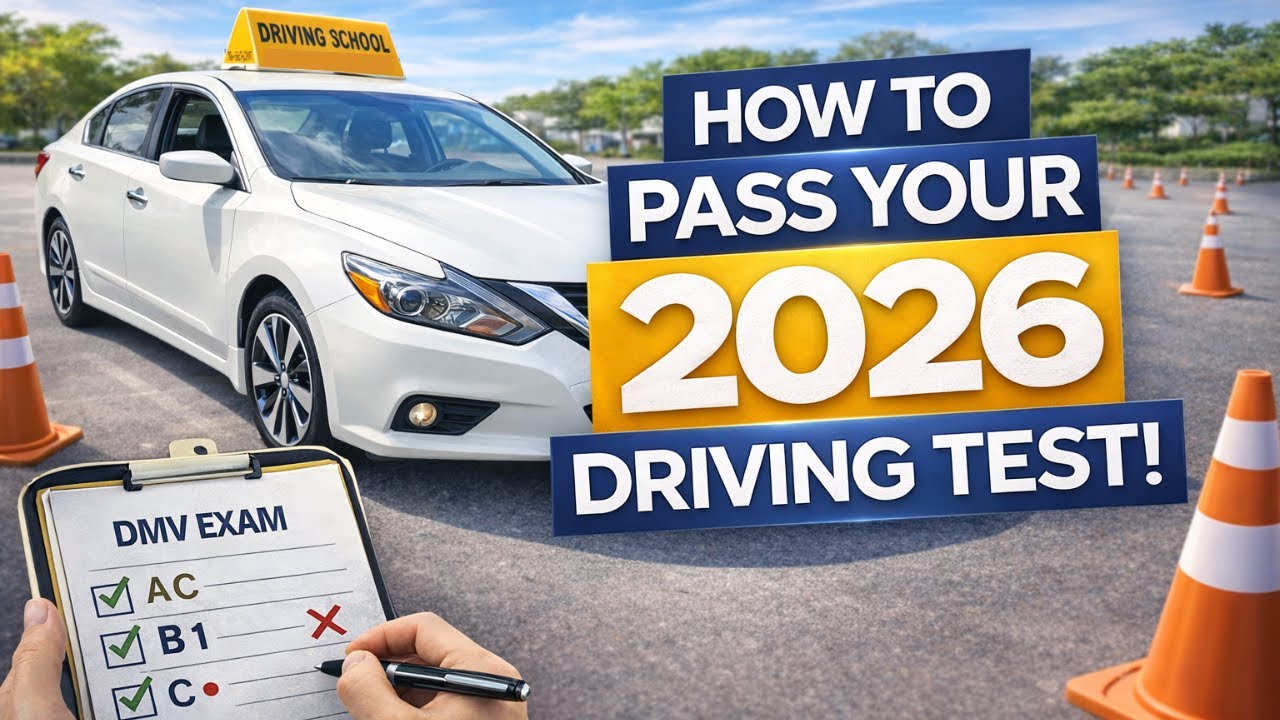
To better understand this concept, watch this helpful video:
Achieving a result on your first attempt requires a significant psychological shift. You aren’t just “showing what you’ve learned”; you’re proving you can manage a tonne of metal independently in high-pressure environments. In South West London, the density of red routes and cycle lanes means your awareness must be proactive. This is why our intensive driving courses focus on deep-level mastery. We move beyond the basics to ensure you are truly test-ready before you ever reach the test centre gates. Using high-level pass driving test first time tips is about more than technical skill; it’s about demonstrating you are the safest choice for the road.
New 2026 Booking Regulations You Must Know
The DVSA introduced stricter measures on 31 March 2026 to combat long waiting lists and discourage unprepared candidates. You are now permitted a maximum of only two changes to your appointment. Additionally, from June 2026, you can only move your test to one of the three nearest centres to your original booking. These restrictions mean you no longer have the luxury of “having a go” to see what the test is like. Every booking must be treated as your final, successful attempt. Preparation is now your most valuable asset.
Common Reasons for First-Time Failure
Many learners search for pass driving test first time tips only to overlook the most frequent pitfalls. Observation at junctions remains the primary reason for failure across Surrey and London. This isn’t just about looking; it’s about correctly timing your emergence into gaps that disappear in seconds. Inappropriate speed is another common issue. Driving too slowly can be just as dangerous as speeding, as it frustrates other road users and disrupts traffic flow. Finally, incorrect signalling on complex roundabouts often leads to serious faults. Mastery of these technicalities is what separates a first-time pass from a costly retest.
Mastering the DVSA Standard: The 27 Essential Skills
To secure your licence, you must master the 27 essential skills defined by the DVSA. These aren’t just boxes to tick; they represent the professional standard of a safe, independent road user. One of the most effective pass driving test first time tips is to categorise these skills into manageable groups: vehicle control, road procedure, and awareness. By breaking the syllabus down, you can track your progress alongside your instructor and identify specific areas that require refinement. This structured approach transforms an overwhelming list into a clear, achievable journey toward your milestone.
The Ready to Pass? campaign emphasises that independent driving is where many candidates lose focus. During this 20-minute section, you must follow sat nav directions or traffic signs without verbal guidance. This phase serves as the ultimate test of your ability to plan ahead whilst maintaining technical control. If you find yourself waiting for a prompt to check your mirrors or adjust your speed, you aren’t quite ready. True competence means making these decisions instinctively. Applying these pass driving test first time tips ensures you aren’t just hoping for luck on the day; you are relying on proven skill.
Don’t underestimate the “Show Me, Tell Me” questions. They are the perfect confidence builder at the start of your test. In 2026, these include updated knowledge on automated external defibrillators (AEDs) and CPR. Getting these right sets a positive tone for the rest of the drive. It proves you’ve done the work and respect the technical responsibilities of car ownership. If you feel you need a final professional appraisal of these skills, you can book a session with our expert team to confirm your readiness.
The Core Competencies for London Roads
London roads present unique challenges that national checklists often overlook. You must demonstrate heightened awareness of vulnerable road users, including the increasing number of e-scooter riders and cyclists in South West London. Navigating red routes and bus lanes requires precise timing and a deep understanding of signage to avoid a serious fault. In heavy city traffic, your use of mirrors must be constant and effective, ensuring you are always aware of your surroundings before changing position or speed.
The “Ready to Pass” Self-Assessment
Before you commit to a test date, perform a rigorous self-assessment. Can you drive for a full 40 minutes without a single serious mistake or the need for instructor intervention? You should feel confident managing your nerves without seeking external reassurance from the person in the passenger seat. We define being “test-ready” as the ability to drive safely and independently without any verbal or physical assistance. If you still rely on prompts for basic observations, you are not yet at the required standard for a first-time pass.
The Power of Mock Tests and Local Route Familiarity
Professional mock tests are the single best predictor of first-time success. They provide a high-pressure rehearsal that exposes technical flaws before they become serious faults on the big day. One of the most vital pass driving test first time tips is to treat these simulations as the real event. By following the official DVSA ‘Ready to Pass?’ guidance, you can ensure your preparation meets the exact criteria examiners use to assess safety and independence. At centres like Morden, Tolworth, and Mitcham, the environment is unforgiving. A mock test allows you to experience the specific lane configurations and traffic rhythms of these locations without the risk of losing your test fee.
Success on the day depends on how you use your mock test feedback to organise your final five hours of tuition. Instead of general practice, you should focus exclusively on the specific faults identified during the simulation. This strategic approach ensures you arrive at the test centre with every weakness addressed. We’ve found that students who complete at least two professional mock tests are significantly more likely to achieve a clean sheet. It’s about building a layer of resilience that keeps you calm when the examiner remains silent.
Why Local Knowledge Matters in South West London
South West London presents a unique set of obstacles that national checklists often overlook. The A3 dual carriageway requires precise speed control and confident merging, whilst the high-density pedestrian zones in Kingston and Wimbledon demand constant vigilance. You must also identify “trap” junctions where lane discipline is frequently tested. For instance, certain roundabouts in Mitcham have specific markings that catch out the unprepared. Practising on these actual routes under exam conditions ensures you won’t be surprised by a complex layout on the day. Local familiarity transforms a stressful route into a manageable journey.
Simulating the Test Environment
To truly prepare, you must step outside your comfort zone. We recommend having a different instructor conduct your mock test to remove the familiarity of your regular lessons. This replicates the professional distance of an examiner and helps you learn to cope with the silence of the vehicle, which many learners find unsettling. This experience is crucial for building the mental stamina needed to drive independently for 40 minutes. You can book a professional mock test with our team to gain this invaluable exposure and refine your performance before the real assessment begins.
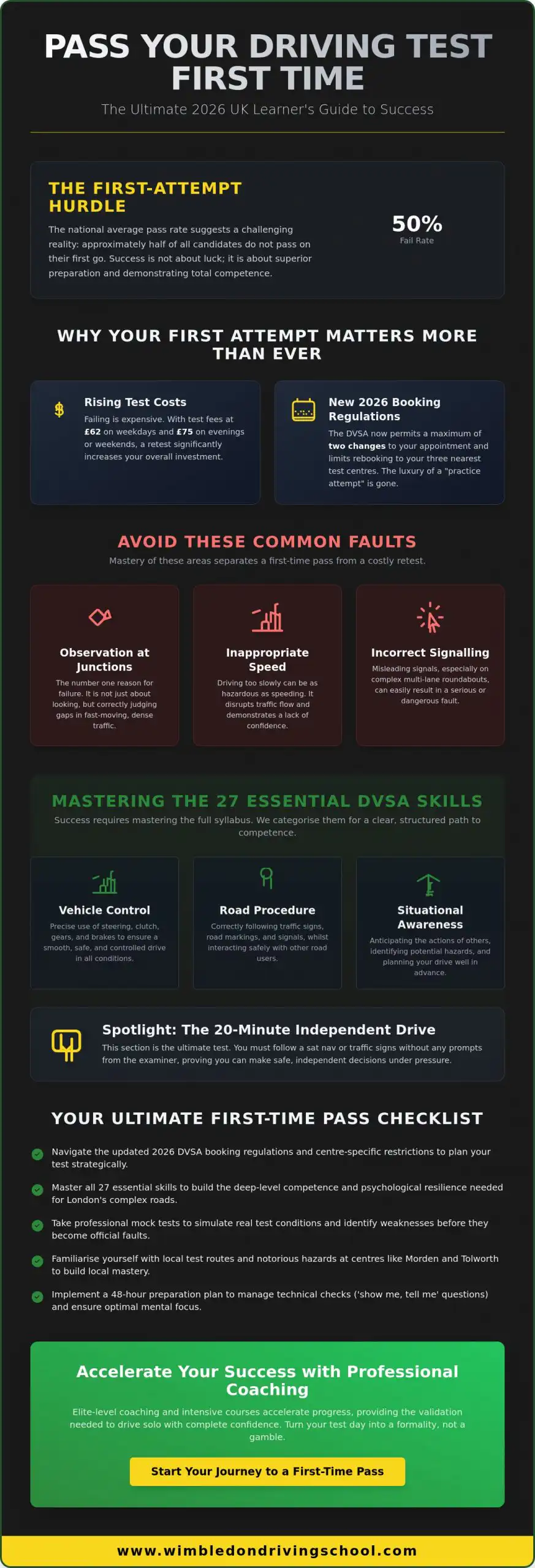
Your Ultimate First-Time Pass Checklist: 15 Essential Tips
The final countdown to your assessment is as much about logistical precision as it is about technical skill. With the 2026 restrictions limiting test changes to just two attempts, you cannot afford a cancellation due to a forgotten document or a preventable technicality. This checklist consolidates the most effective pass driving test first time tips into a chronological plan. It moves you from the final hours of practice to the moment you secure that first-time pass certificate. By following this structured path, you ensure that nothing is left to chance.
The 48-Hour Preparation Phase
Your preparation begins two days before the examiner greets you. Precision at this stage prevents the anxiety that often leads to minor faults during the drive. Ensure you have these logistical must-haves organised:
- Verify your documents: You must have your physical provisional licence. Without it, your test will be cancelled and your fee lost.
- Theory Pass Certificate: Whilst examiners can often verify this digitally, bringing the physical copy demonstrates a professional level of readiness.
- Vehicle Compliance: If you aren’t using an instructor’s car, ensure yours has an extra rear-view mirror for the examiner, correctly positioned L-plates, and is clean inside and out.
- Warm-up Lesson: Organise a final session roughly two hours before your test time to acclimatise to the day’s traffic and road conditions.
- Rest and Hydration: Prioritise a full night’s sleep to maintain the high level of concentration required for London driving.
During the Test: Success Strategies
Once the engine starts, your behaviour must project total confidence to the examiner. They aren’t looking for a perfect driver; they are looking for a safe, independent one. Use these pass driving test first time tips to signal your competence:
- Exaggerate observations: Move your head slightly when checking mirrors so the examiner can clearly see you are monitoring your surroundings.
- Recover from mistakes: If you stall or take a wrong turn, stay calm. You are allowed up to 15 minor faults, and a technical error is rarely an immediate fail unless it affects safety.
- Clarify instructions: If you are unsure of a direction, ask the examiner to repeat it. It is better to clarify a command than to make a rushed, dangerous decision.
- Maintain lane discipline: Be particularly vigilant at roundabouts and junctions, ensuring you don’t drift into adjacent lanes whilst turning.
Managing Test Nerves
Psychological resilience is the secret weapon of successful candidates. Avoid excessive caffeine on the morning of your test, as it can heighten physical jitters and lead to “heavy” footwork on the pedals. Utilise deep breathing techniques whilst waiting in the test centre to lower your heart rate and sharpen your focus. During the drive, keep your attention entirely on the road environment rather than the examiner’s clipboard. If you feel your nerves rising, remember that your instructor has already validated your ability; you are simply demonstrating that skill to a second professional.
Ready to finalise your preparation and secure your licence? You can book your final assessment lessons with our RoSPA-certified team today to ensure every box on your checklist is ticked.
Strategic Success with Wimbledon Driving School
Achieving a first-time pass is a transformative milestone that requires more than just basic instruction. It demands a partnership with a mentor who understands the gravity of the UK’s rigorous safety requirements. At Wimbledon Driving School, our instructors hold elite RoSPA Gold and IAM certifications, positioning us as a premier provider in the competitive London market. We don’t just teach you to drive; we guide you through a journey toward total road mastery. By choosing an institution with a track record of excellence, you ensure that your education is both safe and highly effective.
Our intensive driving courses are designed for those who want to fast-track their success without compromising on quality. These programmes condense months of learning into a focused period, allowing you to maintain momentum and retain complex skills more effectively. This approach is one of our most successful pass driving test first time tips, as it keeps the technical requirements fresh in your mind. Consequently, our pass rates consistently exceed the South West London average, providing you with the validation you need to feel confident on test day.
A critical differentiator in our service is our professional Mock Driving Tests. While many competitors merely suggest route familiarity, we provide a formal simulation that replicates the exact pressure of the DVSA environment. This service identifies minor technicalities before they become serious faults, allowing us to customise your final lesson plans. Whether you are a nervous beginner or an experienced driver from overseas, our tailored coaching ensures you are ready to drive solo in heavy traffic. We prioritise your specific needs, adapting our professional knowledge to suit your individual learning style.
Flexible Learning to Suit Your Schedule
We operate seven days a week to accommodate the logistical needs of modern learners. Consistent practice is vital for building muscle memory and confidence, especially when navigating the complex red routes of South West London. You can Explore Our Intensive Courses to see how we can accelerate your timeline toward a licence. For those seeking a smoother learning curve, our Automatic Lessons for Faster Progress offer an efficient route to success by removing the complexities of gear changes in heavy city traffic.
Take the First Step Toward Your Licence
Join the thousands of successful learners across South West London and Surrey who have achieved their goals with our support. Booking your first session is the definitive step toward your personal freedom and professional mobility. Start your journey with a confident mentor who is serious about your safety and rigorous in their standards. Book Your First Lesson with Wimbledon Driving School today and secure your place on the road with the highest industry standard of instruction.
Secure Your First-Time Pass and Driving Independence
Mastering the 27 essential skills and embracing the rigour of professional mock tests are the definitive steps toward your motoring freedom. In an environment with stricter 2026 booking regulations, every lesson must count. These pass driving test first time tips provide the framework you need to demonstrate total competence to your examiner, ensuring you are prepared for the unique hazards of South West London and Surrey. By focusing on independent driving and local route familiarity, you transform a daunting assessment into a manageable milestone.
We offer more than just instruction; we provide a transformative experience led by RoSPA Gold and IAM certified instructors. As specialists for nervous drivers with the highest pass rates in South West London, we ensure you feel supported at every stage of your journey. It’s time to move past the waiting lists and secure your first-time pass certificate with the backing of a premier institution.
Start Your Journey with Wimbledon Driving School
You have the skills and the checklist; now it’s time to take the wheel with confidence. We look forward to seeing you on the road as a safe, independent driver.
Frequently Asked Questions
How many driving lessons do I need to pass first time in 2026?
The DVSA recommends an average of 45 hours of professional instruction to be fully prepared for the practical assessment. This should ideally be supplemented with at least 22 hours of private practice to build necessary confidence. However, every learner is unique; our intensive courses are designed to help you reach this professional standard more efficiently by focusing on high-level proficiency in a compressed timeframe.
Can I use my own car for the driving test?
You can use your own car for the test provided it meets all current DVSA safety and insurance requirements. The vehicle must be fitted with an extra rear-view mirror for the examiner, have correctly positioned L-plates, and be covered by a policy that specifically includes driving tests. Most of our students find using their instructor’s car more effective, as it is already fully compliant and familiar to them.
What happens if I make a mistake during the independent driving section?
Making a navigational mistake, such as taking a wrong turn, will not result in a fail if you continue to drive safely. The examiner is assessing your ability to manage the vehicle independently rather than your ability to follow a sat nav perfectly. If you realise you’ve gone the wrong way, stay calm and follow the road safely until the examiner provides further directions to get you back on track.
Is it easier to pass the driving test in an automatic car?
Passing in an automatic car is often considered more straightforward because it eliminates the need for gear changes and clutch control. This significantly reduces the risk of stalling, which is a common source of anxiety for many candidates in heavy traffic. Whilst the physical operation is simpler, you must still demonstrate the same rigorous level of observation and hazard perception required for any first-time pass.
What should I do if I am extremely nervous before my test?
Managing nerves effectively starts with the knowledge that you have reached the required professional standard through rigorous preparation. One of the most effective pass driving test first time tips is to complete multiple professional mock tests to familiarise yourself with the exam environment. On the day, utilise deep breathing techniques and ensure you have a warm-up lesson to settle into the car before the examiner arrives.
How do I book a driving test at Morden or Tolworth?
You must book and manage your practical test yourself through the official GOV.UK website, as instructors can no longer book on your behalf in 2026. Given the high demand at centres like Morden and Tolworth, it is wise to check for availability regularly. For learners in other regions such as Canada, services like Book Your Road Test can assist with local scheduling needs. Remember that under 2026 regulations, you are only permitted to move your appointment to one of the three nearest centres to your original booking.
What are the “Show Me, Tell Me” questions for the 2026 test?
The “Show Me, Tell Me” section includes two vehicle safety questions, including updated 2026 queries regarding CPR and automated external defibrillators (AEDs). You will answer one “tell me” question before you start the engine and one “show me” question whilst you are driving. Mastering these technical checks early in your journey demonstrates a professional level of car maintenance knowledge and builds immediate confidence with your examiner.
How long is the practical driving test in the UK?
The practical driving test lasts approximately 40 minutes, during which you must demonstrate total independence and safety. This duration includes the eyesight check, safety questions, and roughly 20 minutes of independent driving using a sat nav or traffic signs. Implementing proven pass driving test first time tips regarding mental stamina will help you maintain the high level of concentration needed until you switch off the engine back at the centre.