Did you know that only 44.9% of learners managed to pass their theory test last year? It is a sobering statistic that proves why finding the best way to prepare for uk driving theory test is more critical than ever. With the 2026 introduction of life-saving CPR and AED questions, plus new restrictions on booking and changing test dates, the margin for error has never been smaller. You shouldn’t have to feel overwhelmed by an endless sea of road signs or the specific pressure of hazard perception click-timing.
We understand that the sheer volume of information can feel daunting, especially when conflicting advice makes it difficult to know which revision tools to trust. You deserve a clear, professional roadmap that replaces anxiety with absolute certainty. This guide reveals the definitive strategy to master the Highway Code and ace your hazard perception. We will explore how to integrate digital tools with professional insights to ensure you secure that first-time pass and move quickly toward your practical driving test.
Key Takeaways
- Understand why the best way to prepare for uk driving theory test involves more than simple memorisation, particularly with the 2026 addition of life-saving CPR and AED questions.
- Identify the three essential revision pillars and why official DVSA materials remain the most reliable foundation for your success.
- Master the psychological distinction between potential and developing hazards to perfect your click-timing and reaction speed during the assessment.
- Follow a structured four-week revision roadmap that transforms overwhelming road signs and regulations into manageable, daily milestones.
- Discover how professional guidance during practical lessons bridges the gap between theoretical knowledge and real-world driving competence.
Why the UK Driving Theory Test Requires a Professional Strategy
Many learners mistakenly view the theory test as a simple box-ticking exercise or a basic memory game. This perspective often leads to disappointment. With the official pass rate sitting at just 44.9% for the 2024/2025 period, it’s evident that relying on “common sense” is a risky gamble. The 2026 test is more demanding than ever, now featuring critical questions on life-saving skills like CPR and the use of AEDs. Much like how Meridian Private Primary School nurtures an early spirit of inquiry and foundational knowledge in its students, adopting a structured, professional mindset is the best way to prepare for uk driving theory test and ensure you aren’t caught out by these recent updates.
Success starts with understanding that the UK driving test is a two-part challenge designed to build a foundation for safe, lifelong driving. You must pass both the multiple-choice section and the hazard perception test in the same sitting. Starting your revision before you even book your first practical lesson provides a massive strategic advantage. It allows you to recognise road signs and understand traffic priorities before you ever have to manage a vehicle in live traffic. You can find more resources to help your journey in our learning centre.
To better understand this concept, watch this helpful video:

The Multiple-Choice Challenge
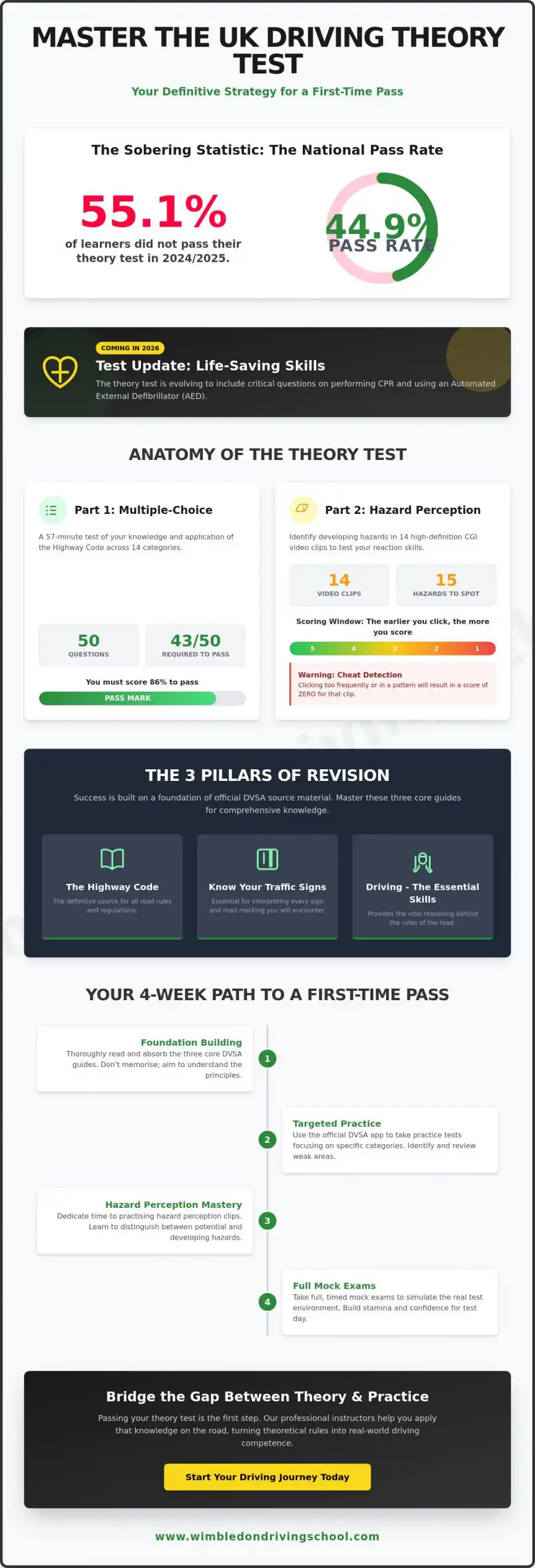
The first part of the assessment involves 50 multiple-choice questions selected from 14 diverse categories. You’ll have 57 minutes to navigate topics ranging from ‘Alertness’ and ‘Safety Margins’ to ‘Vulnerable Road Users’. To pass, you need a score of at least 43. Finding the best way to prepare for uk driving theory test means diving deep into each of these categories rather than skimming the surface. The DVSA phrases these questions carefully to test your actual understanding of road rules. They want to see if you can apply logic to a scenario, not just recite a handbook. This is why rote memorisation often fails when faced with the pressure of the exam centre.
The Hazard Perception Hurdle
The Hazard Perception Test (HPT) is the second hurdle. It uses 14 high-definition CGI video clips to simulate various driving conditions. You are tasked with identifying 15 developing hazards; these are situations that would cause you to take action, such as changing speed or direction. Each hazard carries a maximum of 5 points. The sooner you spot the danger, the higher your score. However, you must be precise. The system includes a ‘cheat’ detection algorithm. If you click too many times or in a repetitive pattern, you will automatically score zero for that clip. Mastering the gap between seeing a potential hazard and reacting to a developing one is vital for a first-time pass.
The Essential Revision Toolkit: Beyond the Question Bank
Many learners fall into the trap of only practicing questions through random online quizzes. While question banks are useful, the best way to prepare for uk driving theory test is to build a deep understanding of the source material. You should treat your revision as a three-pillared foundation consisting of “The Highway Code”, “Know Your Traffic Signs”, and “Driving – The Essential Skills”. These are the primary sources the DVSA uses to create every question you will face. The latter is often overlooked, but it provides the vital reasoning behind the rules, making it far easier to remember complex scenarios during the exam.
Following official government guidance ensures you are studying the most accurate and up-to-date information. While third-party apps like “Theory Test 4 in 1” offer excellent supplementary features and tracking, the official DVSA Theory Test Kit app remains the gold standard for accuracy. It mirrors the actual test environment, helping you build the necessary exam stamina to stay focused during the 57-minute multiple-choice session. Mock tests aren’t just about checking your score; they are about training your brain to handle the mental fatigue of a high-stakes assessment.
Mastering The Highway Code
Don’t just read the code; analyse it. Pay close attention to the distinction between “Must” and “Should”. Rules using “Must” or “Must Not” are legal requirements, often backed by specific legislation, whereas “Should” indicates advisory behaviour. Focus heavily on sections regarding road markings and junctions, as these are frequently tested and form the backbone of safe driving. For additional support, our Wimbledon Driving School Learning Centre provides local context that makes these abstract rules feel real and applicable to your future driving experience.
Digital Revision Strategies
Efficiency beats volume every time. Use the spaced repetition method by dedicating 20 minutes a day to revision rather than attempting a grueling five-hour cramming session on a Sunday. This approach helps move information from your short-term to long-term memory effectively. As you progress, flag difficult questions for targeted review in your final week. Transition from “practice mode” to “timed mock test mode” at least two weeks before your date to reduce test-day nerves. This disciplined approach ensures you arrive at the test centre with the confidence of a seasoned driver. If you find the theory easier to grasp whilst behind the wheel, consider starting your practical journey to see these rules in action.
Mastering Hazard Perception: Developing Your ‘Road Eye’
Hazard perception is arguably the most psychologically demanding portion of the assessment. Many candidates fail here because they treat it as a video game rather than a test of professional road awareness. The best way to prepare for uk driving theory test is to bridge the gap between spotting a “potential” hazard and identifying a “developing” one. A potential hazard is simply a situation that might require you to act, such as a pedestrian standing on the pavement. However, it only becomes a developing hazard when that pedestrian actually starts to cross the road. You must react to the movement, not just the presence.
Learners often click too late because they wait for the danger to become undeniable. By the time the hazard is obvious, you’ve already missed the high-scoring five-point window. To counter this, professional instructors often recommend the “Three-Click Method”. When you spot a potential hazard, click once. Click again a second later as the situation develops, and a third time a moment after that. This strategic approach ensures you land at least one click within the optimal scoring zone without triggering the “cheat” detection software. Accessing Official DVSA revision materials is essential here; these resources provide the high-quality CGI clips that mirror the latest 2026 standards.
The Scanning Technique
Effective hazard perception requires a disciplined scanning technique. Experienced drivers don’t just stare at the car in front; they scan the foreground, middle ground, and background in a continuous loop. Look for subtle clues that signal trouble. A ball bouncing into the street is a classic indicator that a child might follow. A flashing indicator on a parked car suggests it is about to pull out. A developing hazard is a situation that forces a change in speed or direction. If you don’t have to adjust your driving, the hazard hasn’t developed yet.
Avoiding the ‘Click-Happy’ Trap
The DVSA’s software is designed to catch anyone trying to “game” the system. If you click rhythmically or in a rapid-fire burst across the entire clip, you’ll receive a zero score for that video. This penalty is frustrating but entirely avoidable with discipline. Over-anticipating can be just as damaging as being too slow if you click before the scoring window even opens. To sharpen your timing, practice mental rehearsal whilst you’re a passenger in a car. Commentary driving, where you vocalise every potential risk you see, is a transformative way to build your “road eye” before you even start your intensive driving course.
A Structured 4-Week Plan to Guarantee a First-Time Pass
While social media platforms like Reddit are full of claims about passing with only three days of revision, this high-risk strategy is a major contributor to the high failure rates seen recently. A disciplined, professional approach is the best way to prepare for uk driving theory test and ensures you aren’t part of the 55.1% of candidates who walk away empty-handed. By spreading your preparation over 28 days, you allow your brain to move information into long-term memory. This isn’t just about passing a test; it is about building the foundation for your safety once you are actually behind the wheel.
Week 1-2: Building the Knowledge Base
Your first fortnight should focus on the 14 categories of the multiple-choice section. Set a firm goal of 30 to 45 minutes of active study per day. During Week 1, read the Highway Code cover-to-cover and complete every category question at least once. This phase should ideally coincide with your provisional driving licence application process to keep your momentum high. It’s the perfect time to familiarise yourself with the updated 2026 questions regarding life-saving skills.
In Week 2, shift your focus toward road signs and the scanning techniques discussed in previous sections. Start your first few practical lessons during this time. Seeing a “No Entry” sign or a “Give Way” marking in real-time reinforces your digital study in a way that reading alone cannot. It transforms abstract rules into tangible driving habits. You’ll find that the best way to prepare for uk driving theory test is to see the theory in action on the streets of London or Surrey.
Week 3-4: Refinement and Confidence
Week 3 is about targeted revision. Revisit every question you flagged as difficult in the previous weeks. You’ll likely find that braking distances or document knowledge are the areas that require extra attention. Begin taking two full mock tests daily to build your exam stamina. This helps you get used to the 57-minute time limit and the pressure of the 50-question format. Consistency is your goal here.
During the final sprint in Week 4, your objective is absolute mastery. Don’t head to the test centre until you can achieve a 95% pass rate in at least 10 consecutive mock tests. This provides a vital safety buffer for test-day nerves. Follow the 48-hour rule: stop all intense cramming two days before your appointment to avoid mental fatigue. Finally, double-check the exact location of your test centre to avoid any last-minute stress. If you want to see how these rules apply to the road before your big day, you can book a professional assessment lesson with our expert team.
How Practical Lessons with Wimbledon Driving School Accelerate Your Success
Whilst digital apps are invaluable, the best way to prepare for uk driving theory test is to experience road rules in a physical environment. Our instructors act as your “Confident Mentor,” bridging the gap between a multiple-choice screen and a busy London junction. During your manual driving lessons, you won’t just be learning to control the clutch. You’ll be challenged to identify road signs in real-time and explain the priorities at every roundabout you encounter. This active participation turns abstract theory into second nature.
Mock practical tests are particularly effective for cementing your knowledge of lane discipline and junction priority. By applying the theory whilst under the guidance of a professional, you build the validation and confidence needed to excel. This holistic approach is widely recognised as the best way to prepare for uk driving theory test because it treats the subject as a living skill rather than a static exam. We aim to make you a thinking driver, someone who understands the “why” behind every rule in the Highway Code.
Real-World Hazard Perception
CGI clips are excellent for learning the basics, but they can only simulate the unpredictability of South West London traffic. Your instructor will train your brain to spot hazards before they even begin to develop. We use “what-if” scenarios during your lessons to sharpen your anticipation. We might discuss the potential risks of a delivery van parked on a blind bend or a cyclist approaching a narrowing road. This real-world training ensures that when you sit the official assessment, your “road eye” is already finely tuned to the nuances of British driving conditions.
Booking Your Practical Test
Once you secure your theory pass, the clock begins to tick. Your certificate is valid for exactly two years. You must pass your practical driving test within this window, or you’ll be required to retake the theory exam. If you’re eager to reach the finish line quickly, our intensive driving courses are designed to maintain your momentum and build on your theoretical foundation. Remember, passing your theory is more than just a box-ticking exercise; it’s the first triumphant step in a transformative journey toward a lifetime of driving excellence and independence.
Empower Your Journey to the Driver’s Seat
Mastering the 2026 theory test requires more than just memorising facts; it demands a transformation in how you perceive the road. By following a structured four-week timeline and refining your “road eye” through professional hazard perception techniques, you’ve already gained a significant advantage over the average learner. The best way to prepare for uk driving theory test remains a strategic integration of high-quality digital revision and expert practical instruction. This dual approach ensures you don’t just pass a test, but become a confident, safe road user for life.
At Wimbledon Driving School, we take pride in maintaining some of the highest pass rates in the country. Our RoSPA Gold and IAM certified instructors operate seven days a week across South West London, providing the elite mentorship you need to succeed. Don’t leave your first milestone to chance. Book your first lesson with Wimbledon Driving School today and let us guide you toward your full licence with absolute confidence. Your future on the road starts with the right foundation, and we’re here to ensure you reach your destination safely.
Frequently Asked Questions
How many times can you fail the UK driving theory test?
There is no legal limit on the number of times you can fail the theory test. You are free to retake the exam as often as necessary to achieve a pass. However, you must wait at least three working days before you can sit the test again. Following a professional revision plan is the best way to prepare for uk driving theory test and avoid the cost of multiple attempts.
Can I take my practical driving test before passing the theory?
No, you must successfully pass your theory test before you can book or take a practical driving test. The DVSA requires your theory pass certificate number to access the practical booking system. This regulation ensures that every learner possesses a fundamental understanding of road safety and the Highway Code before they are assessed on their physical driving ability in live traffic.
What is the pass mark for the hazard perception part of the test in 2026?
The pass mark for the hazard perception section is 44 out of a possible 75 points. This part of the assessment involves 14 interactive CGI clips that test your ability to identify developing hazards. Each hazard is worth up to five points. Scoring highly requires a disciplined scanning technique and precise click-timing, which are essential skills for any learner driver aiming for a first-time pass.
How long is the theory test certificate valid for?
Your theory test pass certificate is valid for exactly two years from the date you pass the exam. If you don’t pass your practical driving test within this 24-month window, your theory certificate will expire. You’ll then need to book, pay for, and retake the theory test again. This ensures your theoretical knowledge remains current and aligns with any recent changes to road safety legislation.
Which app is best for the UK driving theory test in 2026?
The official DVSA Theory Test Kit app is widely considered the premier choice for learners. It provides the most accurate questions and hazard perception clips that mirror the actual test environment. Using official materials is the best way to prepare for uk driving theory test because they are updated directly by the agency responsible for the exam, ensuring you never study outdated or incorrect information.
Can I take the theory test in a language other than English?
You must take the theory test in either English or Welsh. The DVSA withdrew the option for foreign language voiceovers and interpreters in 2014 to ensure all drivers can read road signs and understand vital safety instructions. If you have reading difficulties, you can request a voiceover in English or Welsh, which allows you to hear the questions through headphones during the multiple-choice section.
For international learners who need to bolster their language skills to meet these requirements, a structured English course Singapore can provide the foundational literacy needed to navigate technical road terminology with confidence.
What should I bring with me to the theory test centre?
You must bring your UK photocard provisional driving licence to your appointment. If you fail to produce this, the centre staff will not allow you to take the test and you’ll lose your fee. If you still hold an old-style paper licence, you must also bring a valid passport as photographic identification. Personal items like mobile phones and bags are not permitted inside the examination room.
How soon can I rebook my theory test if I fail?
You can book your next attempt immediately, but you must wait at least three working days before you can actually sit the test again. This mandatory gap is intended to give you sufficient time to review your performance and study the categories where you struggled. Use this time effectively to refine your knowledge and ensure you arrive at your next appointment with the confidence to pass.