What if your first hour behind the wheel wasn’t a nerve-wracking test of skill, but a structured masterclass in control where it is actually impossible to fail? Most learners approach their initial session with a knot in their stomach, worrying about stalling in traffic or confusing the pedals whilst an instructor watches on. It is completely natural to feel this pressure when embarking on such a transformative personal milestone, but the reality is far more supportive than you might imagine.
Knowing exactly what to expect on your first driving lesson uk is the most effective way to replace anxiety with genuine excitement. We have designed this 2026 guide to walk you through every detail, from the moment your professional mentor arrives at your door to your very first successful move-off. You will discover the precise structure of a premier lesson, understand how dual controls guarantee your safety, and learn exactly what you need to bring to start your journey toward driving excellence with total confidence.
Key Takeaways
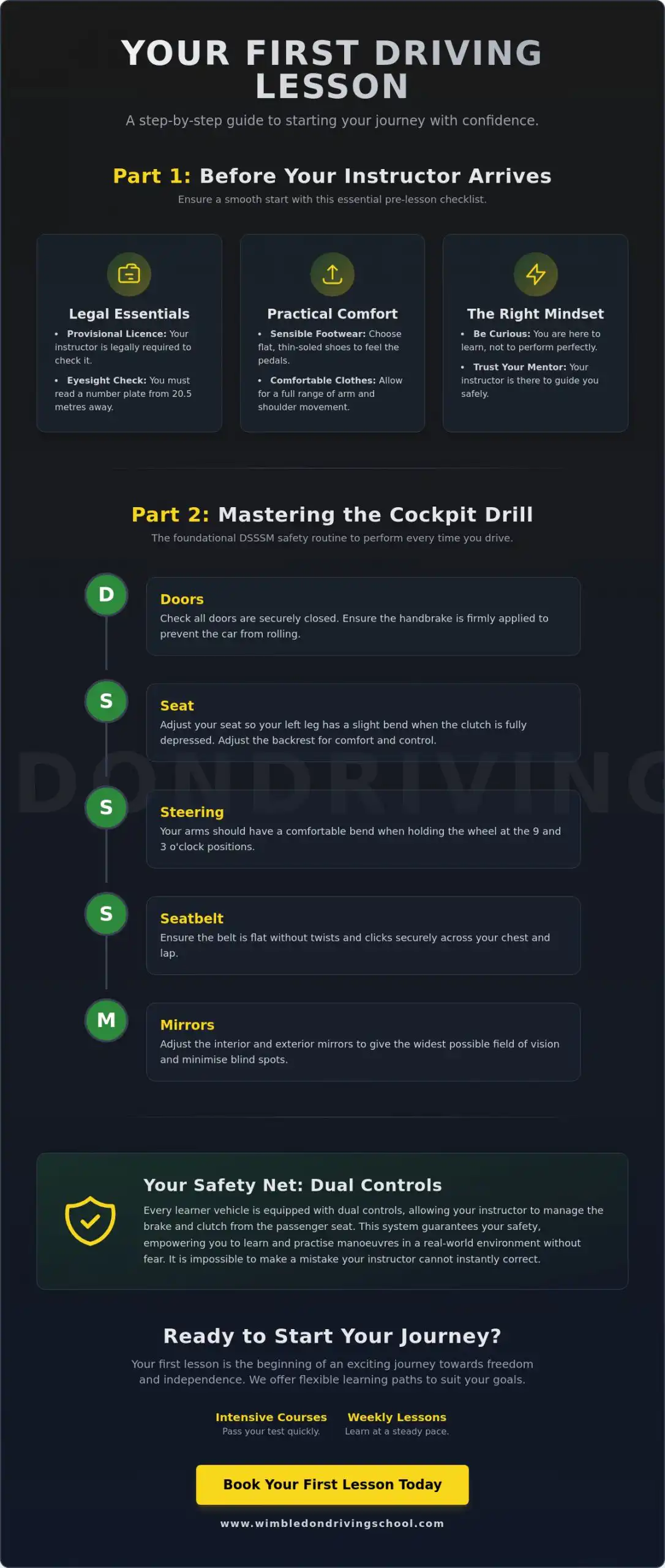
- Confirm your legal readiness by preparing your provisional licence and passing the mandatory 20-metre eyesight check before your mentor arrives.
- Establish total vehicle control from the start by mastering the DSSSM cockpit drill, the essential foundation of every professional driving session.
- Gain absolute clarity on what to expect on your first driving lesson uk, including how dual controls empower you to practice safely in a real-world environment.
- Achieve a smooth and confident first move-off by applying the POM routine and learning the technical secret to finding the biting point.
- Plan your path to achievement by understanding how to review your progress and select the most effective learning pace, such as intensive driving courses or weekly lessons.
Essential Preparation: What to Bring and Do Before You Start
Success behind the wheel begins long before you turn the ignition. Your first lesson is a significant milestone, and being properly prepared ensures you can focus entirely on the experience rather than worrying about admin. You don’t need to arrive with any prior technical knowledge; your instructor is a professional mentor who expects a complete beginner. However, there are specific legal and practical steps you must take to ensure the session can proceed safely and legally.
The Legal Essentials for Your First Lesson
The most critical item you need is your UK provisional driving licence. Your instructor is legally required to check this before you even sit in the driver’s seat. It’s a good idea to verify your licence details online via the DVLA website beforehand to ensure there are no unexpected issues. Alongside the physical card, you must pass a basic eyesight test. This involves reading a standard UK number plate from a distance of 20.5 metres. This isn’t just a formality; it’s a fundamental part of the broader UK driving test requirements that you’ll eventually face during your practical exam. If you fail this check, the lesson cannot go ahead. Once the legalities are cleared, your instructor will typically present a professional progress logbook. This tool tracks your achievements and helps you see exactly how far you’ve come after every session.
Comfort and Logistics
What you wear significantly impacts how you interact with the vehicle. When considering what to expect on your first driving lesson uk, many learners overlook the importance of footwear. Choose flat, thin-soled shoes that allow you to feel the subtle vibrations of the pedals. Thick boots or heavy trainers can mask the biting point of the clutch, making it harder to master smooth move-offs. Clothing should be comfortable and allow for a full range of movement, particularly in your arms and shoulders. If you’ve booked your session within our primary service areas in South West London or Surrey, confirm your exact pick-up location with your instructor at least 24 hours in advance. If you require glasses or contact lenses for distance vision, ensure they are with you; driving without them is both illegal and dangerous.
Finally, embrace a mindset of curiosity rather than performance. You aren’t expected to know “how” to drive yet. Your instructor is there to guide you through the process, using dual controls to maintain absolute safety. Knowing what to expect on your first driving lesson uk means understanding that you are a student, not a master. Arriving with a calm, open mind is the best preparation you can possibly do.
The Cockpit Drill: Mastering the DSSSM Routine
After the initial greetings and legal checks, you will move into the driver’s seat for the very first time. This is where your transformation from passenger to pilot begins. The first technical skill your mentor will introduce is the cockpit drill, a vital safety sequence known by the acronym DSSSM. Following the official DVSA driving syllabus, this routine ensures that the vehicle is perfectly configured to your height and reach before you ever engage the engine. It is the foundation of every successful session and a core component of what to expect on your first driving lesson uk.
Breaking Down DSSSM
The DSSSM routine is a logical progression that prioritises your safety and ergonomic control. Your instructor will guide you through each stage with professional precision to ensure you are ready for the road:
- Doors: You must check that all doors are securely closed and that the handbrake is firmly applied to prevent any accidental movement while you adjust your surroundings.
- Seat: Adjust the base so your left leg has a slight bend when the clutch is fully depressed. You must also set the backrest to ensure you aren’t reaching too far for the controls, which prevents fatigue.
- Steering: Your arms should have a comfortable bend when holding the wheel at the ten and two or nine and three positions. This allows for maximum leverage during manoeuvres.
- Seatbelt: Ensure the belt is flat, without twists, and clicks securely into place across your chest and lap.
- Mirrors: Set your interior and exterior mirrors to provide the widest possible field of vision. This step is crucial for identifying blind spots, which are the specific areas around the car that you cannot see through the mirrors alone.
Introduction to the Controls
Once you are seated correctly, you’ll be introduced to the primary controls that dictate the car’s behaviour. In a manual car, your feet will manage the ABC pedals: the Accelerator (right), the Brake (middle), and the Clutch (left). Your hands will navigate the gear stick, the handbrake, and the indicators. For many, the most daunting part of the first lesson is the clutch, but your mentor will simplify the process. The biting point is the precise moment when the clutch plates meet and the engine’s power begins to transfer to the wheels, causing the car to want to move forward. Mastering this feeling is the key to a smooth start. If you are ready to begin this journey with a premier provider, you can book your first session today and experience our industry-leading instruction firsthand.
Moving Off and Stopping: Your First Manoeuvre
Your transformation into a driver takes place away from the chaos of busy high streets. In urban areas like South West London or the winding lanes of Surrey, your mentor will initially take the wheel and drive you to a “nursery road.” These are specifically selected, quiet residential streets with minimal traffic where you can focus entirely on the mechanics of the car without the pressure of other road users. This transition is a vital part of what to expect on your first driving lesson uk; it ensures your first experience of motion is calm, controlled, and safe.
The POM Routine Step-by-Step
The POM routine is the industry-standard sequence for moving off safely. It stands for Preparation, Observation, and Manoeuvre. Mastering this early on builds the disciplined habits required for a lifetime of safe driving. Your instructor will guide you through this three-stage process with professional patience:
- Preparation: With the clutch fully depressed, select first gear. Apply a small amount of gas and slowly raise the clutch until you find the biting point. You’ll feel the car dip slightly as the engine engages.
- Observation: Perform a thorough six-point check. This involves looking over your left shoulder, checking the left mirror, looking ahead, checking the interior mirror, the right mirror, and finally the right-hand blind spot. You must be certain the road is clear before proceeding.
- Manoeuvre: Once safe, release the handbrake. Gently increase the gas whilst smoothly releasing the clutch, steering slightly into the road to join the flow of traffic.
Steering and Stopping Safely
Once the car is in motion, you’ll begin to practice the “push-pull” steering technique. This method ensures you always have both hands on the wheel and prevents you from crossing your arms, which provides maximum leverage and control during turns. It may feel unusual at first, but it quickly becomes second nature. Stopping the car is just as critical as moving it. Your mentor will teach you to check your mirrors, apply the brake progressively, and depress the clutch just before the car comes to a halt to prevent the engine from cutting out.
It is important to remember that stalling is a perfectly normal part of the learning process. Even the most proficient drivers stalled during their first hour. If the engine cuts out, don’t panic; your instructor’s dual controls are there to keep the vehicle secure whilst you simply restart the routine. Understanding what to expect on your first driving lesson uk means accepting that mistakes are merely stepping stones toward proficiency. For more detailed guides on specific techniques, you can explore our learning centre to further prepare for your journey toward a full licence.
Expectations vs Reality: Addressing First-Lesson Fears
The image of being thrust into the heart of a congested city centre on your first day is a persistent myth that fuels unnecessary anxiety. When researching what to expect on your first driving lesson uk, you might encounter horror stories on social forums, but the professional reality is far more controlled. Your mentor’s primary objective is to build your confidence through a series of small, manageable victories. High levels of focus often found in nervous learners actually serve as an advantage; these students tend to be more attentive to safety protocols and instructor guidance from the very first minute.
The Safety of Dual Controls
The most powerful tool in your instructor’s arsenal is the dual control system. This means that while you are in the driver’s seat, your mentor has a duplicate set of pedals on their side of the vehicle. They can intervene at any moment to slow the car down, stop it completely, or manage the clutch to prevent a stall. You cannot accidentally drive into a wall or pull out into dangerous traffic because your professional mentor acts as a literal safety net. This setup allows you to focus on learning the mechanics without the fear of causing a collision. Trust is built quickly during these first 60 minutes as you realise you are never truly alone in controlling the car.
Learning in South West London and Surrey
Our instructors are experts in local geography, specifically selecting environments that match your current skill level. If you are learning in our core service areas like Wimbledon, Sutton, or Kingston, you won’t be tackling the Tibbet’s Corner roundabout or the Kingston one-way system on day one. Instead, your instructor will use quiet residential pockets or secluded car parks to ensure you have the space to make mistakes safely. We transition from stationary drills to quiet “nursery roads” only when you feel ready. This strategic approach ensures that the reality of your first lesson is one of calm achievement rather than overwhelming stress. If you are ready to experience this professional level of support, you can book your first lesson today and start your journey with total peace of mind.
Planning Your Journey: What Happens After Lesson One?
As your first session concludes, your professional mentor will provide a comprehensive debrief. This is a pivotal moment in understanding what to expect on your first driving lesson uk, as the focus shifts from managing initial nerves to mastering long-term achievement. You will review your progress logbook, identifying specific successes in your cockpit drill and POM routine whilst setting clear, tangible goals for your next hour. This structured feedback loop ensures that every minute spent in the car moves you closer to your personal milestone of independence.
Intensive vs Weekly Lessons
Choosing the right rhythm for your education is vital for maintaining momentum. A fast-track intensive driving course is an excellent choice for learners with urgent milestones, as it condenses months of traditional training into a focused period of high-level instruction. Alternatively, consistent weekly tuition provides the benefit of regular, bite-sized learning that aids long-term memory retention. Data from the Driver and Vehicle Standards Agency (DVSA) in early 2026 suggests that the average learner requires approximately 45 hours of professional instruction, supplemented by 20 to 22 hours of private practice. With the national average pass rate currently standing at 48.7% as of June 2026, selecting a learning path that aligns with your schedule and learning style is the safest way to ensure a first-time success.
Next Steps and Booking
Efficiency is key to securing your preferred time slots and maintaining your progress. We recommend booking your next session before you leave the vehicle to ensure your journey remains on track. This is also the ideal time to discuss low driving school prices and the logistical advantages of block booking. Purchasing lessons in advance does more than just provide better value; it represents a psychological commitment to your transformation into a confident driver.
To support your practical development, you should immediately begin utilizing our learning centre. This resource is essential for mastering the theory test, which, as of early 2026, now includes updated first aid requirements regarding CPR and AED usage. By studying theory alongside your practical sessions, you create a holistic understanding of the road. Your first lesson was the start of a prestigious journey; by staying committed and following your mentor’s guidance, you are making the most effective choice for your future on the road.
Start Your Journey Toward Driving Excellence
Your first hour behind the wheel is more than just a lesson; it’s the beginning of a transformative journey toward a lifetime of freedom. By understanding exactly what to expect on your first driving lesson uk, you have already taken the most important step in overcoming initial anxieties. You now know that professional instruction prioritises your safety through dual controls and structured routines like DSSSM and POM. These foundations ensure that you aren’t just learning to move a vehicle, but are building the elite habits of a safe, competent driver.
Wimbledon Driving School is a premier provider with a reputation for excellence across South West London. Our team of highly qualified RoSPA Gold and IAM instructors are specialists in supporting nervous first-time drivers, ensuring every student feels secure and empowered. We take pride in our high pass rates and our commitment to industry-leading standards. Book your first lesson with Wimbledon Driving School today and experience the prestige of learning with the best in the business. Your destination is closer than you think.
Frequently Asked Questions
Do I need to have passed my theory test before my first driving lesson?
No, you don’t need to have passed your theory test to start learning to drive. You only need a valid UK provisional licence. Many students find that learning theory whilst taking practical lessons helps them understand road signs and traffic behaviour more effectively in a real-world context.
Will I actually get to drive the car on my first lesson?
Yes, you’ll definitely get behind the wheel and experience the car in motion. After completing the legal checks and the cockpit drill, your instructor will guide you through moving off and stopping in a quiet residential area. This hands-on experience is a fundamental part of what to expect on your first driving lesson uk.
What happens if I stall the car or make a mistake?
Stalling is a perfectly normal part of the learning process and is expected by every professional mentor. Your instructor remains calm and uses dual controls to ensure the vehicle is secure at all times. They’ll simply guide you through the restart procedure without any judgment or pressure.
How long does the first driving lesson usually last in the UK?
Most initial sessions last two hours. This duration is the industry standard because it allows sufficient time for the mandatory eyesight check, licence verification, and the cockpit drill without rushing your first practical experience of moving the car. It ensures you feel accomplished by the end of the session.
Can I choose between a male or female instructor for my first lesson?
You can absolutely request a male or female instructor when booking your session. We recognise that feeling comfortable with your mentor is essential for effective learning. We prioritise your preferences to ensure you feel relaxed and confident from the moment you enter the vehicle.
What should I do if I am extremely nervous about my first lesson?
Communicate your feelings to your instructor as soon as they arrive. Our mentors are experts in supporting nervous learners and will adapt their teaching style to match your pace. Understanding what to expect on your first driving lesson uk helps, but your instructor’s professional empathy is what will truly put you at ease.
Will my instructor pick me up from my house or a specific centre?
Your mentor provides a convenient door-to-door service as part of our premium offering. They can collect you from your home, workplace, or college, provided the location is within our covered service areas. This saves you time and allows you to start your lesson in a familiar environment.
Do I need to bring my own L-plates to the first lesson?
You don’t need to bring L-plates or any other equipment for the car. The instructor’s vehicle is a professional training car, fully equipped with dual controls and the necessary legal signage. All you need to bring is your provisional licence and any required eyewear.