

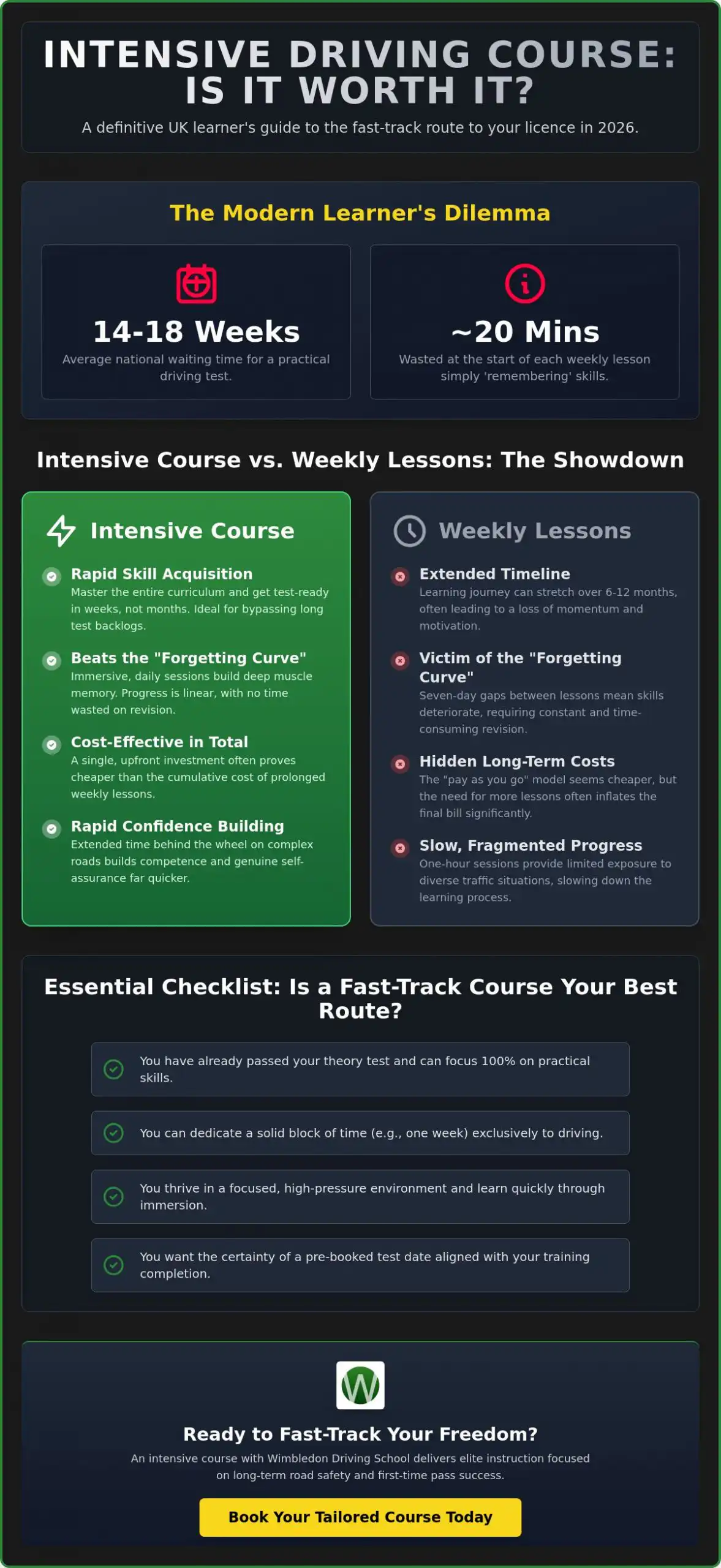
The traditional model of weekly driving lessons is fundamentally flawed for the modern learner who values efficiency. Spending months repeating basic manoeuvres because you’ve forgotten the nuances between sessions isn’t just frustrating; it’s a significant drain on your time and your budget. You’re likely asking, is an intensive driving course worth it uk wide, especially as average practical test waiting times stretch between 14 and 18 weeks in 2026. The demand for a more streamlined, immersive approach to gaining your licence has never been higher.
This definitive guide reveals how a fast-track intensive driving course can transform your learning journey from a long-term chore into a rapid, successful achievement. We’ll explore the pedagogical benefits of deep immersion, which helps you build muscle memory faster and feel truly confident on complex UK roads. You’ll learn exactly how these courses bypass the “forgetting curve,” how they stack up against rising tuition costs, and whether this high-performance path is the right choice for your lifestyle. It’s time to stop waiting and start driving.
Key Takeaways
- Master the full driving curriculum in weeks rather than months by leveraging an immersive schedule designed to beat the current 18-week national test backlog.
- Evaluate the true return on investment and see if an intensive driving course is worth it uk wide by comparing total upfront costs against the hidden expenses of long-term weekly tuition.
- Benefit from superior information retention by using concentrated training sessions that build deep muscle memory and eliminate the common “forgetting curve” between lessons.
- Identify your ideal learning path using our expert checklist to determine if your personality and experience level suit a fast-track driving journey.
- Gain the prestige of elite-level instruction that focuses on long-term road safety and professional competence rather than just passing the practical test.
Understanding the Intensive Driving Course Value Proposition
In 2026, the path to a driving licence has evolved significantly. A modern intensive driving course isn’t just a hurried “crash course” but a professionally structured curriculum designed for rapid skill acquisition. It represents a strategic response to the current DVSA climate, where national average waiting times for practical tests often reach 18 weeks. By aligning high-frequency training with a pre-booked test slot, this model offers a level of certainty and momentum that traditional methods struggle to provide.
Many learners find that is an intensive driving course worth it uk wide primarily because it eliminates the inefficiency of the “forgetting curve.” In a weekly lesson format, you often spend the first twenty minutes of every hour simply remembering what you learned seven days prior. An intensive programme removes this wastage. Every minute spent in the car builds directly upon the last hour, ensuring that your progress is linear, rapid, and far more cost-effective in the long run.
To help you decide if this high-speed approach suits your learning style, watch this expert breakdown:

The Science of Immersive Learning
Daily repetition is the cornerstone of the intensive method. When you spend five or six hours a day behind the wheel, your brain enters a state of flow. You’re not just learning how to drive; you’re habituating the physical responses required for safe road use. This immersive approach allows complex tasks like clutch control and steering to move from conscious effort to subconscious habit much faster. By focusing solely on driving for a set period, you reduce the cognitive load that comes with switching between your daily job and a weekly lesson. This method is particularly effective for those who already have some experience, as it polishes existing skills to meet the rigorous UK driving test standards with precision.
Fast-Track vs. Semi-Intensive: Which is Better?
Choosing between a one-week 30-hour blast and a two-to-three-week semi-intensive approach depends on your personal stress tolerance and lifestyle. The “fast-track” option is an incredible tool for those who thrive under pressure and want to conquer the 47-hour DVSA average in a fraction of the time. Conversely, a semi-intensive course allows for a “sleep on it” approach, which some learners find better for long-term reflection. Regardless of the speed, you must have your theory test passed before embarking on a fast-track intensive driving course. This ensures your focus remains entirely on the practical application of road safety and car control, leading to a much higher chance of first-time success.
The Pros and Cons: Is the Fast-Track Route Right for You?
For professionals in high-pressure environments like London, time is the most valuable currency. A traditional learning schedule can drag on for twelve months, often leading to a cycle of two steps forward and one step back. When considering if is an intensive driving course worth it uk based learners often find the answer in the sheer volume of progress made in a single week. By staying in the driving seat for extended periods, you develop a level of familiarity with the vehicle that weekly students simply cannot match. This consistency builds a unique rapport with your instructor; you aren’t just a face they see for an hour, you’re a dedicated partner in a shared mission.
Why Intensive Courses Build Confidence Rapidly
In a standard one-hour lesson, the first fifteen minutes are usually spent shaking off the “rust” from the previous week. This warm-up period is effectively dead time. Intensive training eliminates this wastage. You spend your energy on the meat of the curriculum, such as navigating complex multi-lane roundabouts and mastering high-speed dual carriageways. This immersion facilitates a profound psychological shift. You stop feeling like a student following instructions and start feeling like a driver making independent decisions. Following the official government guide to getting your licence becomes a focused sprint rather than a marathon of attrition.
From a professional instructor’s perspective, the retention of advanced skills is actually higher during concentrated training. Elite instructors utilize techniques similar to those found in RoSPA or IAM advanced training to ensure you’re absorbing roadcraft, not just passing a test. Managing the mental load is a skill in itself. Our instructors are experts at pacing these sessions, ensuring that information is delivered in digestible blocks that prevent burnout whilst maintaining momentum. This high-level guidance transforms what could be a stressful experience into a structured, empowering journey.
Potential Drawbacks to Consider
It’s vital to be realistic about the demands of this path. Spending five or six hours a day behind the wheel is physically and mentally taxing. You’ll need high levels of concentration and a willingness to push through periods of fatigue. There’s also the financial reality of a larger upfront commitment. Whilst the total cost is often lower than a year of weekly lessons, the initial outlay is higher. Finally, there’s the perceived pressure of test day. When you’ve invested a week of your life into a single goal, the stakes feel higher. However, for the right candidate, this pressure acts as a catalyst for peak performance. To see how our elite instructors can help you achieve this, you can book your initial assessment today and start your journey with confidence.
Calculating the ROI: Comparing Intensive vs. Weekly Lessons in 2026
Determining whether is an intensive driving course worth it uk learners often find, requires a look beyond the initial price tag. While a weekly lesson might seem manageable for a monthly budget, the total accumulation of costs over a year often tells a different story. The DVSA recommends approximately 45 hours of professional tuition, plus 22 hours of private practice. Spreading these hours across twelve months exposes you to multiple price increases as fuel and insurance costs fluctuate throughout the year. It’s a slow-burn investment that often costs more than you anticipate.
Weekly lessons also carry a hidden “refresher tax.” If you spend just 15 minutes of every hour re-learning what you forgot since last Tuesday, you’re effectively wasting 25% of your investment. Over a 45-hour syllabus, that’s over 11 hours of redundant instruction. An intensive course bypasses this entirely. By following the official steps to learning to drive in a concentrated burst, you maintain a high state of readiness. You’ll often reach test-standard in fewer total hours because your momentum never stalls.
The Financial Logic of Block Booking
Many students look for block booking discounted fees to mitigate the rising costs of tuition. While this offers some protection against inflation, intensive packages provide a more comprehensive value proposition. These packages often include administrative support for securing a practical test date. This is vital in 2026, as national waiting lists still hover between 14 and 18 weeks. The “opportunity cost” is also a major factor. Gaining your licence six months earlier could mean accepting a better job, reducing commute times, or gaining independence that has its own tangible financial value.
Long-Term Skill Retention
Professional instructors with RoSPA Gold certification observe higher first-time pass rates amongst intensive learners. This isn’t a coincidence. The immersion method ensures that the complex rules of the road remain fresh and deeply ingrained. Intensive students often perform better in mock driving tests because they haven’t had time to develop the “lazy” habits that can creep in over months of casual weekly practice. This concentrated practice leads to a more disciplined approach to road safety. You aren’t just learning to pass; you’re building a foundation of elite driving behaviour that lasts a lifetime. Our focus is on creating safe, competent drivers who feel at home on the road from day one.
Essential Checklist: How to Tell if an Intensive Course is Worth It for You
Deciding whether is an intensive driving course worth it uk learners often ask, comes down to an honest self-appraisal. It isn’t just about the car; it’s about your readiness to commit. Your theory test is the non-negotiable starting point. Without that certificate in hand, you cannot book a practical test, making a fast-track course impossible to complete. Clear your calendar entirely for one to two weeks. This journey requires your full mental presence to be successful.
Your current experience level dictates the length of the programme you need. A complete beginner requires the full 40 to 45 hour syllabus, whereas someone who has already mastered the basics might only need a 20 hour refresher. Think about how you handle pressure. If you thrive in fast-paced environments and enjoy seeing rapid results, this model is built for you. If you prefer long periods of quiet reflection between new tasks, you might find a semi-intensive pace more comfortable. Success in this format requires a proactive mindset and a willingness to be coached at a higher tempo than traditional lessons allow.
The Nervous Driver Test
Many believe that high-intensity training is unsuitable for anxious learners. In reality, the opposite is often true. Nervousness frequently stems from the “unknown” and the long gaps between weekly lessons where doubt can fester. By staying in the driving zone through daily training, you build a protective layer of competence that keeps anxiety at bay. Our specialists in South West London are experts at adapting the pace. We ensure that while the training is frequent, it never feels overwhelming. You’re always supported by a mentor who understands the unique challenges of nervous students, turning fear into focused achievement.
Location Matters: Intensive Training in London
Training on the specific roads where you will take your test is a critical advantage. Navigating the unique challenges of London traffic requires more than just general skill; it requires local knowledge. Mastering the specific quirks of the Morden or Sutton test routes during your intensive block ensures there are no surprises on the big day. Learning in long blocks allows you to experience various traffic conditions, from the morning rush to midday quiet, all in a single week. To see if we can help you conquer your local roads, find your local area we cover and check our availability.
Ready to transform your driving potential? Book your initial assessment now to determine exactly which course fits your needs and start your journey toward a full UK licence.
Why a Tailored Intensive Course with Wimbledon Driving School Delivers Results
Wimbledon Driving School doesn’t just offer instruction; we provide a transformative experience that turns nervous learners into elite road users. We believe that the question of is an intensive driving course worth it uk wide is only answered with a “yes” when the tuition is of the highest possible standard. Our philosophy centres on creating safe, competent drivers who possess genuine roadcraft, rather than just coaching students to scrape through a test. By choosing a tailored intensive driving course in London, you’re investing in a legacy of excellence and a curriculum designed for the modern road.
While many providers offer generic packages, we specialise in the specific challenges of South West London. Mastering the notorious multi-lane roundabouts of Morden or the intricate filtering lanes near the Tolworth test centre requires more than basic skill; it demands local expertise. We bridge the gap between national standards and local reality. This targeted approach is why we maintain one of the highest pass rates in the country, consistently outperforming the national average of 48%. We don’t just teach you to drive; we teach you to conquer the exact routes where your licence will be won.
Elite Instruction for Fast-Track Success
Our team represents the gold standard of the industry. Many of our instructors hold prestigious RoSPA Gold or IAM certifications, ensuring you receive tuition from the most highly qualified professionals available. A cornerstone of our intensive curriculum is the use of rigorous mock driving tests. These sessions replicate the exact pressure of the DVSA exam, allowing you to identify and correct minor faults before they become major issues. We also provide dedicated support for drivers from overseas. If you’re looking for a swift conversion to a UK licence, our instructors understand the nuances of international driving styles and can help you adapt quickly to British road behaviour.
Flexible Options: Manual and Automatic
We recognise that every learner’s journey is unique. Whether you prefer the control of manual driving or the streamlined ease of automatic driving lessons, our intensive courses are fully adaptable. In 2026, automatic intensives have become the favourite amongst learners who want to reduce their cognitive load and focus entirely on road positioning and hazard perception. This choice often leads to even faster progression. The first step in your journey is booking a professional assessment lesson. This allows your instructor to evaluate your current skill level and recommend the precise course length required for success. Secure your future on the road with a provider that prioritises your safety and your achievement.
Your Journey to Driving Independence Starts Now
Choosing the right path to your licence is a decision that defines your first experiences as a driver. We’ve explored how immersion builds deep muscle memory and why beating the 18-week test backlog is essential in 2026. When you evaluate the total investment of time and resources, the answer to is an intensive driving course worth it uk wide becomes clear for those who value professional excellence. By opting for a concentrated burst of elite tuition, you eliminate the inefficiency of weekly gaps and accelerate your progress toward that transformative milestone.
Wimbledon Driving School stands as a premier provider, offering one of the UK’s highest pass rates and a team of instructors with RoSPA Gold and IAM certifications. We specialise in supporting nervous and first-time drivers, ensuring you feel empowered rather than overwhelmed. Don’t let your goals sit on a waiting list. It’s time to take control and experience the prestige of learning with the best in the industry. Book your fast-track intensive course today and join the thousands of successful drivers who chose the most effective route to their licence. We look forward to guiding you toward your destination.
Frequently Asked Questions
Is an intensive driving course better than weekly lessons?
Intensive training is often a superior choice for learners who value efficiency and want to avoid the “forgetting curve” associated with weekly lessons. By staying in the driving seat for several hours daily, you build deep muscle memory and habituate safe behaviours faster than the traditional model allows. It’s an effective way to reach test readiness in a fraction of the time, provided you have the focus for a concentrated schedule.
What is the pass rate for intensive driving courses in the UK?
The national average pass rate for the practical driving test in the UK is approximately 48%. Whilst individual results vary, intensive learners often see high success rates due to the concentrated nature of their practice. At Wimbledon Driving School, we pride ourselves on maintaining one of the highest pass rates in the country. This achievement is a testament to our elite instructors and the rigorous mock tests integrated into our curriculum.
Can I take an intensive driving course without passing my theory test?
You cannot complete a fast-track intensive course without first passing your theory test. This is because a valid theory certificate is a legal requirement to book your practical driving test. We strongly recommend securing your theory pass before starting your intensive block. This approach allows you to focus your full mental energy on mastering the physical car control and roadcraft required to meet the highest industry standards.
How many hours a day is an intensive driving course?
A typical intensive driving course involves between five and six hours of tuition per day, usually with structured breaks to maintain peak concentration. This immersion is designed to push you toward rapid achievement whilst respecting your mental stamina. Pacing is key; our instructors are specialists at managing the training flow to ensure you remain sharp and focused throughout your journey. This concentrated schedule makes the transition from student to driver swift.
Are intensive driving courses suitable for complete beginners?
Intensive driving courses are absolutely suitable for complete beginners, provided you choose a package that covers the full 45-hour DVSA recommended syllabus. Starting from scratch in an intensive environment can be highly rewarding, as you don’t have any existing bad habits to unlearn. It’s a transformative experience that takes you from your first time behind the wheel to test-standard proficiency in a matter of weeks rather than months.
How much does an intensive driving course cost in London for 2026?
When asking is an intensive driving course worth it uk learners must consider the total investment. Industry data for 2026 shows that intensive courses across the UK typically range from £900 to over £2,000, depending on the number of hours required. In London, prices often reflect the high demand and specialised local knowledge needed for city test centres. This upfront cost often represents a significant saving when compared to a year of fragmented weekly tuition.
What happens if I fail my test after an intensive course?
If you don’t pass your test on the first attempt, your skills don’t simply vanish. You’ve already built a robust foundation of roadcraft that remains with you. Under current 2026 regulations, you’ll need to wait at least ten working days before rebooking. We recommend a short refresher course to maintain your momentum and address the specific faults identified by the examiner. This focused follow-up ensures you return to the test centre with even greater confidence.
How quickly can I get a driving test with an intensive course?
Securing a driving test quickly is one of the primary benefits of an intensive model. Whilst national waiting times in 2026 average between 14 and 18 weeks, professional providers often have systems in place to help you find test cancellations or pre-booked slots. The goal is to align your final training hours perfectly with your test date. This strategic timing ensures you are at the absolute peak of your performance when you meet the examiner.
Disclaimer
This article is provided for general informational purposes only and does not constitute professional driving, legal, or safety advice. While we aim to keep our content accurate and up to date, rules, prices, and DVSA test requirements can change — always check gov.uk or contact us directly at 020 3524 7968 for the latest guidance before making any decisions. Nothing in this article guarantees a specific outcome, including passing your driving test within any stated timeframe. For current pricing, course availability, and instructor details, please visit our Prices page or get in touch.