What if the very thing making you hesitate was actually your secret weapon for success behind the wheel? For many, the idea of learning to drive at 30 uk feels like a late start, often accompanied by the fear of being judged by younger instructors or struggling to fit lessons around a demanding career. However, starting this journey as a mature learner in 2026 isn’t about catching up; it’s about utilising your life experience to become a safer, more efficient driver from day one.
Discover why your maturity gives you a significant cognitive edge and how to fast-track your licence without wasting resources. By learning to drive at 30 uk, you are choosing a path of disciplined progress that respects your time and your need for family independence. We will explore the strategic transmission choices and local expertise required to master the roads of London, Surrey, and Middlesex. Ultimately, learning to drive at 30 uk is your transformative step toward a personal milestone that brings both prestige and practical freedom.
Key Takeaways
- Understand the strategic benefits of learning to drive at 30 uk and why starting later often results in becoming a more proficient, safer driver.
- Learn how mature learners use superior emotional regulation and risk assessment to master complex driving scenarios faster than their younger peers.
- Identify whether manual or automatic lessons best suit your lifestyle goals, particularly with the rapid shift towards hybrid and electric vehicles.
- Compare intensive driving courses with traditional weekly lessons to determine which path offers the most efficient route to gaining your licence around work and family.
- Master the unique challenges of London and Surrey roads by utilising elite instruction and industry-leading expertise tailored specifically for adult learners.
Is 30 Too Late to Learn to Drive in the UK?
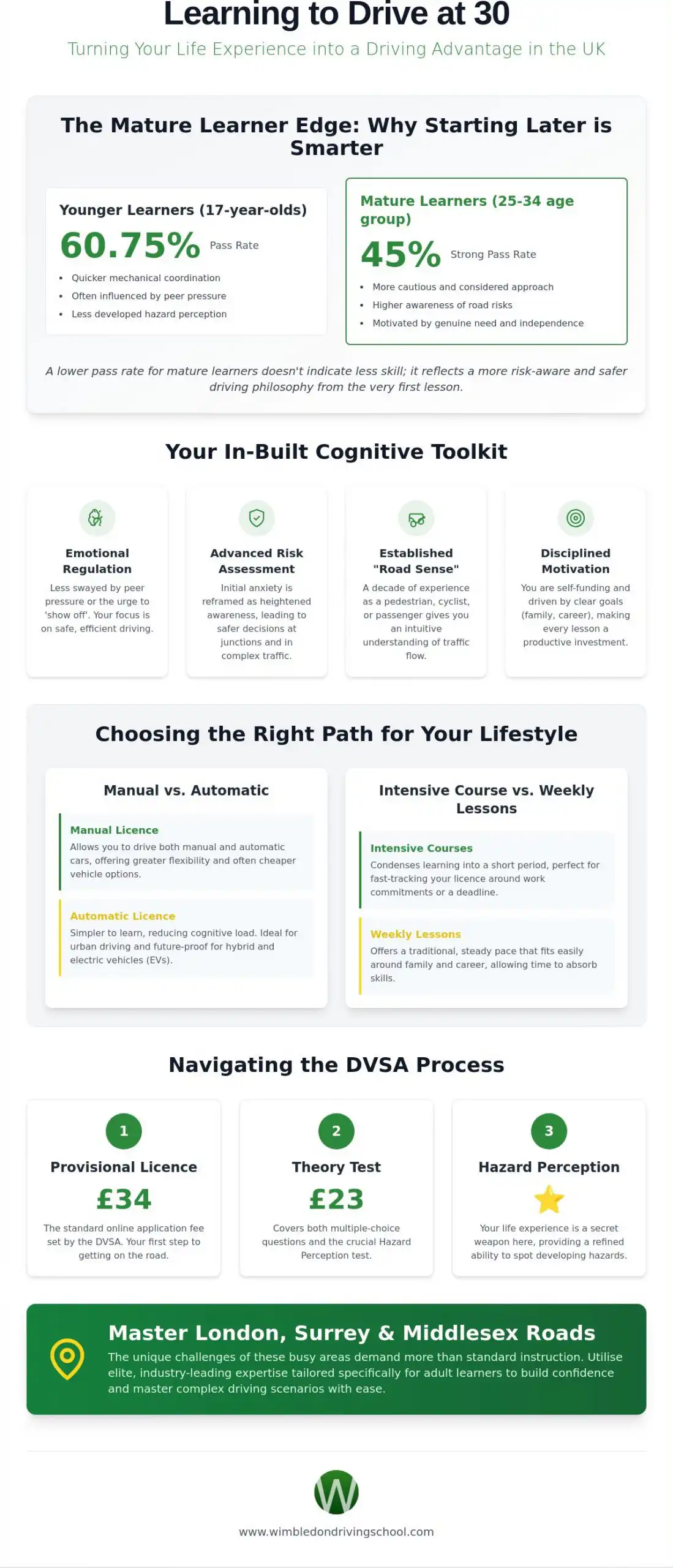
Many people assume they’ve missed the boat if they haven’t passed their test by 21. That couldn’t be further from the truth. In 2026, learning to drive at 30 uk is a strategic choice made by thousands of professionals and parents every year. You aren’t an outlier; you’re part of a growing demographic of savvy learners who value safety over speed. Whilst 17-year-olds see a pass rate of 60.75%, the 25 to 34-year-old age group maintains a strong 45% success rate. This slight difference doesn’t reflect a lack of skill. Instead, it shows that mature learners are more aware of the risks, leading to a more cautious and considered approach to the steering wheel.
To better understand this concept, watch this helpful video of a fellow learner starting their journey:

The Freedom Factor: Why You Are Doing This Now
The transition into your 30s often brings lifestyle changes that make a car essential. Perhaps you’re escaping the limitations of London public transport to facilitate family life, or maybe a promotion requires a full UK driving licence for site visits. The psychological shift from “wanting” to “needing” to drive is powerful. It provides a level of focus that younger learners often lack. When you’re obtaining a UK driving licence at this stage of life, you aren’t just gaining a plastic card; you’re unlocking a new tier of professional and personal autonomy. You’ll find that your motivation levels are higher because the tangible benefits, such as easier grocery hauls or spontaneous weekend trips to the Surrey Hills, are immediately apparent.
Age and the DVSA: Are the Rules Different?
The DVSA maintains identical standards for every candidate, regardless of whether you’re 17 or 70. You will pay the same £34 online fee for your provisional licence and £23 for your theory test. However, your life experience serves as a secret weapon during the Hazard Perception test. Having spent over a decade as a pedestrian, cyclist, or passenger, your ability to spot developing hazards is often far more refined than that of a teenager. You already understand the “language” of the road. Success when learning to drive at 30 uk depends heavily on your choice of mentor. It’s vital to select an instructor who respects your professional background and tailors their communication to an adult learner. You can explore our learning centre for more resources on how to prepare effectively for your first lesson.
The Cognitive Edge: Why Learning at 30 is Actually Easier
Forget the idea that your brain is less “plastic” at thirty. While younger learners might pick up the mechanical coordination of gear shifts slightly faster, they often lack the cognitive maturity required for safe, independent driving. When you are learning to drive at 30 uk, you bring a decade of adult life experience to the driver’s seat. You have likely spent years navigating the world as a pedestrian or cyclist, meaning you already understand the flow of traffic and the often-unpredictable behaviour of others. This “road sense” is a massive advantage that teenagers simply haven’t developed yet.
Mature learners also benefit from superior emotional regulation. You are less likely to be swayed by peer pressure or the desire to “show off” behind the wheel. Instead, your focus is on the tangible outcome: getting from A to B safely and efficiently. This disciplined mindset often translates into faster progress when learning to drive at 30 uk. Because you are likely self-funding your education, you possess a level of financial discipline that ensures every hour spent in the car is productive. You aren’t just going through the motions; you are actively investing in a life skill.
Turning Anxiety into Awareness
Many adults worry that their nerves will hold them back. In reality, being a “nervous” learner often means you are a more observant driver. We reframe this anxiety as high-level risk assessment. Instead of rushing into junctions, you are naturally inclined to wait for a safe gap, which is exactly what examiners look for. Following the official government steps to getting a licence becomes much easier when you approach each stage with a professional mindset. Our instructors use a “Confident Mentor” approach, adapting their teaching style to match your pace and professional background.
Hazard Perception and Adult Responsibility
Your brain is now wired for responsibility. Whether you are managing a team at work or looking after a family, you are used to predicting outcomes and mitigating risks. This skill is directly transferable to the Hazard Perception test and real-world driving. Mature learners are exceptionally good at anticipating the actions of distracted pedestrians or erratic drivers because they’ve seen it all before from the pavement. Your advanced risk-assessment skills naturally lead to a more methodical driving style, which significantly reduces the likelihood of accumulating minor faults for hesitation or poor observation.
If you are ready to turn your life experience into a driving advantage, you can book your first lesson with our expert team today.
Manual vs Automatic: Choosing the Right Path for Your Lifestyle
Decisions made at 30 are typically driven by logic, efficiency, and long-term utility. When learning to drive at 30 uk, the choice between manual and automatic transmissions is no longer a matter of tradition but a strategic assessment of your future needs. The UK automotive landscape is shifting rapidly. With the government’s push towards digital driving licences by 2027 and the increasing dominance of electric vehicles, your choice of vehicle today will dictate your comfort and capability on the road for the next decade.
The Case for Manual Lessons
Opting for manual instruction provides you with a “full” UK licence, which permits you to drive both manual and automatic vehicles. This flexibility is invaluable if you anticipate hiring vans for house moves, driving older petrol models, or travelling to countries where manual rentals remain the standard. Mastering manual gears offers a deeper mechanical “feel” for the car, allowing you to control gear ratios and engine braking with precision. Many of our mature students find that securing Manual Driving Lessons provides a comprehensive skill set that matches their professional drive for excellence and self-reliance.
The Benefits of Automatic in London
In 2026, the rise of electric and hybrid vehicles has made automatic the logical choice for many urban professionals. Since electric cars do not have traditional gearboxes, learning in an automatic future-proofs your driving for the modern market. By removing the “clutch control” hurdle, you can dedicate your full attention to complex navigation and the dense, stop-start traffic typical of South West London. This significantly reduces the cognitive load during your initial training. You can explore our Automatic Driving Lessons for a stress-free experience that prioritises safety and allows for faster progress through the syllabus.
Whilst traditionalists may argue for manual, the reality for a 30-year-old learner is often about the fastest route to independence. Automatic lessons typically require fewer hours to reach test standard, making them an excellent choice for those balancing a full-time career or family commitments. Whether you choose the mechanical engagement of a manual or the streamlined efficiency of an automatic, our instructors provide the elite-level mentorship required to navigate busy UK roads with absolute confidence.
Fast-Tracking Your Freedom: Intensive Courses vs Weekly Lessons
Balancing a career while learning to drive at 30 uk requires a strategic approach to your timetable. You have two main paths: the steady consistency of weekly lessons or the rapid immersion of an intensive course. The right choice depends entirely on your learning style and the urgency of your deadline. Whilst the DVSA recommends around 45 hours of professional tuition to reach test standard, how you distribute those hours can drastically change your success rate and your confidence levels.
Weekly lessons are excellent for building long-term muscle memory. They allow you to process new skills between sessions, which is often the preferred choice for those managing high-pressure jobs or childcare. However, if you need a licence for a specific deadline, like a new job, an intensive course provides a focused sprint to the finish line. Many of our students find the “semi-intensive” middle ground ideal. By committing to 4 to 6 hours per week, you maintain strong momentum without the total exhaustion of a full-day schedule.
Is an Intensive Course Right for a Mature Learner?
As an adult, you know how you absorb information best. Some thrive under pressure; others need reflection time. A Fast-Track Intensive Driving Course requires significant mental stamina. Driving for five hours a day is physically and mentally taxing, even for a seasoned passenger. We recommend an initial assessment to see if your focus remains sharp over long durations. This ensures you aren’t just doing hours but actually making tangible progress toward your goal.
Organising Your Lessons Around a Busy Schedule
Your time is your most precious resource. We provide 7-day-a-week availability to ensure you can train before work, during lunch, or on weekends. Managing the logistics of learning to drive at 30 uk is easier when you have an instructor who understands professional boundaries. Block booking is the smartest financial move you can make for several reasons:
- It guarantees consistency with the same instructor for every session.
- It allows you to secure your favourite time slots (early mornings or weekends) weeks in advance.
- It prevents the “stop-start” progress that happens when you pay for individual sessions.
Consistency is more important than the total number of hours. If you skip weeks, you spend the first twenty minutes of your next lesson re-learning old skills. You can secure your lesson slots through our online booking system to ensure your training stays on track.
Navigating London and Surrey: Expert Support for Your Journey
Success when learning to drive at 30 uk isn’t just about passing a test; it’s about mastering the specific geography of your daily life. Whether you’re tackling the complex multi-lane geometry of the Morden roundabout or the narrow, winding country lanes of Surrey, local expertise is your greatest asset. High-level proficiency requires more than just basic instruction. It demands a mentor who understands the nuances of South West London’s unique road architecture. Our instructors hold elite qualifications, including RoSPA Gold and IAM certifications, ensuring you receive the highest industry standard of training available.
We don’t just teach you how to operate a vehicle. We frame the learning process as a transformative experience that prepares you for the realities of urban driving. By focusing on advanced hazard perception and disciplined road behaviour, we ensure that your transition from learner to licence holder is seamless and secure. This professional authority aims to reassure you that you’ve made the safest choice for your education.
Mastering Local Test Centres
The practical test is as much about local familiarity as it is about technical skill. Centres like Morden, Tolworth, and Mitcham each have specific “trap” areas that can catch out the unprepared. We use Mock Driving Tests to replicate exact examiner behaviour and route challenges, ensuring there are no surprises on the big day. By checking the Areas We Cover, you can find a specialist familiar with your specific postcode. This local insight transforms a daunting test route into a familiar journey you’ve already conquered multiple times during your training.
Your Path to Becoming a Confident Driver
Gaining your licence is just the beginning of your journey toward total independence. For mature drivers, the goal is often more than just a commute. It’s about family trips and professional flexibility. This is why we offer Pass Plus Courses and Motorway Driving Lessons to bridge the gap between passing the test and truly mastering the UK’s fastest roads. Choosing high-quality tuition over “cheap” alternatives is a wise investment in your long-term safety. When learning to drive at 30 uk, you aren’t just looking for a quick fix; you’re building a foundation for decades of safe travel.
You’ve already proven you have the discipline and the drive to succeed in your career and personal life. Now, it’s time to apply that same excellence to the road. You’re never too old to master a new skill, and with the right mentor, your full UK driving licence is well within reach. Take that first step toward your personal milestone and secure your future on the road today.
Take the Wheel of Your Future Today
Choosing to start learning to drive at 30 uk is a strategic investment in your personal and professional autonomy. You now understand that your maturity is a premium asset, offering superior risk assessment and the emotional discipline required for modern roads. Whether you opt for the mechanical control of manual lessons or the streamlined efficiency of automatic in an EV-heavy market, your success depends on high-quality mentorship. Navigating the complexities of South West London and Surrey becomes significantly easier when you have an expert by your side who knows every local test route challenge.
Wimbledon Driving School is proud to offer some of the highest pass rates in the country. Our RoSPA Gold and IAM certified instructors provide elite-level training tailored to adult learners, with lessons available 7 days a week to fit your busy schedule. You are not just gaining a licence; you are embarking on a transformative journey toward a major life milestone. Book your first lesson with Wimbledon Driving School today and experience the highest industry standard of driver education. Your path to independence is ready when you are.
Frequently Asked Questions
Is it harder to learn to drive at 30 than at 17?
No, it is not harder; it is simply a different cognitive experience. While younger drivers may have slightly faster reaction times, those learning to drive at 30 uk benefit from superior hazard perception and emotional maturity. You are less likely to take unnecessary risks and more likely to understand the consequences of your actions. This disciplined mindset often results in a higher standard of driving once the licence is obtained.
How many driving lessons does the average 30-year-old need in the UK?
The DVSA recommends an average of 45 hours of professional tuition plus 22 hours of private practice. However, mature learners often find they can reach the required standard more efficiently due to their focused approach. Your progress depends on your consistency and your ability to apply feedback. Block booking your sessions ensures you maintain momentum and helps you master the syllabus without long gaps between lessons.
Can I learn to drive in an automatic car if I am over 30?
You can certainly choose to learn in an automatic vehicle at any age. This is an increasingly popular choice in 2026 due to the rise of electric and hybrid cars, which are inherently automatic. If your goal is to get on the road quickly in an urban environment, removing the complexity of manual gear changes can significantly reduce your initial learning curve and stress levels whilst training.
What is the best way to manage driving test nerves as an adult?
The most effective way to manage nerves is through exposure and thorough preparation. Taking multiple mock driving tests with a qualified instructor helps desensitise you to the pressure of being observed. As an adult, you likely have experience managing stress in professional environments. Use those same coping mechanisms, such as deep breathing and positive visualisation, to maintain your focus during the practical examination.
Do I need to pass my theory test before I start driving lessons?
You don’t need to pass your theory test before you sit in the driver’s seat for your first lesson. You only need to have your provisional licence in your possession. Many students find that starting their practical training whilst studying for the theory test makes the material easier to remember. Seeing road signs and traffic situations in real life reinforces what you read in the Highway Code.
How much do driving lessons cost for mature learners in London?
Hourly rates for professional instruction in London typically reflect the higher cost of living and insurance in the capital. While national averages exist, London learners should expect to pay a premium for high-quality instruction from certified professionals. We recommend block booking your lessons to secure the best value and to ensure you have a consistent schedule with your preferred instructor throughout your journey.
Can I take an intensive driving course if I have never driven before?
Beginners can absolutely enrol in an intensive course. These programmes are designed to take you from zero experience to test-ready in a matter of weeks. It is a demanding route that requires significant mental energy and several hours of concentration each day. If you have a specific deadline or prefer an immersive learning style, this is often the most efficient way to gain your freedom.
What happens if I have an overseas licence but need a UK one at 30?
If you hold an overseas licence, the process depends on which country issued it. Some licences can be exchanged directly for a UK version, whilst others require you to pass the standard UK theory and practical tests. Even if you are an experienced driver abroad, taking a few refresher lessons is vital to familiarise yourself with UK road markings, roundabouts, and specific driving etiquette before your test.
Disclaimer
This article is provided for general informational purposes only and does not constitute professional driving, legal, or safety advice. While we aim to keep our content accurate and up to date, rules, prices, and DVSA test requirements can change — always check gov.uk or contact us directly at 020 3524 7968 for the latest guidance before making any decisions. Nothing in this article guarantees a specific outcome, including passing your driving test within any stated timeframe. For current pricing, course availability, and instructor details, please visit our Prices page or get in touch.