
What if the “white-knuckle” terror you feel when approaching a slip road isn’t a permanent flaw, but simply a gap in your professional training? For many, the fear of being “trapped” in the middle lanes or the panic of merging at speed can make the UK’s motorway network feel like an impossible obstacle. You might feel embarrassed about taking the long route to see family, yet learning how to get over fear of driving on motorways is a transformative journey that restores your absolute freedom. We understand that this anxiety is a rational response to a high-speed environment, and we are here to help you navigate it with prestige and poise.
At Wimbledon Driving School, we believe that true confidence is built through high-level proficiency and expert mentorship. This guide provides a structured, industry-recognised roadmap to help you replace your driving anxiety with calm, calculated control. We will deconstruct the mechanics of high-speed lane changes, explain the vital 2026 smart motorway safety protocols, and show you why specialist instruction is the most effective choice for your education. It is time to stop avoiding the fast lane and start mastering the road with the support of the highest industry standards.
Key Takeaways
- Validate your anxiety as a common condition and learn to deconstruct the “fight or flight” response triggered by high-speed environments.
- Reframe your perception of risk by understanding why motorway design actually makes these routes safer than complex urban junctions.
- Implement a structured 5-step roadmap using graduated exposure and off-peak practice to build your skills without the pressure of heavy traffic.
- Gain specific strategies for navigating local challenges like the M25 and the Wisley interchange with absolute composure.
- Discover how to get over fear of driving on motorways through professional training that offers the psychological safety net of dual-controlled cars.
Understanding Motorway Anxiety: Why High-Speed Roads Feel Terrifying
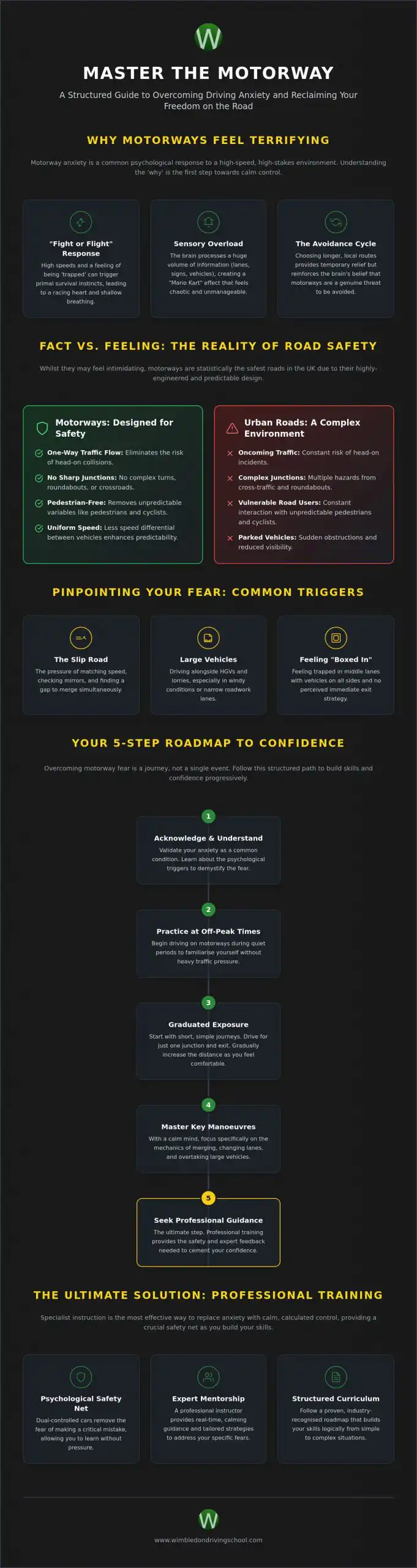
At Wimbledon Driving School, we recognise that motorway anxiety, clinically known as Amaxophobia, is far more prevalent amongst UK drivers than you might realise. It isn’t a reflection of your underlying driving ability; rather, it’s a specific psychological response to a high-pressure environment. When you’re travelling at 70mph, your brain is processing information at an incredible rate, which can lead to a phenomenon often described as the “Mario Kart” effect. This sensory overload occurs when the sheer volume of lanes, signs, and fast-moving vehicles exceeds your immediate mental bandwidth, making the road feel like a chaotic simulation rather than a manageable journey.
This feeling of being overwhelmed frequently triggers a primal “fight or flight” response. Because you cannot simply stop or turn around on a motorway, your nervous system can feel trapped, leading to physical symptoms like a racing heart or shallow breathing. Understanding these biological triggers is the first step in learning how to get over fear of driving on motorways and reclaiming your independence behind the wheel.
To better understand this concept, watch this helpful video:
Ultimately, motorway anxiety is a manageable phobia that often stems from a cycle of avoidance rather than a genuine lack of technical skill.
This principle applies to many areas of life where confidence is built through expert-led exposure. For instance, individuals seeking professional Swimming Lessons and Facility Hire often find that a structured environment is the most effective way to overcome their initial hesitation and achieve mastery in a new setting.
The Psychology of Avoidance
Every time you choose a longer, familiar route to avoid a motorway, you inadvertently reinforce your fear. This “safety net” trap provides temporary relief, but it signals to your brain that the motorway is a genuine threat that you’ve narrowly escaped. Over time, this leads to catastrophising, where you begin to imagine worst-case scenarios at every slip road or junction. Understanding the psychology of driving phobia reveals that the key to breaking this cycle is changing your internal narrative. You aren’t someone who “cannot” drive on motorways; you are simply a driver who has not yet mastered the specific environment with the right professional guidance. Our comprehensive learning centre resources emphasise that gradual, expert-led exposure is the most effective way to dismantle these mental barriers.
Common Triggers for Motorway Fear
Identifying the specific moments that spark your anxiety allows you to address them with precision. Knowing how to get over fear of driving on motorways requires tackling these common triggers head-on:
- The Slip Road: The intense pressure of matching speed and finding a gap to merge whilst checking mirrors and blind spots simultaneously.
- Large Vehicles: Driving alongside HGVs and lorries, especially during windy conditions or within narrow roadworks lanes.
- The “Boxed In” Sensation: Feeling trapped in the middle or outer lanes with vehicles on all sides, leading to a perceived lack of an immediate exit strategy.
The Mechanics of Motorways: Why They Are Actually Safer Than Local Roads
Motorways can feel intimidating due to high speeds, yet they are the most highly engineered and safe environments on the UK road network. Unlike urban streets, which are cluttered with pedestrians, cyclists, and complex cross-road junctions, motorways offer a streamlined, one-way flow of traffic. There are no sharp turns to navigate and no risk of a head-on collision. Many drivers wonder how to get over fear of driving on motorways when they first see a busy four-lane stretch, but the secret lies in recognising the logic behind the layout. This environment is designed for efficiency and safety, removing the most dangerous variables found in city driving.
One of the biggest hurdles for nervous drivers is the 70mph speed limit. However, safety is often found in uniformity. In a 30mph city zone, the speed differential between a car, a cyclist, and a parked vehicle pulling out is massive and unpredictable. On a motorway, most vehicles travel at similar speeds in the same direction. This consistency reduces the likelihood of sudden, high-impact conflicts. To maintain your composure, we teach the concept of “The Bubble.” This involves consciously maintaining a clear space of at least two seconds around your vehicle, giving you the time and room needed to react without panic. When you control your space, you control your anxiety.
Statistical Safety vs. Perceived Danger
Data consistently shows that UK motorways are statistically the safest roads to travel on, with significantly fewer accidents per mile than A-roads or residential streets. The primary reason for this is the physical separation of traffic. By removing the possibility of oncoming vehicles, engineers have eliminated the leading cause of serious road incidents. If you are looking for practical advice for overcoming driving fears, start by accepting that your environment is designed to protect you. Motorways are engineered for predictability, removing the chaotic variables of city driving.
Understanding Motorway Signs and Signals
Confidence comes from clarity and knowledge. Modern smart motorways use overhead gantries to manage traffic flow and provide real-time information. It is vital to understand these signals; as of July 2026, ignoring a Red X sign now results in a £100 fine and six penalty points. Learning to read these gantries, along with distance marker posts and “Tiger Tails” (the painted zones on slip roads that guide merging), allows you to plan your movements well in advance. Following the two-second rule is non-negotiable. It ensures that even at high speeds, you remain in total control of your journey. If you feel ready to put these theories into practice, you can book a professional session to experience these safe designs with an expert mentor by your side. Understanding how to get over fear of driving on motorways is much easier when you have a professional explaining the technical safety features in real-time.
A 5-Step Roadmap to Overcoming Motorway Fear
Transformation begins with a structured plan. You don’t need to conquer the entire M25 in a single afternoon. Instead, we advocate for a graduated approach that builds your resilience through manageable milestones. This roadmap is designed to move you from the relative comfort of local roads to the prestige of high-speed mastery. Understanding how to get over fear of driving on motorways involves a logical, five-step progression that respects your pace whilst pushing you toward achievement.
- Step 1: Graduated Exposure. Begin on high-quality dual carriageways. These roads offer a “motorway-lite” experience, allowing you to practise merging without the full intensity of a three or four-lane motorway.
- Step 2: Off-Peak Practice. Timing is everything. Schedule your initial trips for Sunday mornings or late evenings. Lower traffic volume reduces the pressure, giving you the mental space to focus on your technical skills.
- Step 3: The “One Junction” Rule. Set a modest goal. Enter at one junction and exit at the very next one. Proving to yourself that you can navigate a single stretch safely is a massive psychological victory.
- Step 4: Professional Feedback. Engage a mentor with RoSPA Gold or IAM certifications. An expert can identify subtle errors in your lane discipline or mirror work that might be fuelling your anxiety.
- Step 5: Independent Navigation. Once you feel secure with an instructor, transition to using a sat nav. This allows you to focus on the road whilst the technology handles the directions, building your autonomy.
Graduated Exposure: From A-Roads to M-Roads
Local arteries like the A3 or A217 are perfect training grounds. They feature slip roads and high-speed limits that mimic motorway conditions. Use these stretches to refine your mirror-signal-manoeuvre (MSM) routines. The goal is to turn these actions into muscle memory so they don’t fail you under stress. If you feel you need a professional to sit beside you during these first steps, consider Refresher Driving Lessons in Surrey to sharpen your foundational skills and build the necessary momentum for the journey ahead.
The Power of a “Driving Buddy” or Mentor
A calm passenger can act as an emotional anchor, but choose wisely. Avoid critical relatives who might increase your stress. We recommend “commentary driving,” where you speak your actions and observations out loud. This technique keeps your mind anchored in the present moment and prevents panic from spiralling. When you’re ready to elevate your skills to the highest standard, transitioning to a Motorway Driver Training specialist ensures you receive the elite instruction necessary for long-term confidence. Learning how to get over fear of driving on motorways is an investment in your personal freedom that pays dividends for a lifetime of stress-free travel.
Practical Strategies for Navigating the M25 and Surrey Arteries
For many drivers in South West London, the M25 represents the ultimate test of nerves. Transitioning from the stop-start nature of urban roads in Wimbledon or Putney to the high-speed flow of Surrey’s motorways requires a significant shift in mental gear. Learning how to get over fear of driving on motorways is often about mastering these specific local “beasts” with a strategy that prioritises observation and early planning. When you understand the unique rhythm of the London Orbital, the fear of the unknown is replaced by a sense of professional control.
Mastering the M25: Tips for the “London Orbital”
The M25 is a unique environment that demands peak concentration. Unlike quieter rural motorways, it features variable speed limits controlled by digital gantries. These are designed to smooth traffic flow, but the constant changes can be stressful for the uninitiated. You must remain vigilant regarding smart motorway signals. As of July 2026, ignoring a Red X sign is a serious offence that results in a £100 fine and six penalty points. Staying informed on these mandatory safety protocols is a vital part of building your confidence. To manage the psychological pressure of the London area, focus on the “keep left” rule. By staying in the left-hand lane unless overtaking, you create a predictable path for yourself and allow others to merge smoothly at busy junctions near the Heathrow and Gatwick corridors.
Navigating Local High-Speed Interchanges
The Wisley interchange, where the A3 meets the M25, is often cited by our students as a primary source of anxiety. This complex junction requires you to manage multiple lanes whilst anticipating the movements of drivers exiting and entering at speed. Success here depends on looking well ahead; identify your exit early and position your vehicle with plenty of time to spare. Similarly, the A3 journey into London presents its own challenges. You must manage the transition from a 70mph limit down to 40mph zones without braking harshly, which requires expert speed awareness and throttle control.
For those heading out of Middlesex, the M3 and M4 corridors offer a different pace, but the same principles of space and “The Bubble” apply. Explore our areas we cover to find a local instructor who is intimately familiar with these specific routes and can guide you through them in a dual-controlled car. If you are ready to transform your driving experience and regain your independence, book your professional motorway assessment today. Taking this proactive step is the most effective way to ensure you are making the safest choice for your education.
Why Professional Motorway Training is the Ultimate Solution
While self-led practice and gradual exposure are valuable steps, professional mentorship is the definitive way to bridge the gap between hesitation and high-level proficiency. A YouTube video or a written guide can explain the theory, but they cannot intervene if you feel overwhelmed in a live traffic situation. This is where the psychological “safety net” of a dual-controlled car becomes a game-changer. Knowing that a highly qualified expert can take control at any second allows your nervous system to remain calm, creating the ideal state for learning how to get over fear of driving on motorways effectively.
Professional training offers more than just safety; it provides precision. Often, what feels like an insurmountable fear is actually a reaction to a minor technical flaw. An instructor can spot if your anxiety is being fuelled by poor mirror positioning, which creates blind spots, or late signalling that causes other drivers to react unpredictably. By refining these mechanics, we remove the triggers that lead to panic. You will also learn advanced “scanning” methods used by RoSPA and IAM drivers. These techniques train you to anticipate hazards up to 10 seconds ahead, giving you a sense of mastery and foresight that makes motorway travel feel remarkably controlled.
The Wimbledon Driving School Approach
Our approach is rooted in the highest industry standards. We don’t just offer instruction; we provide a transformative experience led by staff holding RoSPA Gold and IAM certifications. We specialise in supporting nervous drivers, ensuring our environment is entirely non-judgmental and focused on your personal achievement. For many, a structured course is the most effective choice for their education. You can learn about our Pass Plus Courses to master high-speed roads whilst potentially reducing your insurance premiums. This investment in your skill set ensures you are making the safest and most efficient choice for your long-term driving career.
Investing in Your Freedom
Overcoming your fear is an investment that pays immediate dividends. Motorways are significantly more fuel-efficient than urban routes, meaning your new-found confidence will directly reduce your travel costs. Beyond the financial benefits, you regain your absolute independence. Mastering the motorway network opens up new career opportunities and holiday destinations that were previously out of reach. Don’t let anxiety dictate your boundaries any longer. Book your first motorway lesson today and reclaim your freedom on the road with the support of a confident mentor. Understanding how to get over fear of driving on motorways is the final milestone in your journey toward becoming a truly complete driver.
Take the Fast Lane to Driving Freedom
You’ve explored the logical design that makes UK motorways our safest roads and discovered a structured roadmap to reclaim your independence. By understanding the psychology behind your anxiety and applying advanced techniques like “The Bubble,” you’ve already taken the first step toward mastery. Learning how to get over fear of driving on motorways isn’t just about technical skill; it’s about shifting your mindset from avoidance to achievement.
Wimbledon Driving School has been serving South West London and Surrey since 2006. Our RoSPA Gold and IAM certified instructors are specialists in nervous drivers, providing the elite mentorship you need to transform anxiety into poise. We provide a secure, dual-controlled environment where you can face high-speed roads with absolute confidence. This isn’t just a lesson; it’s a transformative journey toward a personal milestone.
Don’t let the M25 or complex interchanges remain an obstacle in your life. It’s time to invest in your confidence and start your journey today. Master the Motorway with Wimbledon Driving School and experience the prestige of being a truly complete driver. Your road to freedom starts with a single, confident decision.
Frequently Asked Questions
Is it normal to be scared of motorways after passing my test?
It is entirely normal to feel anxious about motorways after passing your test. Until relatively recently, learner drivers weren’t permitted on UK motorways, meaning many new drivers have zero experience with 70mph traffic flow. This lack of exposure creates a natural apprehension that can be resolved through professional mentorship and graduated exposure in a safe, dual-controlled environment.
Can I take motorway lessons if I already have a full driving licence?
Yes, you can absolutely take specialist motorway lessons even if you have held a full driving licence for years. We frequently support experienced drivers who have avoided high-speed roads for long periods and want to regain their independence. Our refresher courses provide the perfect opportunity to discover how to get over fear of driving on motorways whilst under the guidance of an expert.
How many motorway lessons will I need to feel confident?
Most drivers find that between two and six hours of professional instruction are sufficient to transform their confidence. The exact number depends on your current anxiety levels and prior technical experience. We tailor every session to your specific needs, ensuring you move from hesitation to mastery at a pace that feels secure yet productive for your personal development.
What happens if I have a panic attack whilst driving on the motorway?
If you feel a panic attack beginning, you should focus on your breathing and exit at the next available junction or service station. In a genuine emergency where you cannot reach an exit, you can use an Emergency Area on a smart motorway or the hard shoulder. Practising with a RoSPA Gold instructor is the most effective way to prevent these attacks by building the technical competence that stops panic before it starts.
Are smart motorways more dangerous for nervous drivers?
Smart motorways require a higher level of observation due to variable speed limits and the removal of the permanent hard shoulder, but they aren’t necessarily more dangerous. These routes are heavily monitored by technology and overhead gantries to manage traffic flow. Understanding 2026 safety protocols, such as the mandatory Red X rules, is a key part of our training to ensure you feel secure on these modern routes.
Will motorway training help reduce my car insurance costs?
Completing a structured Pass Plus course, which includes a dedicated motorway module, can lead to reduced insurance premiums with many participating providers. Beyond the potential financial savings, the real value lies in the significantly reduced risk of accidents. Investing in professional training demonstrates to insurers that you are committed to the highest industry standards of safety and road craft.
Can I practise motorway driving at night to avoid traffic?
Practising at night can reduce traffic volume pressure, but it introduces new challenges like reduced visibility and headlight glare. We recommend starting your journey during off-peak daylight hours, such as Sunday mornings, for your initial sessions. This allows you to master how to get over fear of driving on motorways without the added complexity of limited light, ensuring your first experiences are as clear as possible.
What is the “two-second rule” and why is it vital on motorways?
The two-second rule is the minimum safe following distance you must maintain from the vehicle in front to allow for adequate reaction time. At 70mph, your car travels approximately 31 metres per second, making this gap vital for safety if the traffic ahead brakes suddenly. In wet or icy conditions, you should always double this distance to at least four seconds to account for increased stopping distances.
Disclaimer
This article is provided for general informational purposes only and does not constitute professional driving, legal, or safety advice. While we aim to keep our content accurate and up to date, rules, prices, and DVSA test requirements can change — always check gov.uk or contact us directly at 020 3524 7968 for the latest guidance before making any decisions. Nothing in this article guarantees a specific outcome, including passing your driving test within any stated timeframe. For current pricing, course availability, and instructor details, please visit our Prices page or get in touch.