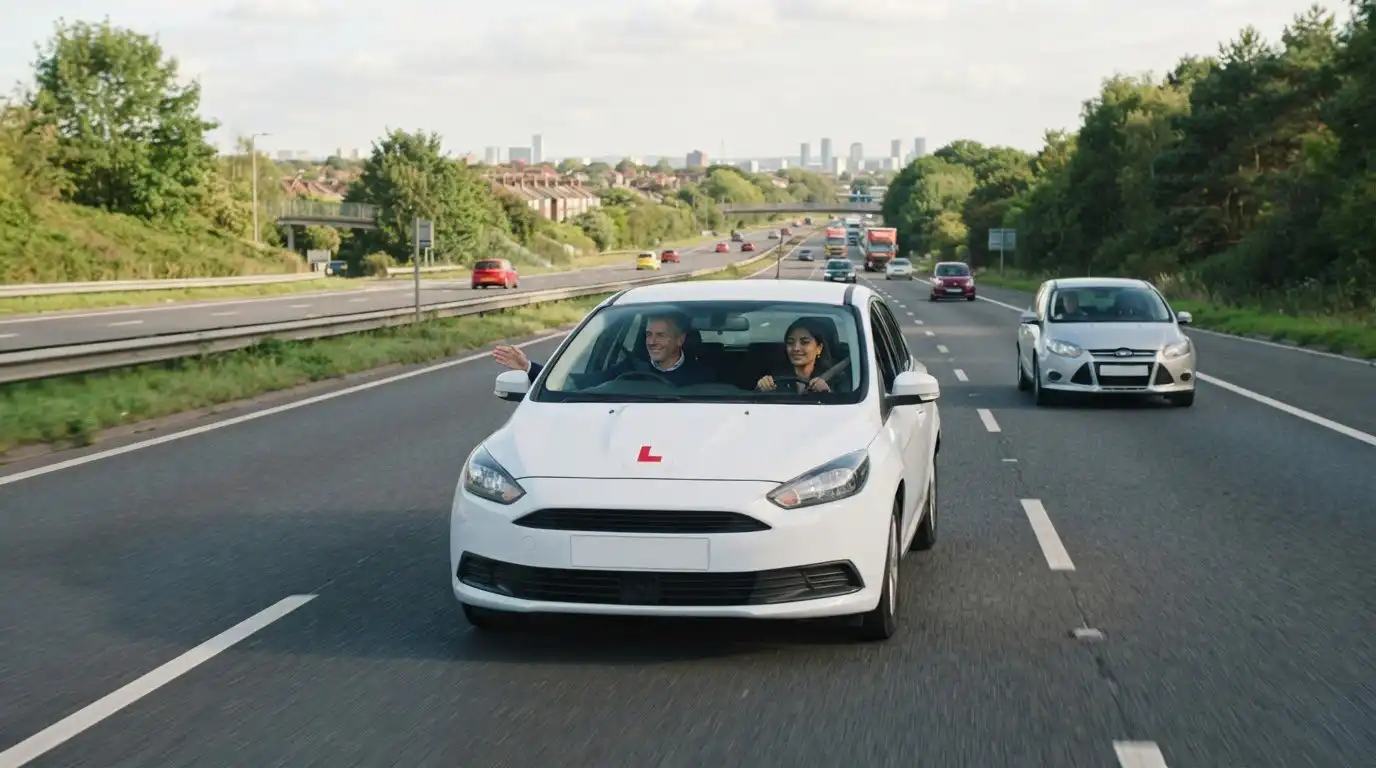

Did you know that a January 2026 survey revealed driver anxiety on smart motorways is actually rising, despite the government halting new construction? It’s completely natural to feel your pulse quicken when joining the M25 or merging into heavy, fast-moving traffic. The pressure of high-speed tailgating and the complexity of overhead gantry signs can make any journey feel like a trial. Professional motorway driver training is designed to replace that hesitation with absolute precision and elite-level observation skills.
We understand that the road can feel unpredictable, but we believe you deserve to feel in total control. This article reveals how expert instruction transforms high-speed driving from a daunting task into a calm, strategic, and safe experience. You’ll learn the nuances of smart motorway safety, the importance of Red X compliance, and how advanced skills can even lead to reduced insurance premiums. We also examine the latest 2026 updates regarding digital licences to ensure you’re fully prepared for the modern road network. Let’s turn your motorway nerves into a definitive milestone of personal achievement.
Key Takeaways
- Understand why 70mph travel demands specialised cognitive processing and how professional tuition bridges the gap between dual carriageways and the motorway network.
- Master the art of merging seamlessly into high-speed traffic and maintaining safe following distances to ensure a calm, strategic driving experience.
- Navigate the complexities of Smart Motorways with confidence by learning to decode gantry signs and strictly adhering to Red X safety protocols.
- Compare the benefits of a full Pass Plus course against bespoke motorway driver training to find the most effective path for your specific requirements.
- Benefit from the prestige and professional knowledge of industry-leading instructors to turn high-speed navigation into a rewarding personal milestone.
What is Motorway Driver Training and Why is it Essential?
Motorway driver training is a specialised form of tuition that focuses on the high-speed road networks, complex interchanges, and unique signage found on the UK’s major arteries. Since the law changed in June 2018, learner drivers have been permitted to gain this experience before their test, provided they are accompanied by a qualified ADI in a dual-controlled car. This shift was a landmark moment for road safety, ensuring that the first time a driver hits 70mph isn’t a solitary, high-stakes experiment. It’s about moving beyond basic car control and mastering the psychology of high-speed travel.
Driving at 70mph involves a significant cognitive leap from the 50mph or 60mph limits found on most dual carriageways. At these speeds, your field of vision naturally narrows and the time available to react to hazards shrinks dramatically. Professional driver’s education provides the strategic observation skills needed to move beyond “survival driving,” where you merely react to the car in front, and toward proactive, long-range planning. We teach you how to process information faster, allowing you to anticipate the behaviour of others long before it becomes a risk.
To better understand this concept, watch this helpful video:
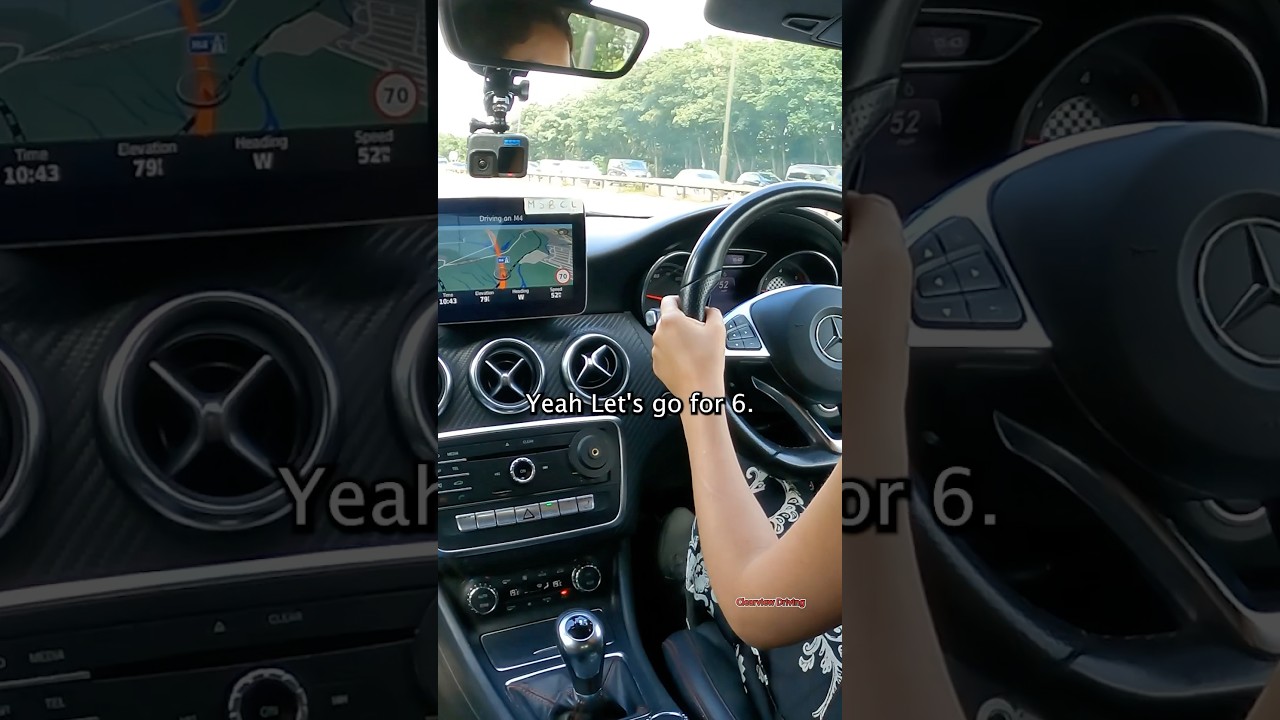
Professional motorway driver training ensures you don’t fall into the trap of reactive habits. Many unguided drivers develop a “tunnel vision” approach, focusing only on the immediate vehicle ahead. Our goal is to expand that awareness, teaching you to scan the horizon for brake lights, identify lane closures on overhead gantries, and manage the space around your vehicle with total precision. This elevated level of proficiency is what separates a confident motorway user from someone who is merely “getting by.”
The Reality of Motorway Driving in South West London
For those in our local area, the challenges are intensified by the sheer volume of traffic. Navigating the M25, the world’s busiest orbital road, requires a level of lane discipline and gantry-sign interpretation that isn’t covered in standard town driving. Whether you’re managing the complex interchanges where the M3 or M4 meet the M25, or joining from tricky slip roads in Surrey and Middlesex, local knowledge is vital. We help you master these specific entries and exits, turning intimidating junctions into predictable, well-executed manoeuvres. Building this foundation of urban road confidence starts well before the motorway — learners who take driving lessons in Mitcham develop the precise junction skills and roundabout awareness that make transitioning to high-speed roads far more manageable.
Who Should Consider Specialist Motorway Lessons?
- Newly qualified drivers: If you passed your test without motorway experience, these sessions bridge the gap to total independence and long-distance travel.
- Current learners: Build elite-level confidence and superior observation skills before you even receive your full licence.
- Drivers from overseas: Adapt quickly to the UK’s “keep left” rules and unique motorway etiquette via our specialised driver from overseas support.
The Anatomy of a Motorway Lesson: Core Skills for Every Driver
Professional motorway driver training isn’t just about increasing your speed; it’s about mastering the technical precision required to integrate seamlessly into a fast-moving environment. The journey begins on the slip road. This is your dedicated space to match the velocity of lane one. We teach you to accelerate decisively so that you join the flow of traffic without forcing other drivers to brake or swerve. Since the introduction of motorway lessons for learner drivers, instructors have focused heavily on this initial merge, as it’s often where anxiety is highest.
Once you’re established in the flow, maintaining a safe buffer is vital. At 70mph, your stopping distance is significantly longer than on urban roads. We implement the “two-second rule” as a minimum baseline in dry conditions. If it’s raining or the road is damp, we’ll show you how to double that gap to four seconds. This extra space provides the essential thinking time needed to react to sudden brake lights ahead. When it’s time to overtake, we refine the Mirror-Signal-Manoeuvre (MSM) routine for high-speed use, ensuring you check your blind spots with a quick, safe glance before moving out.
Exiting the motorway requires just as much focus as joining. You’ll learn to interpret the blue countdown markers, which appear at 300, 200, and 100 yards before the off-ramp. Managing your deceleration on the slip road, rather than on the main carriageway, ensures you don’t become a hazard to vehicles behind you. This structured approach turns a potentially stressful exit into a smooth, controlled transition.
The Psychology of Speed and Long-Range Scanning
Effective motorway driver training prioritises your mental processing. We help you develop “motorway vision,” which involves scanning up to 20 seconds ahead rather than just looking at the car in front. This allows you to identify “hazard clusters,” such as a group of lorries bunching together or a vehicle merging aggressively, long before you reach them. By anticipating these situations, you remain calm and strategic. We also cover techniques to combat “highway hypnosis,” a trance-like state caused by long periods of monotonous driving, by keeping your eyes moving and your mind engaged with the road’s layout.
Lane Discipline and the ‘Keep Left’ Rule
Correct lane discipline is the hallmark of a premier driver. In the UK, you must always stay in the left-hand lane unless you are overtaking. Lanes two, three, and four are not “fast lanes”; they are dedicated overtaking lanes. Middle-lane hogging is a punishable offence that can result in a £100 fine and three penalty points. We’ll guide you through the process of completing an overtake and moving back to the left safely, ensuring you don’t cut across other drivers. Mastering this etiquette creates a safer, more efficient journey for everyone on the road. If you’re ready to elevate your skills, you can secure your first session with our expert team today.
Navigating Smart Motorways and Complex UK Junctions
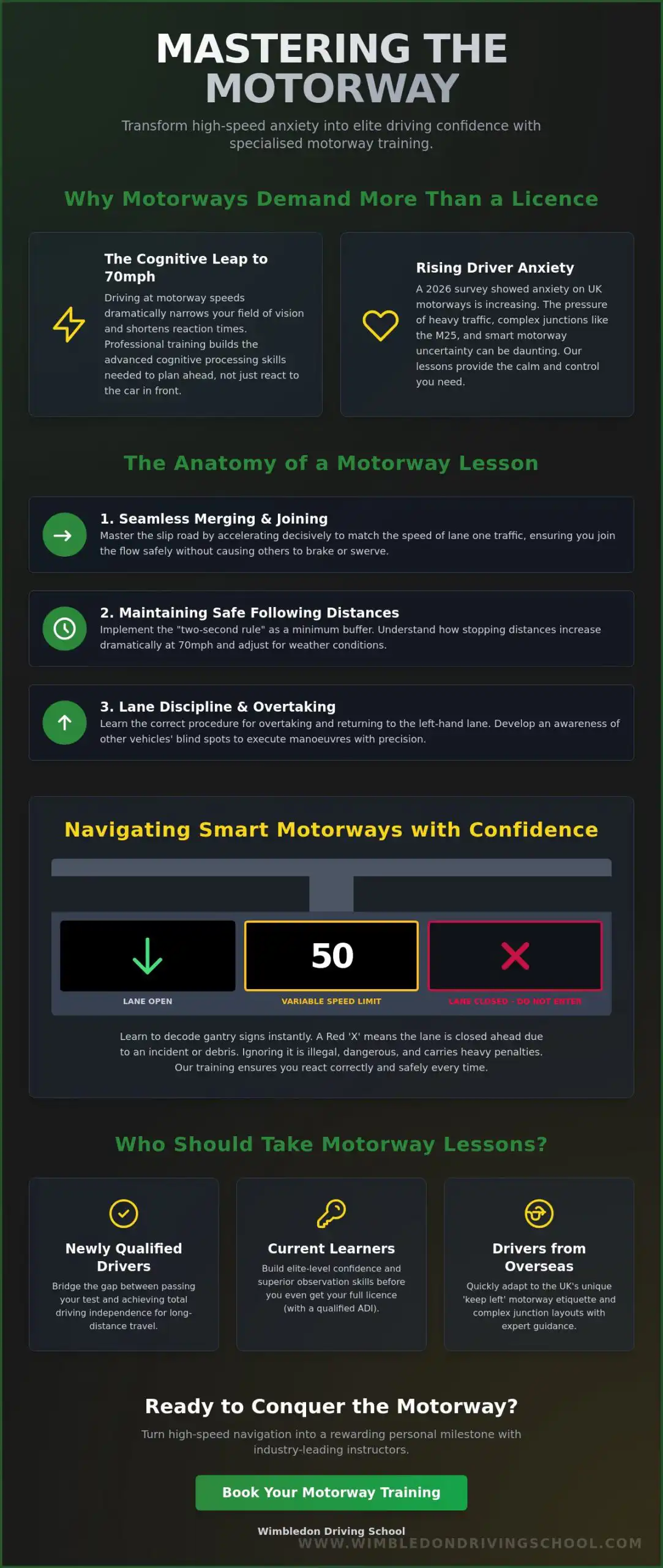
The infrastructure of the UK road network has evolved rapidly, making modern motorway driver training more essential than ever. While the government halted new smart motorway construction in 2023, existing sections remain a significant part of your journey. You’ll likely encounter All Lane Running (ALR) stretches, where the hard shoulder is permanently used as a live lane, or Dynamic Hard Shoulder sections, where it opens only during peak congestion. Understanding these distinctions is vital for your safety. By 2026, over 95% of ALR sections are equipped with Stopped Vehicle Detection (SVD) radar technology. This system can detect a stationary vehicle and trigger safety protocols in under 20 seconds, but your awareness remains the primary line of defence.
The Red X sign is perhaps the most critical signal on a smart motorway. It indicates a closed lane due to an accident, a broken-down vehicle, or roadworks. Ignoring this instruction is a non-negotiable safety violation and a legal offence. In 2026, the penalty for driving under a Red X remains a £100 fine and six penalty points on your licence. We teach you to react instantly to these gantry signs, moving out of the closed lane safely and early. If you do experience a fault, you’ll learn how to reach an Emergency Refuge Area (ERA) and the specific steps to take once you’ve stopped, including how to use the roadside emergency telephone to contact National Highways.
Variable speed limits are another hallmark of the modern motorway. These are used to smooth the flow of traffic and prevent “phantom” traffic jams caused by sudden braking. We help you stay ahead of these changes by interpreting gantry signs effectively. Maintaining a steady pace that matches the displayed limit ensures you avoid unnecessary lane changes and reduces the risk of being caught by enforcement cameras. This strategic approach keeps you moving efficiently whilst others struggle with the shifting pace of the road.
Mastering Large Interchanges and Multi-Lane Roundabouts
Navigating the M25/M3 interchange requires rapid decision-making and flawless lane positioning. We provide the professional knowledge needed to decode complex overhead signage well before you reach the junction. In Surrey and Middlesex, motorway exits often lead into “spiral” roundabouts. These can be disorienting as the lanes push you outwards toward your exit. We teach you to trust the road markings over your satellite navigation in these high-pressure moments, ensuring you stay in the correct lane from entry to exit.
Adverse Weather and Night Driving on Motorways
High-speed travel in poor conditions demands specific technical adjustments. On the M4, for example, heavy rain can create a “spray” factor from large goods vehicles that completely obscures your vision. You’ll learn how to adjust your speed and use fog lights correctly when visibility drops below 100 metres. Night driving introduces the challenge of glare and the need to identify reflective stud colours. We’ll ensure you know that red studs mark the left edge, white mark the lane divisions, and amber mark the central reservation, allowing you to read the road’s layout even in total darkness.
Comparing Training Options: Pass Plus vs Standalone Motorway Lessons
Choosing the right path for your motorway education depends on your current experience and long-term goals. While some drivers prefer a comprehensive overhaul of their skills, others require a surgical focus on specific anxieties. This is where the distinction between Pass Plus and standalone motorway driver training becomes vital. Both options offer a transformative journey, but they serve different logistical needs. One provides a broad certification, whilst the other offers a bespoke, flexible approach to high-speed navigation.
Pass Plus is a structured, six-module course designed to bridge the gap between passing your test and becoming a truly elite road user. It covers motorways, night driving, rural roads, all-weather driving, dual carriageways, and complex town environments. There is no final test; instead, you are assessed continuously by your instructor. This certification still carries significant weight with many UK insurance providers. In fact, completing the course can lead to insurance premium discounts of up to 30%, making the initial investment a strategic financial move for young or newly qualified drivers.
If you are already confident in your general driving but feel a specific dread when approaching the M25, standalone motorway driver training is the superior choice. These sessions are entirely student-centric and flexible. We don’t follow a rigid curriculum; instead, we focus exclusively on your personal pain points. Whether you struggle with merging at high speeds or feel overwhelmed by the sheer volume of traffic on the orbital network, these targeted lessons provide the professional knowledge needed to overcome those fears. It is an efficient way to achieve total confidence without committing to a multi-module programme. Learners who have already built their urban driving skills through driving lessons in Mitcham often find they are exceptionally well-prepared to progress directly into this kind of focused motorway tuition.
The Benefits of the Pass Plus Scheme
The assessment-based model of Pass Plus removes the pressure of a formal exam, allowing you to focus on genuine skill acquisition. The motorway module is particularly intensive, ensuring you understand the strategic observation required for 70mph travel. This course is an investment in your safety and your wallet. To decide if this is the right route for you, explore our guide on Pass Plus Courses: Are They Worth the Investment?
Tailored Refresher Lessons for Experienced Drivers
Even experienced drivers often find their confidence wavering after a break from driving or when facing a new, high-pressure commute. Refresher lessons with a RoSPA-certified instructor provide a fresh, expert perspective on your habits. We can tailor these sessions to your specific daily routes, such as a new job that requires navigating the M23 or M25. If you’re ready to regain your edge and drive with prestige, check out Refresher Driving Lessons Near Me.
Take the first step toward mastering the UK road network with a mentor you can trust. Book your specialised motorway session with our premier instructors today.
Why Wimbledon Driving School is the Premier Choice for Motorway Excellence
Wimbledon Driving School stands as the definitive choice for those seeking to master the fastest roads in the country. Since 2006, we’ve established ourselves as a premier provider by blending rigorous safety standards with a deeply supportive instructional style. Our motorway driver training isn’t merely a set of instructions; it’s a transformative experience that turns a source of anxiety into a genuine personal achievement. When you choose us, you’re aligning yourself with a legacy of excellence and a community of drivers who prioritise proficiency above all else.
We believe that the quality of your education is directly linked to the calibre of your mentor. That’s why we provide access to the highest tier of instructional talent in the UK. Our team includes specialists who have achieved the most prestigious accolades in the industry, ensuring that your learning journey is guided by absolute experts. This level of professional knowledge allows us to offer a student-centric approach that remains calm and encouraging, even whilst navigating the busiest sections of the orbital network. We don’t just teach you to drive; we coach you to excel.
Our RoSPA Gold and IAM Certified Instructors
The “Wimbledon Way” is built upon a foundation of elite-level coaching. Many of our instructors hold RoSPA Gold or IAM certifications, placing them amongst the top 1% of driving professionals in the country. These advanced coaching techniques go far beyond standard learner instruction. We focus on high-level risk management, fuel-efficient driving, and the psychological resilience needed for long-distance travel. This commitment to safety and excellence ensures that you receive the most sophisticated education available in the modern market.
Our local authority is unmatched. We possess a deep, practical understanding of the motorway network across South West London, Surrey, and Middlesex. Whether you’re tackling the intricate lane changes of the M25 or the high-pressure interchanges of the M3 and M4, our instructors know every junction and slip road like the back of their hand. This local expertise allows us to prepare you for the specific challenges you’ll face during your daily commute or weekend travels.
Booking Your Motorway Journey Today
We respect your time and logistical needs, which is why we offer flexible scheduling seven days a week. Your education should fit your life, not the other way around. Our high-quality training is a strategic investment that pays for itself through increased safety, reduced stress, and the potential for lower insurance premiums. Don’t let the speed of the road dictate your confidence. Take the final step in your driving education and secure your future as a competent, high-speed navigator. Contact us now to book your bespoke motorway driver training session and begin your journey toward total road mastery.
Secure Your Future as a Confident High-Speed Navigator
Mastering the UK’s high-speed network is a significant personal milestone that unlocks a new world of travel freedom. You’ve seen how professional motorway driver training transforms daunting tasks, such as merging into fast-moving traffic or decoding smart motorway gantries, into predictable and safe manoeuvres. By choosing specialised instruction, you ensure that your approach to the M25 or M3 is grounded in elite-level observation and strategic planning rather than guesswork.
Wimbledon Driving School has established a legacy of excellence across South West London and Surrey since 2006. Our instructors hold prestigious RoSPA Gold and IAM certifications, helping us maintain one of the highest pass rates in the UK. We provide the professional knowledge you need to navigate even the most complex interchanges with total poise. Your transition from a nervous learner to a premier road user is a journey we are proud to lead.
Book your expert motorway driver training with Wimbledon Driving School today. We are ready to help you reach your destination with absolute confidence.
Frequently Asked Questions
Can I take motorway driving lessons if I only have a provisional licence?
Yes, you can take motorway lessons on a provisional licence. Since the law changed in June 2018, learners have been permitted on the motorway network provided they are accompanied by an Approved Driving Instructor in a car fitted with dual controls. This allows you to gain elite-level experience and master high-speed observation before you even sit your practical driving test.
How many motorway lessons will I need to feel confident?
Most students find that three to six hours of dedicated tuition provides a significant boost to their confidence. These are often conducted as a single intensive session or two shorter blocks to allow for deep-dive practice on complex junctions. Your instructor will tailor the duration to your specific needs, ensuring you achieve total proficiency at your own pace.
Will motorway driver training reduce my car insurance premiums?
Completing specialised motorway driver training can lead to substantial insurance savings. Whilst a standalone lesson is beneficial, the formal Pass Plus course is recognised by many leading UK insurers, sometimes resulting in discounts of up to 30%. It’s a strategic way to demonstrate you are a low-risk, high-skill driver to your provider, potentially making your policy much more affordable.
What happens if I break down on a smart motorway during a lesson?
Your safety is our absolute priority. If a breakdown occurs on a smart motorway, we aim to reach an Emergency Refuge Area immediately. By 2026, Stopped Vehicle Detection technology covers over 95% of all-lane running sections, meaning a Red X is typically triggered in under 20 seconds. Your instructor will manage the situation and contact National Highways via the roadside emergency telephone.
Is it better to take motorway lessons in a manual or automatic car?
It is best to take lessons in the type of vehicle you intend to drive daily. Manual cars offer greater control over engine braking, whilst automatic cars allow you to focus entirely on observation and lane discipline during high-speed merges. We offer both manual and automatic driving instructors near me to ensure your training is perfectly aligned with your personal goals and your licence type.
Do I need to use my own car for motorway refresher lessons?
You don’t need to use your own vehicle. We provide modern, dual-controlled cars for all our sessions to ensure maximum safety for both you and the instructor. However, if you’ve already qualified and would prefer to use your own car for a refresher driving lesson, this can be organised. You’ll just need to ensure the vehicle is roadworthy and your insurance covers professional tuition.
What is the difference between a motorway and a dual carriageway?
The primary differences lie in regulation and infrastructure. Motorways use blue signage and generally prohibit certain road users like cyclists or pedestrians. Dual carriageways use green signage and often have lower speed limits or more frequent intersections. Motorways also feature more sophisticated technology, such as variable speed limit gantries and dedicated emergency areas, which require a higher level of strategic planning.
Can I do motorway training as part of an intensive driving course?
Yes, motorway driver training is a popular addition to our intensive driving courses. Integrating high-speed training into a condensed schedule allows you to build momentum and master complex road types in a shorter timeframe. It’s an excellent way to ensure you’re fully prepared for the realities of modern driving the moment you receive your full licence, giving you a head start on road safety.
Disclaimer
This article is provided for general informational purposes only and does not constitute professional driving, legal, or safety advice. While we aim to keep our content accurate and up to date, rules, prices, and DVSA test requirements can change — always check gov.uk or contact us directly at 020 3524 7968 for the latest guidance before making any decisions. Nothing in this article guarantees a specific outcome, including passing your driving test within any stated timeframe. For current pricing, course availability, and instructor details, please visit our Prices page or get in touch.