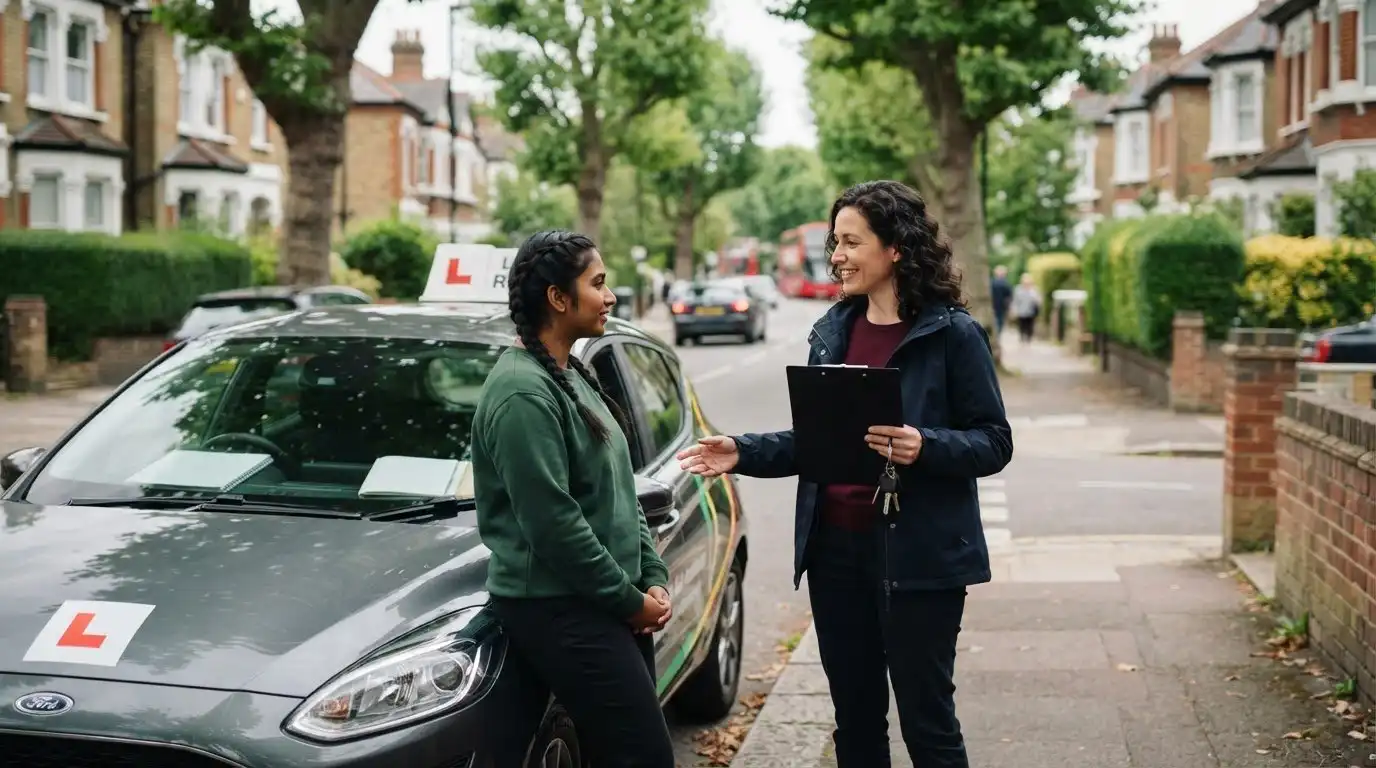
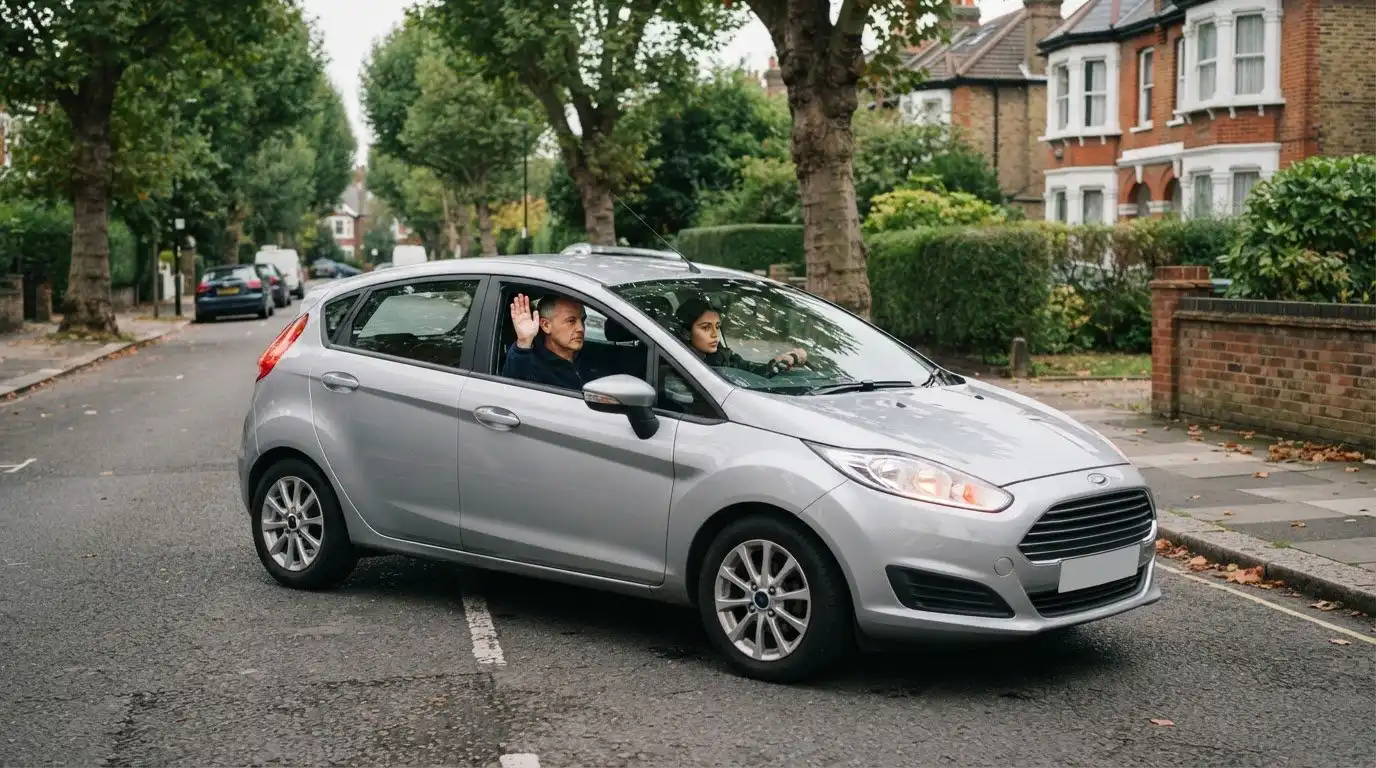
Braking as hard as possible isn’t the aim of the emergency stop driving test. The examiner wants to see you react promptly, stop safely and keep control of the car, which can feel daunting if you’re unsure what signal to expect or worry about stalling.
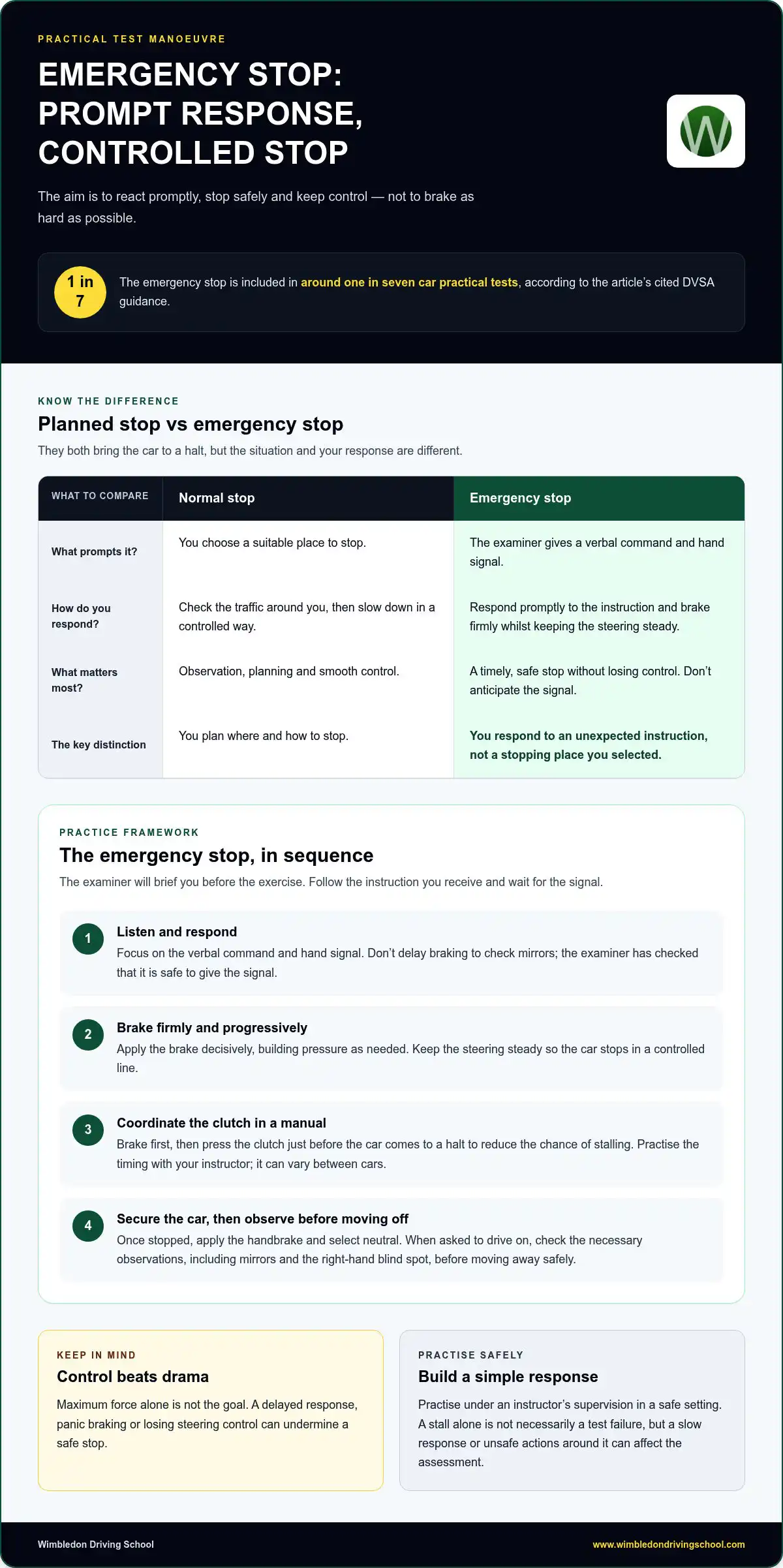
That uncertainty is understandable, but the manoeuvre follows a clear sequence. The examiner will explain what to do before giving a verbal command and hand signal. The emergency stop is included in around one in seven car practical tests, according to current DVSA guidance.
This guide explains what happens, how to respond without braking too early or losing steering control, and what to do before moving off again. You’ll also learn what the examiner is assessing and which mistakes to practise avoiding, including pressing the clutch too soon or forgetting your observations afterwards. With calm, structured practice, you can build confidence in the manoeuvre and feel better prepared for the wider test.
Key Takeaways
- The emergency stop driving test checks how you respond to an instruction, not how forcefully you can brake.
- Learn how an unexpected stop differs from slowing down for a planned stop in traffic.
- Spot how panic or a delayed response can affect your control, and what to focus on instead.
- Practise the manoeuvre with a qualified instructor in a safe setting, building confidence at a suitable pace.
- A mock test can help you rehearse the wider test experience and prepare for the manoeuvre in Wimbledon and surrounding areas.
Emergency stop driving test: what is the manoeuvre for?
The emergency stop assesses whether you can respond promptly to an instruction and bring the car to a stop safely while remaining in control. In short: an emergency stop is a prompt, controlled response to an unexpected instruction to stop.
During the exercise, the examiner will explain what to expect, then give a verbal command and a visual signal when it’s time to stop. This section explains the general test context and how to prepare, but it can’t predict what any individual test will include. For wider background, you can read this overview of driving test requirements, which discusses emergency stops as a feature of practical tests in different countries.
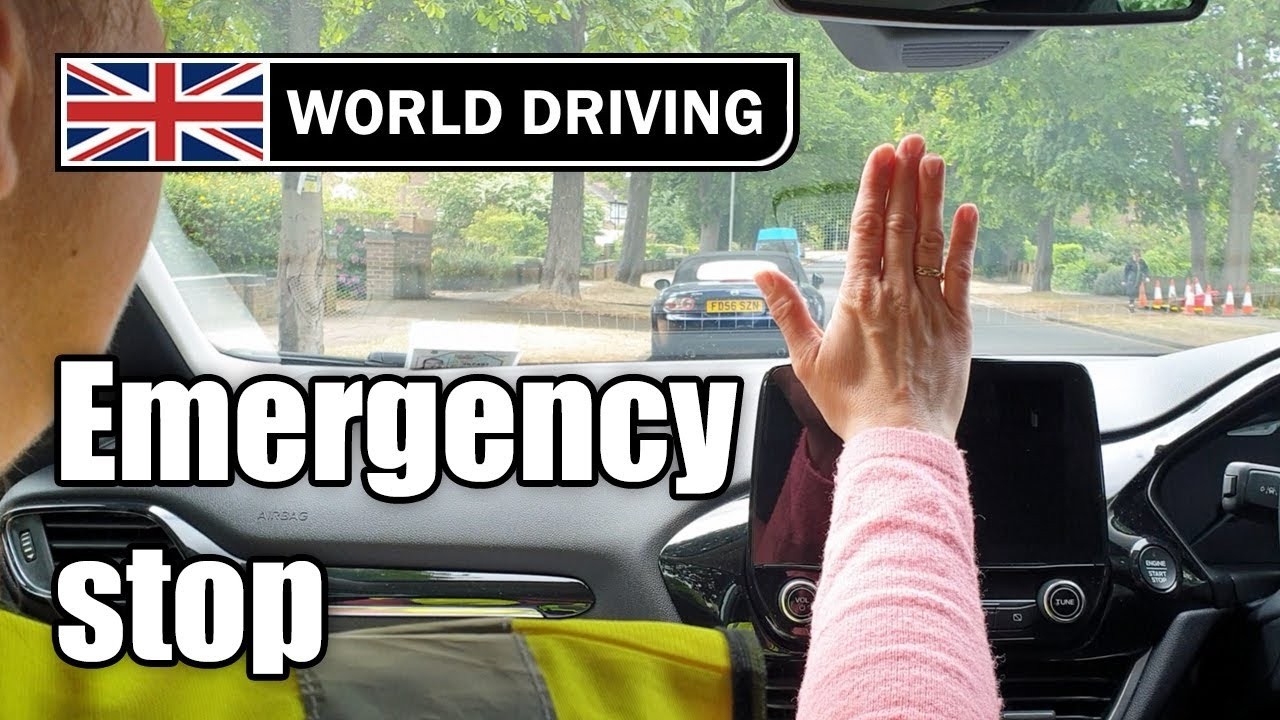
For a visual demonstration before you continue, watch this video:
What does the examiner want to see?
The priority is a timely response that brings the car to a safe stop without losing control. The examiner is assessing your driving response, not whether you make the stop look dramatic or apply the brakes with maximum force regardless of control.
DVSA guidance describes the examiner briefing the candidate before the exercise and giving a “Stop” command with a hand signal. The key is to listen, stay alert and respond when instructed. The emergency stop driving test is about showing a safe reaction under pressure, rather than trying to anticipate the signal.
Is an emergency stop the same as a normal stop?
No. A normal stop is planned: you choose a suitable place, check the traffic around you and slow down in a controlled way. An emergency stop practises your response to an unexpected need to stop, so the instruction comes from the examiner rather than from a stopping place you’ve selected.
Don’t treat every reason to slow down as an emergency. Everyday driving calls for observation, planning and smooth control; the emergency exercise tests a different response. Confusing the two could lead to unnecessary harsh braking or an unsafe stop in traffic.
For more detail on the practical technique, read our guide to safe emergency-stop technique. Familiarising yourself with the sequence can help you understand the exercise, but practise it under an instructor’s supervision rather than attempting it on your own.
How to respond to an emergency stop instruction safely
General practice guidance: Stay alert for the examiner’s instruction, react promptly and brake firmly while keeping the car under control. The exact response will depend on the car and your instructor’s guidance, so practise the sequence under supervision rather than trying to rehearse it in traffic.
The GOV.UK guide to official driving test requirements includes the emergency stop as a possible part of the practical test. The examiner’s instruction is given before the signal. Follow the briefing you receive on the day, and wait for the examiner’s signal rather than anticipating it.
What should you do when the instruction is given?
Use this numbered sequence as a practice framework, not a substitute for your instructor’s demonstration:
- Listen and respond. Focus on the examiner’s verbal command and hand signal. Don’t delay to check mirrors before braking: the examiner has checked that it’s safe to give the signal, and a prompt response matters.
- Brake firmly and progressively. Apply the brake decisively, building pressure as needed. Keep the steering steady so the car stops in a controlled line rather than veering.
- Coordinate the clutch if you’re driving a manual. Brake first, then press the clutch just before the car comes to a halt to reduce the chance of stalling. Your instructor can help you adapt the timing to the vehicle.
- Secure the car and prepare to move off. Once stopped, apply the handbrake and select neutral. When asked to drive on, make the necessary observations, including checking mirrors and the right-hand blind spot, before moving away safely.
Keep your attention on the immediate stop. Looking for a dramatic pedal movement or trying to memorise a rigid routine can distract you from controlling the car. The aim is a quick, stable stop, not force at the expense of safety.
What changes when you are learning in a manual car?
In a manual, you need to manage the brake and clutch without letting pedal coordination slow your response. Prioritise braking; pressing the clutch too early can reduce engine braking. Practise the timing with your instructor, since the feel and response can vary between cars.
If the engine stalls, stay calm and follow your instructor’s guidance for restarting and moving off safely. A stall alone isn’t necessarily a test failure, but a slow response or unsafe actions around it can affect the assessment. Read our advice on preventing stalls on a driving test.
For calm, supervised practice, you can book a driving lesson and work on the technique at a suitable pace.
Emergency stop driving test mistakes: what can undermine control?
Braking as hard as possible isn’t, by itself, a good emergency stop. The aim is to respond promptly and bring the car to a safe halt while keeping control. Panic can make you stamp on the pedals without managing the steering, while hesitation can delay your response. Either way, safety and control matter more than making the stop look forceful.
Other difficulties can arise if you focus too much on remembering a complicated sequence. For example, worrying about clutch timing may distract you from responding to the instruction, or concentrating on stopping may leave you unsettled when it’s time to move off again. Build a simple, practised response with your instructor instead of trying to memorise a script.
How can nerves affect your response?
Nerves can make you rush, freeze or second-guess what you’ve heard. If you start anticipating the signal, you may react before it’s given; if you overthink each action, you may respond too slowly. Practise the manoeuvre repeatedly in a suitable, supervised setting so the sequence feels familiar without becoming mechanical.
If test anxiety is affecting your confidence, our guide to managing driving-test nerves offers further ideas for staying composed.
Does stalling or making a small error mean you have failed?
Not necessarily. A stall or a minor slip shouldn’t be judged in isolation: the circumstances and the effect on safety matter. For instance, the assessment may take account of whether you responded promptly, kept the car under control and dealt safely with what happened next. Don’t assume that every error is harmless, either. The examiner assesses the driving as it unfolds.
Driving-test faults are generally discussed as driving faults, serious faults and dangerous faults. The distinction depends on the nature and impact of what happened, not just on the name of the manoeuvre. You can read more about major and minor driving-test faults, but check current DVSA guidance for the official fault framework and definitions.
If something goes wrong, avoid letting one moment unsettle the rest of your drive. Stay focused, follow the examiner’s instructions and continue safely. Calm, supervised practice can help you understand what needs work without treating every imperfect attempt as a failure.
How to practise the emergency stop before your driving test
Practise the emergency stop with a qualified driving instructor in an appropriate, safe setting. It isn’t a manoeuvre to rehearse on your own on public roads. A calm introduction, clear demonstration and supervised practice let you understand the exercise before you work on making your response steady and confident.
Good practice isn’t about repeating the stop as quickly as possible. Your instructor can explain what to expect, demonstrate how the exercise works, then guide you through it at a pace that suits your experience. You can ask questions between attempts and focus on one point at a time, such as responding promptly or keeping the car stable.
How can an instructor help you practise safely?
An instructor can choose when and how to introduce the exercise, explain the signal and give clear guidance before you try it. After each attempt, discuss what felt comfortable and what needs attention. Feedback can cover your response, control of the car and how you settle the vehicle afterwards, helping you build a reliable approach rather than guess what went wrong.
As you become more familiar with the manoeuvre, a mock driving test can help you practise listening to instructions and managing the wider test experience. It gives you a chance to focus on the whole drive, rather than treating the emergency stop as the only moment that matters. Read more about the benefits of mock driving tests.
How can you prepare if test nerves are affecting you?
Tell your instructor what’s making you anxious. Ask them to explain or demonstrate the exercise again, then repeat supervised practice until the response feels familiar. You don’t need an elaborate script: a simple understanding of the instruction and the actions you’ve practised can be easier to recall under pressure.
Keep the manoeuvre in perspective. It’s one possible part of a practical test, and your wider preparation includes the everyday skills you use throughout the drive. If you feel unsettled after an attempt, take feedback on board and return to the next lesson ready to practise again. Confidence grows through understanding and steady work, though no practice plan can promise a particular test result or timeframe.
Build your confidence with structured, supervised practice.
Get calm, structured driving-test preparation in Wimbledon
Practising the emergency stop with calm, professional feedback can help you understand what you’re doing well and what to refine. A driving lesson gives you the chance to work on the manoeuvre in a suitable setting, with guidance matched to your experience rather than pressure to get everything right first time.
Wimbledon Driving School serves learners in Wimbledon and surrounding areas across South West London, Surrey and Middlesex. Some instructors hold RoSPA Gold and IAM qualifications, bringing recognised road-safety and advanced-motoring experience to their instruction.
What can a focused lesson help you improve?
A focused lesson can help you practise responding to instructions, controlling the car and recovering safely after the stop. Your instructor can explain what to expect, observe your technique and give clear feedback. If you’re already confident with the basics, the lesson can focus on a specific concern, such as staying composed or coordinating the pedals in a manual car.
The emergency stop driving test is only one part of the practical test. Mock tests can help you rehearse the wider experience, including listening to directions and maintaining concentration throughout the drive. They also give you a chance to notice how you respond to test-style pressure, then discuss any areas you’d like to practise further.
Lessons can build on what you’ve already learned. You might start by discussing the sequence and watching a demonstration, then move on to supervised attempts when you’re ready. Clear feedback after each attempt helps you understand your progress and identify a practical next step, without making one manoeuvre feel like the whole test.
Book driving lessons to practise with confidence
If you’re feeling nervous, tell your instructor what’s on your mind. Ask questions, take time to understand the guidance and practise at a pace that feels manageable. Steady preparation can help you feel more settled behind the wheel, though no lesson can guarantee a particular test result.
Build your confidence with structured driving lessons in Wimbledon and the surrounding area. Book a lesson with Wimbledon Driving School to practise with professional guidance and prepare for your practical test.
Build confidence for your practical test
The emergency stop driving test is about reacting promptly, braking with control and keeping the car safe, not simply applying maximum force. Remember to stay focused on the instruction and treat the manoeuvre as one part of your wider practical test.
Supervised practice helps you understand what to do and build a steady response. A mock test can also help you get used to following instructions and maintaining concentration across the whole drive. If a mistake or stall worries you, discuss it with your instructor and focus on what you can learn from the experience.
Wimbledon Driving School has supported learners since 2006. The school has a 4.8-star review rating and a multi-year ThreeBestRated Best Driving School in London award. Some instructors hold RoSPA Gold and IAM qualifications, bringing additional road-safety and advanced-motoring experience to your preparation.
Take the next step at a pace that suits you. Calm, consistent practice can help you feel more prepared, even though no lesson can guarantee a particular test result.
Book a driving lesson
Keep building your skills, and approach test day with confidence in the progress you’ve made.
Frequently Asked Questions
Will I have to do an emergency stop on my driving test?
Not necessarily. Current DVSA guidance says the emergency stop is included in around one in seven car practical tests, so you may be asked to do it, but it isn’t part of every test. Prepare for it alongside the rest of your driving rather than assuming it will or won’t happen. Your examiner will explain the exercise before giving the signal to stop.
What does the examiner say before an emergency stop?
The examiner gives you a briefing before the manoeuvre. The standard wording begins: “Shortly I shall ask you to carry out an emergency stop. When I give this signal, ‘Stop,’ I’d like you to stop as quickly and as safely as possible.” They’ll also tell you to wait for their signal. Listen carefully and ask if you don’t understand the instructions.
How do you perform an emergency stop in a manual car?
Respond promptly to the examiner’s verbal instruction and hand signal. Apply the brake firmly and keep the steering controlled so the car stops safely. In a manual car, press the clutch just before the car comes to a halt to reduce the chance of stalling. Once stopped, secure the car as instructed. Follow your instructor’s guidance, as pedal feel and timing can vary between vehicles.
Can you fail your driving test for stalling during an emergency stop?
A stall doesn’t automatically mean you’ve failed. The examiner assesses what happened in context, including whether you reacted promptly and kept the car under control. A stall combined with a delayed response or unsafe actions could affect the assessment. If the engine stalls, stay calm and follow the examiner’s instructions. For definitive fault definitions, refer to current DVSA guidance rather than assuming a particular event is harmless or automatically serious.
Do you check your mirrors before an emergency stop?
You aren’t expected to check your mirrors before carrying out the emergency stop itself. The examiner checks that it’s safe to give the signal, and your priority is to respond promptly when instructed. After you’ve stopped, the examiner will tell you when to move off. Before pulling away, make the appropriate observations, including checking your mirrors and right-hand blind spot, and move off only when it’s safe.
How can I practise an emergency stop before my test?
Practise with a qualified instructor in an appropriate, safe setting, not by attempting emergency stops on public roads on your own. Ask your instructor to explain and demonstrate the exercise, then practise under supervision at a suitable pace. Feedback can help you refine your response and vehicle control. A mock test can also help you practise following instructions as part of the wider test experience.
Disclaimer
This article is provided for general informational purposes only and does not constitute professional driving, legal, or safety advice. While we aim to keep our content accurate and up to date, rules, prices, and DVSA test requirements can change — always check gov.uk or contact us directly at 020 3524 7968 for the latest guidance before making any decisions. Nothing in this article guarantees a specific outcome, including passing your driving test within any stated timeframe. For current pricing, course availability, and instructor details, please visit our Prices page or get in touch.