Think of your clutch not as a pedal to be pressed, but as a rhythmic dialogue with your engine. While many learners view the manual gearbox as a mechanical hurdle, the reality is that mastering it is the definitive mark of a truly skilled driver. We understand the sheer panic of stalling at a congested London junction or the physical ache of leg fatigue during a slow crawl through Surrey traffic. It’s a common frustration that can make the journey to your driving licence feel unnecessarily daunting.
Our expert-led guide provides the essential clutch control tips for learners you need to eliminate stalling anxiety and achieve total vehicle mastery. You’ll learn how to identify the biting point through sensory cues and execute flawless hill starts without the fear of rolling back. We’ll break down the professional techniques used by our RoSPA Gold certified instructors to ensure your pull-aways are smooth every single time. From navigating busy roundabouts to passing your practical test without gear-related faults, this is your roadmap to becoming a confident, high-calibre driver.
Key Takeaways
- Understand the mechanical art of partial engagement to unlock the full freedom and vehicle control provided by a manual driving licence.
- Discover why relying on sensory cues like engine pitch is superior to watching the rev counter when applying our clutch control tips for learners to find the biting point.
- Master the “more gas, more bite” rule to navigate the challenging hills of Surrey and London with absolute confidence and zero rollback.
- Implement a disciplined three-step recovery process to handle stalls efficiently, ensuring you remain calm and professional in high-pressure traffic situations.
- Learn how to synchronise the handbrake release with the biting point for flawless, smooth pull-aways at every junction and roundabout.
The Fundamentals of Clutch Control for British Learners
What is clutch control? In technical terms, it is the art of partially engaging the clutch plates to manage speed and power. Unlike a simple on-off switch, the clutch acts as a sophisticated bridge between the engine and the gearbox. Mastering this skill is the cornerstone of your journey, as it allows you to manipulate the car’s movement with millimetre precision during manual driving lessons.
In the UK, manual vehicles remain a popular choice for learners seeking total licence freedom. Holding a manual licence ensures you can drive any car, whereas an automatic licence restricts your options. Beyond the legality, the mechanical engagement of a manual gearbox provides a deeper connection to the car’s performance. You aren’t just a passenger; you’re the conductor of the vehicle’s momentum. Mastering the mechanical dialogue between the engine and the wheels early on will significantly accelerate your progress toward passing the practical test.
This skill is particularly vital when navigating the stop-start nature of London traffic or performing slow-speed manoeuvres. Whether you are creeping forward in a queue on the A3 or performing a tight parallel park in a Surrey suburb, your left foot does the heavy lifting. Using these clutch control tips for learners will help you transform the “dreaded” clutch into your most trusted tool for total vehicle control.
Understanding the Three Stages of the Pedal
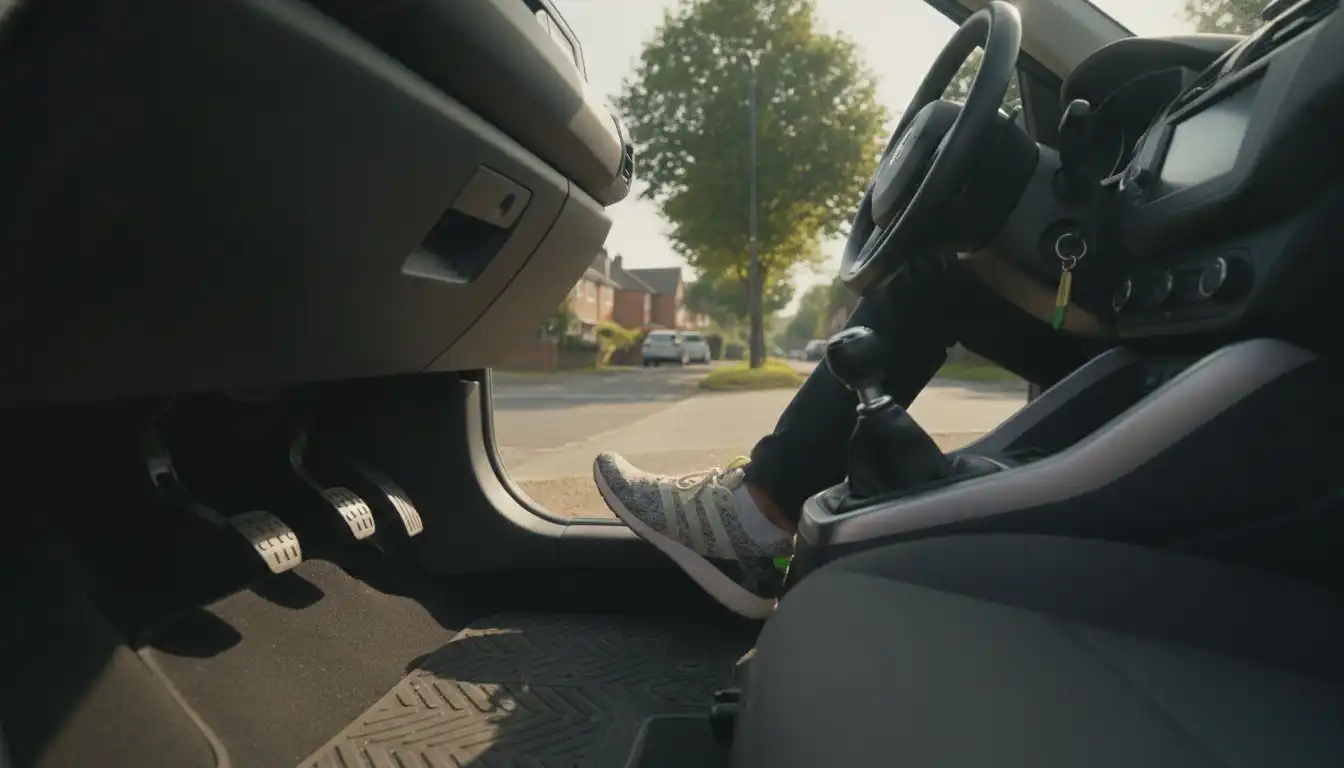
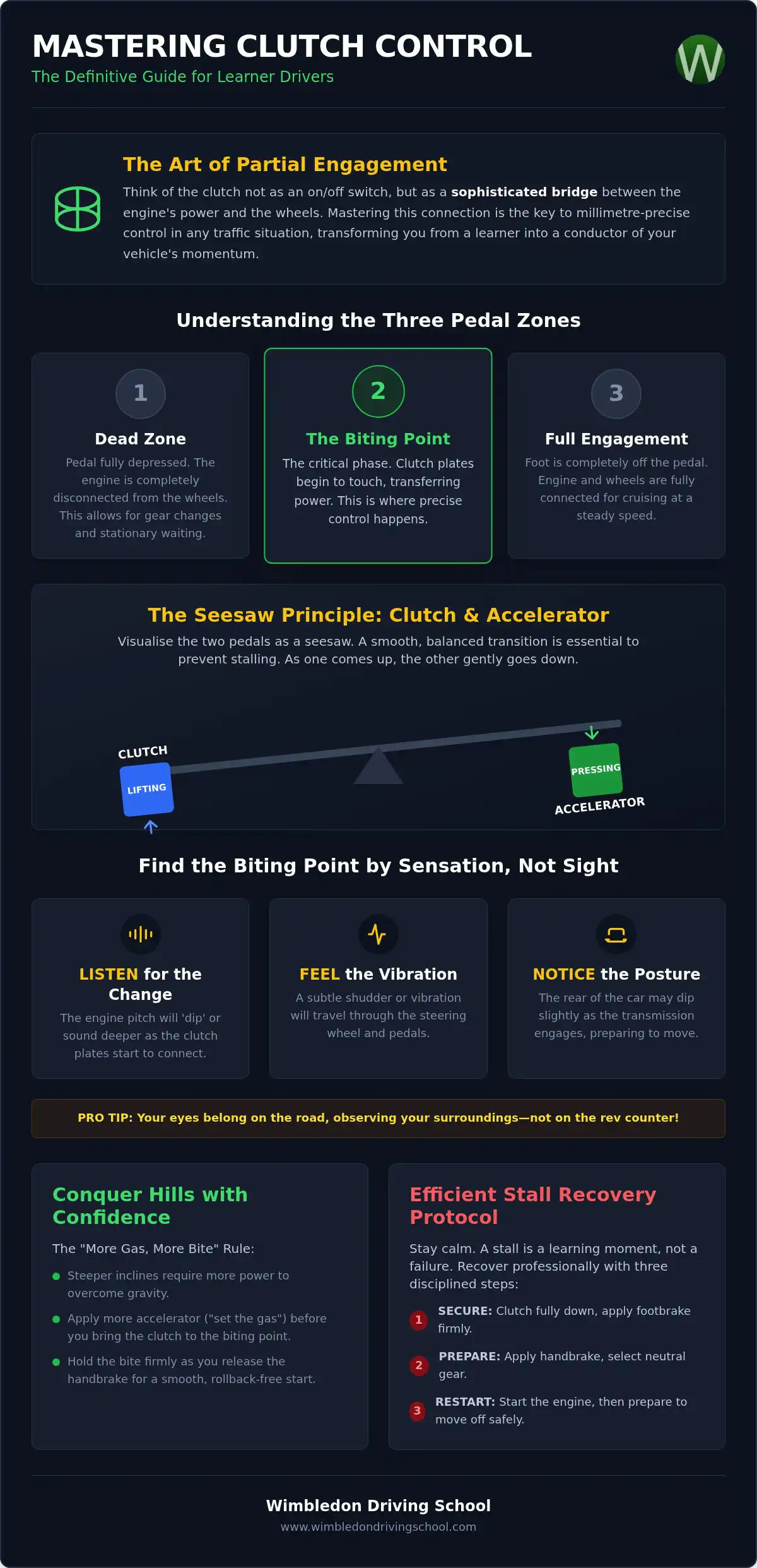
To master the pedal, you must recognise its three distinct zones. The “Dead Zone” occurs when the pedal is fully depressed. At this stage, the engine is completely disconnected from the wheels, allowing you to change gears or remain stationary. The “Biting Point” is the most critical phase; it’s the moment the two clutch plates begin to touch and transfer power. Finally, “Full Engagement” is when your foot is entirely off the pedal, and the car is cruising at a steady speed. Recognising these transitions by feel rather than sight is a hallmark of a premier driver.
The Relationship Between the Clutch and Accelerator
The most effective way to visualise this interaction is the “seesaw” analogy. As your left foot rises to the biting point, your right foot must gently apply pressure to the accelerator. This “sets the gas,” providing the engine with enough power to move the car’s weight. One of the most common clutch control tips for learners is to avoid “popping” the clutch. Releasing the pedal too abruptly causes the engine to meet sudden resistance, resulting in a violent stall. Instead, hold the bite for a second as the car begins to move before smoothly releasing it fully.
Finding and Mastering the Biting Point
Many novice drivers fall into the trap of staring at the rev counter whilst searching for the bite. This is a dangerous habit that compromises your situational awareness and safety. Professional instructors prioritise sensory feedback over dashboard gauges because it allows you to keep your eyes on the road. Developing this “feel” for the vehicle is a core component of Mastering the Biting Point with absolute precision.
To identify the biting point without looking down, you must tune into three specific sensory cues. First, listen for the engine pitch. As the clutch plates begin to meet, the engine sound will “dip” or become slightly deeper. Second, pay attention to the steering wheel; you’ll often feel a subtle vibration or “shudder” through your hands. Finally, notice the physical posture of the car. On many vehicles, the rear will dip slightly as the gears engage and the car prepares to move. Recognising these signals transforms your driving from a mechanical process into an intuitive instinct.
The “Feet Off” Exercise for Beginners
We recommend practising the “feet off” exercise in a safe, flat environment to build your confidence. Without using the accelerator, slowly lift the clutch pedal millimetre by millimetre. The goal is to find the exact point where the car begins to creep forward. Once you feel this movement, “freeze” your foot in position for at least two seconds. This pause is vital. It allows the plates to synchronise and prevents the sudden surge that leads to stalling. Applying these clutch control tips for learners in a controlled space ensures you are ready for more complex road scenarios.
Coordinating Gear Changes with the Palming Method
Smooth driving isn’t just about moving off; it’s about the transition between gears. The clutch acts as the facilitator for these changes, but your hand technique matters just as much. We teach the “palming method” to ensure you never crunch the gearbox. By using the flat of your palm to guide the gear stick rather than a tight grip, you allow the lever to find its natural path. This coordination is a primary focus of our intensive driving course, where we aim to make gear changes a seamless, subconscious action.
If you find yourself hesitating at junctions or struggling with the rhythm of the pedals, it might be time to book a session with a specialist instructor who can provide personalised feedback on your technique.
Essential Clutch Control Tips for Smooth Pull-Aways
Executing a flawless pull-away is the ultimate test of a learner’s coordination. It requires a disciplined sequence of actions that begins long before the car actually moves. First, you must prepare the vehicle by “setting the gas.” Apply a gentle, steady pressure to the accelerator until the engine produces a consistent hum. Whilst holding the handbrake firmly on, slowly raise the clutch to the biting point. You will feel the car strain slightly against the brake; this is your signal that the engine is ready to take the load.
The transition from stationary to moving is where many learners falter. As you release the handbrake, you must keep both feet absolutely still. This is the “holding” phase. Unlike the poor advice often found on social media forums, you should never “dump” the clutch as soon as the car moves. Instead, hold the pedal at the biting point for approximately 2-3 metres as the car gains momentum. Once the vehicle is rolling steadily, gently ease your left foot off the pedal and place it on the floor. Following these clutch control tips for learners ensures your pull-aways remain professional and jerk-free.
Clutch Control in Stop-Start London Traffic
Navigating a Wimbledon traffic jam or a slow crawl through South West London requires a specific set of skills. In very slow-moving queues, you can often move the car using “clutch only” techniques, especially in modern diesel or high-torque petrol vehicles. However, be wary of “riding the clutch.” This habit involves keeping the pedal partially depressed whilst driving at speed, which leads to premature wear and expensive gearbox repairs. To avoid leg fatigue, select neutral and apply the handbrake if you expect to be stationary for more than a few seconds. It keeps your muscles relaxed and your mind focused.
Managing Junctions and Roundabouts
Approaching junctions requires early preparation to maintain a smooth flow. Slow down well in advance and select the appropriate gear, which is usually second for most open junctions. If you are emerging from a blind junction, use the “peep and creep” method. This involves staying at the biting point to move the car forward millimetre by millimetre until your view is clear. By mastering this level of precision, you can maintain momentum and merge into traffic safely without the need for a full, jarring stop. This proactive approach demonstrates the high level of vehicle control that examiners look for during the practical test.
Navigating Hills and Surrey Slopes with Confidence
Hills represent the definitive test of your practical driving test readiness. Gravity is a constant force that exposes any weakness in your pedal coordination. On a flat road, a minor error might only cause a slight jerk. On a steep Surrey incline, that same mistake leads to a dangerous rollback or a stall. Mastering the handbrake-to-clutch transition is what separates a nervous learner from a competent driver who is truly ready for the road.
When you face a significant gradient, you must apply the “more gas, more bite” rule. A standard pull-away uses minimal revs, but a hill start requires more torque to overcome the vehicle’s weight. You’ll need to increase your engine speed more than usual to prevent the car from struggling. This isn’t about speed; it’s about providing the engine with the necessary power to move the car upward without hesitation. Using these clutch control tips for learners will ensure you never feel intimidated by the landscape again.
The Perfect Hill Start Technique
Consistency is the key to confidence. Follow this three-step discipline to ensure a perfect start every time:
- Step 1: Secure the car with the handbrake and select first gear. Keep your right foot ready on the accelerator.
- Step 2: Increase your revs to approximately 2000 RPM. Slowly lift the clutch to find a “stronger” biting point. You’ll know you’ve found it when the car’s bonnet rises slightly and the engine sound deepens.
- Step 3: Perform a full six-point check, including your mirrors and blind spot. If it’s safe, release the handbrake whilst holding both feet absolutely steady. The car will move forward smoothly without an inch of rollback.
Local Challenges: Morden and Mitcham Test Routes
Test routes around Morden and Mitcham are famous for their subtle, deceptive gradients. It isn’t just the steep hills that cause issues; it’s the junctions situated on slight slopes that often catch learners off guard. If you don’t recognise the incline, you might not apply enough gas, leading to a stall in the middle of a busy junction. Our instructors specialise in these specific South West London routes. Learning with a RoSPA Gold or IAM certified mentor ensures you develop the high-level proficiency required to identify these local traps before they become a problem on your test day.
Control doesn’t end at the summit. When descending steep hills, use engine braking by selecting a lower gear. This technique uses the engine’s resistance to manage your speed, which saves your brakes from overheating and provides superior vehicle stability. It’s a hallmark of an advanced driver who understands the mechanical limits of their vehicle.
If you want to turn your fear of hills into a display of driving excellence, book your manual driving lessons with our expert team and master the slopes of Surrey today.
Overcoming Stalling and Building Driving Instinct
Stalling is an inevitable rite of passage for every manual driver. Mechanically, a stall occurs when the engine’s rotational force is insufficient to overcome the resistance of the wheels, usually because the clutch was released too abruptly or without enough accelerator pressure. While it feels like a major setback in the heat of a busy London junction, it is simply a signal that your pedal coordination needs a minor adjustment. We believe that how you recover from a stall is far more important than the stall itself.
A professional, calm recovery follows a disciplined three-step process:
- Brake and Clutch Down: Immediately depress both pedals to secure the car and prevent it from rolling.
- Neutral and Restart: Shift into neutral and restart the engine. This resets the vehicle and your own focus.
- Re-assess: Perform a quick 360-degree check of your surroundings. Re-find your biting point and move off when it is safe to do so.
Maintaining your composure is vital, particularly when other drivers become impatient. At Wimbledon Driving School, our instructors are specialists in supporting nervous learners through this phase. We provide the patience and expertise needed to turn these moments into constructive learning experiences rather than sources of anxiety.
The Mental Game: From Thinking to Instinct
Mastering the vehicle means moving beyond conscious thought. In your initial lessons, you might find yourself over-analysing every millimetre of pedal movement. Through professional tuition and consistent repetition, this transitions into muscle memory. You will eventually stop “thinking” about your feet and start “feeling” the car’s intentions through the vibrations in the seat and the pitch of the engine. Once these clutch control tips for learners become instinctive, you will have the mental capacity to handle complex environments, such as motorway driver training, with absolute confidence.
Booking Your Path to Success
Choosing the right mentor is the most effective way to secure your driving future. We are the premier choice for South West London learners because we combine industry-leading expertise with an encouraging, student-centric approach. Our exceptionally high pass rates and the prestige of our RoSPA Gold and IAM certified instructors ensure you receive the highest standard of education available. Book your manual lessons now and master the clutch with the most respected driving school in the region. Your journey toward total vehicle mastery begins with a single, confident decision.
Take Command of Your Driving Journey
Mastering manual driving isn’t just about passing a test; it’s about gaining total vehicle control for a lifetime on the road. By focusing on sensory cues like engine pitch and the “more gas, more bite” rule for Surrey slopes, you’ve already started to build the instincts of a professional. These clutch control tips for learners provide the essential foundation, but true mastery comes from expert guidance and consistent practice in the driver’s seat.
At Wimbledon Driving School, we specialise in transforming nervous first-time students into elite drivers. Our RoSPA Gold and IAM certified instructors maintain one of the highest pass rates in the UK, ensuring your education meets the highest possible industry standards. We don’t just teach you to drive; we guide you through a transformative journey toward a major personal milestone with patience and professional authority.
Master your manual driving with Wimbledon Driving School today. Your road to success starts here, and we are proud to be your partners in every gear change.
Frequently Asked Questions
What is the biting point and how do I find it?
The biting point is the specific moment the clutch plates meet to transfer power from the engine to the wheels. You can find it by slowly lifting the pedal until you hear the engine pitch drop and feel a slight vibration through the steering wheel. Our RoSPA Gold instructors recommend practising this on a flat, quiet road in South West London to build muscle memory before you attempt to tackle busy junctions or roundabouts.
Is it bad for the car to ride the clutch?
Yes, riding the clutch causes premature wear on the release bearing and friction plates, leading to significant repair costs. This habit involves keeping your foot partially on the pedal whilst driving or holding the car on the bite for too long instead of using the handbrake. To protect your vehicle, only use the clutch when changing gears or performing slow manoeuvres, and always rest your foot on the floor during steady cruising.
Why does my car jerk when I pull away from a junction?
Jerking usually occurs because you are releasing the clutch too quickly or without sufficient accelerator pressure. This sudden engagement forces the engine to meet the car’s weight abruptly. To achieve a smooth pull-away, apply a steady amount of gas first, then lift the clutch to the bite and hold it there for two seconds as the car gains momentum. This “pause” is one of the most effective clutch control tips for learners to master.
Can I fail my driving test for stalling the engine?
Stalling itself is often recorded as a minor fault, provided you recover safely and don’t affect other road users. However, if you stall in a dangerous position, such as in the middle of a busy Surrey roundabout, or if you fail to check your mirrors before moving off again, it can lead to a serious fault and an immediate fail. Demonstrating a calm, disciplined recovery is essential for passing your practical test with confidence.
How do I do a hill start without rolling backwards?
Preventing rollback requires a coordinated transition between the handbrake and the biting point. Secure the car with the handbrake, set your revs slightly higher than usual, and find a strong biting point where the car’s bonnet begins to rise. Only release the handbrake once you feel the engine “tug” against it. This technique is a core focus of our manual driving lessons across Morden and Mitcham, where deceptive gradients are common.
Should I always use the handbrake when I stop at traffic lights?
You should use the handbrake if you expect to be stationary for more than a few seconds. It secures the vehicle against accidental rolls and allows you to rest your feet, reducing leg fatigue during London’s heavy traffic. Using the handbrake also ensures that if your car is hit from behind, it is less likely to be pushed into the junction or the vehicle in front, which enhances your overall safety.
How long does it take to master clutch control?
Most learners begin to feel comfortable with the biting point after three to five hours of professional tuition. However, achieving total instinctual mastery, where you no longer think about your feet, typically takes longer and varies by individual. Consistent practice using our proven clutch control tips for learners can accelerate this process significantly. Our specialists focus on building this muscle memory early to ensure you can handle complex South East London road systems without hesitation.
Is it easier to learn in an automatic car if I struggle with the clutch?
Automatic cars are simpler to operate because they remove the need for manual gear changes and clutch management entirely. This can be a great option for nervous drivers who find the coordination of three pedals overwhelming. However, remember that an automatic licence restricts you to driving only automatic vehicles. We offer both manual and automatic driving lessons, helping you choose the path that best suits your long-term goals and driving confidence. If those goals include a career in commercial driving, you can check out Right Way Transport Training to see how professional truck driver training is delivered.
Disclaimer
This article is provided for general informational purposes only and does not constitute professional driving, legal, or safety advice. While we aim to keep our content accurate and up to date, rules, prices, and DVSA test requirements can change — always check gov.uk or contact us directly at 020 3524 7968 for the latest guidance before making any decisions. Nothing in this article guarantees a specific outcome, including passing your driving test within any stated timeframe. For current pricing, course availability, and instructor details, please visit our Prices page or get in touch.