

What if the professional sitting in the passenger seat is the single most important factor in whether you pass or fail your driving test? Many learners treat the search for a tutor like a lottery, yet understanding how to choose a driving instructor is the definitive first step toward your independence. You shouldn’t have to worry about wasting your hard-earned money on an instructor who makes you feel anxious or lacks the necessary local expertise to guide you through complex test routes.
We understand that you want to feel safe, respected, and empowered behind the wheel. This 2026 guide provides the roadmap to finding a mentor who adapts to your specific pace, helping you master the road with a level of skill that goes far beyond the basic requirements. We will demystify the technical jargon surrounding ADI and PDI status whilst highlighting why elite certifications like RoSPA Gold set the industry standard for tuition. From vetting coaching philosophies to identifying instructors with superior local knowledge, you are about to learn how to secure the high-calibre education you deserve for a first-time pass.
Key Takeaways
- Understand the vital difference between fully qualified ADIs and trainees to ensure your instructor possesses the highest level of professional expertise and a proven track record.
- Discover how to choose a driving instructor who adapts their teaching style to your specific learning behaviour, fostering a supportive environment that is particularly beneficial for nervous drivers.
- Utilise a comprehensive vetting checklist to verify local test route knowledge in areas like South West London and Surrey to avoid unexpected challenges on the day of your exam.
- Identify why industry-leading certifications, such as RoSPA Gold or IAM, are the definitive markers of a premier driving education and a safer journey toward your licence.
- Use the initial trial lesson as a strategic opportunity to confirm instructor chemistry and ensure the vehicle and teaching pace are a comfortable fit for your requirements.
The Fundamentals: Understanding ADI vs PDI Status
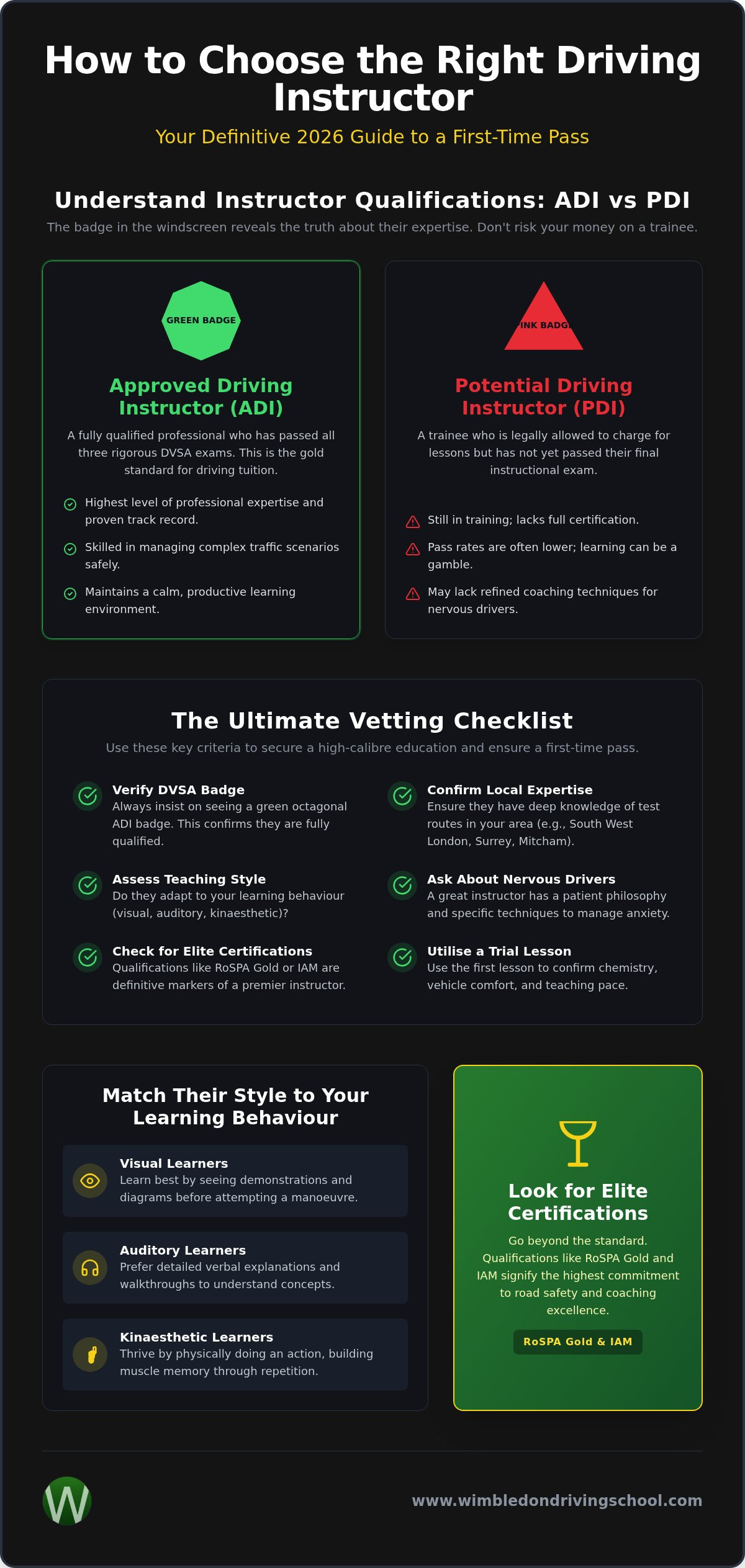
Before you commit to a block of lessons, you must verify the credentials of the person sitting next to you. The search for how to choose a driving instructor often starts with a personal recommendation, but the legal reality is found on the vehicle’s windscreen. The Driver and Vehicle Standards Agency (DVSA) uses a colour-coded system to distinguish between fully qualified professionals and those still in training. Handing over payment without checking for a valid badge is a risk your safety and your wallet cannot afford.
What is an Approved Driving Instructor (ADI)?
An ADI is a professional who has passed the rigorous DVSA Part 3 exam. This green octagonal badge signifies that the instructor has successfully completed a comprehensive three-part qualifying process. This includes a high-level theory test, an advanced driving ability assessment, and a final, stringent test of their instructional skill. Choosing a green badge holder ensures you are learning from someone who has met the gold standard for road safety and coaching. They possess the experience to manage complex traffic scenarios whilst maintaining a calm, productive environment for the learner.
The Truth About Potential Driving Instructors (PDIs)
A pink triangular badge indicates a Potential Driving Instructor (PDI). These individuals are still in training and have not yet passed their final instructional exam. While they are legally allowed to charge for lessons, they lack the full certification that guarantees consistent results. Learning with a PDI can be a gamble; their pass rates are often lower, and they may lack the refined coaching techniques needed to help nervous drivers overcome specific hurdles. Understanding these distinctions is a core part of how to choose a driving instructor who can actually deliver on their promises. If the badge is pink, they are still a trainee.
In the demanding environment of London and Surrey, high-level proficiency is non-negotiable. Navigating the intricate junctions of South West London or the high-speed challenges of the A3 requires an instructor with deep professional knowledge. At Wimbledon Driving School, we refuse to settle for the industry average. We ensure our team meets elite standards, with many of our instructors holding additional RoSPA Gold and IAM certifications. This commitment to excellence is why we maintain one of the highest pass rates in the country. We provide a transformative experience that turns nervous beginners into confident, skilled drivers. You deserve a mentor who understands the specific pressures of Douglas House or Mitcham test routes. Check our learning centre for more resources on starting your journey with the best in the business.
Matching Teaching Styles to Your Learning Behaviour
Learning how to choose a driving instructor involves more than just checking a pass rate; it requires finding a professional who speaks your language. Every learner processes information differently. Some need to see a diagram before they can execute a turn, whilst others need to feel the car’s weight shift during a gear change. A “Confident Mentor” doesn’t just bark instructions. They observe your reactions and pivot their coaching style to match your specific learning behaviour. This tailored approach ensures that every hour you spend in the car is productive rather than overwhelming.
Most successful students fall into one of three categories: visual, auditory, or kinaesthetic learners. If you find yourself asking for a demonstration before trying a manoeuvre, you likely lean toward visual learning. If you prefer a detailed verbal walkthrough, you are auditory. Kinaesthetic learners often thrive by doing, needing to physically repeat an action to build muscle memory. This is a critical step in how to choose a driving instructor who actually understands your needs. Effective communication is the most powerful tool in the vehicle, and it starts with an instructor who can translate complex road rules into simple, actionable steps that resonate with you.
Finding a Specialist for Nervous Drivers
Anxiety behind the wheel is a significant hurdle that requires a specific set of coaching skills. You should ask potential instructors about their experience with high-stress situations and their philosophy on student mistakes. Patience isn’t just a virtue here; it’s a requirement. Elite instructors with RoSPA Gold or IAM certifications are trained to manage student stress levels through calm, authoritative guidance. They create a safe space where you can focus on building confidence without the fear of being shouted at or judged. This empathetic environment is what separates a premier driving school from a budget independent tutor.
Manual vs Automatic: Choosing Your Vehicle Type
Your choice of vehicle will dictate the rhythm of your learning journey and your long-term driving goals. Manual lessons offer total control and allow you to drive any vehicle once you pass, but they come with the added complexity of clutch control and gear coordination. Automatic cars remove these physical demands, allowing you to focus entirely on road positioning and hazard perception. Many students find that Automatic Driving Instructors Near Me provide a faster route to a licence in heavy London traffic. Ensure your chosen mentor specialises in your preferred transmission to get the most out of your tuition. Once you’ve decided on the right vehicle, you can secure your first session with a mentor who fits your style.
The Ultimate Vetting Checklist for 2026 Learners
Selecting the right mentor is a significant financial and emotional investment. You need a structured approach to filter out average tuition and find a professional who truly values your success. When researching how to choose a driving instructor, treat the first phone call like an interview. A high-calibre instructor will welcome your questions and provide transparent, confident answers that demonstrate their professional authority.
Professionalism markers are often visible before you even start the engine. Punctuality and car maintenance aren’t just minor details; they reflect the instructor’s respect for your time and safety. A clean, modern vehicle equipped with dual controls is a baseline requirement. Beyond the car, look for a clear lesson structure. Your sessions should follow a logical syllabus that builds your skills progressively, rather than driving aimlessly around the same few streets every week. Structured progress tracking is essential to ensure you aren’t paying for more lessons than you actually need.
Five Questions to Ask Your Potential Instructor
Prepare a list of specific queries to gauge an instructor’s competence and suitability for your needs. Use these five questions as your starting point:
- How do you track my progress? Look for instructors who use digital logs or physical progress cards to show exactly where you are in the syllabus.
- What is your specific experience with the Morden or Tolworth test centres? Local route knowledge is vital for navigating difficult junctions that often appear on exams.
- Do you offer motorway training or Pass Plus courses? This indicates a commitment to your long-term safety beyond just passing the test.
- What is your policy for lesson cancellations and rescheduling? Flexibility is key for the modern learner’s busy schedule.
- Can you provide a mock test before my actual exam date? Mock Driving Tests are the most effective way to reduce test-day nerves and identify final weaknesses.
Reviewing Social Proof and Reputation
Online reviews offer a window into the student experience, but you must filter for authenticity. Look for detailed feedback that mentions specific challenges the instructor helped the student overcome, rather than generic praise. Longevity in the industry is perhaps the most reliable marker of quality. Wimbledon Driving School has served the London and Surrey communities for over 20 years. This two-decade history reflects a consistent standard of excellence that independent, fly-by-night tutors simply cannot match. Word-of-mouth recommendations amongst local communities often highlight the “Confident Mentor” personality that makes the difference between a stressful experience and a transformative journey toward your licence.
Why Local Expertise is Non-Negotiable in London and Surrey
Understanding how to choose a driving instructor means looking beyond their car or hourly rate. You need someone who knows the specific terrain. South West London and Surrey present unique challenges that can rattle even the most prepared learner. From the multi-lane complexity of Tibbet’s Corner to the narrow, parked-car-lined streets of Wimbledon, local knowledge is a strategic advantage. A mentor who lives and breathes these routes identifies “hot spots” where examiners often look for specific behaviours, such as lane discipline on complex roundabouts or speed management in residential zones.
Navigating the dense urban landscape requires more than basic car control. It demands a sophisticated understanding of local traffic flow and the ability to anticipate the unpredictable actions of other road users in high-pressure environments. This insight allows you to practise the exact scenarios you will face during your forty-minute assessment. This level of preparation is a core component of how to choose a driving instructor who can truly guarantee a first-time pass. An instructor with deep professional knowledge of Mitcham or Douglas House test centres can prepare you for the specific quirks of those areas, ensuring you aren’t surprised on the day.
Mastering Local Test Routes
Familiarity breeds confidence. Knowing where a speed limit changes or which lane to pick for a specific exit reduces the cognitive load during your exam. When you aren’t guessing the road layout, you can focus entirely on your observations and hazard perception whilst maintaining total control of the vehicle. We recommend reviewing our learning centre for comprehensive route preparation and advice. Practising on the same roads used by examiners transforms the test from a daunting mystery into a familiar drive, significantly reducing test-day nerves.
Coverage Areas and Reliability
Logistical efficiency is another reason to prioritise local tutors. By checking the areas we cover, you ensure your instructor is intimately familiar with the traffic patterns between your home and the training ground. Local instructors are less likely to be delayed by congestion because they know the shortcuts and peak-time bottlenecks to avoid. This reliability protects your lesson time and ensures a seamless experience. Additionally, a local expert knows the best quiet spots for early manoeuvres. They can find a secluded road in Merton or a quiet cul-de-sac in Kingston where you can master your parallel park without the pressure of heavy traffic.
Ready to start your journey with an expert who knows your streets? Secure your first session today and experience the difference that local mastery makes to your progress.
Making the Final Decision: Trial Lessons and Commitment
The final stage of your search for how to choose a driving instructor is the physical trial. No amount of online research can replace the first sixty minutes spent in the car. This initial session acts as a litmus test for instructor chemistry. You’ll quickly discover if their communication style aligns with your learning behaviour or if their presence adds to your anxiety. A professional mentor should arrive with a clear plan, immediately establishing a sense of safety and professional authority that puts you at ease.
Deciding between an independent tutor and an established school is often a choice between uncertainty and security. While some independents are excellent, they frequently lack the infrastructure to support you if a car breaks down or if they fall ill. An institution like Wimbledon Driving School offers a robust support network, ensuring your learning journey remains uninterrupted. This stability is a vital factor in how to choose a driving instructor who can see you through to your test date without logistical headaches. Once you’ve found the right match, block booking is the most efficient way to maintain momentum. It secures your preferred time slots and signals a serious commitment to your personal milestone.
Evaluating Your First Lesson
During your first hour, pay close attention to the clarity of instruction. Did the instructor explain the session’s goals before you set off? A high-quality lesson should feel structured, moving from theory to practice with a logical flow. You should feel encouraged to ask questions without hesitation. If the car environment feels cramped or the instructor seems distracted, these are significant red flags. Trust your instinct after the first 60 minutes in the car; if the chemistry isn’t there, don’t be afraid to look elsewhere. Your time and resources are too valuable to spend on tuition that doesn’t make you feel confident.
Securing Your Success with Wimbledon Driving School
Choosing a premier, multi-award-winning school provides the peace of mind that every learner deserves. Our instructors don’t just teach you to pass a test; they coach you to become a safe, elite driver for life. We specialise in transitioning beginners to test-ready status rapidly through a sophisticated blend of patience and professional expertise. By following our structured tuition programmes, you’ll avoid the common pitfalls of fragmented learning. We take pride in our market-leading position and our ability to adapt to the modern learner’s needs. Ready to start? Book your first lesson with our elite team today and take the first step toward your independence.
Take the First Step Toward Your Driving Independence
Mastering the road is a transformative experience that begins with a single, informed decision. By prioritising fully qualified ADI status, seeking out instructors with elite RoSPA Gold or IAM certifications, and insisting on deep local expertise across London and Surrey, you’ve already simplified the complex task of how to choose a driving instructor. You now possess the vetting tools to avoid common pitfalls and find a mentor who respects your specific learning pace whilst ensuring your absolute safety.
With over 20 years of excellence and one of the highest pass rates in the United Kingdom, Wimbledon Driving School remains the premier choice for students who refuse to settle for the industry average. We don’t just provide lessons; we guide you through a journey toward a life-changing milestone with confidence and skill. Trust your instincts, value your time, and choose a school that is as committed to your success as you are. Your future as a confident, independent driver starts with the right seat choice.
Secure your driving future and book with London’s premier instructors
Frequently Asked Questions
How many lessons does the average learner need to pass?
The DVSA reports that the average learner requires approximately 45 hours of professional tuition supplemented by 22 hours of private practice. However, this varies significantly based on individual learning pace and consistency. Students at Wimbledon Driving School often find that our structured syllabus and high-calibre instruction allow them to reach test-ready status more efficiently. Regular sessions and intensive options can further accelerate your progress toward a first-time pass.
Is it better to choose a male or female driving instructor?
The best choice depends entirely on your personal comfort and learning preferences. Whilst gender doesn’t determine instructional skill, some learners feel more relaxed with a specific gender, which can significantly improve their concentration and confidence. We provide access to both male and female professionals across South West London to ensure you feel completely at ease. The priority is finding a mentor whose communication style matches your specific needs.
What should I do if I don’t get on with my driving instructor?
You should address any concerns immediately or request a change if the chemistry isn’t right. Learning to drive is a significant investment, and having a supportive relationship with your mentor is crucial for success. Established schools make this transition seamless by offering a diverse team of instructors. If you find that your current teaching style isn’t clicking, we can reassign you to a different professional who better suits your personality.
How much should I expect to pay for a high-quality instructor in London?
Rates for premium tuition in London and Surrey typically reflect the instructor’s experience, certifications, and the type of vehicle provided. Whilst you might find cheaper independent tutors, professional schools invest in high-calibre staff with advanced RoSPA Gold or IAM qualifications. These experts often provide better value by helping you pass in fewer lessons. You can view our current rates for manual and automatic sessions on our booking page.
Can I change my instructor if I have already booked a block of lessons?
Yes, students at reputable schools can usually transfer their pre-paid balance to another instructor within the same organisation. This flexibility is a key advantage of choosing a larger school over a solo independent tutor. We prioritise your progress and comfort, so if a change of mentor is required to help you feel more confident, our office team can organise this without you losing your block booking discount.
Do I need to pass my theory test before choosing an instructor?
You don’t need to pass your theory test before you start practical lessons, but beginning your tuition early can actually help you understand the theory better. Seeing road signs and hazard perceptions in a real-world environment makes the revision process more intuitive. We encourage learners to study for their theory test whilst starting their initial practical sessions to ensure they are ready to book their practical exam as soon as possible.
What is the difference between an independent instructor and a driving school?
Independent instructors operate alone, whereas a driving school like ours provides a managed network of professionals with centralised support. Schools offer greater reliability, as they can provide replacement vehicles or alternative instructors if needed. Additionally, established schools often maintain higher standards through rigorous internal vetting and additional certifications like RoSPA Gold, providing a more consistent and secure educational journey compared to many independent tutors.
How do I check if my instructor is fully qualified?
You can verify an instructor’s status by checking the colour of the badge displayed in their windscreen. A green octagonal badge confirms they are a fully qualified Approved Driving Instructor (ADI). When researching how to choose a driving instructor, you should always insist on a green badge holder. Trainees display a pink triangular badge, and whilst they can legally charge for lessons, they have not yet passed their final instructional exams.