A recent survey revealed that 32% of drivers actively avoid reverse bay parking, citing it as their most dreaded manoeuvre. If the thought of navigating a tight space in a busy London car park makes your palms sweat, you aren’t alone. This bay parking tutorial uk is here to help you overcome the anxiety of hitting the lines or losing track of your reference points while the examiner watches your every move. We understand that mastering this skill is about more than just passing a test; it’s about gaining the freedom to drive anywhere with total composure.
This comprehensive guide is designed to replace that uncertainty with the clinical precision of a RoSPA Gold-qualified driver. We’ve distilled our award-winning instruction methods into a clear, step-by-step process that prepares you for every scenario you might face in 2026. You’ll learn how to execute both forward and reverse manoeuvres with the fluid control that examiners demand, ensuring you feel at home in even the narrowest supermarket bays in Morden or Surbiton.
In the following sections, we’ll break down the exact reference points for different car sizes, explain the latest DVSA marking criteria, and show you how to make safe corrections if your initial positioning isn’t perfect. It’s time to stop fearing the car park and start your journey toward becoming a truly elite, confident road user.
Key Takeaways
- Understand the specific DVSA requirements for both forward and reverse manoeuvres to ensure you are fully prepared for whichever exercise the examiner selects on the day.
- Master the repeatable “3-Line” method within this bay parking tutorial uk to achieve consistent accuracy and finish perfectly between the lines every time.
- Learn how to judge the necessary “swing room” for forward entries, allowing you to navigate narrow London parking spaces with professional-level precision.
- Prioritise 360-degree observation over a perfect finish to avoid the most common serious faults and keep yourself safe in busy car park environments.
- Discover how training with RoSPA Gold and IAM certified instructors can simplify complex manoeuvres and build the confidence needed for a first-time pass.
Mastering the Bay Park: Why It’s Crucial for Your UK Driving Test
Bay parking is a cornerstone of the DVSA practical driving test, designed to assess your ability to control a vehicle in confined spaces. While many learners view it with trepidation, it’s actually a vital tool for navigating the reality of London’s congested streets. The examiner isn’t looking for a professional racing driver; they want to see a safe, methodical motorist who respects the space of others. By following a structured bay parking tutorial uk, you can transform this source of anxiety into a clear demonstration of your road readiness.
Mastering this move does more than just help you pass the test. It builds a foundation of spatial awareness that makes every other part of driving easier. When you can comfortably position a car between two white lines, you develop a better sense of where your wheels are and how the vehicle pivots. This confidence is essential when you’re navigating tight residential roads in Wimbledon or finding a space in a crowded Surrey supermarket car park.
The DVSA Standard: What the Examiner Is Looking For
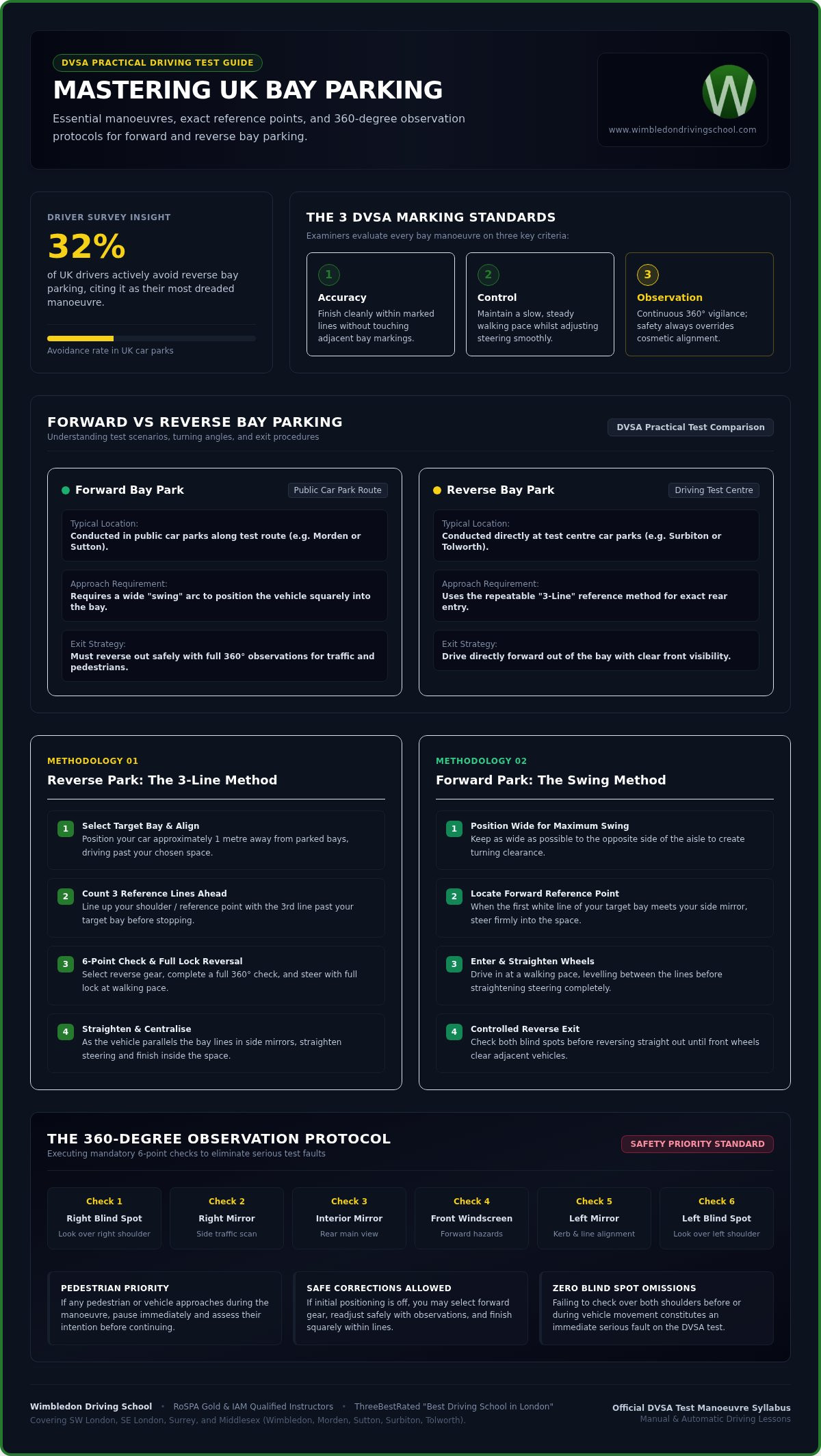
During your test, you’ll be expected to show three core competencies: accuracy, control, and observation. Perpendicular parking (bay parking) is the technical term for this manoeuvre, and the examiner will mark you based on how you manage the car’s position relative to the white lines. You don’t need to be perfectly parallel, but you must finish within the designated space without touching the lines of an adjacent bay.
Control is equally vital. You should move the car at a slow, walking pace, which gives you time to make steering adjustments and respond to hazards. However, the most critical element is observation. You must perform a comprehensive 6-point check before you even move the car. This means looking over both shoulders, checking all mirrors, and ensuring the front and rear are clear. If you miss a blind spot or fail to react to a pedestrian walking behind you, it’s likely to result in a serious fault. Safety always takes precedence over a “perfect” park.
Forward vs Reverse Bay Parking: Key Differences
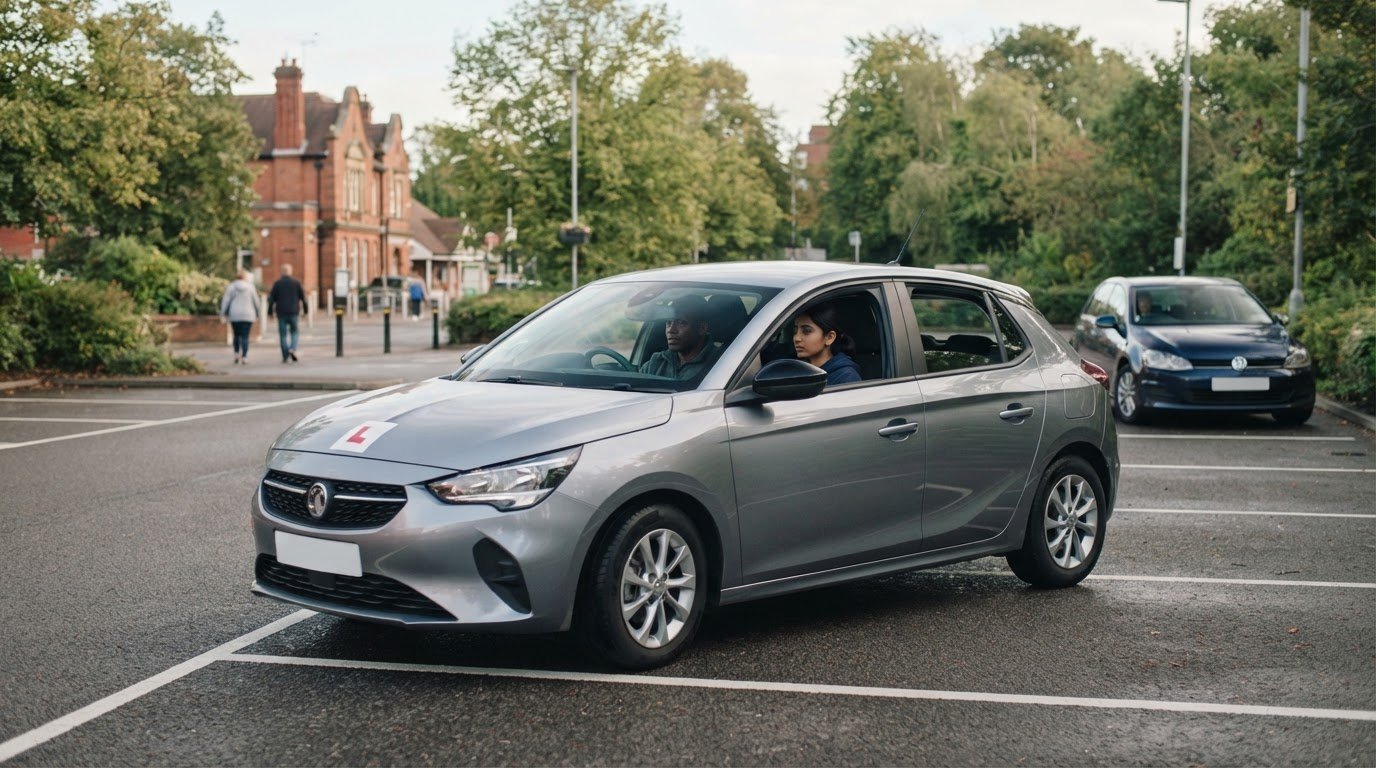
The examiner will choose one of two methods on the day. In a forward bay park, you’ll drive into a bay and then reverse out. This is usually performed in a public car park during the test route, perhaps near a local landmark in Morden or Sutton. A reverse bay park, where you back into the space and drive out, is often conducted at the test centre itself, such as at Surbiton or Tolworth.
For many students, the coordination required for these moves is the hardest part of learning. This is why many choose automatic driving lessons to simplify the process. Without a clutch to manage, you can dedicate 100% of your focus to your observations and steering. Whether you are learning in a manual or an automatic, our RoSPA Gold and IAM qualified instructors at Wimbledon Driving School ensure you have the confidence to park in any busy urban environment across SW London and Middlesex.
Step-by-Step Tutorial: Forward Bay Parking Like a Pro
Forward bay parking is a frequently tested skill that requires a blend of precise steering and constant vigilance. Unlike reversing into a space, driving forward gives you a clear view of your target, but it demands a much wider turning circle to clear the lines. This bay parking tutorial uk focuses on the “swing” method, which is the most effective way to ensure your car enters the bay squarely. By preparing early, you give yourself the best chance of success without needing multiple corrections.
Safety remains the priority throughout the move. Before you begin your approach, you must check all mirrors and blind spots to ensure no pedestrians or other vehicles are in your path. Following the official driving test instructions means you must demonstrate full control whilst maintaining a slow, walking pace. If you want to perfect these techniques under the guidance of a RoSPA Gold instructor, consider booking a mock test to sharpen your skills before the big day.
Setting Up Your Approach
The secret to a successful forward park is your initial road position. You should position your car as far to the opposite side of the car park aisle as possible. If the bay you want is on the right, keep your car close to the left hand side. This creates the “swing room” needed for the front of the car to clear the white lines. Always signal your intent early so other road users understand you are about to stop and turn.
For a standard hatchback, the reference point is typically reached when the first white line of your target bay appears just below the bottom of your door mirror. Identifying this moment is the key to timing your turn perfectly. Using this bay parking tutorial uk method prevents you from turning too early and clipping the vehicle in the adjacent space.
Steering and Alignment Accuracy
Once you reach your reference point, apply full lock steering quickly but smoothly. Keep the car moving slowly; this allows the steering to take effect without the car leaping forward. As you enter the space, look ahead to a point in the middle of the bay to help you guide the car in straight. Use your door mirrors to monitor the white lines on either side, ensuring you are central within the space.
If you find the car is slightly wonky, don’t panic. The DVSA allows you to reverse out and realign, provided you perform all the necessary safety observations. Once the car is straight and central, straighten your wheels, select neutral, and apply the handbrake. Mastering this level of precision is exactly what our instructors help you achieve across SW London and Surrey.
Reverse Bay Parking: The Three-Line Method Explained
Reverse bay parking is frequently cited by learners as the most intimidating part of the practical test. However, it is a highly predictable manoeuvre when you use a repeatable system. Unlike the vague 45-degree angle approach, the 3-line method provides specific, visual markers that work in almost any standard car. This bay parking tutorial uk focuses on creating a reliable routine that takes the guesswork out of your positioning, allowing you to focus on safety and control.
Maintaining a slow speed is the secret to a successful reverse. In a manual car, this means using precise clutch control to keep the vehicle at a crawl. For those who prefer automatic driving lessons, you will rely on light brake modulation to manage your pace. Moving slowly gives you the vital seconds needed to process your observations and make small steering adjustments before the car deviates from its path.
Finding Your Reference Points
To begin, drive past your chosen bay and stop when you are lined up with the “third line” from your target space. For most hatchbacks, this means the third white line (counting the one at the start of your bay as line one) should appear roughly in the middle of your passenger door window. This consistent starting point is a core part of our Bay Park 5 Easy Steps programme, which has helped thousands of students in SW London and Surrey pass their tests.
You can also use the “door handle” method to judge your depth. As you reverse, look for the line at the back of the bay to appear near your door handle in the side mirror. This indicates you have moved far enough back into the space. Identifying these markers early prevents the common mistake of finishing too far forward or hitting the kerb at the rear.
Executing the Turn and Reversing
Once you are at your 3-line reference point, select reverse gear and perform a full 360-degree observation. If the coast is clear, apply full lock steering towards the bay. Timing is everything here; turning too late or too early will throw off your alignment. As the car begins to swing, you must look out the back window. Relying solely on mirrors is a common reason for failure, as it limits your field of vision and spatial awareness.
Safety is non-negotiable. If a pedestrian or another vehicle enters the car park, you must stop immediately. Wait for them to pass or for the situation to clear before continuing. For nervous drivers, remember that you are allowed to make minor corrections. If you see you are getting too close to one side, straighten the wheels, pull forward slightly, and try again. The examiner wants to see a safe, controlled recovery rather than a panicked attempt to force a bad position.
Avoiding Common Faults: Observations and Safety
The technical ability to steer into a bay is only half the battle. According to DVSA data, the #1 reason for failure during manoeuvres isn’t poor alignment, but a lack of effective all-round observation. It’s a common trap; students get so focused on their reference points that they forget to check what’s happening outside the car. This bay parking tutorial uk highlights that safety is always the priority. If you can’t show the examiner you’re aware of your surroundings, the most “perfect” park won’t save your test result.
Test nerves often cause learners to rush, leading to the “blind spot trap.” You might feel like you’ve checked your mirrors, but if you don’t physically turn your head to check over your shoulder, you’ve missed vital information. The examiner needs to see that you’re actively searching for hazards, not just going through the motions. A single pedestrian appearing behind you whilst you’re moving could result in an immediate fail if you don’t react correctly.
The 360-Degree Observation Routine
Before you even select a gear, you must perform a rigorous 6-point check. This starts from your right shoulder blind spot and moves across the front to your left shoulder blind spot. You aren’t just looking for cars. You’re scanning for cyclists, pedestrians, or even stray shopping trolleys. During the move, your eyes should be constantly moving. Don’t just stare at one mirror; keep your head on a swivel to demonstrate “active” looking to the examiner.
- Stop for pedestrians: If anyone walks behind or near your car, you must stop immediately. Do not wait for the examiner to tell you.
- Check the front: As the front of your car swings out during a reverse park, the front end becomes a hazard. Check that you aren’t about to clip a vehicle in the opposite row.
- Blind spot checks: Every time you change direction or start moving again after a pause, re-verify your blind spots.
Navigating Busy London Test Centres
London test centres present unique challenges. At the Morden Test Centre, the bays can feel exceptionally tight, especially when the car park is full of other candidates and nervous parents. The pressure of having an “audience” of waiting drivers can lead to rushed decisions. If someone is waiting for you to finish, take a breath. It’s their responsibility to wait whilst you complete your manoeuvre safely. Rushing leads to missed checks and potential collisions.
Effective observation on manoeuvres is what separates a learner from a qualified driver. When you’re under the spotlight of the practical test, nerves can make you feel like you need to finish quickly. This bay parking tutorial uk encourages you to resist that urge. A slow, safe park with one correction is far better than a fast park that ignores a hazard. Our instructors at Wimbledon Driving School specialise in helping you manage these high-pressure moments so you stay calm and focused.
Perfecting Your Manoeuvres with Wimbledon Driving School
Mastering the technical steps in this bay parking tutorial uk is a significant milestone, but the final stage of your transformation involves professional, hands-on guidance. At Wimbledon Driving School, we provide more than just basic instruction. Our team includes instructors who hold RoSPA Gold and IAM (Institute of Advanced Motorists) qualifications, representing the highest tier of driving proficiency in the country. This elite level of expertise allows us to simplify complex manoeuvres, turning daunting reverse parks into second-nature habits through proven, methodical coaching.
Learning in the actual environments where you’ll be tested is a strategic advantage. Our lessons cover SW and SE London, Surrey, and Middlesex, ensuring you’re familiar with the specific car park layouts at centres like Morden, Tolworth, and Surbiton. For those looking to accelerate their progress, our intensive driving courses are specifically designed to build muscle memory fast. By condensing your learning, you maintain a high level of focus that makes mastering reference points and observations far more efficient than staggered weekly lessons.
Tailored Lessons for Every Learner
We recognise that every student starts from a different place. If you’re a nervous beginner or someone struggling with test-day anxiety, our “Confident Mentor” approach provides a calm, supportive atmosphere that builds your self-belief. We also specialise in helping international drivers adapt to the unique challenges of British roads, ensuring you master the specific safety protocols required by the DVSA. Whether you choose to learn in a manual or prefer the streamlined experience of automatic driving lessons, we tailor every session to your specific needs and parking confidence.
Our status as a multi-year “Best Driving School in London” award winner, backed by a 4.8-star review average, is a testament to our commitment to quality. We don’t just prepare you for a 40-minute test; we equip you with the skills to navigate busy urban environments for a lifetime of safe driving. By focusing on the “why” behind every observation and steering adjustment, we ensure you’re ready for any scenario London’s roads can throw at you.
Book Your Journey to Driving Success
Getting started is straightforward. Whether you’re looking for a block booking to secure your schedule or a fast-track course to meet a specific deadline, we have the capacity to accommodate your logistical needs. Our coverage extends across Wimbledon, Sutton, Kingston, and the surrounding suburbs, providing flexible service delivery that respects your time. You aren’t just booking a lesson; you’re making the safest and most effective choice for your driving education.
Take the first step toward earning your full UK driving licence with a team that prioritises your safety and achievement. Our professional knowledge and industry-recognised status make us the premier choice for learners across South West London and Surrey. Start your journey today and experience the difference that elite instruction makes.
Mastering bay parking is a transformative step in your journey toward becoming a fully licensed driver. By internalising the reference points and the safety-first observation routines outlined in this bay parking tutorial uk, you’ve already gained a significant advantage for your driving test. Success isn’t just about technical accuracy; it’s about the calm, controlled spatial awareness that keeps you and other road users safe in busy car parks across SW London and Surrey.
As a multi-year “Best Driving School in London” winner with a 4.8-star rating, we take pride in our ability to turn nervous learners into elite motorists. Our instructors hold prestigious RoSPA Gold and IAM certifications, ensuring you receive the highest standard of professional mentorship available in the market. You’re making the safest choice for your education by choosing a school that values safety and rigorous requirements as much as you value your independence.
Take the wheel with confidence and let our experts guide you toward that personal milestone. Your destination is closer than you think.
Frequently Asked Questions
Can I fail my driving test if I’m not perfectly straight in the bay?
No, you won’t fail simply for being slightly wonky. The examiner requires you to be within the lines and not touching them. As long as the car is safely inside the bay and doesn’t pose a hazard to others, you can pass. Safety and observation are prioritised over aesthetic perfection. If you’re outside the lines, however, that’s a serious fault that will result in a fail.
Is it easier to forward or reverse bay park during the test?
Ease is subjective, but many learners find forward parking more intuitive because they can see the target directly. However, reverse parking offers better manoeuvrability in tight London car parks because the rear wheels don’t steer, allowing for a sharper turn. The examiner decides which one you’ll perform, so mastering both via a comprehensive bay parking tutorial uk is essential for test day success.
What should I do if I realise I’m going to hit a line whilst parking?
You should stop immediately, check your surroundings, and pull forward to realign. The DVSA allows for corrections as long as they are done safely with full observations. It is much better to recognise a mistake and fix it than to continue and hit the line or an adjacent vehicle. Your examiner wants to see that you can identify hazards and correct them independently during the move.
How many times can I shunt or correct my position during a bay park?
There is no official limit on shunts, but you should aim to complete the move efficiently. Generally, one or two corrections are acceptable if performed safely. If you constantly move back and forth, the examiner may mark you for a lack of control or progress. Focus on accuracy and slow speed to minimise the need for multiple adjustments during your practical driving test.
Do I need to use my indicators when bay parking in a car park?
Yes, you should use indicators if there are other road users or pedestrians present who would benefit from knowing your intentions. In a quiet car park with no one around, it isn’t strictly mandatory, but it is good practice. Demonstrating clear signals shows the examiner that you’re an observant and considerate driver, which is a key part of the mentor approach we teach in London.
What happens if another car tries to take the bay I am reversing into?
You must stop the car and wait for the situation to resolve safely. Do not get into a confrontation or try to win the space. If the other driver persists, the examiner will likely ask you to move on and find another location. Staying calm and prioritising safety over the manoeuvre itself is exactly what an examiner looks for in high-pressure London environments like Morden or Sutton.
How do reference points change if I am driving a larger car like a VW Golf?
Reference points are vehicle-dependent and will usually be slightly later in a longer car. While a small hatchback might turn when a line hits the middle of the door, a larger car like a VW Golf may require you to wait until the line is further back. Our instructors specialise in helping you adapt these rules to different vehicles, ensuring your bay parking tutorial uk knowledge works regardless of dimensions.
Is bay parking harder in a manual car compared to an automatic?
Manual cars require more physical coordination because you must manage the clutch to maintain a slow speed. This can be challenging for nervous learners in tight spaces. In contrast, automatic cars allow you to focus entirely on steering and observations. Many students in SW London find that automatic lessons remove the stress of stalling, making complex manoeuvres feel significantly more manageable on their practical test day.
Disclaimer
This article is provided for general informational purposes only and does not constitute professional driving, legal, or safety advice. While we aim to keep our content accurate and up to date, rules, prices, and DVSA test requirements can change — always check gov.uk or contact us directly at 020 3524 7968 for the latest guidance before making any decisions. Nothing in this article guarantees a specific outcome, including passing your driving test within any stated timeframe. For current pricing, course availability, and instructor details, please visit our Prices page or get in touch.