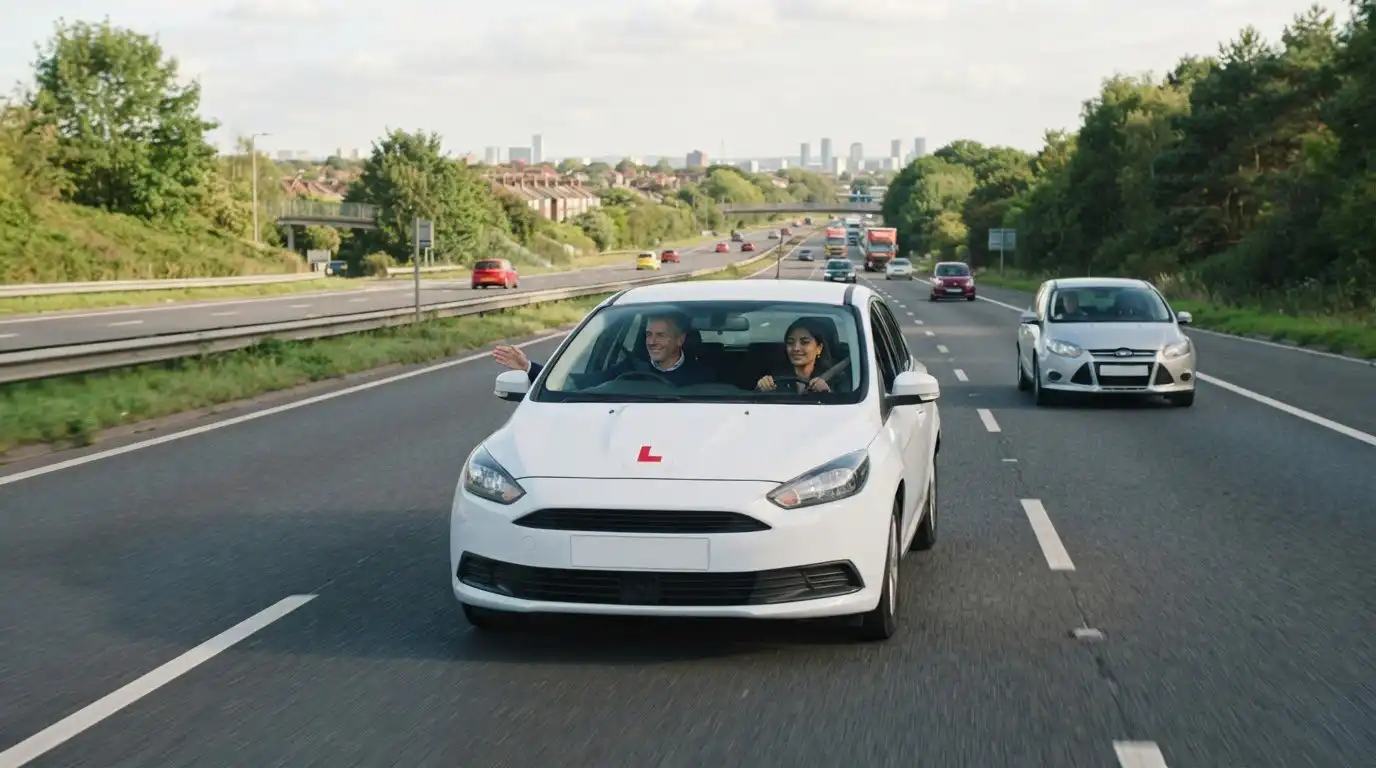
Could a pulsing brake pedal during an emergency stop mean you’ve made a mistake? Not necessarily. If you’re preparing for the anti lock braking system driving test uk questions, remember this: ABS helps you keep steering control during firm braking, but it doesn’t take over your responsibility to respond safely.
It’s understandable to feel unsure about how hard to brake, or to worry that the emergency-stop exercise might catch you off guard. The good news is that knowing what ABS does and what it feels like can make the experience much less daunting.
This guide explains ABS in plain English, what to expect when it activates and how it relates to the emergency stop and the car’s “tell me” question. You’ll also find practical points to work on with your instructor, so you can build confidence before test day. Calm, supervised practice helps you learn how firm braking feels in your car and keep your attention on the road.
Key Takeaways
- For the anti lock braking system driving test uk, learn its limits: ABS doesn’t guarantee a shorter stopping distance or prevent every skid.
- Focus on the driving skills the examiner can observe, including how you respond to instructions and control the car.
- Know what an ABS warning light can indicate and how to answer the related “tell me” question.
- Practise firm braking only with suitable instruction, following your instructor’s directions.
- Build confidence by learning your car’s controls and how the brake pedal feels when ABS activates.
What is an anti-lock braking system, and why does it matter to learners?
An anti-lock braking system, usually called ABS, helps prevent your car’s wheels from locking when you brake hard. A locked wheel can reduce your ability to steer, so preventing lock-up can help you keep control of your direction as you slow down. That’s useful to understand as you prepare for the anti lock braking system driving test uk questions, but ABS is an aid, not a substitute for careful driving.
In simple terms, ABS adjusts the braking when it detects that a wheel is about to stop turning. You don’t need to know the system’s internal components to understand its purpose. For a broader technical overview, see Anti-lock braking system (ABS).
What happens when ABS activates?
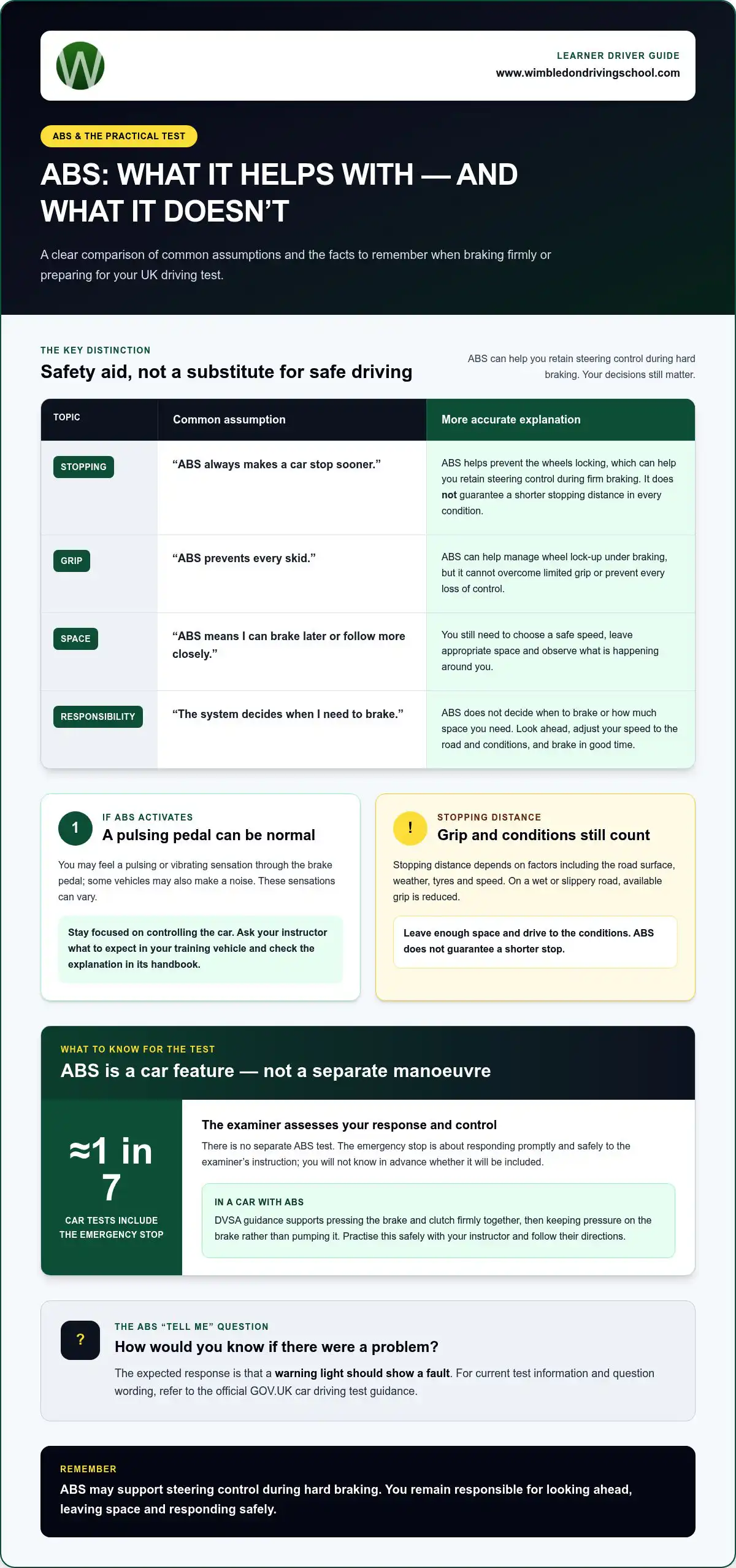
When ABS intervenes, you may feel a pulsing or vibrating sensation through the brake pedal. Some vehicles may also make a noise. These sensations can vary, so familiarise yourself with the explanation in your car’s handbook and ask your instructor to explain what to expect in the vehicle you’re learning in.
If the pedal feels different during firm braking, stay focused on controlling the car and follow your instructor’s directions. Learning what your car feels and sounds like can help you respond calmly rather than being startled by an unfamiliar sensation.
Does ABS change how you should think about braking?
ABS doesn’t decide when you should brake or how much space you need. You’re still responsible for looking ahead, adjusting your speed to the road and conditions, and braking in good time. The system can help you retain steering control during hard braking, but it can’t remove the need to respond safely.
ABS helps prevent wheel lock-up and can support steering control during hard braking, but it doesn’t guarantee a shorter stopping distance or prevent every loss of grip. Stopping distance depends on factors such as the road surface, weather, tyres and speed. Don’t assume the system will stop the car faster in every situation; leave enough space and drive to the conditions.
This is the practical point behind anti lock braking system driving test uk preparation: understand what the technology can assist with, while keeping your attention on your own decisions and control. To explore other learner essentials, read our essential tips for learner drivers.
How does ABS relate to the UK practical driving test?
ABS is a feature of the car, not a separate manoeuvre you’re expected to demonstrate. The examiner assesses how you drive and respond to the road, including whether you brake safely when needed. The test also includes a vehicle-safety question about ABS, but that doesn’t mean you’ll be asked to operate the system as a separate practical skill.
For the anti lock braking system driving test uk question, keep the distinction clear: the technology may support your control during firm braking, but your decisions and actions remain central to safe driving.
Is ABS itself tested during a driving test?
There isn’t a separate ABS test. However, the DVSA’s car-test “tell me” questions include one about how you’d know if there were a problem with the anti-lock braking system. The expected response is that a warning light should show a fault. For current test information and question wording, refer to the official GOV.UK car driving test guidance.
What should you understand about the emergency stop?
The emergency stop is an exercise in responding promptly and safely to the examiner’s instruction. It’s included in approximately one in seven car tests, according to current test guidance. You won’t know in advance whether it will be part of your test, so focus on listening carefully, checking your surroundings and following the instruction without letting nerves distract you.
In a car with ABS, DVSA guidance supports pressing the brake and clutch firmly together and keeping pressure on the brake rather than pumping it. If ABS activates, a pulsing pedal can be normal. Your instructor can help you practise the response safely and understand how it feels in your training car. For manoeuvre-specific preparation, read our guide to the emergency stop during your practical driving test.
Remember, the manoeuvre tests your response and control, not your ability to make ABS do something. Stay alert to what’s around you and follow the examiner’s directions.
ABS myths: does it guarantee a quicker stop or prevent every skid?
ABS is a useful safety aid, but it can’t change the limits of grip or make every braking situation predictable. For the anti lock braking system driving test uk, the key is to understand what the system may help with and what remains your responsibility as the driver.
| Common assumption | More accurate explanation |
|---|---|
| ABS always makes a car stop sooner. | It helps prevent the wheels locking, which can help you retain steering control during firm braking. It doesn’t guarantee a shorter stopping distance in every condition. |
| ABS prevents every skid. | ABS can help manage wheel lock-up under braking, but it can’t overcome limited grip or prevent every loss of control. |
| ABS means you can brake later or follow more closely. | You still need to choose a safe speed, leave appropriate space and observe what’s happening around you. |
Does ABS always stop a car faster?
No. ABS can support steering control during hard braking, but it doesn’t guarantee a shorter stopping distance. How quickly a car stops depends on factors such as speed, the road surface, weather and the condition of the vehicle’s tyres and brakes. On a wet or slippery road, for example, available grip is reduced, so you still need to allow extra room and adjust your driving to the conditions.
Steering control and stopping distance aren’t the same thing. ABS is designed to help prevent the wheels locking so you may retain more ability to steer while braking; it can’t promise that the car will stop within a particular distance. Keep looking well ahead and brake in good time instead of relying on the system to make up for a late response.
Can ABS prevent every loss of control?
No. ABS can’t create grip where there’s very little, correct an unsafe speed or prevent every skid or collision. A driver who brakes suddenly without noticing a hazard early, or follows too closely, can still face a dangerous situation even in a car with ABS.
Build sound judgement through supervised practice. Learn to spot hazards early, choose a speed that suits the road and leave space to respond. Your instructor can help you understand how your car behaves during firm braking, while keeping the focus on safe decisions rather than treating ABS as a guarantee.
How should you practise firm braking safely before your test?
Build confidence through gradual, supervised practice, not by trying emergency braking on your own. Your instructor can help you understand the car’s controls, notice how it responds and practise only when conditions and the setting are suitable. Follow their directions throughout, and don’t experiment with hard braking in traffic.
What can you practise with an instructor?
Start with normal braking. Focus on noticing hazards early, judging the road and traffic around you, and slowing smoothly when appropriate. Once these skills are developing, your instructor can decide whether and how to practise a firmer stop safely. Calm feedback helps you make sense of the pedal feel and the car’s response without rushing.
A simple preparation sequence can help you feel more organised:
- 1. Learn the controls. Get comfortable with the brake and, in a manual car, the clutch. Ask your instructor to explain anything that feels unfamiliar.
- 2. Practise everyday braking. Build a feel for slowing down smoothly while observing ahead and checking what is happening around you.
- 3. Talk through conditions. Notice how visibility, the road surface and nearby traffic affect when and how you should brake.
- 4. Follow your instructor’s lead. Only practise a firmer stop when your instructor considers it appropriate and gives clear directions. Never rehearse an emergency stop in traffic or without supervision.
- 5. Review what you felt. Describe any uncertainty about the pedal or vehicle response, then use your instructor’s feedback to build confidence.
What should you do if the ABS warning light appears?
Don’t try to diagnose the cause yourself. Warning-light meanings and recommended actions can vary between vehicles, so consult the handbook for the car you’re using and follow its guidance before driving. If the light appears during a lesson, tell your instructor and let them guide the next step in line with the handbook.
Preparing for the anti lock braking system driving test uk topic also means feeling ready for the wider test, not just firm braking. For more on the questions you may be asked, see our guide to driving test questions.
Build braking confidence with practical driving lessons
Understanding ABS for the anti lock braking system driving test uk questions is one part of becoming a confident driver. The system may assist you during firm braking, but safe vehicle control still depends on noticing hazards, judging the road and responding appropriately. Practising these skills with an instructor can help make braking feel more familiar before test day.
How an instructor can help you feel more prepared
If firm braking makes you nervous, tell your instructor. They can adapt practice to your experience, starting with everyday braking and building towards a firmer stop only when it’s suitable and safe. You can ask questions about pedal feel, the car’s response and what to do if ABS activates. Clear feedback helps replace uncertainty with a better understanding of your own actions.
Lessons can also bring braking into its wider context. You’ll practise observing ahead, anticipating hazards and adjusting to traffic and road conditions, rather than treating a sudden stop as an isolated technique. Wimbledon Driving School provides learner-focused tuition across South West London, South East London, Surrey and Middlesex. If test nerves are part of the picture, our tips for relaxing during your driving test offer further ideas for feeling calmer and more prepared.
Take your next step towards test confidence
ABS can assist you, but it can’t replace good judgement, observation or appropriate braking. With steady, supervised practice, you can learn how your car responds and build confidence in your own decisions, one skill at a time.
Take your braking confidence into your next lesson
ABS helps prevent the wheels locking during hard braking, but it can’t make every stop shorter or prevent every loss of control. The key lesson for the anti lock braking system driving test uk is to understand what the system can assist with while continuing to observe carefully, judge conditions and brake appropriately.
Practise firm braking only with suitable instruction. Start with confident everyday vehicle control, learn how your car responds and follow your instructor’s guidance if you work towards an emergency stop. Small steps can help make an unfamiliar sensation feel more manageable.
Wimbledon Driving School has supported learners since 2006, with practical tuition across South West London, South East London, Surrey and Middlesex. Keep building your skills at a steady pace. With preparation and clear feedback, you can approach test day feeling more assured.
Frequently Asked Questions
What does ABS do in a car?
ABS helps prevent the wheels locking when you brake hard. This can help you retain steering control while slowing down, but it doesn’t take over your decisions or guarantee a shorter stopping distance. You still need to look ahead, choose a safe speed and brake appropriately for the road and weather. If the system activates, you may feel a pulsing sensation through the brake pedal.
Is ABS tested during the UK driving test?
ABS isn’t a separate driving skill that you’re asked to demonstrate. However, the DVSA car test includes a “tell me” question about how you’d know if there were a problem with the anti-lock braking system. The expected answer is that a warning light should show a fault. The emergency stop may also be included, but it isn’t part of every test.
How should I brake in a car with ABS during an emergency stop?
Follow the examiner’s instruction and, in a car with ABS, press the brake and clutch firmly together. Keep firm pressure on the brake rather than pumping it, and stay aware of your surroundings. The pedal may pulse or vibrate as ABS activates. Practise the response with your instructor first, so you know how your training car feels and can focus on carrying out the instruction calmly.
Can ABS make a car stop faster?
ABS doesn’t guarantee a shorter stopping distance in every condition. Its main purpose is to help prevent the wheels locking, which can help you retain steering control during firm braking. How quickly your car stops depends on factors including speed, road surface, weather and the vehicle’s condition. Leave enough space, adjust your speed to the conditions and don’t rely on ABS to compensate for late braking.
Should I pump the brake pedal if my car has ABS?
No. If ABS activates during firm braking, maintain pressure on the brake pedal rather than pumping it. The system manages wheel braking to help prevent the wheels locking. A pulsing sensation or noise may occur, depending on the vehicle. Learn what to expect from your instructor and check the car’s handbook for vehicle-specific guidance. In an emergency, keep your attention on the road and your surroundings.
What should I do if the ABS warning light stays on?
Check your vehicle handbook and follow its instructions; don’t try to diagnose the fault yourself. A warning light that remains on after the engine starts can indicate an ABS problem. The DVSA says a test will not go ahead if a safety-related warning light, including the ABS light, stays on. If you’re preparing for your test, make sure the car’s warning lights behave as described in its handbook.
Can I practise an emergency stop on my own before the driving test?
No. Don’t attempt an emergency stop on your own or experiment with hard braking in traffic. Practise only under suitable instruction, when your instructor considers it safe, and follow their directions. Wimbledon Driving School provides learner-focused manual and automatic lessons across South West London, South East London, Surrey and Middlesex. This supervised practice can help you understand your car’s response and feel more prepared for the test.
Disclaimer
This article is provided for general informational purposes only and does not constitute professional driving, legal, or safety advice. While we aim to keep our content accurate and up to date, rules, prices, and DVSA test requirements can change — always check gov.uk or contact us directly at 020 3524 7968 for the latest guidance before making any decisions. Nothing in this article guarantees a specific outcome, including passing your driving test within any stated timeframe. For current pricing, course availability, and instructor details, please visit our Prices page or get in touch.