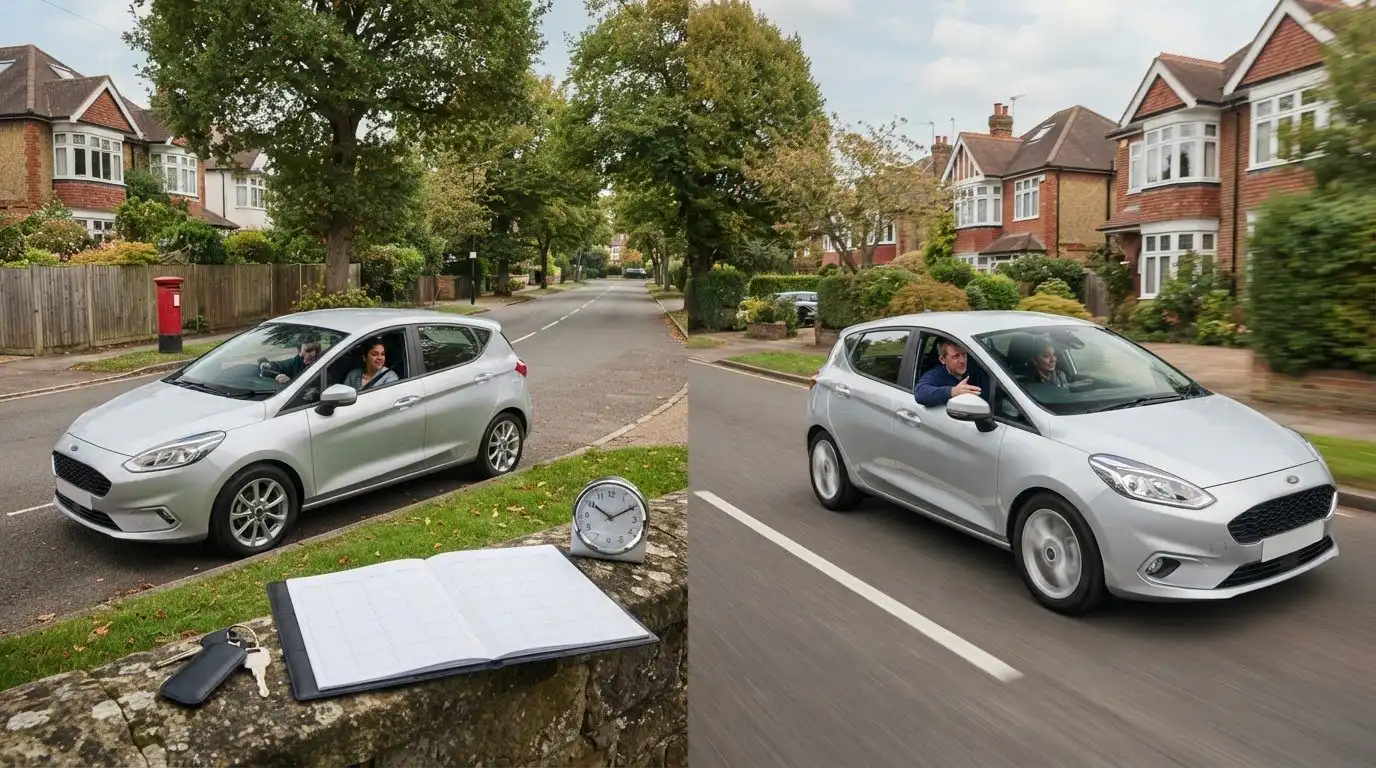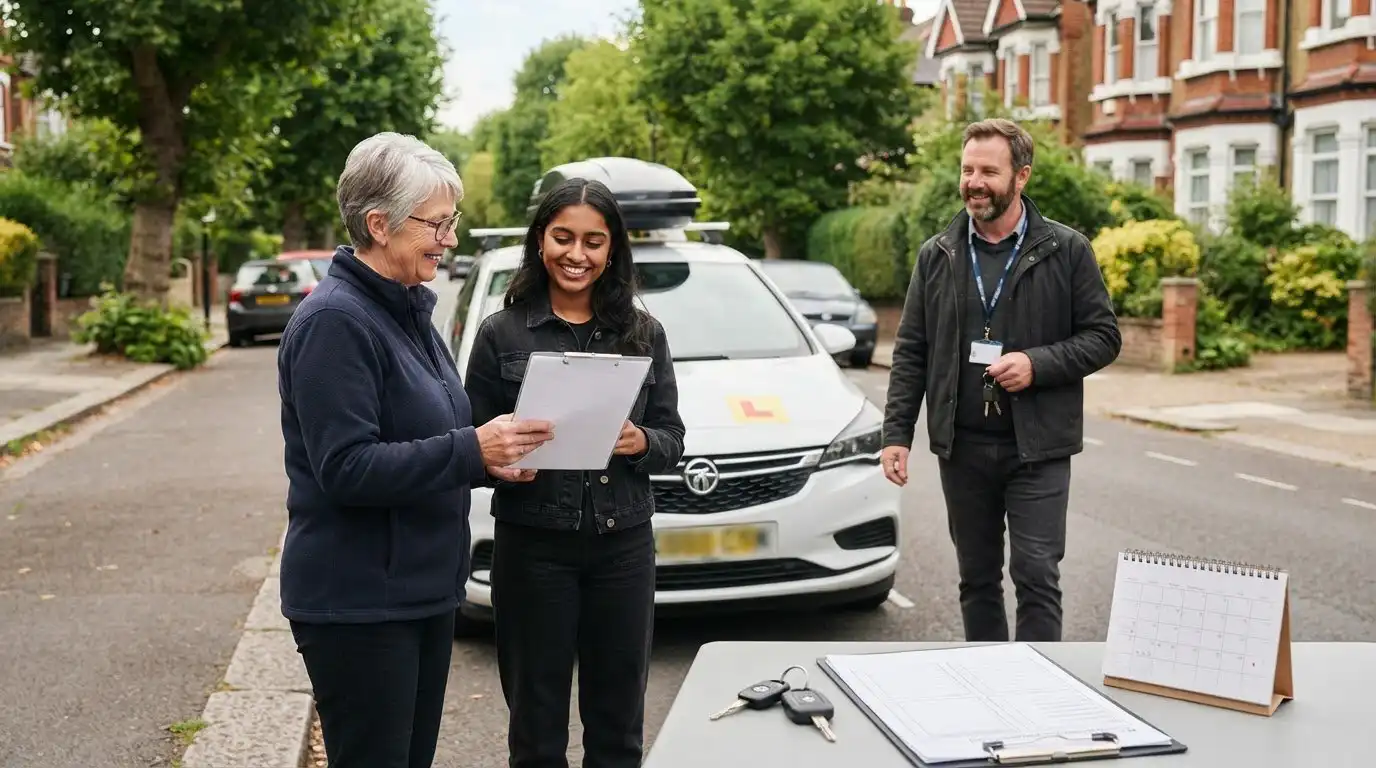
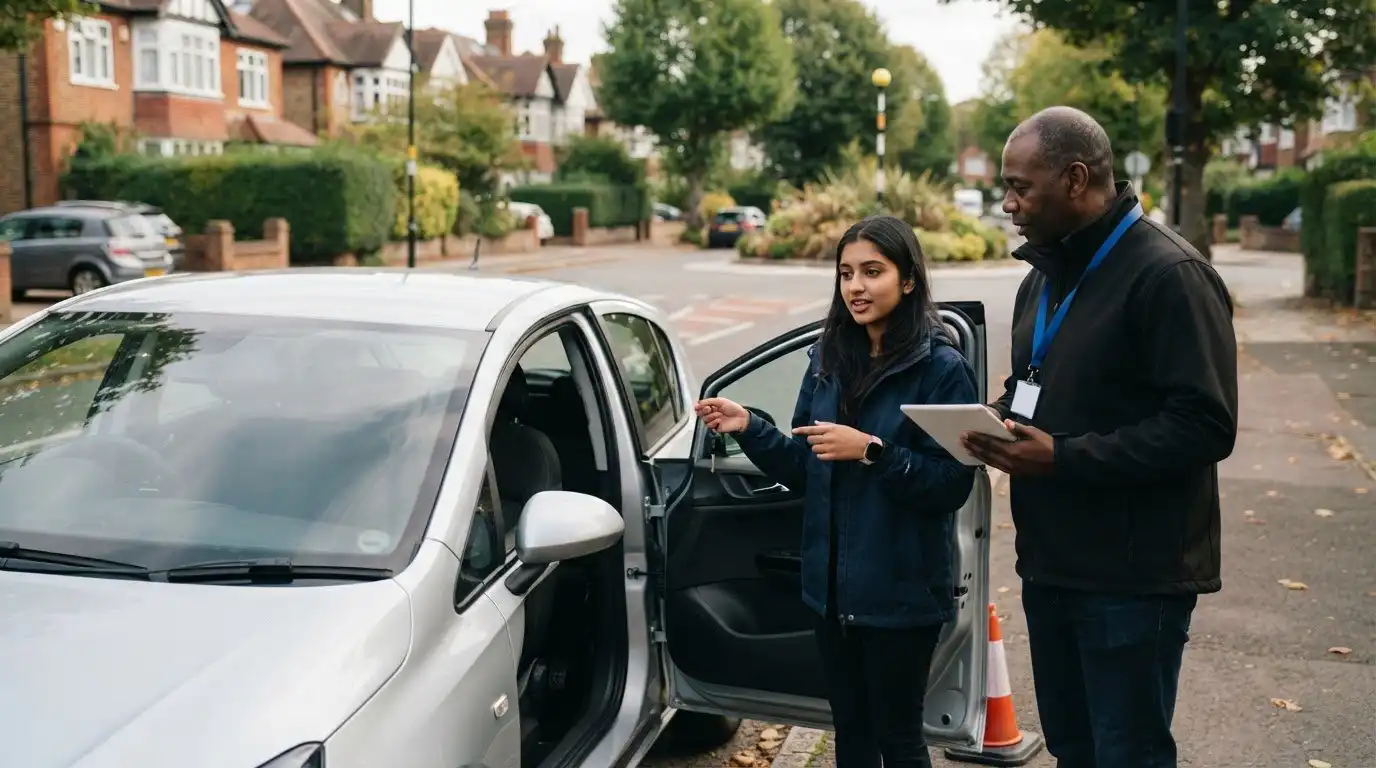
Safe, consistent driving matters more than memorising a route. What to practise before your driving test includes vehicle safety checks, mirror and blind-spot observations, manoeuvres, junctions, roundabouts and independent driving. For the windscreen-demisting show-me task, practise finding the controls and directing airflow at the front windscreen while keeping your attention on the road.
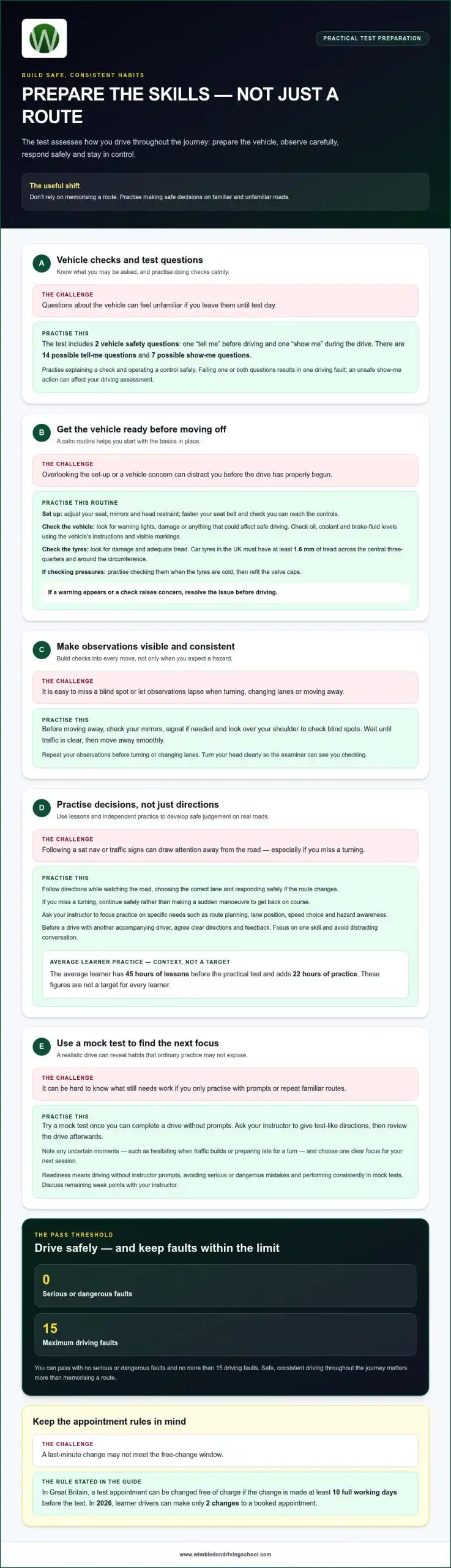
It’s natural to focus on manoeuvres or worry about making a mistake. But the test assesses how you drive throughout the journey, including whether you spot hazards and respond safely. You can pass with no serious or dangerous faults and no more than 15 driving faults.
This guide covers the checks, skills and road situations to practise, as well as the test rules to understand. It also explains how a mock test can reveal what needs more work, helping you prepare with focused practice and build confidence.
Key Takeaways
- Practise the eyesight check and vehicle safety questions so you can answer calmly on test day.
- Build consistent observation habits before moving off, changing direction or responding to hazards.
- Rehearse reversing and parking manoeuvres until you can complete them safely and under control.
- Give junctions, roundabouts and pedestrian crossings focused practice, where effective observations matter.
- Learn how driving faults differ from serious or dangerous faults, and use mock tests to spot skills that need more work.
1. Legal responsibilities and vehicle safety checks
Before test day, practise the checks that show you can prepare a vehicle and move off safely. The Driver and Vehicle Standards Agency (DVSA) requires you to read a number plate from 20 metres away during the UK practical driving test eyesight check.
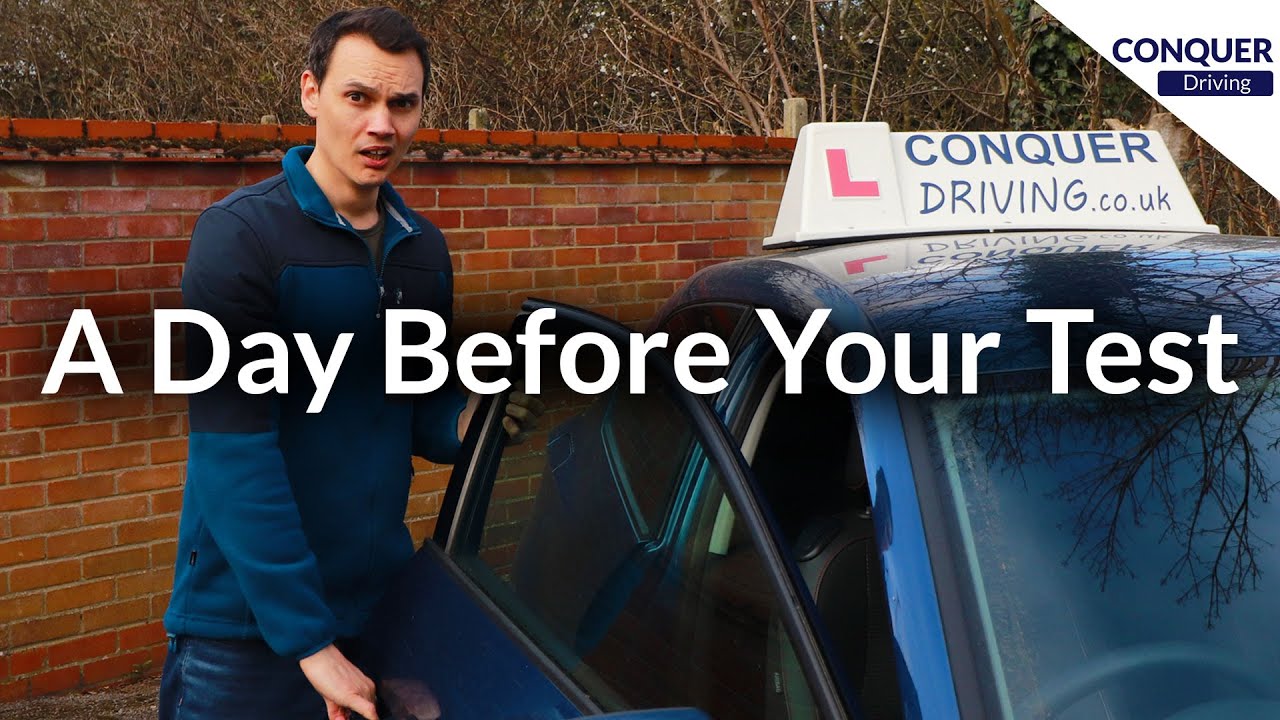
To see how to prepare on the day before your test, watch this video:
The test includes 2 vehicle safety questions: a “tell me” question before driving and a “show me” question during the drive. There are 14 possible tell-me questions and 7 possible show-me questions, so practise explaining a check and operating a control safely.
For example, a tell-me question may ask how you’d check the brakes before a journey. A show-me question may ask you to operate a control, such as the windscreen wipers, while driving. Failing one or both questions results in one driving fault, but an unsafe action during a show-me task can affect your driving assessment.
Before setting off, make sure the vehicle is ready and adjust your seat, mirrors and head restraint. Check the engine oil, coolant and brake-fluid levels using the vehicle’s instructions and visible markings. Look for warning lights, damage or anything else that could affect safe driving.
Check the tyres for damage and adequate tread. In the UK, car tyres must have at least 1.6mm of tread across the central three-quarters and around the circumference. Practise checking tyre pressures when the tyres are cold, then refit the valve caps.
Settle into the driver’s seat, fasten your seat belt and check that you can reach the controls. Adjust the head restraint so its rigid part is at least as high as your eyes or the top of your ears, and as close to the back of your head as is comfortable.
When moving away from a parked position, check your mirrors, signal if needed and look over your shoulder to check blind spots. Wait until traffic is clear, then move away smoothly. Repeat your observations before turning or changing lanes, and turn your head clearly so the examiner can see you checking.
Readiness includes knowing the appointment rules as well as handling the vehicle. According to the Driver and Vehicle Standards Agency (DVSA), a driving test appointment in Great Britain can be changed free of charge if the change is made at least 10 full working days before the test. In 2026, learner drivers in Great Britain can make only 2 changes to a booked appointment.
Practise these steps in the vehicle you’ll use, including a final check before setting off for the test centre. If a warning appears or a check raises concern, don’t ignore it. Resolve the issue before driving.
2. Practising safely with an instructor or other drivers
Use lessons to bring individual skills together into safe decisions on real roads. Ask your instructor to practise route planning, lane positioning, speed choice and hazard awareness. On a familiar road, explain what you’ve noticed and what you plan to do next. This helps your instructor see whether you can make safe decisions independently, without prompts.
Independent driving involves following a sat nav or traffic signs. Practise following directions while watching the road, choosing the correct lane and responding safely if the route changes. If you miss a turning, continue safely instead of making a sudden manoeuvre to get back on course. Prioritising safety over following directions perfectly is the right response.
Build up your practice with an instructor before driving with another accompanying driver. Choose routes that focus on one skill, such as emerging at junctions or meeting traffic on a narrow road. Agree on clear directions and feedback beforehand, and avoid distracting conversation. Before each drive, decide what to practise before your driving test, then focus on one specific skill.
The average learner has 45 hours of lessons before the practical test and adds 22 hours of practice. These figures aren’t a target for every learner. Use each session for a specific need, such as anticipating pedestrians, judging gaps in traffic or maintaining a safe following distance. Your instructor’s feedback can help you choose the next focus and adapt practice as your skills develop.
Try a mock test once you can complete a drive without prompts. Ask your instructor to give directions similar to those on test, then discuss the drive afterwards. A mock can reveal habits that ordinary lessons may not expose, such as hesitating when traffic builds or preparing too late for a turn. Note the feedback and choose a clear focus for your next session.
After each lesson, identify one decision you handled well, one uncertain moment and one skill to work on. If you needed prompting at a roundabout, revisit lane choice, approach speed and observation. This gives your next session a practical purpose and helps you decide what to practise before your driving test without trying to tackle everything at once.
A learner is usually ready when they can drive without instructor prompts, avoid serious or dangerous mistakes and perform consistently in mock tests. Your instructor’s view can help you assess readiness. Discuss any remaining weak points and use focused practice to strengthen them. The aim is to make safe decisions reliably, even when a route or traffic situation feels unfamiliar.
3. General driving and reversing manoeuvres
Practise manoeuvres at low speed, with clear observations and steady control. On the Great Britain practical test, you’ll be asked to pull up and move away safely, then complete a reversing manoeuvre chosen by the examiner.
The examiner can choose parallel parking, parking in a bay, or pulling up on the right and reversing before rejoining traffic. For the right-side option, you’ll reverse for around two car lengths before moving back into traffic. The choice can vary, so practise every manoeuvre rather than relying on a favourite.
For parallel parking, begin beside the parked vehicle and choose a position that gives you room to turn. Reverse slowly, checking around the car as it moves. Make small steering adjustments, pause to reassess if needed, and finish close and parallel to the kerb without touching it or another vehicle.
For a bay park, practise driving into and reversing into a space. Look for pedestrians and other vehicles before turning, then keep checking your position as you enter the bay. Finish centred within the lines. If you need to correct your position, make controlled adjustments instead of rushing the final movement.
Pulling up on the right tests more than your reversing. Check the road and traffic before choosing a safe place, stop without obstructing other road users, then observe carefully before moving away. Practise rejoining traffic from different positions, including where parked vehicles limit your view. Wait until you can see that it’s safe to proceed.
A controlled stop is included in one in every three UK car driving tests. In a safe, supervised setting, practise responding promptly to your instructor’s direction, then regain control before moving off when instructed. Focus on a controlled response and clear awareness of your surroundings.
The manoeuvre details here apply to the Great Britain practical test. Use them to prepare for your own test, and practise each option rather than assuming the examiner will choose a particular one.
Repeat each manoeuvre in different surroundings, such as a quiet car park and a road with parked cars. Before reversing, check around the vehicle, move slowly and keep observing throughout. Stop if a pedestrian or vehicle enters your path. These habits help you adapt when the space or direction is unfamiliar.
Practise each parking option with an instructor and ask for feedback on positioning, control and observations. This parking manoeuvre guide can help you identify details to work on between lessons.
4. Junctions, roundabouts and pedestrian crossings
At junctions, practise building a clear picture before you commit. Ease off early, check signs and road markings, then scan both directions for vehicles, cyclists and pedestrians. Look again if a vehicle or hedge blocks your view. Inadequate observations can lead to test faults, so make your checks before emerging.
At a give-way line, choose a position that lets you see without entering the path of traffic. If your view is restricted, move forward carefully only when it’s safe, then reassess. Wait for a suitable gap rather than automatically following the vehicle ahead. Practise left and right turns, looking for people crossing the road you’re entering.
Roundabouts require early planning. Read the signs and lane markings on approach, choose the appropriate lane and adjust your speed to the traffic. Check for vehicles already on the roundabout and cyclists near your intended exit. Keep scanning as you travel around, signal when appropriate and avoid sudden lane changes.
At pedestrian crossings, scan the pavements and road edges as you approach. Look for people waiting, stepping towards the crossing or already crossing. Slow down when needed and be ready to stop safely. With your instructor, practise identifying crossing types and their markings, then position the vehicle so you don’t obstruct people using the crossing.
Check beyond the crossing before moving away. A pedestrian may still be crossing, or a cyclist may approach from behind another vehicle. Keep your attention on the full scene instead of watching only the person closest to your car. At junctions near crossings, don’t let a gap in traffic rush your decision.
Safe spacing supports sound judgement. Leave a two-second gap behind the vehicle ahead in good conditions and increase it to four seconds when it’s wet. This gives you more time to respond if traffic slows near a roundabout, crossing or junction. Practise counting the gap while maintaining a steady speed and adjusting for hazards.
Choose practice routes with varied layouts, from quiet side roads to busier junctions and roundabouts. A route with parked vehicles, cyclists and crossings can help you rehearse observation and positioning together. You can explore roads to practise before a driving test and ask your instructor to explain what each junction demands.
After each drive, choose one specific moment to review, such as waiting for a clearer view before emerging or selecting a lane earlier at a roundabout. Then practise that situation with your instructor. Consistent observations, safe positioning and patient decisions help you respond to changing traffic without rushing.
5. Driving test fault categories and pass thresholds
You can pass the UK practical driving test with no serious or dangerous faults and no more than 15 driving faults. A driving fault is not automatically a failure, but the examiner considers its impact and whether similar errors recur during the drive.
A serious fault or a dangerous fault means you haven’t met the pass standard. The distinction depends on the effect of the action in its circumstances: a dangerous fault involves actual danger, while a serious fault is a significant error that could create danger. Either can result in a failed test, even if the rest of your drive is strong.
Common reasons for failing include ineffective observations at junctions and actions that put other road users at risk. For example, moving into a junction without checking properly can leave you unaware of approaching traffic. Practise gathering enough information before deciding to proceed.
Faults are assessed in context, not as a simple tally of every imperfect movement. A small steering correction may remain a driving fault if it causes no risk. The same control issue could be more serious if it sends the vehicle towards another road user or prevents you from responding safely.
Patterns matter. If the same lapse happens repeatedly, it may show that a skill isn’t dependable yet. Use feedback from a lesson or mock test to identify the trigger. Was the problem caused by rushing, uncertainty about a direction or focusing on one part of the road? Understanding the cause helps you practise a safer response.
The vehicle safety questions count too: failing one or both show-me or tell-me questions results in one driving fault. However, an unsafe action while answering the show-me question can lead to a major fault and automatic failure. Keep control of the vehicle and operate a control only when it’s safe.
Review feedback after every practice drive. Record the situation, the decision you made and what you’ll do differently next time. For instance, if you misread a road marking, practise noticing signs and markings earlier, before positioning the vehicle. This turns an error into a specific skill to improve.
During the test, don’t let one minor mistake dominate your attention. Regain focus and continue making safe decisions. The pass threshold allows some driving faults, but you still need to respond responsibly throughout the test. Aim for consistent judgement, not a perfect drive.
Wimbledon Driving School: Manual Driving Lessons
Wimbledon Driving School offers Manual Driving Lessons to help you build control, practise road skills and prepare for your practical test. If you’re still developing confidence with clutch control, junctions or manoeuvres, lessons can focus on the areas that need attention.
You can also choose Automatic Driving Lessons or an Intensive Driving Course to suit your learning needs. Pass Plus Courses offer further driving development after you pass. The right next step depends on your experience, the skills you want to strengthen and how you prefer to learn.
Use the points in this guide to identify where you need more practice, then work through them with structured instruction. Contact Wimbledon Driving School to discuss your driving lessons and next steps.
Turn your preparation into a clear next step
Knowing what to practise before your driving test gives you a starting point. Turn that knowledge into a simple plan: choose one skill that still takes effort, practise it with focused feedback, then review what feels more consistent. This keeps preparation purposeful instead of trying to perfect everything at once.
Pay attention to how you make decisions, not just whether you complete a task. If you’re unsure about a manoeuvre, a road situation or your readiness, talk it through with your instructor and agree on what to work on next. Steady progress comes from understanding each correction and applying it on your next drive.
Your test is a milestone, and focused practice can help you approach it with greater control. Keep building your skills one drive at a time.
Keep practising with purpose. You’re moving towards a more confident drive.
Frequently Asked Questions
Can you show me how you would demist the front windscreen?
Use the windscreen-demisting controls to direct airflow onto the front glass. Adjust the fan and temperature as needed, following the controls in the car you’re learning in. Practise finding the right setting while parked, so you can operate it confidently if asked during the test. Keep your attention on the road and make sure you can see clearly before continuing.
Can you show me how you would operate the horn?
Locate the horn control on the steering wheel and press it briefly when it’s safe to demonstrate. Its precise position can vary between vehicles, so practise in your lesson car. During a show-me request, stay aware of the road and operate the horn without letting the action distract you from steering or responding to traffic.
Can you show me how you would switch on your dipped headlights?
Use the vehicle’s lighting control to select dipped headlights, not main beam or sidelights. The control design varies, so learn where it is in your lesson car and check the dashboard display if you’re unsure which setting is active. Practise identifying it while parked, then operating it safely when asked during a drive.
How would you check that the brakes are working before starting a journey?
Before setting off, press the brake pedal and check that it doesn’t feel unusually soft or slack. Once moving, test the brakes gently at low speed when the road is clear. Notice whether the vehicle slows smoothly and stays steady. If the pedal or braking response feels abnormal, stop safely and have the issue assessed before continuing.
How would you check that the headlights and taillights are working?
Switch on the relevant lights, then check them from outside the vehicle. Ask someone to confirm the front and rear lights are illuminated, or use reflections in a suitable surface if you’re practising alone. Check each setting separately, as dipped headlights and other lighting controls may activate different lamps. Repeat the check if you’re unsure what’s on.
How would you check the direction indicators are working?
Switch on the left indicator and check that it flashes at the front and rear, then repeat on the right. A helper can confirm the lamps are working while you operate the control. You can also check the dashboard indicator, but it doesn’t confirm that every external lamp is functioning. Practise this check while parked, away from moving traffic.
What manoeuvres are tested in the UK driving test?
The test includes pulling up at the side of the road and moving away safely. The examiner also chooses a reversing task: parallel parking, parking in a bay, or pulling up on the right and reversing before rejoining traffic. Practise each option in different spaces so you can adapt your observations and control, rather than relying on one familiar location.
How should I practise mirror checks, signalling and observations?
Link each mirror check to a change in speed, direction or position. For example, before passing a parked vehicle, check behind and alongside, signal if needed, then look again before moving out. Reassess if a cyclist appears or traffic changes. Use a lesson to develop a natural routine, not a memorised sequence that ignores what’s happening around you.
Disclaimer
This article is provided for general informational purposes only and does not constitute professional driving, legal, or safety advice. While we aim to keep our content accurate and up to date, rules, prices, and DVSA test requirements can change — always check gov.uk or contact us directly at 020 3524 7968 for the latest guidance before making any decisions. Nothing in this article guarantees a specific outcome, including passing your driving test within any stated timeframe. For current pricing, course availability, and instructor details, please visit our Prices page or get in touch.