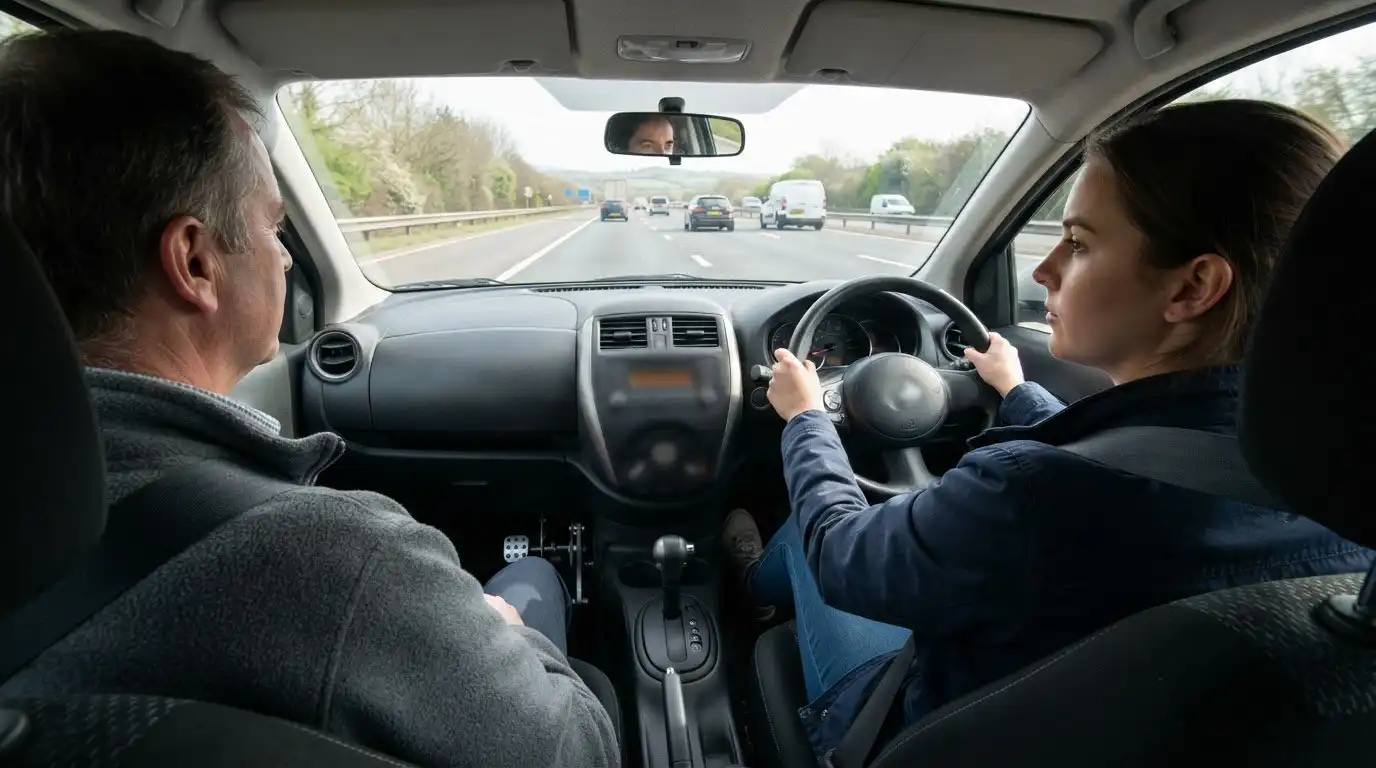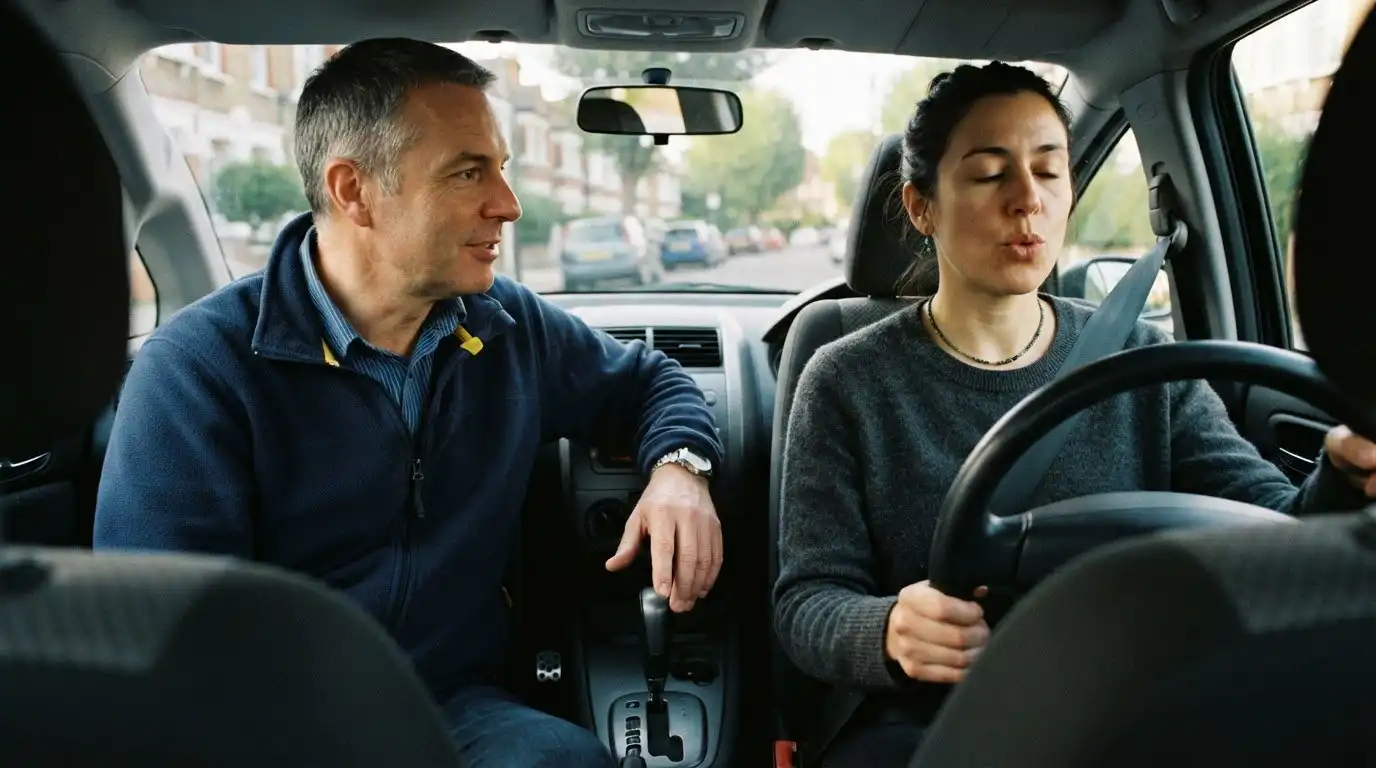
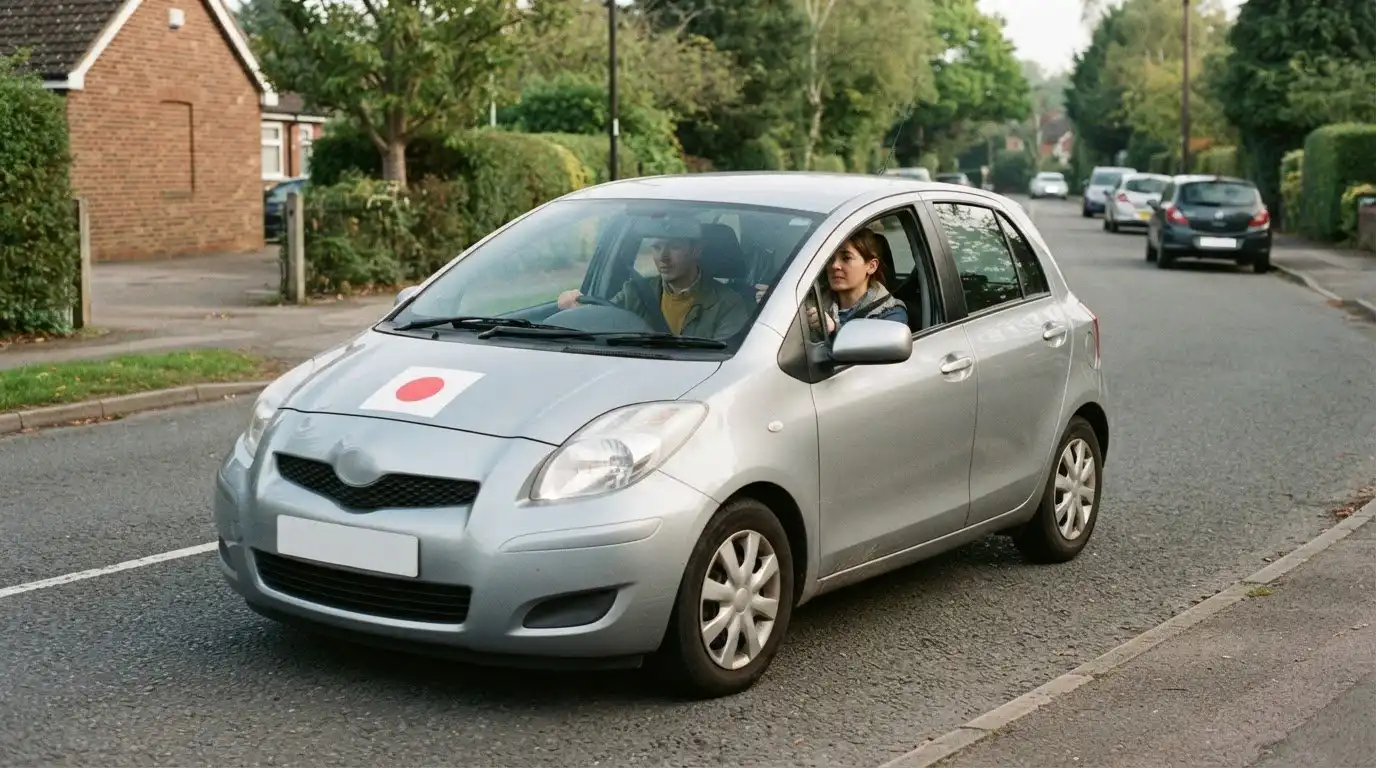
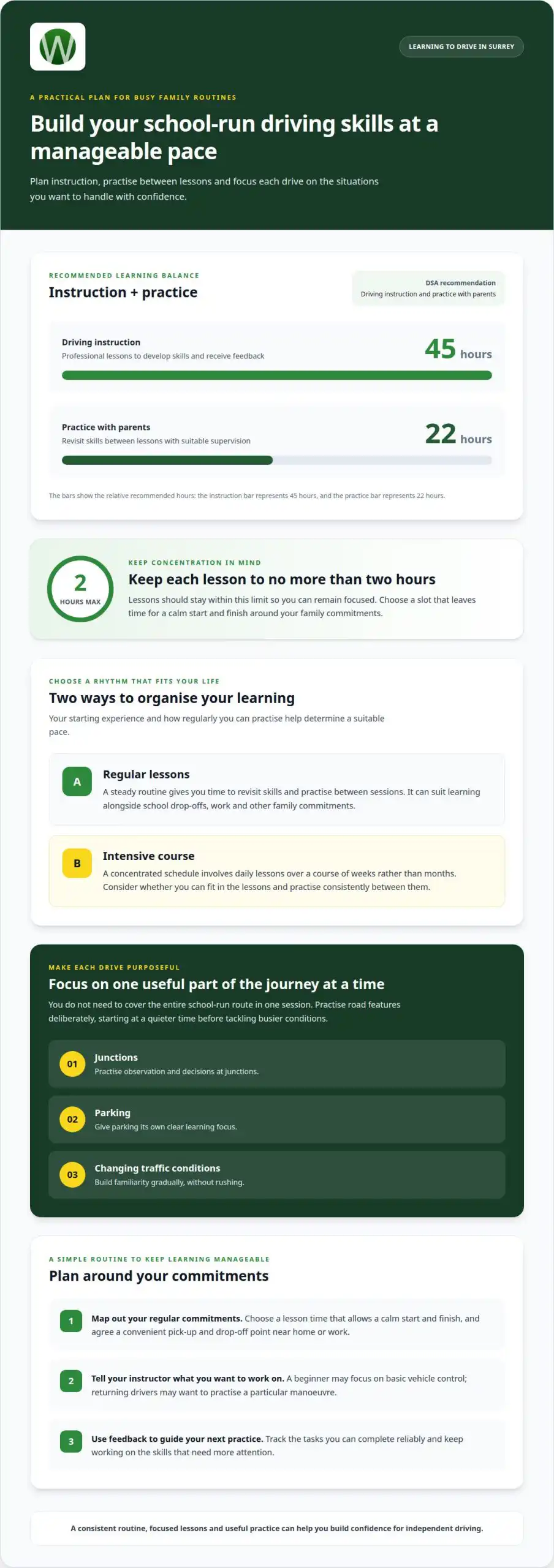
Learning to drive for the school run in Surrey takes a mix of professional lessons and practice between them. The DSA recommends 45 hours of driving instruction and 22 hours of practice with parents; lessons should be kept to no more than two hours so you can stay focused. The right pace depends on your experience and how regularly you can practise.
It’s understandable to want learning to drive for the school run in Surrey to fit around school drop-offs, work and family commitments. You can build your skills gradually with regular lessons, or choose an intensive course if you’re ready for a more concentrated schedule.
This guide explains how to plan lesson times around the school run, choose a course pace that suits your experience and make practice useful. You’ll also find out what to look for in a local instructor, so you can work towards confident, independent driving at a manageable pace.
Key Takeaways
- Fit lesson times around school and family commitments by planning a routine you can keep consistently.
- Choose a course pace that reflects your current experience and how often you can practise between lessons.
- Use local lessons to build familiarity with the roads and driving conditions you may encounter around Surrey.
- Plan practice alongside instruction, and use each session to work on specific skills rather than simply adding time behind the wheel.
- Compare beginner lesson options by how well they suit your goals, preferred transmission and learning pace.
Flexible lesson scheduling
Plan lessons around your family commitments and the driving situations you want to practise. A regular slot can help you build skills without rushing between drop-off and pick-up.
Lesson Times and Pick-up Locations
Map out your regular commitments first, then choose a lesson time that allows for a calm start and finish. Agree on a convenient pick-up and drop-off point, such as near home or work, so the lesson fits your day. You can use a school-run route purposefully by practising its road features at a quieter time before tackling busier conditions.
For learning to drive for the school run in Surrey, focus on the parts of the journey where you need practice instead of trying to cover the whole route in one session. Junctions, parking and changing traffic conditions each offer a clear learning focus.
Lessons Tailored to Individual Needs
A tailored lesson takes your experience, confidence and priorities into account. A beginner may need to develop basic vehicle control, while someone returning after a break may want to practise a specific manoeuvre. Tell your instructor which situations you find challenging so you can focus on the skills you want to strengthen.
Refresher Lessons can help you regain familiarity after time away from driving. A Motorway Driving lesson covers a different road environment and suits drivers who want experience beyond local journeys.
Can learner drivers take children on the school run? A learner can carry a child when accompanied by a supervising driver and following the relevant passenger and child-restraint rules. Plan the journey with your supervisor rather than making a school drop-off your first practice drive.
What are the rules for using a car seat or child restraint in the UK? GOV.UK says children must normally use a child car seat until they are 12 years old or 135cm tall, whichever comes first. After that, they must use an adult seat belt; choose and fit the restraint according to the child’s size and the manufacturer’s instructions.
How can you practise school-run routes safely as a learner? Plan the route with your supervising driver and start at a quieter time. Agree where you can pause or turn around safely, then focus on anticipating hazards and making decisions without rushing.
Are automatic driving lessons and tests available in Surrey? Yes. You can learn and take your practical test in an automatic car, allowing you to focus on observation, road position and traffic decisions without changing gears manually.
If a booked test clashes with family plans, the Driver and Vehicle Standards Agency says learners must move or cancel it at least 10 working days before the test date to avoid losing the fee. Add the deadline to your calendar when you book.
Course lengths and learner experience requirements
Choose a course length based on your experience, practice routine and progress with core skills. Aim for a pace that supports consistent learning instead of planning around a preferred test date alone.
Course Lengths and Lesson Requirements
New students need time to develop vehicle control, observation and sound decisions in traffic. Someone returning after a break may have existing skills but still benefit from focused practice. Intensive courses involve daily lessons over a course of weeks rather than months. Lessons should not last more than two hours, because concentration can start to waver.
Consider how often you can attend and practise between sessions. Regular lessons give you time to revisit skills, while a concentrated schedule keeps learning close together. Either way, lesson content can respond to your progress. The factors that affect how many lessons you may need include your starting experience and the consistency of your practice.
Lessons Needed to Pass
There’s no fixed number of lessons that suits every learner. The DSA recommends 45 hours of driving instruction and 22 hours of practice with parents. Your progress depends on how consistently you practise and how confidently you apply skills in different traffic conditions.
Track which tasks you can complete reliably, such as responding to junctions or managing traffic. Use lesson feedback to identify skills that still need work before your test. Passing the theory test is a separate milestone; continue practical training until you can apply your knowledge on the road.
What are the rules for learning to drive with a qualified supervising driver? Follow the current learner-driver supervision rules, including requirements for the supervisor and the vehicle’s insurance. GOV.UK explains the eligibility criteria, so check its current learner-driver guidance before arranging supervised practice.
What are the costs of a first car, learner insurance and road tax in Surrey? The total depends on the car you choose, its insurance details and the tax that applies to it. Plan for both the purchase price and ongoing running costs.
How many driving lessons does it typically take to pass in the UK? The DSA recommends 45 hours of instruction alongside 22 hours of practice with parents. Your own needs depend on your previous experience, the consistency of practice and your ability to drive safely across different situations.
What are the steps to get a UK provisional driving licence? Apply through GOV.UK and follow its current application process. Once you have your provisional licence, arrange lessons and build practical experience before taking your test.
Local instructors and test-centre knowledge
A local instructor can help you practise the road situations you’ll encounter around Surrey. Useful local knowledge goes beyond knowing a test route: it includes explaining junctions, traffic patterns and observation points clearly.
Ask how lessons can build your familiarity with the area. For example, practice might progress from quieter residential roads to busier junctions and more complex roundabouts. This helps you prepare for everyday driving rather than simply memorising a route. A good instructor also gives you feedback you can apply on different roads and in changing conditions.
Test-centre figures need context. The average pass rate at Redhouse Road test centre in Mitcham was 42% between April and September 2019. At Unit 4 The Forum, Hanworth Lane, Chertsey, the average was 50% for the same period. These historical figures describe recorded results then; they don’t predict an individual learner’s outcome today.
The average pass rate at 10 Tudor Drive in Morden was 47% between April and September 2019. Treat all three figures as background, not as a reason to choose a test centre solely by percentage. Your preparation, decision-making and ability to drive safely matter more than a historic centre average.
Use local practice to strengthen skills you can apply on any road. Ask your instructor what makes a road challenging, then practise the relevant decisions in different settings. A narrow residential street, for example, tests speed control and awareness, while a busy roundabout calls for careful observation and timely positioning.
Before choosing a driving school, look for clear communication and lessons that respond to your progress. A useful instructor explains what went well, identifies a specific area to improve and sets a practical focus for your next drive. You should be able to discuss the routes and situations that matter to your daily journeys.
- Discuss your goals: explain which Surrey roads or driving situations you want to handle confidently.
- Ask about lesson feedback: find out how progress and areas for improvement are reviewed.
- Practise beyond test routes: build judgement across varied roads, not just familiar centre approaches.
Local knowledge is most useful when it helps you drive independently. An instructor who explains hazards and choices can help you apply the same thinking on unfamiliar roads. This matters on a school run, where parked vehicles, turning traffic and changing conditions can make every journey different.
Local preparation also means understanding booking limits that can affect where and when you take a test. From 9 June 2026, driving test location changes are limited to the three nearest test centres to the original booking. From 12 May 2026, only the learner driver can book, change, swap or cancel a car driving test in the United Kingdom. The waiting time to rebook a driving test after failing is increasing from 10 working days to 28 working days, and the independent driving portion of the test is increasing to 20 minutes.
The driving test changed on 4 December 2017 to include following sat-nav directions and increase the free-driving phase to 20 minutes. Practising navigation and independent decisions can therefore complement local route knowledge. School-run journeys also depend on more than individual driving skills: a report argues that lasting changes to school-run travel require schools, local authorities, planners and families to work together.
Recommended practice hours
Regular practice helps you turn tuition into habits you can use independently. The recommendation discussed earlier can provide a planning benchmark, but the quality and range of practice matter too. For the school run, practise everyday decisions such as checking for pedestrians, choosing a safe road position and responding to parked cars.
Agree on a focus with your supervising driver before each drive. One session could cover junctions on a familiar route; another could involve practising parking in a suitable, quiet area. Keep the focus manageable, then review what felt difficult and tell your instructor at your next lesson.
Practise when you can concentrate, rather than treating every available journey as useful training. A rushed school trip can bring pressure and distractions. Rehearse the route at a quieter time first with a qualified supervisor, then build familiarity with busier conditions as your skills develop.
Theory study supports practical learning. Link a Highway Code topic to a real example: after reviewing pedestrian crossings, notice where parked vehicles affect visibility. This connects theory with observation and planning instead of keeping revision separate from your driving experience.
- Set one clear aim for each practice drive, such as smoother approaches to junctions.
- Choose a route that matches that aim and suits your current confidence.
- Afterwards, note one skill that went well and one to revisit during tuition.
- Tell your instructor about any situation that felt difficult or unexpected.
Pass rates offer only a limited measure of readiness because they don’t show your individual strengths or gaps. Use feedback from lessons and practice instead. If you can repeat a skill reliably on different roads, that gives you a more useful picture than a test centre’s historical result alone.
Discounts on lesson packages may look attractive, but a large block of tuition only helps if the schedule suits your learning pace. Consider whether you can attend consistently and leave time to practise between lessons. A steady routine can make feedback easier to apply than scattered sessions.
Keep school-run practice varied without making every drive complicated. Once a route feels familiar, practise a different approach or destination with your supervisor. This builds flexibility for roadworks, changes in traffic and other everyday conditions, while keeping each drive focused on safe decisions.
Review your progress with your instructor as your experience grows. If a task still needs attention, make it the focus of your next lesson and supervised practice. If it feels consistent, move on to another skill, such as observation at roundabouts or careful positioning on narrower roads.
Which Surrey driving schools offer lessons for beginners and parents?
Look for a Surrey driving school that teaches beginners and understands family schedules. Explain your experience, preferred lesson times and school-run goals, then discuss a practical learning plan. Parents can support practice between lessons when suitable supervised arrangements are in place.
For a beginner, check that lessons build skills progressively. Early sessions might focus on moving off, stopping and steering before developing observation at junctions and roundabouts. This gives you clear milestones, while feedback helps you and your family understand what to practise next.
Parents can play a practical role too. Agree how to support learning without adding pressure, such as discussing a route before supervised practice. Keep feedback specific: talk about one moment, such as approaching a junction, rather than criticising the whole drive. A calm, consistent approach helps everyone focus on safe decisions.
Choose a school that adapts its teaching to your needs. You might feel nervous in traffic, be returning after a break or prefer learning in an automatic car. Ask how your instructor will identify priorities and review progress, rather than expecting every beginner to follow the same pace.
Before booking, consider these practical points:
- Learning goals: name the skills or Surrey journeys you want to handle confidently.
- Lesson planning: discuss how your experience and available practice shape the sequence.
- Communication: agree how progress and next steps will be explained to you.
- Family support: decide how parents can encourage practice without taking over instruction.
For the school run, explain which situations you want to manage confidently, such as parked cars, school gates or busier junctions. A lesson can focus on those skills while building broader road awareness. Practising only one familiar route won’t prepare you for every change in traffic or road conditions.
Learner confidence and lesson continuity are useful criteria when choosing a driving school. A consistent plan makes it easier to connect instructor feedback with supervised practice. Consider how the teaching approach will adapt as your experience grows, and how you’ll know what to work on between lessons.
Be clear about your next step. Share your experience, preferred transmission and main learning goal when arranging tuition. This gives the school useful context for planning your first lesson, whether you’re new to driving or rebuilding your skills after time away.
Your Surrey Driving School advises that driving lessons should not last more than 2 hours because concentration can start to waver. The page states that one in five driving tests will not feature a sat nav, so ask how lessons prepare learners to navigate without relying on one.
Family choices also matter: the report found that children, including young children, can influence their parents’ decisions about how to travel to school. The University of Surrey research team used the COM-B model, which considers capability, opportunity and motivation, to examine what stops or supports families from choosing active travel for the school run. This context can help parents discuss practical school-run goals while keeping lessons focused on safe driving.
Wimbledon Driving School
Wimbledon Driving School can help you build the skills and routines needed for everyday journeys around Surrey, South West London, South East London and Middlesex. Choose Manual Driving Lessons or Automatic Lessons, then develop at a pace that reflects your experience and practice between sessions.
If you already have driving experience and want a more concentrated schedule, Intensive Driving Courses offer daily lessons over a course of weeks rather than months. Pass Plus Courses can support you after passing, helping you continue your learning beyond the test.
Share your starting point, preferred transmission and school-run goals when discussing your next step. That gives your learning plan a practical focus, whether you’re a complete beginner or returning to driving. Contact Wimbledon Driving School to discuss the lessons that suit your journey.
Take the next step towards confident school-run driving
Learning to drive for the Surrey school run is a practical goal, but your progress should prepare you for more than one familiar journey. Aim to become comfortable making safe decisions on different roads, in changing traffic and when plans shift. That confidence can make everyday travel feel more manageable, whether you’re heading to school or somewhere new.
Wimbledon Driving School can help you turn that goal into a clear learning plan. Share your experience and what you’d like to achieve, then take the next step at a pace that suits you. Your first lesson starts your journey towards greater independence.
Keep building your skills one drive at a time. Steady practice and focused instruction can help you handle the school run with greater confidence.
Frequently Asked Questions
What should I consider when choosing lesson times around school drop-off and pick-up?
Choose lesson times that leave room for school handovers and unexpected delays, rather than squeezing a drive between drop-off and collection. Consider whether you want to practise in quieter conditions or experience busier traffic near schools. For example, use a non-school day to learn a route, then practise relevant traffic situations in a separate session. A regular slot can also help you organise family commitments.
What are the rules for learning to drive with a qualified supervising driver?
Follow current learner-driver supervision rules, including the requirements for the supervising driver and the vehicle’s insurance. Check current learner-driver guidance before arranging supervised practice.
Disclaimer
This article is provided for general informational purposes only and does not constitute professional driving, legal, or safety advice. While we aim to keep our content accurate and up to date, rules, prices, and DVSA test requirements can change — always check gov.uk or contact us directly at 020 3524 7968 for the latest guidance before making any decisions. Nothing in this article guarantees a specific outcome, including passing your driving test within any stated timeframe. For current pricing, course availability, and instructor details, please visit our Prices page or get in touch.