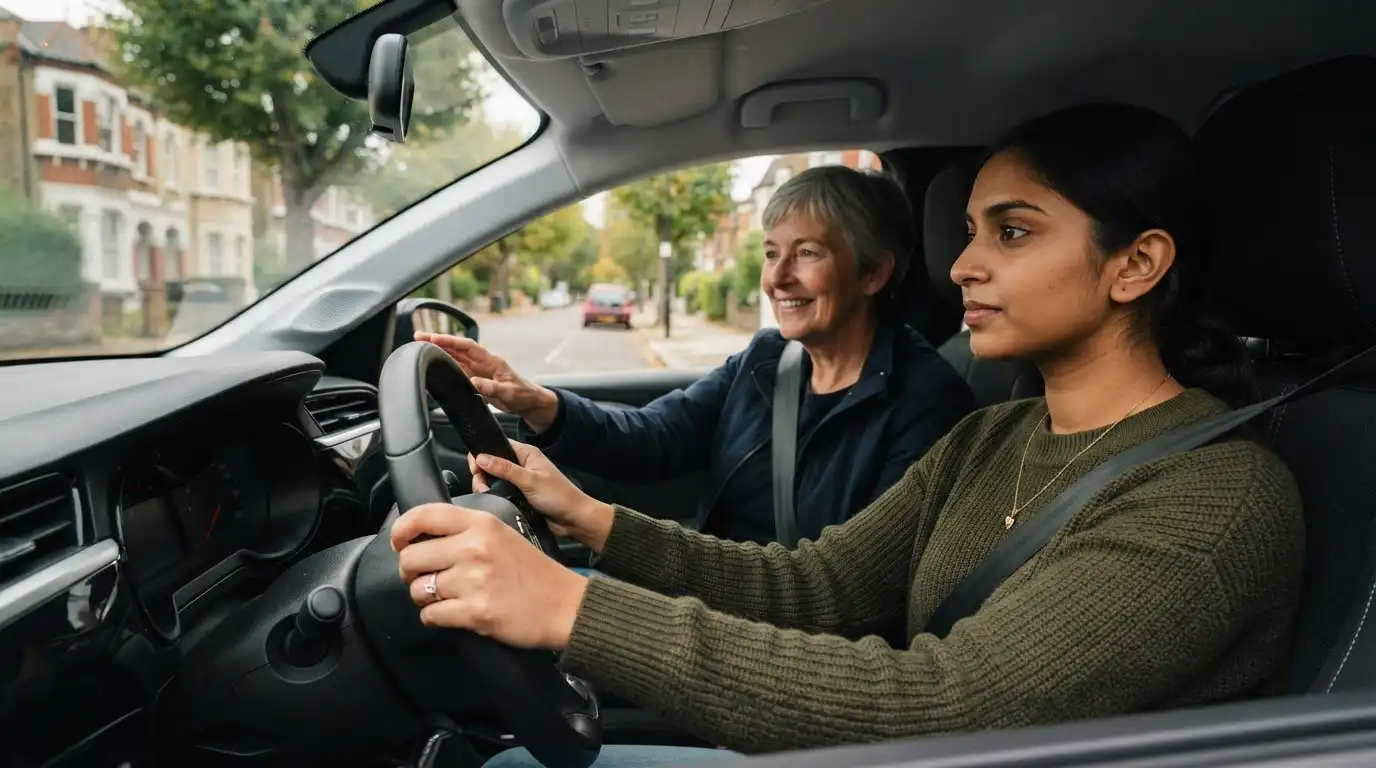
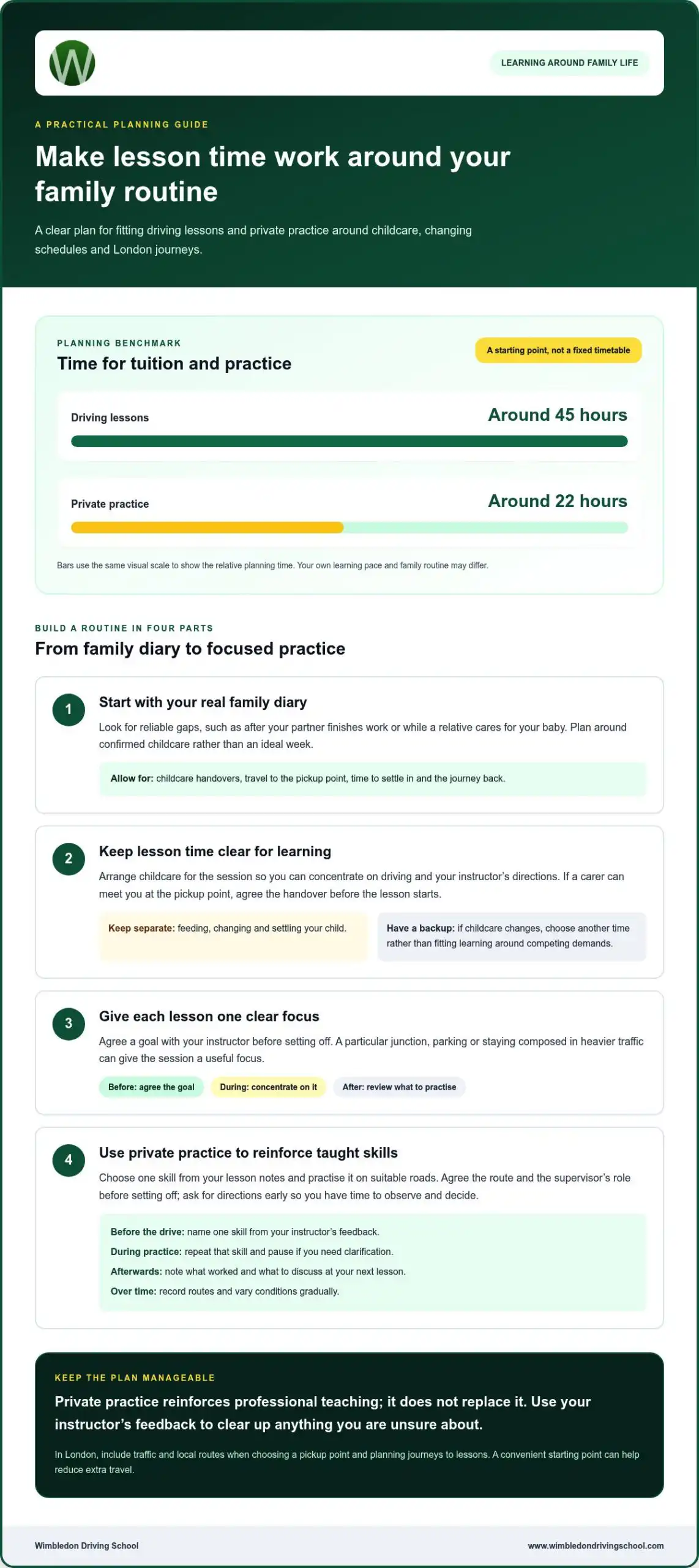
Around 45 hours of driving lessons, alongside around 22 hours of private practice, is a useful planning benchmark for learners preparing for their test. For new parents fitting driving lessons into life in London, the challenge is making that learning time work around childcare, feeds, naps and family routines. These figures are a starting point, not a fixed timetable for every learner.
It’s understandable if committing to regular lessons feels difficult when your days can change at short notice. Flexible pickup arrangements can make it easier to plan lessons around home or other practical locations, while choosing manual or automatic tuition lets you learn in the car type that suits your goals.
This guide explains how lesson pickups, tuition choices and private practice can fit around family commitments across London. You’ll also learn how to make practice sessions manageable and what to consider when building a steady routine, so progress towards independent driving feels achievable alongside the demands of new parenthood.
Key Takeaways
- Use private practice to reinforce professional lessons, with safe supervision and clear goals for each drive.
- Build lesson times and pickup points around your family routine to make learning easier to sustain.
- Compare manual and automatic tuition by considering the car you want to drive and the skills you want to learn.
- Plan around London traffic and local routes when choosing where to take lessons and practise.
- Find out what to consider before assuming a baby or child can travel during a lesson, and whether an intensive course suits your routine.
Benefits of private practice alongside professional lessons
Private practice lets you revisit skills after your instructor has introduced them. Use your lesson notes to choose one clear focus, such as checking your mirrors before changing speed. Repeating a familiar skill helps you notice what feels controlled and what still needs attention. Keep practice purposeful instead of trying to cover every driving situation in one outing.
Before setting off, agree the route and the supervisor’s role. According to the Driver and Vehicle Standards Agency (DVSA), a supervising driver must be over 21 years old. In Great Britain, most people can start learning to drive a car when they are 17 years old, according to the Driver and Vehicle Licensing Agency (DVLA). Choose a supervisor who can remain calm and give clear directions.
Use each drive to practise responding, not just repeating a route. Ask your supervisor to give directions early, for example, so you have time to observe signs and choose a safe position. At a junction, talk through what you can see before deciding when to move. This helps you practise observing and making decisions without relying on prompts at every step.
- Before the drive, name one skill from your instructor’s feedback.
- During practice, repeat that skill on suitable roads and pause when you need clarification.
- Afterwards, note what worked and what you want to discuss at your next lesson.
- Keep a record of practice routes so you can vary conditions gradually.
Private practice can also help you recognise the behaviours assessed on test day. For example, practise making observations visible and responding to road signs in good time. Understanding what driving test examiners look for can help you and your supervisor focus on relevant habits. Use your instructor’s feedback to clarify any manoeuvre or decision that remains uncertain, rather than rehearsing an approach you may have misunderstood.
Keep feedback specific. Instead of asking whether the drive was good, discuss a particular moment, such as approaching a parked vehicle or choosing a safe gap. Your supervisor can describe what they observed, while your instructor can explain how to improve your technique. This connects taught skills with independent practice.
Private practice works best as reinforcement, not a replacement for professional teaching. Use it to repeat familiar techniques, develop independent observation and note questions for your next lesson. This measured approach can help you become more consistent behind the wheel and prepare for a wider range of driving situations.
Driving lessons that fit around family commitments
A workable lesson plan starts with your actual family diary, not an ideal week. For driving lessons for new parents in London, choose a time and pickup point that leave room for childcare handovers and travel.
Scheduling around family commitments
Look for reliable gaps in your routine, such as after a partner finishes work or while a relative cares for your baby. Allow time to reach the pickup point, settle in and return afterwards. In London, factor in traffic, especially if your journey crosses busy routes. Share any timing constraints when arranging lessons.
Protect lesson time by avoiding appointments immediately before or after tuition. A delayed handover or unexpected family task can make it harder to arrive ready to concentrate. If your weekly routine changes, plan around confirmed childcare rather than squeezing a lesson into an already crowded day. Reviewing your diary regularly helps you keep learning without treating every change as lost progress.
Before each session, agree on one clear focus with your instructor. You might work on a particular junction, parking or staying composed in heavier traffic. A specific goal makes the lesson easier to review and helps you decide what to practise next. If you’re planning driving lessons for new parents in London, build your schedule around your learning priorities and the support available at home.
Lessons with a baby or child in the car
Arrange childcare for the lesson so you can focus on driving and instruction. A child needing care can distract you while you observe traffic, respond to directions or practise a new manoeuvre. For example, ask a trusted carer to look after your baby during tuition rather than trying to fit family errands into the session.
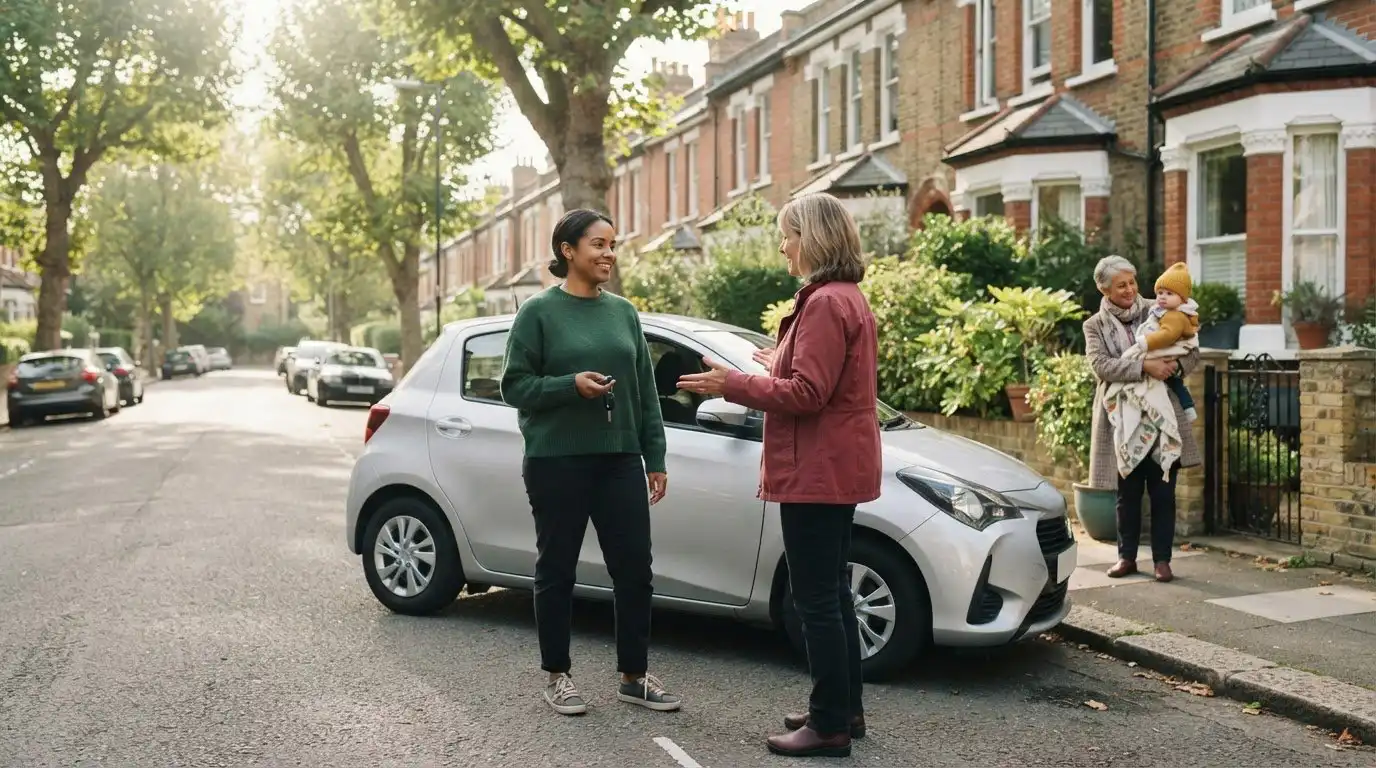
If a carer can meet you at the pickup point, arrange the handover before the lesson starts. Keep feeding, changing and settling your child separate from driving time. If childcare changes unexpectedly, choose a focused lesson on another occasion rather than trying to learn while managing competing demands.
- Put lesson times and childcare handovers in a shared calendar.
- Choose a pickup point that works with your usual travel and care arrangements.
- Agree a lesson goal before setting off, then review it afterwards.
- Keep a backup plan for changes to childcare or feeding routines.
A calm plan gives you more room to concentrate and make steady progress. Arrange a lesson time that fits your commitments.
Driving lessons in London and surrounding areas
London’s size makes lesson location a practical decision. There are around 20 driving test centres in and around London, so consider where you’ll learn, travel and take your test. For parents arranging driving lessons in London after a new baby, a convenient pickup can reduce extra travel and make it easier to protect learning time.
Map your regular journeys before choosing a starting point. A parent in Wimbledon might prefer lessons near home, while someone travelling from Surrey may need a pickup that fits their route into London. Include childcare handovers and travel time in your plan. A location that looks convenient on a map may involve a difficult journey in busy traffic.
Roads across South West London, South East London, Surrey and Middlesex offer varied driving conditions. You might encounter parked vehicles on a residential street, busy traffic near shops or complex junctions on a main road. Start with routes that match your current ability, then work towards more demanding roads as your observations, positioning and decisions improve.
Test-centre location matters too. Consider which centre is practical to reach and whether your lessons can cover relevant local roads. Learning only one short route may leave you less prepared for changing layouts and traffic. A varied plan helps you develop skills for roads beyond your immediate neighbourhood.
Compare driving schools by the practical details that affect your routine and learning:
- Pickup area: Choose a location that works with home, childcare or work journeys.
- Route variety: Look for lessons that progress from quieter streets to busier traffic.
- Test-centre access: Consider how lessons can build familiarity with roads near your intended centre.
- Vehicle type: Choose a transmission that suits your plans and learning preferences.
- Travel time: Include the journey to and from the pickup point in your schedule.
Mark home, childcare and your preferred test centre on a map, then compare possible pickup points. For driving lessons for new parents in London, this can reveal whether starting locally or travelling towards the test area better suits your week. Prioritise accessible pickups and varied road experience, rather than choosing by postcode alone. This gives you a clearer basis for planning lessons across London and nearby areas.
Can driving instructors provide lessons with a baby or child in the car?
A child passenger may be possible, but arrangements depend on the instructor and training vehicle. Agree on the plan before the lesson, including who will fit the child restraint and how the instructor can teach effectively. Don’t assume a child can travel simply because there’s space in the car.
A child passenger changes the learning environment. Your attention needs to stay on the road, the controls and your instructor’s directions, while the instructor observes your driving and explains decisions. A baby becoming unsettled or a child speaking during a manoeuvre may interrupt an explanation. Consider whether you can respond calmly without losing track of traffic or instructions.
Discuss the practical details in advance. A rear-facing seat, for example, may need a particular seating position, while a larger child seat can affect how passengers use the rear seats. The instructor also needs clear access to the teaching space and an unobstructed view of your driving. Agree where everyone will sit and whether the vehicle setup allows a useful lesson.
Before deciding, work through these points with the instructor:
- Passenger arrangement: Establish who will sit with the child and how the instructor will communicate with you.
- Restraint fit: Make sure the child’s seat can be fitted securely in the vehicle.
- Lesson focus: Choose a session suited to the conditions, rather than introducing a new, demanding task alongside passenger needs.
- Interruption plan: Agree how the lesson will pause if the child needs attention or the car needs to stop.
A passenger may affect the route and pace of a session. Practising a familiar residential route is different from tackling busy junctions or unfamiliar roads. If your child needs attention, the instructor should be able to stop safely before you turn your attention away from driving. Agree how to handle this before setting off.
Keep your child’s needs separate from driving decisions. Don’t reach across, turn around or try to settle your child while the vehicle is moving. If you notice a problem, tell your instructor and follow their direction to stop in a suitable place. This helps you respond deliberately rather than in a rush.
The key question is whether the instructor, vehicle setup and lesson plan can accommodate a child passenger without undermining safe, focused tuition. If they can, agree the details beforehand and keep the learning goal realistic. If the arrangement would divide your attention or prevent clear instruction, a different lesson setup will make better use of your time.
Are intensive driving courses suitable for new parents in London?
An intensive course can suit a new parent who can protect regular learning time and arrange reliable childcare. Concentrated tuition keeps skills fresh between sessions, helping you build on recent feedback. The challenge is maintaining focus alongside feeds, sleep and changing family plans. Consider what support you can rely on before choosing a faster-paced approach.
Start by checking what a typical week realistically allows. Mark childcare, work and family commitments on a calendar, then identify when you can attend lessons without rushing. A partner or relative covering a set period can make your routine more reliable. If support changes daily, a less concentrated schedule may be easier to maintain.
London traffic also affects how demanding each session feels. A lesson may involve residential roads, busy junctions and changing traffic conditions. Intensive learning works best when you have enough energy to listen, observe and practise deliberately. After a tiring night with your baby, a long drive through unfamiliar areas may feel harder than a session planned for a calmer part of your day.
Before committing, work through these practical steps:
- Secure childcare: Arrange a named carer for lesson times, with a backup plan for changes.
- Protect recovery time: Leave space around lessons for feeding, rest and unexpected family needs.
- Set a learning priority: Choose a skill, such as junction approach or reversing, to focus on with your instructor.
- Review progress: After each session, note what feels secure and what needs more teaching.
- Plan test readiness: Treat the driving test as a skills milestone, not a deadline that overrides safe preparation.
An intensive format may be less suitable if childcare is unreliable or frequent interruptions prevent concentration. A parent managing care alone throughout the day, for example, may find separate lessons easier to organise. That can still support steady progress. A consistent schedule that fits your family is more useful than a compressed plan that creates pressure.
Choose a format by weighing childcare, energy and learning needs together. If you can protect lesson time and arrive ready to focus, concentrated tuition can provide structure. If family demands shift often, regular sessions scheduled around confirmed support may be more workable. Either way, keep the goal clear: build safe driving skills and prepare thoroughly for your test.
Wimbledon Driving School: Manual Driving Lessons
Wimbledon Driving School can help you build practical driving skills around family commitments. Choose manual lessons to learn clutch control and gear changes, or automatic tuition if you prefer to focus on road position and traffic awareness. If you can set aside concentrated learning time, an intensive course offers a structured alternative.
Think about the car you expect to drive after passing, the childcare you can arrange and the lesson pace you can sustain. A clear plan helps you make steady progress without treating family life as an obstacle. Pass Plus Lessons can also give newly qualified drivers further experience after passing their test.
Contact Wimbledon Driving School to discuss the right next step for your learning.
Make your next step fit your family routine
Learning to drive as a new parent doesn’t require a perfect, predictable week. Start by choosing a practical next step that suits your circumstances now, then adjust your plan as family routines change. For driving lessons for new parents in London, think beyond the lesson itself: what would help you arrive focused and ready to learn?
You could start by identifying a workable lesson time, arranging support for your child and deciding which transmission suits your longer-term plans. Keep the first goal simple. A clear starting point can make learning a manageable part of your week, without requiring you to solve every scheduling challenge at once.
Wimbledon Driving School can help you take that step towards independent driving. Choose a lesson plan that works for your life now, then build from there with confidence.
Your journey towards greater independence can start with one practical decision.
Frequently Asked Questions
How many driving lessons will I need to pass my driving test?
Use your instructor’s assessment of your driving rather than choosing a lesson total in advance. Ask which test skills you can perform independently and which still need prompting. A mock driving test can highlight areas to practise, such as meeting traffic safely or completing manoeuvres under observation. Review the feedback afterwards and use it to plan the next stage of tuition.
How much do driving lessons cost in London?
The total cost depends on the tuition you choose and how much learning you need. Manual or automatic tuition, lesson length and course format can all affect your budget. Compare the total planned tuition, not just the rate for one session. Keep any test-related charges separate from lesson costs so your budget reflects both parts of preparing to drive.
Why is London a good place to learn to drive?
Learning near places you expect to visit can make lessons relevant to everyday life. For example, practise planning a journey to a familiar station, workplace or local service, then follow directions without relying on a memorised route. This helps develop independent decision-making and confidence using familiar landmarks as reference points.
What driving lesson options are available for new parents in London?
Choose a format that matches your experience and goals. Manual or automatic tuition suits new learners choosing a transmission; intensive courses concentrate learning, while refresher lessons help drivers returning after a break. Pass Plus is available after passing the practical test. Consider whether you’re starting from scratch, rebuilding existing skills or seeking further experience after your test.
How much do driving lessons cost in London in 2026?
Your 2026 tuition budget depends on the lesson format, transmission and total instruction required. To estimate the overall amount, decide what kind of tuition you need and how many sessions fit your learning plan. Avoid treating one hourly rate as the full cost of learning. If comparing options, check that each total covers the same type and amount of tuition.
Which London driving schools offer flexible lesson times or weekend lessons?
Wimbledon Driving School provides lessons seven days a week, giving you the option to plan tuition around weekday responsibilities or consider a weekend session. Lesson times still need to fit your routine, including travel to the pickup point. When planning, consider whether you’ll be alert and able to focus at your chosen time.
How can new parents arrange driving lessons around childcare and feeding schedules?
Keep a simple note of your baby’s usual feeds and sleep periods, then look for a repeatable window that suits your energy too. You might find lessons easier after a settled feed, for instance, rather than when your baby usually needs attention. Plan around your child’s actual routine, not an idealised timetable, and adjust as that routine changes.
How long does it usually take to learn to drive and pass the practical test in London?
The overall timeline includes learning and waiting for a suitable practical test appointment. Your progress through the required skills affects when you’re ready to take the test, while appointment availability affects the final date. Keep these stages distinct when planning: becoming ready to drive independently and finding a test date are separate parts of the journey.
Disclaimer
This article is provided for general informational purposes only and does not constitute professional driving, legal, or safety advice. While we aim to keep our content accurate and up to date, rules, prices, and DVSA test requirements can change — always check gov.uk or contact us directly at 020 3524 7968 for the latest guidance before making any decisions. Nothing in this article guarantees a specific outcome, including passing your driving test within any stated timeframe. For current pricing, course availability, and instructor details, please visit our Prices page or get in touch.