

What if the secret to cutting your petrol costs has nothing to do with driving slowly? Most motorists assume that learning how to save fuel while driving UK roads means crawling along at 20 miles per hour and frustrating everyone behind them. In reality, eco-driving is about active hazard anticipation, smooth momentum management, and sharper car control.
Watching the numbers tick past £90 or £100 every time you fill up at the pumps is genuinely painful, especially when gridlock in London and Surrey turns a simple commute into an expensive test of patience. You might also wonder whether popular habits like coasting in neutral actually save a drop, or if they just compromise your control. We understand that frustration. Driving efficiently shouldn’t feel like a chore or leave you second-guessing your safety behind the wheel.
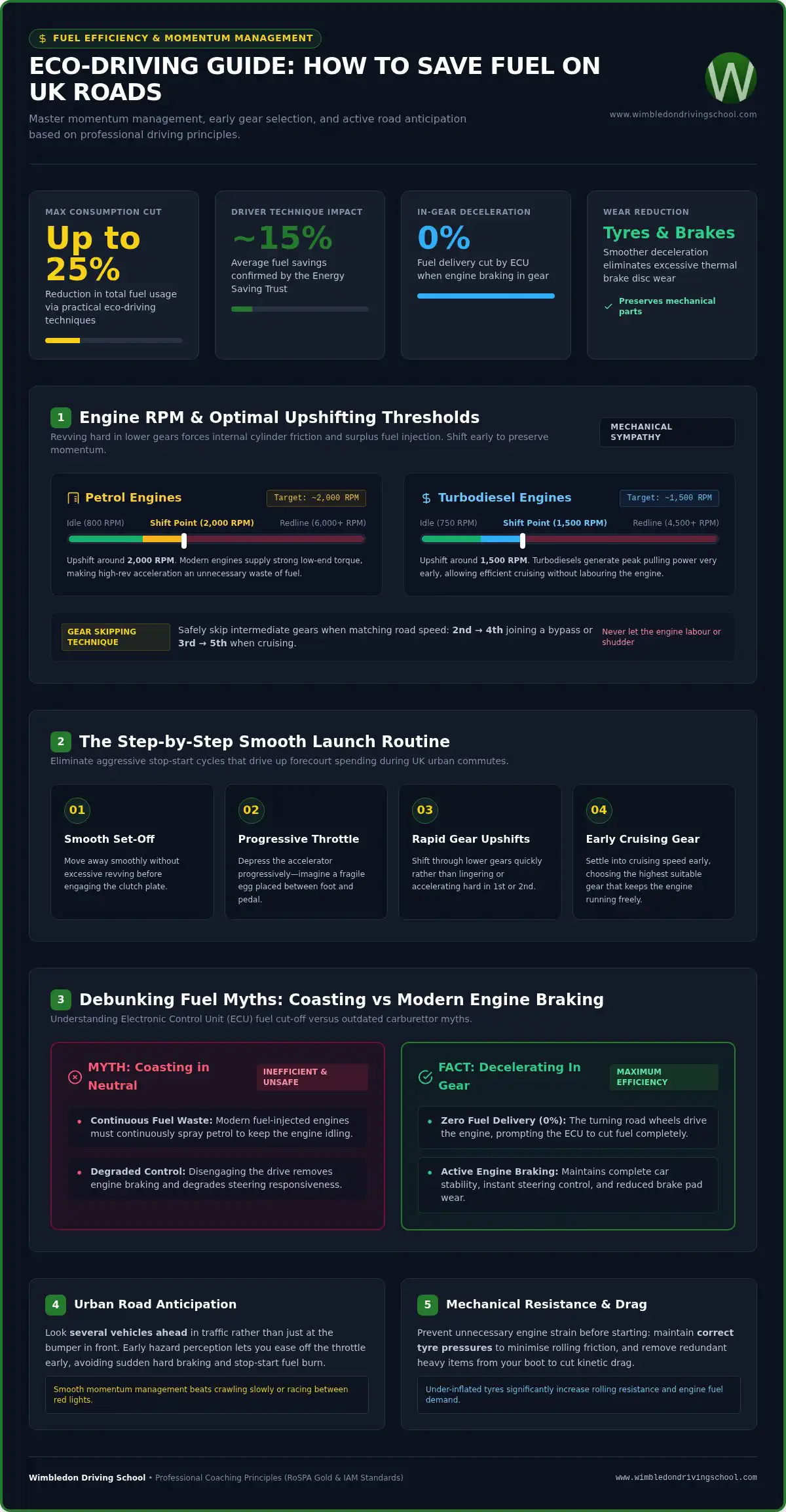
By mastering practical eco-driving habits, you can cut your fuel consumption by up to 25% without adding minutes to your journeys, whilst significantly reducing wear on your tyres and brake pads. In this complete guide, you’ll discover how to read the road ahead, use engine braking effectively, debunk risky fuel-saving myths, and keep your hard-earned money where it belongs.
Key Takeaways
- Momentum management beats sluggish driving: Smooth throttle application and early anticipation eliminate the aggressive stop-start cycles that drive up fuel usage.
- Optimise your gear shifts: Discover practical techniques for how to save fuel while driving UK roads by shifting around 2,000 RPM in petrol engines and 1,500 RPM in diesels.
- Read the road ahead: Looking several vehicles ahead in urban congestion allows you to use engine braking effectively and maintain a steady, efficient pace.
- Minimise mechanical resistance: Correct tyre pressures and removing unnecessary weight from your boot significantly reduce drag and engine strain before you even start the engine.
- Adopt advanced coaching methods: Professional principles used by RoSPA Gold and IAM qualified drivers turn fuel-efficient car control into an instinctive, lifelong driving habit.
Understanding Fuel Consumption: Why Driving Technique Dictates Your Running Costs
Eco-driving is the practice of minimising fuel consumption through smooth momentum management, mechanical sympathy, and proactive hazard perception. Aggressive acceleration forces your engine to work under immense internal load, injecting surplus fuel into the cylinders to build rapid speed. Stomping on the brakes moments later simply converts that costly kinetic energy into wasted thermal heat across your brake discs.
Research from the Energy Saving Trust shows that driver behaviour has a massive impact on efficiency, with calculated techniques reducing consumption by roughly 15%. Discovering how to save fuel while driving uk routes comes down to separating unavoidable road congestion from poor driving habits. While queueing along busy South West London or Surrey corridors burns fuel at idle, repeatedly racing between red lights and slamming on the brakes burns significantly more.
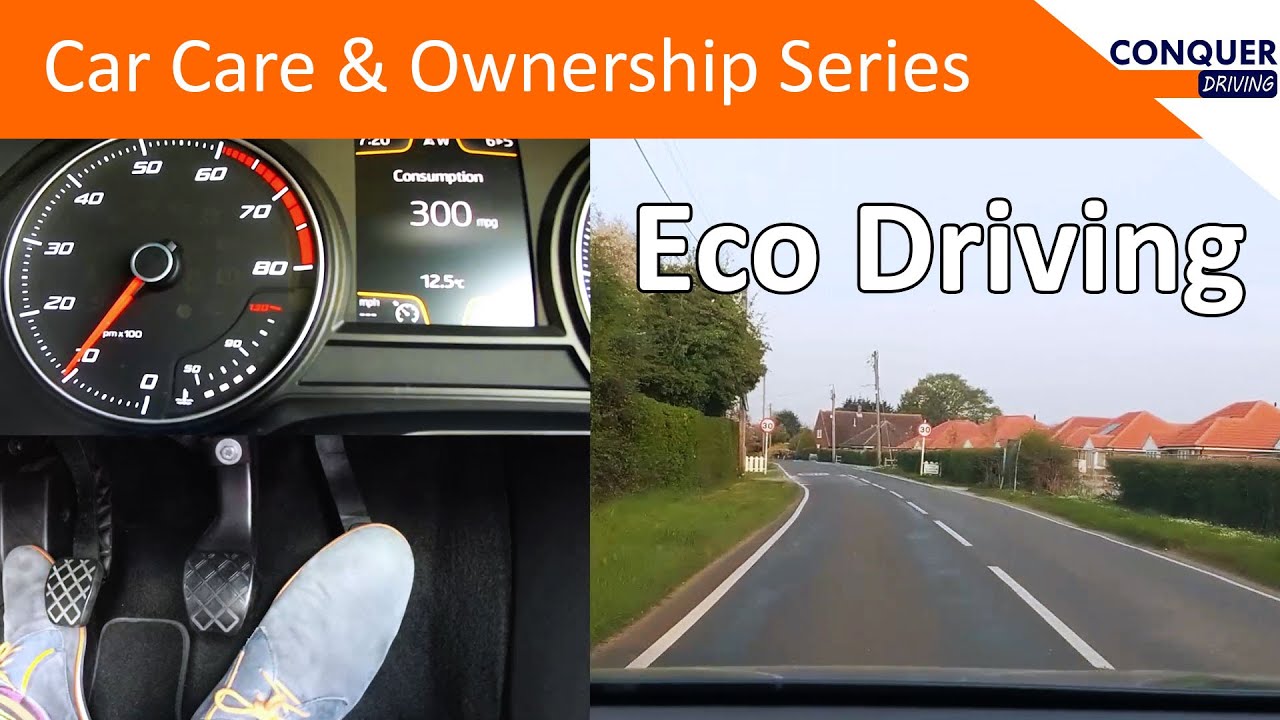
To visualise how smooth throttle inputs transform your car’s efficiency, watch this practical breakdown:
The Mechanics of Fuel Burn: Engine RPM and Throttle Position
Depressing the accelerator pedal increases engine revolutions per minute (RPM) and signals the computer to enrich the fuel supply. Revving hard in first or second gear wastes fuel through severe friction and high piston speeds. By shifting early and maintaining progress in the highest suitable gear without labouring the transmission, you dramatically reduce cylinder cycles and keep fuel delivery low.
Debunking Outdated Fuel Myths: Why Coasting in Neutral Is Inefficient and Unsafe
A persistent motoring myth claims that coasting down hills in neutral or holding the clutch down saves petrol. On modern fuel-injected vehicles, this habit actually consumes more fuel because the engine must spray petrol continuously just to maintain idle. By applying modern energy-efficient driving techniques, you leave the car in gear while decelerating; the turning wheels drive the engine, prompting the electronic control unit (ECU) to cut fuel delivery to zero. Coasting also removes engine braking and degrades steering responsiveness, reducing your overall control when you need it most.
How to Save Fuel While Driving UK Roads: Essential In-Car Techniques
Mastering mechanical control inside the cabin is the fastest way to shrink your weekly forecourt spending. If you want to know how to save fuel while driving uk routes without disrupting following traffic, follow this step-by-step launch routine:
- Set off smoothly without revving the engine before engaging the clutch.
- Depress the throttle progressively, imagining an egg between your foot and the pedal.
- Shift through the lower gears quickly rather than lingering in first or second.
- Settle into your cruising speed early and select the highest gear that keeps the engine running freely.
You can refine these vehicle-handling habits alongside our 14 essential tips for learner drivers to build confidence right from your first drive.
Progressive Acceleration and Early Gear Upshifting
Modern engines deliver healthy low-end torque, meaning you don’t need high revs to gain speed. Upshift around 2,000 RPM in a petrol car and roughly 1,500 RPM in a turbodiesel. You can also skip gears safely, shifting straight from second to fourth when joining a bypass or from third to fifth once up to speed. Never let the engine labour or shudder; if the cabin vibrates or the car struggles to respond to light throttle pressure, drop down a gear immediately.
Mastering Deceleration: Engine Braking over Friction Brakes
Every time you press the footbrake firmly, you turn usable momentum into discarded brake dust and heat. Check your rear-view mirror early, ease off the accelerator ahead of slowing traffic, and let engine braking scrub off speed smoothly. When joining a slip road or coming up to a roundabout, block change down, shifting directly from fifth to third or second as your speed drops, matching the gear to your new pace.
Stop-Start Technology and Managing Engine Idling
Leaving an engine running whilst parked wastes fuel and breaches Rule 123 of the Highway Code. Under the Road Traffic Act 1988, unnecessary stationary idling carries fixed penalties between £20 and £40, rising to £80 across parts of London and even £110 in certain London boroughs. Rely on your vehicle’s automatic stop-start system in crawling commuter traffic. If your car lacks this feature and you expect to remain stationary for over two minutes, switch the ignition off yourself. These small habit adjustments mirror the official government fuel-saving tips published by the DVSA.
If you’d like an experienced instructor to coach you through these fuel-saving techniques on local roads, you can book a driving lesson tailored to your goals.
Road Anticipation and Speed Control: Navigating UK Traffic Efficiently
Your forward vision determines your car’s fuel economy far more than most mechanical adjustments. By tracking traffic movement three to four vehicles ahead rather than staring at the bumper immediately in front, you eliminate harsh braking and preserve forward momentum. Understanding vehicle speed dynamics across varying UK road networks is central to mastering how to save fuel while driving uk routes without adding delay to your schedule.
| Cruising Speed | Relative Efficiency Profile | Primary Road Context |
|---|---|---|
| 20 mph | Moderate (higher engine RPM if held in second gear) | Urban residential zones, London boroughs |
| 30 mph | High (low internal drag in third or fourth gear) | Standard urban roads and built-up areas |
| 60 mph | Optimal peak (aerodynamic drag remains balanced) | Single and dual carriageways, rural routes |
| 70 mph | Reduced (burns roughly 9% to 15% more fuel than 60 mph) | Motorways and high-speed bypasses |
Cruising at 60 to 65 mph on bypasses preserves your fuel reserves whilst yielding virtually the same journey times as pushing to the legal limit. You can explore how to manage pace and lane positioning smoothly by using our guide on driving tips on dual carriageways.
The 10-Second Visual Horizon: Anticipating Hazards Early
Train your eyes to scan at least ten seconds ahead. Spotting a changing traffic signal, a pelican crossing, or brake lights in the distance allows you to ease off the throttle immediately. Timing your arrival so the light turns green before you halt preserves forward roll. Getting a heavy, stationary car moving from a dead stop in first gear demands peak fuel flow; keeping wheels rolling, even at 5 mph, saves petrol every time.
Motorway Cruising: Aerodynamic Drag and the 70 mph Threshold
Aerodynamic resistance rises exponentially as speed increases above 50 mph. Pushing your engine against air resistance at 70 mph burns considerably more petrol than steady travel at 60 to 65 mph. Maintaining a steady throttle on flat motorway stretches and easing slightly on inclines keeps consumption minimal. Consistent high-speed habits transform overall tank range on long cross-country journeys.
Tackling Urban Obstacles: Roundabouts and 20 mph Zones in London and Surrey
Managing speed smoothly through 20 mph zones across South West London requires balancing third gear at low revs without letting the engine chug. Approaching multi-lane roundabouts across Surrey demands early lane selection and steady deceleration, allowing you to enter safe gaps without coming to an abrupt standstill. During stop-start crawls, leave enough gap to roll steadily at idle in second gear rather than constantly riding the clutch in first.
Vehicle Preparation and Aerodynamics: Simple Checks That Prevent Fuel Waste
Driving technique forms the backbone of efficient motoring, but physical resistance can silently sabotage your efforts. If your car is fighting unnecessary mechanical friction or wind resistance, your engine burns excess petrol regardless of your throttle restraint. Mastering how to save fuel while driving uk roads requires pairing smart anticipation with basic pre-journey vehicle maintenance.
Before turning the key, addressing these simple vehicle checks will immediately protect your wallet:
- Tyre pressures: Check and inflate tyres to the manufacturer’s recommended cold pressure setting once a month.
- Cargo audit: Remove tools, sports gear, and unused prams from the boot to keep kerb weight minimal.
- External attachments: Dismantle empty roof bars, bicycle carriers, and roof boxes as soon as your trip finishes.
- Ventilation strategy: Regulate climate control settings based on road speed rather than leaving the compressor running constantly.
Tyre Pressure Maintenance and Rolling Resistance
Under-inflated tyres widen the contact patch with the tarmac, dramatically increasing rolling resistance. Running just 5 PSI below your car’s recommended figure forces the engine to burn roughly 2% to 3% more fuel to maintain momentum, while accelerating outer tread degradation. Check your tyre pressures monthly when the rubber is completely cold, using the tyre placard located on the driver’s door pillar or inside the fuel flap. Correct pressures ensure safer wet-weather braking distances alongside tangible fuel savings.
Weight Stripping and Aerodynamic Drag Removal
Carrying 50 kg of unnecessary clutter inside the boot or rear footwells increases consumption by roughly 1% to 2% during city driving, where inertia must be repeatedly overcome. Empty roof bars and top-boxes create an even worse penalty. These fixtures disrupt the car’s aerodynamic profile, creating wind buffeting that can increase fuel consumption by over 10% at dual carriageway speeds. Take ten minutes to unbolt external carriers once your holiday concludes.
Managing Climate Controls: Air Conditioning versus Open Windows
Your vehicle’s air conditioning compressor is driven mechanically by the engine belt, drawing valuable power and burning additional fuel. In warm weather, use your windows around town and save the air conditioning for faster roads. Forty-five miles per hour marks the critical aerodynamic boundary. Below 45 mph, rolling down windows creates minimal wind resistance and remains far more economical than air conditioning. Above 45 mph, open windows create turbulent cabin buffeting that consumes more fuel than the compressor, making closed windows and air conditioning the smarter choice.
Developing Advanced Driving Habits: Professional Coaching for Lifetime Savings
Reading advice online offers an excellent start, but embedding these techniques into muscle memory requires conscious practice. Professional driver coaching bridges the gap between theoretical knowledge and instinctive habit, transforming basic fuel preservation into an unconscious driving style. When you master how to save fuel while driving uk routes through structured tuition, you lower your lifetime fuel expenditure whilst reducing wear on expensive components like clutches, tyres, and brake discs.
Developing true mechanical sympathy delivers clear mechanical benefits:
- Extended brake life: Forward planning and engine braking eliminate harsh friction stops, doubling brake pad longevity.
- Clutch preservation: Smooth pull-aways and rev-matched downshifts prevent excessive friction plate wear.
- Lower stress: Anticipating traffic flow creates a calm driving environment, even during heavy London congestion.
The RoSPA and IAM Advanced Driving Standard
Instructors holding elite qualifications from the Royal Society for the Prevention of Accidents (RoSPA Gold) and the Institute of Advanced Motorists (IAM) teach a systematic system of car control. This framework prioritises spatial positioning, early hazard detection, and progressive vehicle inputs. By removing erratic bursts of acceleration and late braking, learners build the steady rhythm required to pass driving tests more consistently and drive economically for years to come.
Using Dashboard Telematics and Eco Modes Effectively
Modern vehicle trip computers provide instantaneous feedback on your driving style. Switch your digital cluster to the real-time MPG display to witness how sudden throttle prods drain your tank. Most contemporary cars also feature dedicated Eco driving modes, which remap throttle sensitivity to encourage progressive pedal travel and optimise air conditioning loads. Setting a weekly challenge to beat your average miles per gallon turns efficient motoring into an engaging habit.
Refining Your Technique with Targeted Tuition
Even seasoned motorists pick up lazy habits over time that quietly add hundreds of pounds to annual fuel expenditure. Refresher driving lessons offer an objective evaluation of your car control across varied South West London, Surrey, and Middlesex routes. A professional instructor can isolate minor flaws, such as late gear downshifts or reactive braking, and replace them with advanced techniques that immediately lower fuel consumption. You can schedule personalised tuition directly through Wimbledon Driving School bookings to start driving more smoothly and economically today.
Transform Your Daily Driving into Long-Term Forecourt Savings
Mastering how to save fuel while driving uk roads is never about travelling slower; it is about driving smarter. By scanning well ahead to preserve momentum, shifting early, and keeping your vehicle free of excess weight and under-inflated tyres, you immediately curb avoidable forecourt expense. These refined habits lower your weekly fuel bills whilst protecting your vehicle from premature wear and tear.
Whether you’re preparing for your practical test or seeking to eliminate costly habits accumulated over years behind the wheel, professional coaching accelerates your results. As a multi-year winner of the Best Driving School in London on ThreeBestRated with over 4.8-star pupil reviews across London and Surrey, our instructors hold elite RoSPA Gold and IAM qualifications. We’re here to help you turn smooth, fuel-efficient car control into second nature.
Frequently Asked Questions
Does driving in neutral really save fuel when slowing down?
No, coasting in neutral does not save fuel in modern cars. Modern electronic control units completely cut fuel delivery to the engine whenever your foot lifts off the accelerator while remaining in gear. Shifting into neutral actually forces the engine to burn petrol to maintain an idle speed. Coasting also removes your ability to use engine braking and compromises your steering control, making it both wasteful and unsafe.
What is the most fuel-efficient speed to drive on UK motorways?
The most fuel-efficient cruising speed on UK motorways is between 55 and 65 mph. Aerodynamic drag increases dramatically once your vehicle exceeds 50 mph. Cruising steadily at 60 mph rather than the 70 mph legal limit uses roughly 9% to 15% less fuel. Staying relaxed in the inside lanes at this pace preserves your momentum without adding significant travel time to your journey on routes like the M25 or M3.
At what speed is it better to use air conditioning instead of opening windows?
Around 45 mph is the proven transition point between opening your windows and switching on the air conditioning. Below 45 mph in urban traffic across South West London and Surrey, the aerodynamic drag caused by open windows is minimal, making fresh air the cheaper choice. Above 45 mph on dual carriageways, cabin turbulence creates substantial drag, meaning closed windows and active air conditioning consume less overall petrol.
How much fuel does a car engine use when idling in traffic?
An idling car engine burns between 0.5 and 1 litre of fuel for every hour it remains stationary. While that might sound minor, daily gridlock or waiting at extended red lights quickly drains money from your tank. Stationary idling also violates Rule 123 of the Highway Code. If you anticipate waiting longer than two minutes, switching off your engine saves fuel and prevents local council idling fines.
Does changing gears early damage your car’s engine?
Shifting up early will not damage your vehicle as long as you do not labour the engine. Modern petrol and diesel engines are designed to operate smoothly from low revs, around 1,500 to 2,000 RPM. However, if the car shudders, vibrates, or struggles to accelerate when you press the throttle, you’re labouring the transmission. Simply shift down a gear to restore smooth, responsive engine power.
Can eco-driving habits cause you to fail the UK practical driving test?
Eco-driving will only cause you to fail if it compromises your road safety, vehicle control, or traffic flow. The DVSA encourages eco-safe driving during practical driving tests, specifically assessing smooth acceleration and early anticipation. However, driving well below the speed limit, hesitating at clear junctions, or coasting in neutral will attract driving faults. Learning how to save fuel while driving uk test routes means balancing efficiency with prompt, decisive progress.
How much money can eco-driving realistically save a UK driver per year?
Consistent eco-driving habits can save an average UK motorist between £150 and £300 every year in forecourt costs. Cutting your fuel consumption by 15% to 25% provides immediate relief at the pumps. Mastering how to save fuel while driving uk roads also protects your car’s components, significantly extending the life of your brake pads and tyres through reduced mechanical stress.
Disclaimer
This article is provided for general informational purposes only and does not constitute professional driving, legal, or safety advice. While we aim to keep our content accurate and up to date, rules, prices, and DVSA test requirements can change — always check gov.uk or contact us directly at 020 3524 7968 for the latest guidance before making any decisions. Nothing in this article guarantees a specific outcome, including passing your driving test within any stated timeframe. For current pricing, course availability, and instructor details, please visit our Prices page or get in touch.