Did you know that over 51% of learners fail their practical exam, often due to a single lapse in observation at a junction? It’s a sobering statistic that highlights how easily common driving test failures can derail months of hard work. Whether you’re navigating the complex roundabouts of Morden or the busy urban stretches near Tolworth, the pressure to perform perfectly under the watchful eye of an examiner can feel overwhelming. You might worry about confusing a minor fault with a serious one or wonder if your skills are truly ready for the intensity of London traffic.
We understand that anxiety, and we’re here to transform it into unwavering confidence. This guide will help you master the top reasons for failure while sharing the professional techniques used by South West London’s leading instructors to secure a first-time pass. You’ll gain a clear understanding of the DVSA marking system and a definitive checklist of mistakes to avoid. From perfecting your mirror routines to aceing the independent driving section, we’ll ensure your journey to becoming a qualified driver is smooth, safe, and successful.
Key Takeaways
- Decode the DVSA marking system to understand exactly how to stay within the 15-fault threshold whilst avoiding serious or dangerous errors.
- Master the most common driving test failures, including the “signal before mirror” trap and ineffective observation at busy junctions.
- Gain professional insights into road positioning and steering techniques specifically designed to handle the unique pressures of London traffic.
- Learn why a professional mock driving test is the most effective way to eliminate nerves and identify hidden faults before your big day.
- Discover the specific lane discipline strategies needed to navigate challenging test routes in Morden, Tolworth, and Mitcham with total confidence.
Understanding the DVSA Marking System: Dangerous, Serious, and Driving Faults
The DVSA marking system isn’t designed to catch you out; it’s a rigorous framework created to ensure every new driver on British roads meets a high safety standard. Understanding how your examiner records your performance is the first step toward avoiding common driving test failures. For a deep dive into the history and structure of the assessment, you can consult this UK driving test overview. Essentially, the examiner evaluates your ability to handle a vehicle safely whilst following the Highway Code in real-world conditions.
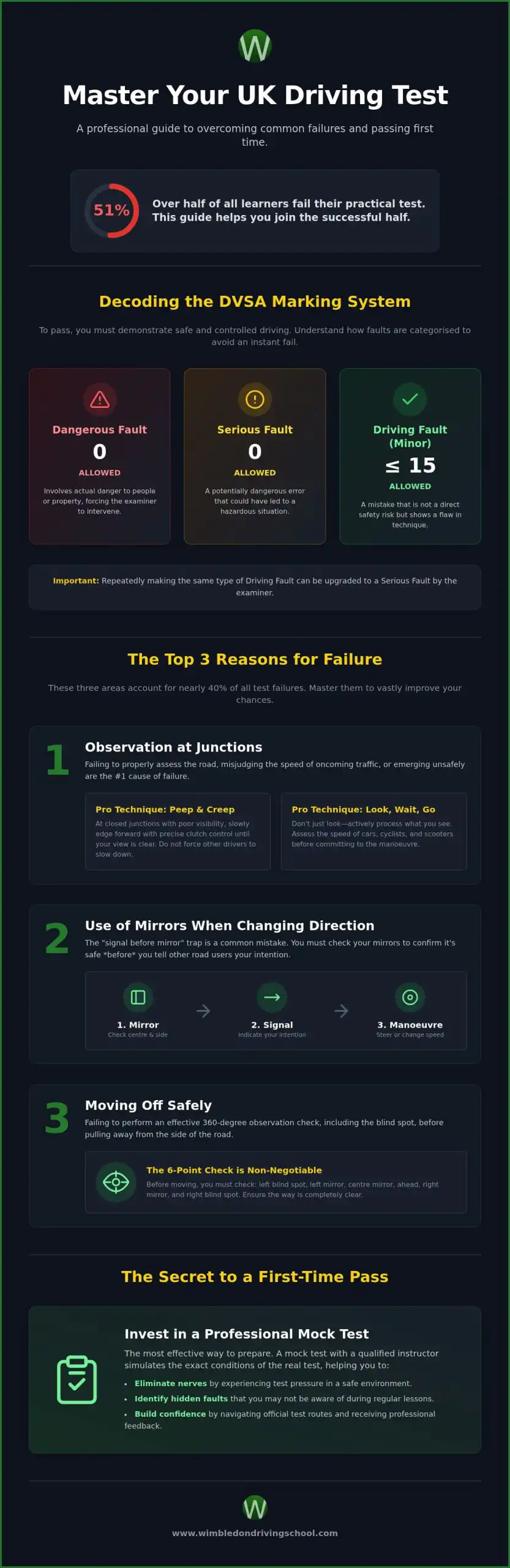
To pass, you must demonstrate consistent control and awareness. A “Driving Fault” (often called a minor) is a mistake that doesn’t pose a direct threat to safety. You’re allowed up to 15 of these, but don’t let that number make you complacent. A “Serious Fault” is a major error that potentially puts someone in danger, resulting in an immediate fail. A “Dangerous Fault” involves actual danger to you, the examiner, the public, or property. In these cases, the examiner may even take control of the vehicle to prevent an accident.
To better understand this concept, watch this helpful video:
The 15-Minor Rule: When do Driving Faults become Serious?
While you have a budget of 15 minor faults, the examiner looks for patterns in your behaviour. If you repeatedly make the same mistake, such as failing to check your mirrors before signalling, the examiner will likely upgrade that category to a Serious Fault. They aren’t just looking for one-off slips; they’re identifying dangerous habits. If you realise you’ve made a minor error, take a deep breath and reset. Dwelling on a mistake often leads to more serious lapses in concentration later in the route. You can find more detailed breakdowns of these criteria in our learning centre.
Serious vs Dangerous: What is the real difference?
The distinction between a Serious and a Dangerous fault often comes down to the presence of other road users. A Serious fault means your action was potentially hazardous. For example, failing to look at a junction when the road is empty is Serious because you didn’t confirm it was safe. A Dangerous fault occurs when your action causes actual harm or forces another driver to take evasive action. If your examiner has to use the dual controls or steer the car for you, it’s a definitive “Major”. Recognising these moments during your test is vital for maintaining your composure, even if you suspect the result isn’t what you hoped for. This awareness is a hallmark of the professional guidance we provide to every student.
The Top 3 Common Driving Test Failures and How to Fix Them
Statistics show that just three specific errors dominate the list of common driving test failures year after year. According to official DVSA data on test failures, ineffective observation at junctions is the primary reason learners fail in Great Britain. When combined with mirror errors and unsafe move-offs, these mistakes account for nearly 40% of all unsuccessful attempts. Mastering these areas isn’t just about passing; it’s about developing the elite-level awareness required for safe London driving.
Effective Observations at Junctions
Junctions are the ultimate test of a driver’s perception. In busy South West London areas like Morden, failing to judge the speed of approaching cyclists or e-scooters is a frequent pitfall. We teach the “Look, Wait, Go” method to ensure you aren’t just looking, but actually processing what you see. For closed junctions with limited visibility, you must use the “Peep and Creep” technique. This involves slowly edging forward with millimetre-perfect clutch control until your view is clear, ensuring you don’t emerge into the path of oncoming traffic or force another driver to slow down.
Mirror Use When Changing Direction
The “signal before mirror” habit is a common trap that leads to an immediate serious fault. You must check your interior mirror followed by the relevant door mirror before you even think about applying a signal. This ensures your intentions are based on the current traffic situation behind you. The Mirror-Signal-Manoeuvre (MSM) routine should be second nature. If you check your mirrors whilst turning, it’s already too late. You need that information beforehand to decide if the manoeuvre is safe to execute, particularly when sharing the road with fast-moving traffic or pedestrians.
Moving Off Safely and Blind Spots
Every time you pull away from the kerb, you must perform a comprehensive six-point check. The most frequent failure here is neglecting the right-hand blind spot. A quick, decisive glance over your shoulder is the only way to confirm no one is overtaking you or cycling alongside. If you’re moving off on a hill, precise coordination is vital; stalling in a way that affects other road users can quickly turn a minor into a serious fault. Our learning centre provides further resources on mastering these technical move-offs and keeping your control fluid under pressure.
To ensure you’ve truly ironed out these habits before your test date, consider arranging a professional assessment with our expert instructors who know the local routes inside out.
Technical Control and Road Positioning Failures
Technical mastery is what separates a student from a qualified driver. In 2026, examiners are placing even greater emphasis on your ability to handle the vehicle with fluid, deliberate actions. Technical errors, particularly those involving steering and lane discipline, remain frequent entries on the list of common driving test failures. These mistakes often stem from a lack of muscle memory or a misunderstanding of how to share space on narrow urban roads. Achieving a first-time pass requires you to demonstrate that you’re in total command of the car’s path at all times.
Beyond the physical handling, you must also show a rigorous response to road markings and signs. A frequent serious fault occurs at Stop signs; unlike a Give Way junction, you must bring the wheels to a complete halt behind the line. Even a “rolling stop” at 1mph is an immediate fail. Similarly, failing to follow directional arrows or hatched markings can lead to a dangerous fault if it forces other road users to take evasive action. Precision is your best ally during the 40-minute assessment.
Steering and Vehicle Control
While the DVSA no longer strictly fails candidates for crossing their hands, doing so in a way that leads to erratic steering or a loss of direction will result in a fault. A particularly common mistake is letting the steering wheel “self-centre” by slipping through your fingers after a turn. This indicates a lack of control. In the tight residential streets of South West London, maintaining a steady, predictable course is essential. We recommend training your muscle memory with progressive, “push-pull” steering to ensure your movements remain smooth and your hands never lose a firm grip on the wheel’s rim.
Road Positioning and Turning Right
Correct positioning is about more than just staying in your lane; it’s about communicating your intentions to others. For normal driving, you should follow the “Left-Third” rule, keeping your vehicle roughly in the centre of the left-hand side of the road. However, when turning right, you must position the car as close to the centre of the road as is safe. Failing to do this is one of the most common driving test failures in areas with complex layouts like the Morden or Tolworth one-way systems. If you stay too far to the left whilst waiting to turn right, you block the flow of traffic behind you and confuse other drivers. To help find your place, use visual markers like the centre of your dashboard or the position of your windscreen wipers relative to the kerb. You can find more specific route advice in our guide to the test centres we cover.
Maintaining a safe distance from parked cars is another vital aspect of positioning. You should aim for a “door’s width” of space whenever possible. If the road is too narrow to allow this, you must slow down significantly to show the examiner you’ve identified the hazard. This level of proactive safety is exactly what our learning centre resources aim to instil in every student.
Navigating London’s Toughest Scenarios: Roundabouts and Traffic Lights
London traffic isn’t just busy; it’s unpredictable. The psychological weight of navigating complex junctions under the gaze of an examiner often leads to common driving test failures. In high-density areas like South West London, the margin for error is slim. You aren’t just being tested on your technical skill but on your ability to maintain composure whilst surrounded by aggressive city traffic. This environment demands a higher level of observation than rural roads, as pedestrians, cyclists, and buses all compete for the same limited space.
Roundabout Lane Discipline and Observations
Large, multi-lane roundabouts, such as those found near the Morden and Tolworth test centres, are notorious for tripping up learners. A frequent fail involves cutting across lanes or failing to signal “Left” when exiting. This lack of communication causes immediate confusion for other drivers. To master this, we teach the “Clock Face” rule: for any exit past 12 o’clock, you must approach in the right-hand lane; for anything before 12, use the left unless road markings dictate otherwise. Always give way to traffic from the right, but remain decisive. Hesitation at a clear roundabout is a minor fault that quickly becomes serious if it impedes the vehicle behind you.
Responding Appropriately to Traffic Lights
Traffic light errors often occur because learners fail to scan far enough ahead. You must identify your “Point of No Return”, which is the moment you’re too close to the line to stop safely if the light turns amber. If you’re further back, you must stop. Jumping an amber light when you had ample time to halt is an immediate fail. Conversely, failing to notice a green “filter light” for a right turn and remaining stationary is a frequent serious fault for lack of progress. Scanning the whole road environment ensures you anticipate changes rather than reacting to them at the last second, a skill our instructors prioritise during every lesson.
Pedestrian crossings on busy high streets also require absolute vigilance. A common mistake is moving off whilst a pedestrian is still on the black and white stripes, even if they’ve cleared your side of the road. The crossing must be entirely clear before you proceed. Failing this shows a lack of safety awareness that examiners cannot ignore. This level of detail is exactly what separates a pass from a fail in the capital’s challenging conditions.
Mastering these high-stakes scenarios requires expert guidance from those who know the local terrain. Book your assessment today to ensure you’re ready for the unique challenges of London’s roads.
The Secret to Passing First Time: Preparation and Mock Tests
Passing the practical assessment is a transformative milestone, but it shouldn’t be left to chance. Whilst many learners hope for a “nice” examiner or a quiet route, the most successful candidates rely on rigorous, structured preparation. True confidence comes from knowing you’ve already faced the most challenging scenarios and emerged successful. By proactively addressing the root causes of common driving test failures, you can transform your performance from merely reaching a “test-standard” to becoming truly “road-ready” for the demands of the capital.
The Value of a Professional Mock Test
A mock driving test is the single most effective tool for identifying hidden serious faults before they cost you your licence. It replicates the exact pressure of the real environment, including the examiner’s professional silence and the formal atmosphere. Our instructors use official DVSA marking sheets to track your progress, providing an objective, data-driven view of your performance. This process often reveals “habitual minors”. These are small, recurring errors in mirror use or positioning that you might ignore during standard lessons but which an examiner will record as a pattern of poor behaviour. Identifying these patterns early allows you to correct them before they escalate into a serious fail on the big day.
Choosing the Right Instruction for South West London
The complex road networks of Morden, Mitcham, and Tolworth require more than just basic car control. They demand local expertise and elite-level coaching. Standard tuition often misses the nuances of specific test routes, but our RoSPA Gold and IAM-certified instructors provide a level of instruction that far exceeds the minimum requirements. This “Confident Mentor” approach ensures you aren’t just memorising manoeuvres. Instead, you’re developing the high-level observation skills necessary for safe, independent driving in any situation. This superior preparation is the best way to ensure you don’t fall victim to common driving test failures.
If you’ve struggled with consistency or need to iron out bad habits quickly after a previous attempt, our intensive driving courses offer a focused, high-impact environment to sharpen your skills in a shorter timeframe. We believe that every learner deserves the highest industry standard of education. Our exceptional pass rates are a testament to our rigorous training methods and our commitment to your safety. Don’t leave your success to luck. Book your first lesson with Wimbledon Driving School and start your journey toward a first-time pass today.
Take the Final Step Toward Your Driving Independence
Mastering the road isn’t about avoiding mistakes through luck; it’s about developing the elite awareness and technical precision required for London’s unique environment. By understanding the DVSA marking system and refining your observation at junctions, you’ve already taken a significant leap toward success. You now have the tools to navigate roundabouts with confidence and eliminate the common driving test failures that hold so many learners back.
At Wimbledon Driving School, we don’t just teach you to pass; we prepare you for a lifetime of safe driving. Our RoSPA Gold and IAM certified instructors are specialists in supporting nervous drivers, helping you overcome test anxiety with proven techniques. As a provider with some of the highest pass rates in South West London, we offer the professional expertise you need to conquer test routes in Morden, Tolworth, or Mitcham. Don’t leave your personal milestone to chance when you can learn from the best in the industry.
Start your journey to a first-time pass with Wimbledon Driving School today. Your destination is closer than you think, and we’re ready to help you reach it with total confidence.
Frequently Asked Questions
What is the most common reason for failing a driving test in London?
Ineffective observation at junctions is the most common reason for failing in London. This is due to the high density of cyclists, pedestrians, and complex crossroads in areas like Morden. You must demonstrate that you’ve looked and processed the traffic before emerging. Failing to do so is a leading cause of common driving test failures. Our instructors focus on these high-pressure scenarios to ensure you remain observant.
How many minor faults are you allowed on the UK driving test in 2026?
You’re allowed up to 15 driving faults, often called minors, on the UK driving test in 2026. However, if you commit a single serious or dangerous fault, you’ll fail immediately. It’s also important to remember that repeated minor faults in the same category can be upgraded to a serious fault. Consistency is key to passing first time, especially when navigating the busy streets of South West London.
Can I fail my driving test for stalling the car once?
Stalling the car once is usually recorded as a minor driving fault, provided it doesn’t happen in a dangerous situation. If you stall and it causes a hazard to other road users, or if you fail to restart the car safely and quickly, it’ll become a serious fault. Maintaining your composure and following a safe restart routine is essential to prevent a simple stall from ending your test.
What happens if I make a serious fault at the very beginning of the test?
If you make a serious fault early in the test, the examiner will usually allow the assessment to continue until the end. This provides you with the full experience and feedback, which is valuable for your next attempt. However, if the fault is deemed dangerous, the examiner may stop the test immediately for safety reasons. Our mock driving tests help you identify these errors before your actual exam.
Are driving tests harder in London than in other parts of the UK?
Driving tests follow the same national criteria, but the environment in London presents unique challenges. The high volume of traffic, complex one-way systems, and constant presence of vulnerable road users require a higher level of concentration. Whilst the marking system is identical, the density of hazards in areas like Tolworth or Mitcham means there are more opportunities to make a mistake compared to quieter, rural test centres.
How can I avoid failing for junction observations?
To avoid failing for junction observations, you must use the “Look, Wait, Go” method consistently. Ensure you’re not just glancing, but actually identifying approaching vehicles, cyclists, and pedestrians. At closed junctions, use the “Peep and Creep” technique to improve your view without emerging unsafely. This proactive approach is one of the best ways to avoid common driving test failures and demonstrate your competence to the examiner.
Is it an automatic fail if I hit the kerb during a manoeuvre?
Hitting the kerb isn’t an automatic fail unless it’s done with force or you mount the pavement. A light touch whilst performing a manoeuvre like a parallel park is typically marked as a minor driving fault. However, if the impact is heavy enough to potentially cause damage or if you mount the kerb, it’ll be recorded as a serious or dangerous fault, resulting in an unsuccessful result.
How many hours of lessons do I need to avoid common mistakes?
The DVSA recommends approximately 45 hours of professional tuition combined with 22 hours of private practice to become test-ready. Every learner is different, so we offer intensive driving courses and mock tests to help you reach the required standard efficiently. Our RoSPA Gold certified instructors specialise in tailoring lessons to your specific needs, ensuring you have the skill to handle the unique demands of South West London traffic safely. For those interested in how professional driver education is structured in other regions, you can visit their website to learn about the programmes offered by Barber’s Driving School.
Disclaimer
This article is provided for general informational purposes only and does not constitute professional driving, legal, or safety advice. While we aim to keep our content accurate and up to date, rules, prices, and DVSA test requirements can change — always check gov.uk or contact us directly at 020 3524 7968 for the latest guidance before making any decisions. Nothing in this article guarantees a specific outcome, including passing your driving test within any stated timeframe. For current pricing, course availability, and instructor details, please visit our Prices page or get in touch.