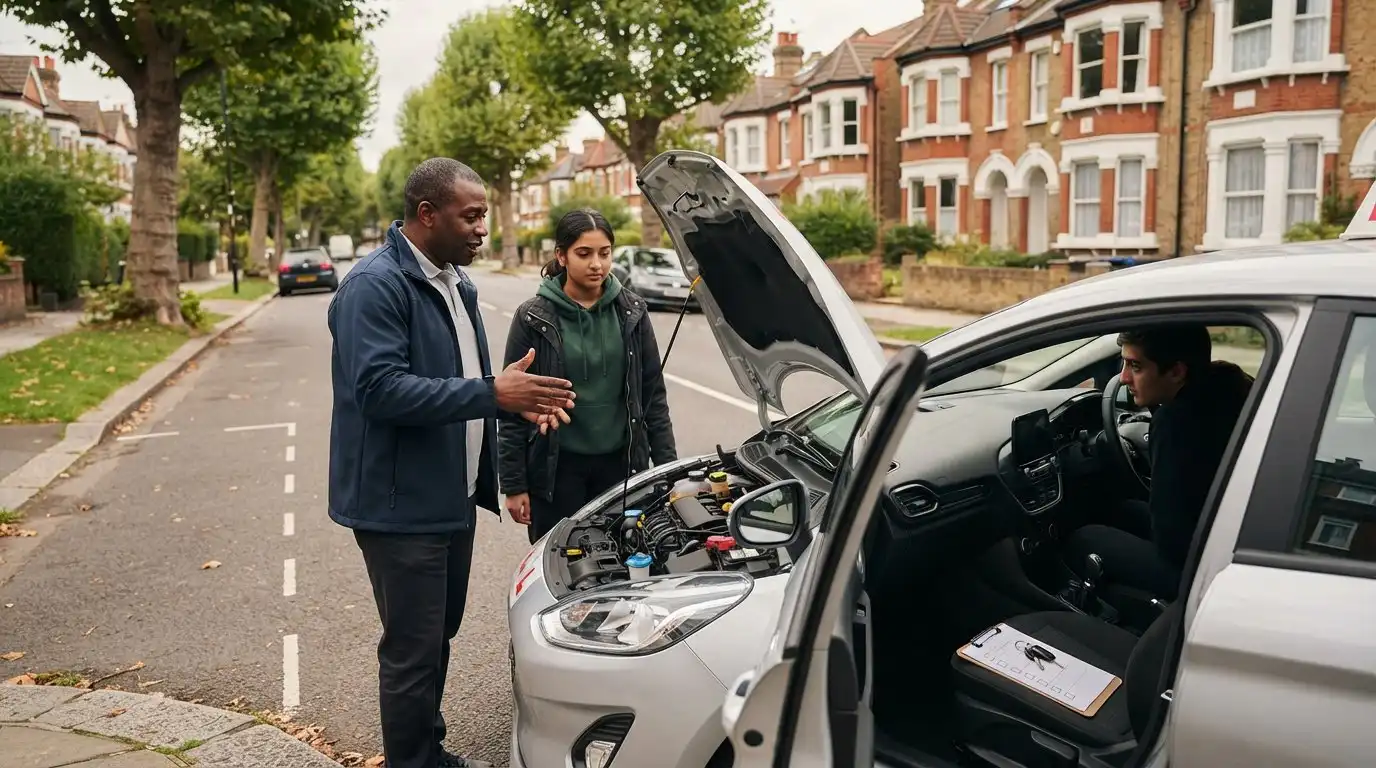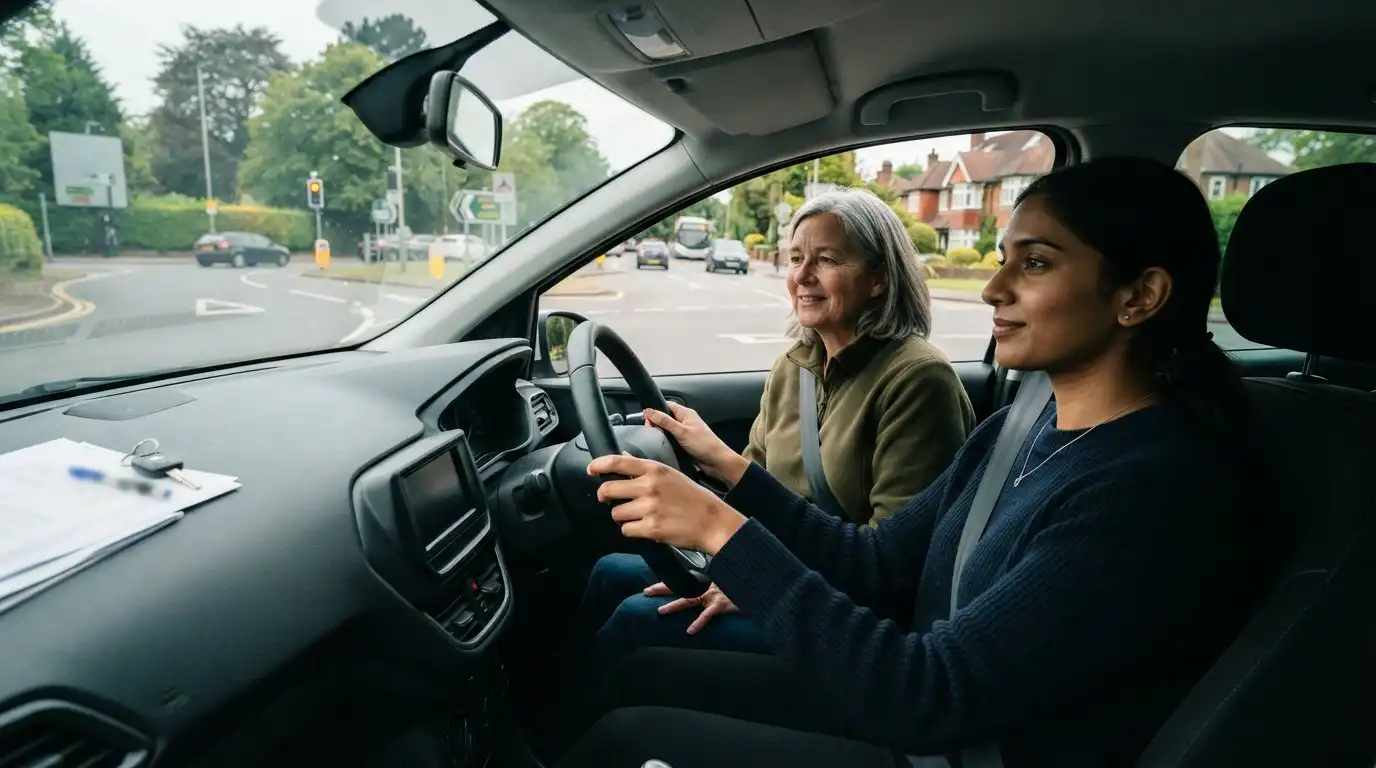
To legally supervise a learner driver in the UK, you must be at least 21 years old, have held a full driving licence for at least three years, and ensure the vehicle is correctly insured with L-plates displayed. You must also be qualified to drive the specific vehicle type, such as a manual or automatic. This parents guide to teaching a learner driver uk provides the essential roadmap to mastering these legalities while supporting professional tuition safely.
Supervising a teenager on the roads of London and Surrey can feel daunting, especially when you’re anxious about passing on bad habits or navigating peak traffic. At Wimbledon Driving School, our RoSPA Gold and IAM qualified instructors believe that private practice should be a calm, mileage-building exercise that mirrors professional lessons. We are here to help you transition from a nervous passenger to a “Confident Mentor,” ensuring your journey together is productive rather than confrontational.
This guide breaks down the latest 2026 legal requirements and safety protocols to give you total peace of mind. You will discover how to structure your sessions, identify the best local routes, and communicate effectively without triggering panic. By following this expert-led approach, you’ll gain the confidence to support your child’s professional training and help them pass their test sooner.
Key Takeaways
- Confirm you meet the 2026 legal criteria for supervisors, including the minimum age of 21 and a three-year licence tenure, to ensure every practice session is fully compliant.
- Follow our parents guide to teaching a learner driver uk to synchronise your private practice with professional tuition, focusing on mileage-building rather than teaching new manoeuvres.
- Enhance safety and awareness by fitting an auxiliary interior mirror and choosing practice routes in SW London and Surrey that avoid peak traffic congestion.
- Adopt the “Confident Mentor” communication style, providing clear and early directions to maintain a calm environment and prevent last-minute panic at junctions.
- Utilise professional mock driving tests to identify hidden weaknesses and ensure your learner has reached the required DVSA standard before booking the practical exam.
UK Legal Requirements and Essential Preparation for Parents
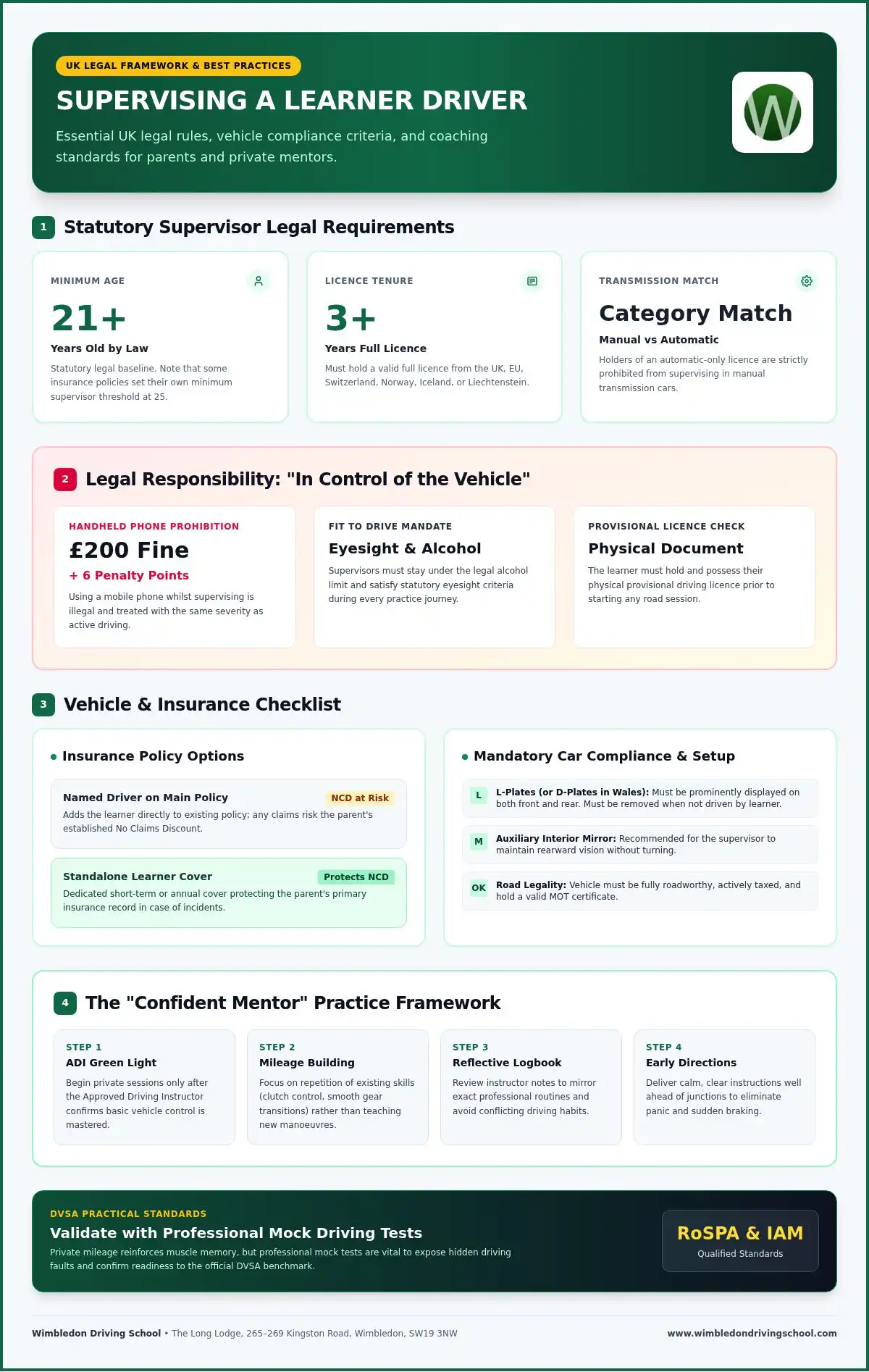
Before the first mile, you must verify that you meet the statutory criteria to supervise. In the UK, you must be at least 21 years old and have held a full driving licence for a minimum of three years. This licence must be from the UK, EU, Switzerland, Norway, Iceland, or Liechtenstein, and it must cover the category of vehicle being driven. If you have an automatic licence, you cannot supervise a learner in a manual car. This parents guide to teaching a learner driver uk emphasises that these rules are non-negotiable; failing to meet them can result in prosecution for both parties.
The learner must also possess a valid provisional licence. Without this physical document, any time spent behind the wheel is illegal. You must also ensure that red ‘L’ plates (or ‘D’ plates in Wales) are clearly displayed on the front and rear of the vehicle. These must be removed when the learner isn’t driving. Ensuring the vehicle meets UK practical driving test requirements for safety and visibility is a vital first step in your journey.
The Supervisor Legal Checklist
As the supervisor, you are legally in charge of the car. This means you must be “fit to drive” just as if you were in the driver’s seat. You must stay under the legal alcohol limit and meet the same eyesight requirements as the learner. Most crucially, using a handheld mobile phone whilst supervising is strictly prohibited. If caught, you face a £200 fine and six penalty points. In the event of an accident, the law treats the supervisor as the person in control, so your focus must remain entirely on the road and the learner’s actions.
Insurance and Vehicle Compliance
Insurance is arguably the most complex hurdle. You can add the learner as a named driver to your existing policy, but this often risks your No Claims Discount if an incident occurs. Many families now opt for standalone learner driver insurance, which provides separate cover for the student. Regardless of the policy type, the car must be roadworthy, taxed, and have a valid MOT. You can find more advice on preparing for the road in our guide on 14 essential tips for learner drivers. Remember that some insurance providers set their own supervisor age limits, often requiring you to be 25 rather than the legal minimum of 21. Check your policy wording carefully before starting this parents guide to teaching a learner driver uk journey.
Structuring Private Practice to Complement Professional Lessons
Private practice is most effective when it serves as a bridge between professional sessions. You shouldn’t start supervising until the Approved Driving Instructor (ADI) gives the “green light”. This ensures the learner has mastered basic car control and safety protocols first. This parents guide to teaching a learner driver uk recommends using a reflective logbook to track specific progress. By reviewing the instructor’s notes, you can focus on repeating the exact routines taught that week rather than introducing conflicting methods. Check the official GOV.UK rules for supervising a learner driver to ensure you stay compliant while supporting their development.
The Collaborative Coaching Model
Success depends on a unified front. Before you head out, have a quick chat with the instructor to understand their current goals. It’s vital to avoid the common “but my dad says” conflict by strictly adhering to the instructor’s modern techniques. If you’re still in the process of finding the right professional partner, read our guide on 5 questions to ask when choosing a driving instructor. If you feel your learner needs more structured support before you take over for practice, you can book professional driving lessons to bridge the gap and maintain momentum.
What to Practise (and What to Avoid)
Your primary role is “mileage building”. This means repeating basic skills like clutch control and smooth gear changes until they become second nature. Stick to quiet local roads in areas like Wimbledon or Morden where the learner feels secure. Avoid complex manoeuvres like parallel parking or high-speed dual carriageways in the early stages. Those high-stakes skills are best left to the professional instructor until the learner’s confidence is robust. By focusing on the routine of Mirror-Signal-Manoeuvre (MSM), you help cement the safety-first mindset required for this parents guide to teaching a learner driver uk to be successful. Repetition in a low-stress environment builds the muscle memory needed for the more challenging aspects of the test later on.
Preparing the Vehicle and Choosing Local Practice Routes
Success in private practice starts with a vehicle that supports both the learner and the supervisor. One of the most effective tools you can buy is a clip-on, suction-cup interior mirror. This allows you to maintain 360-degree awareness without constantly turning your head, which can distract a nervous driver. According to RAC’s guide on teaching a learner driver, planning your route in advance is essential to avoid high-pressure situations. This parents guide to teaching a learner driver uk suggests starting in safe havens like empty industrial estate car parks on Sundays. These locations provide a low-risk environment for mastering the bite point and handling the car if it stalls.
Timing is just as critical as location. In South West London and Surrey, avoiding the morning and afternoon school runs is vital for a calm session. Aim for weekend mornings or mid-evening slots when the roads are quieter. Once the learner has built basic confidence, you can graduate from car parks to quiet residential loops. This progression ensures they aren’t overwhelmed by the aggressive traffic often found on London’s arterial roads during peak hours.
The Best Practice Spots in South West London and Surrey
Residential pockets in Wimbledon, Kingston, and Sutton offer the perfect balance of junctions and parked cars for early sessions. For those looking for specific recommendations, our guide on the best roads in Surrey to practise for your driving test provides a curated list of ideal locations. As confidence grows, start incorporating sections of the Morden or Surbiton test routes. Practising near these centres helps the learner become familiar with specific local challenges, such as the complex roundabouts or narrow one-way systems they will face during the actual exam.
Vehicle Safety Checks for Learners
Preparation isn’t just about the drive; it’s about understanding the machine. Use your practice sessions to run through the Show Me, Tell Me questions that form part of the DVSA exam. Ask the learner to explain how they would check the engine oil or the tyre pressure whilst the car is safely parked. This parents guide to teaching a learner driver uk recommends a weekly maintenance routine to build these habits. Ensure the learner checks the following regularly:
- Tyre Tread and Pressure: Confirming they meet the legal minimum of 1.6mm.
- Fluid Levels: Checking oil, coolant, and windscreen wash.
- Lighting: Verifying all indicators and brake lights are functioning.
- Visibility: Keeping the windscreen spotless and ensuring all mirrors are adjusted specifically for the learner’s height.
Starting every session with these checks builds the professional mindset needed to pass safely.
Mastering Communication: How to Stay Calm and Effective
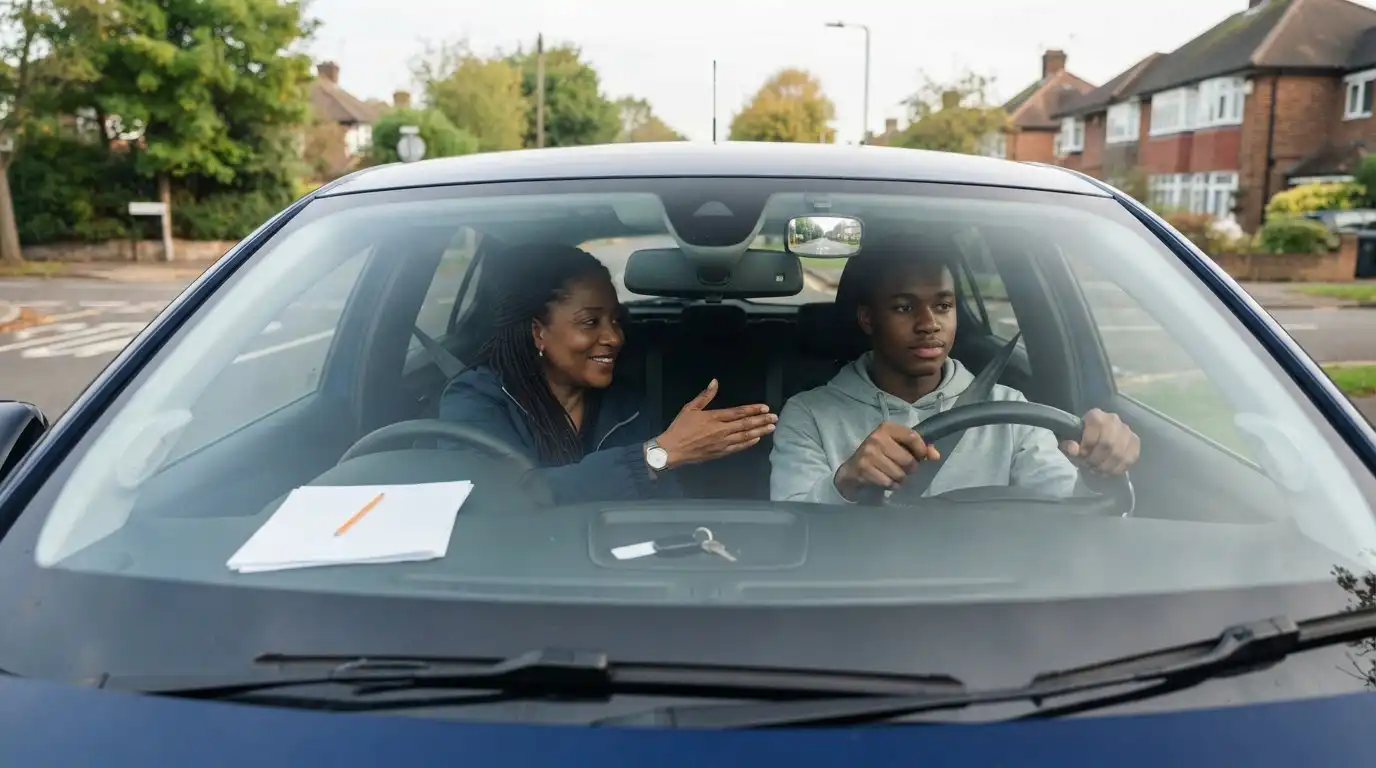
Teaching your child to drive is often a test of your relationship as much as their technical skill. To succeed, you must adopt the “Confident Mentor” persona. This role requires you to be calm, clear, and always one step ahead of the car’s position. A vital element of this parents guide to teaching a learner driver uk is the “Early Instruction” rule. You should provide directions at least 100 yards before a junction or turning. This gives the learner ample time to process the Mirror-Signal-Manoeuvre routine without the pressure of a last-minute decision.
If a mistake happens, such as a stall at a busy Richmond junction, your reaction dictates the outcome. Raising your voice or showing visible frustration only triggers panic, which makes a smooth restart nearly impossible. Instead, stay quiet and let them fix the error. Save the detailed analysis for a “debrief” once the car is safely parked at home. Professional instructors separate the act of driving from the act of critiquing to keep the learner’s focus on the road. For fathers who also have younger children and wish to develop these mentoring skills from the very beginning, they can explore Great Dad Coaching (1-on-1) for specialised support.
When things get tense, don’t try to power through the frustration. Use the “pull over and talk” method instead. Find a safe, legal place to stop, turn off the engine, and take a few minutes to breathe. This physical break resets the emotional climate inside the vehicle. Always focus on what went well before addressing the mistake. For example, praise their lane positioning before discussing a missed signal. If technical errors like stalling persist, our guide on how to stop stalling your car on a driving test provides specific drills to build their confidence.
Proactive Hazard Perception
Teach your learner to scan the road like a pro. They shouldn’t just watch the car directly in front; they need to look 15 seconds ahead to anticipate changes. Use “narrative driving” to facilitate this. Ask the learner to talk through everything they see and what they plan to do about it. Hearing them say, “I see a cyclist ahead, I’ll check my mirrors to overtake,” confirms they are processing hazards. This allows you to step in verbally if they miss something, preventing a dangerous situation before it develops. This proactive approach is a cornerstone of this parents guide to teaching a learner driver uk, turning a reactive student into a thinking driver. To further support your teen’s emotional wellbeing throughout this stressful process, insights from youth mental health speaker Jeff Yalden can help you practise patience and acceptance during moments of frustration.
The final phase of this parents guide to teaching a learner driver uk involves shifting from general practice to specific test preparation. While you have handled the mileage building, a professional mock test is essential to identify hidden habits that could lead to a failure. These simulations use the exact marking criteria employed by the DVSA, providing an objective assessment of whether the learner is truly prepared for the pressure of the exam day.
Intensive polishing lessons are required in the closing weeks to refine technical precision. These sessions ensure the learner is fully conversant with the latest 2026 standards, including independent driving and sat nav usage. Handing over the final preparation to an instructor holding RoSPA Gold or IAM qualifications guarantees that the student is learning from the highest industry standard available.
Identifying the “Test Ready” Milestone
Objectivity is your greatest asset during this stage. Use the DVSA “Ready to Pass” checklist to verify that the learner can consistently perform all 27 essential skills without verbal prompts. There is a distinct gap between driving safely under your supervision and meeting the rigorous expectations of a driving examiner. Understanding why has the driving test changed helps you appreciate the modern focus on high-level hazard perception and independent decision-making.
Why Professional Tuition Wins the Day
Wimbledon Driving School is a multi-year winner of the “Best Driving School in London” award, maintaining a 4.8-star rating. Our experts specialise in the final refinement needed to pass in Morden, Surbiton, or Croydon. Using a professional instructor’s car for the test offers the security of dual controls and a vehicle the examiner recognises as meeting all safety requirements. This partnership ensures the transition from learner to licence-holder is as smooth as possible.
Empower the Next Generation of Safe Drivers
Success behind the wheel is built on a foundation of strict legal compliance and calm, structured practice. By mastering the 2026 regulations and focusing your sessions on building mileage rather than new manoeuvres, you create a safer environment for everyone. This parents guide to teaching a learner driver uk serves as your roadmap, but the final destination requires professional refinement. We specialise in helping nervous learners pass first time by blending aspirational coaching with grounded safety standards.
Our instructors hold RoSPA Gold and IAM qualifications, ensuring your child receives the highest industry standard of education. It’s why we’ve been named the “Best Driving School in London” for multiple years running. You now have the tools to support their transformation into a confident, independent motorist. Let’s work together to make this personal milestone a reality.
Frequently Asked Questions
Can I teach my child to drive in my own car in the UK?
You can teach your child in your own vehicle as long as it is roadworthy, taxed, and has a valid MOT. The car must be correctly insured for a learner and display L-plates on both the front and rear. It is also important to ensure the car’s transmission matches your own licence; you cannot supervise a manual car if you hold an automatic-only licence.
What insurance do I need to teach a learner driver on my policy?
The learner must be specifically covered to drive the vehicle, either as a named driver on your existing policy or through a standalone learner driver insurance policy. Many parents in London and Surrey prefer standalone cover because it typically protects the parent’s No Claims Discount in the event of an accident. Always verify that your specific policy allows for private tuition before starting your first session.
Does the supervisor of a learner driver have to be 21 or 25?
Legally, the supervisor must be at least 21 years old and have held a full licence for a minimum of three years. However, many private insurance providers in the UK set their own internal requirement at 25 years of age. You must check your insurance documents to ensure you meet their specific criteria, as failing to do so could void your cover regardless of the statutory legal minimum.
What happens if a learner driver is caught speeding whilst I am supervising?
The learner driver is legally responsible for the offence and will receive the penalty points and fine. However, as the supervisor, you are legally in charge of the vehicle and could be prosecuted for failing to supervise properly. In 20mph zones across London, this is a serious risk. New drivers also face automatic licence revocation if they accumulate six points within their first two years of passing.
Can a parent teach a learner driver without professional lessons?
While you can legally teach without professional help, this parents guide to teaching a learner driver uk recommends a hybrid approach. Professional instructors at Wimbledon Driving School are trained to identify the technical faults that lead to failures at centres like Morden or Surbiton. Supplementing their expert tuition with your own mileage-building sessions provides the best balance of safety and experience for the learner.
How many hours of private practice should a learner driver have?
The average learner who passes their test has typically completed 45 hours of professional lessons and 22 hours of private practice. This combination ensures they have the technical skill from an ADI and the real-world experience gained from driving with you. We suggest tracking these hours in a logbook to ensure the practice remains structured and covers a variety of road types in South West London.
Can I supervise a learner driver if I have points on my licence?
You can legally supervise a learner driver if you have points on your licence, provided your licence remains valid and you are not disqualified. You must still meet the statutory requirement of holding your full licence for at least three years. However, individual insurance companies in Surrey and Middlesex often have their own restrictions regarding the number of points a supervisor can have, so always check your policy.
What are the rules for L-plates on a private car in 2026?
L-plates must be exactly 178mm square and clearly visible on both the front and rear of the vehicle. In 2026, the DVSA continues to enforce these specific dimensions strictly. You must ensure they are removed or covered when the car is driven by anyone other than a learner. Failing to display them correctly or leaving them on when not required can lead to a fine of up to £1,000.
Disclaimer
This article is provided for general informational purposes only and does not constitute professional driving, legal, or safety advice. While we aim to keep our content accurate and up to date, rules, prices, and DVSA test requirements can change — always check gov.uk or contact us directly at 020 3524 7968 for the latest guidance before making any decisions. Nothing in this article guarantees a specific outcome, including passing your driving test within any stated timeframe. For current pricing, course availability, and instructor details, please visit our Prices page or get in touch.