
Did you know that nearly 52% of learners fail their practical driving test, often because they misunderstand the thin line between a minor driving fault and a serious mistake? It is completely natural to feel a sense of dread when you aren’t sure exactly what examiners look for in the UK driving test. You might worry that one small slip-up will end your journey before it has truly begun, but the reality is that examiners aren’t looking for perfection. They are looking for a driver who is consistently safe, legal, and considerate of others on the road.
This comprehensive guide demystifies the official DL25 marking criteria by breaking down complex requirements into clear, actionable habits. We promise to show you how to demonstrate the high-standard behaviour required to secure your full licence with absolute confidence. We will explore the specific grading standards DVSA examiners use, the nuances of the 20-minute independent driving section, and the professional techniques you need to master to pass on your first attempt in 2026. This is your roadmap to transforming from a nervous learner into a prestigious, fully qualified driver.
Key Takeaways
- Focus on the examiner’s core philosophy of safety and control, recorded in real-time on the digital DL25 tablet.
- Prepare for the five core components of the test, from the eyesight check to vehicle safety questions asked whilst on the move.
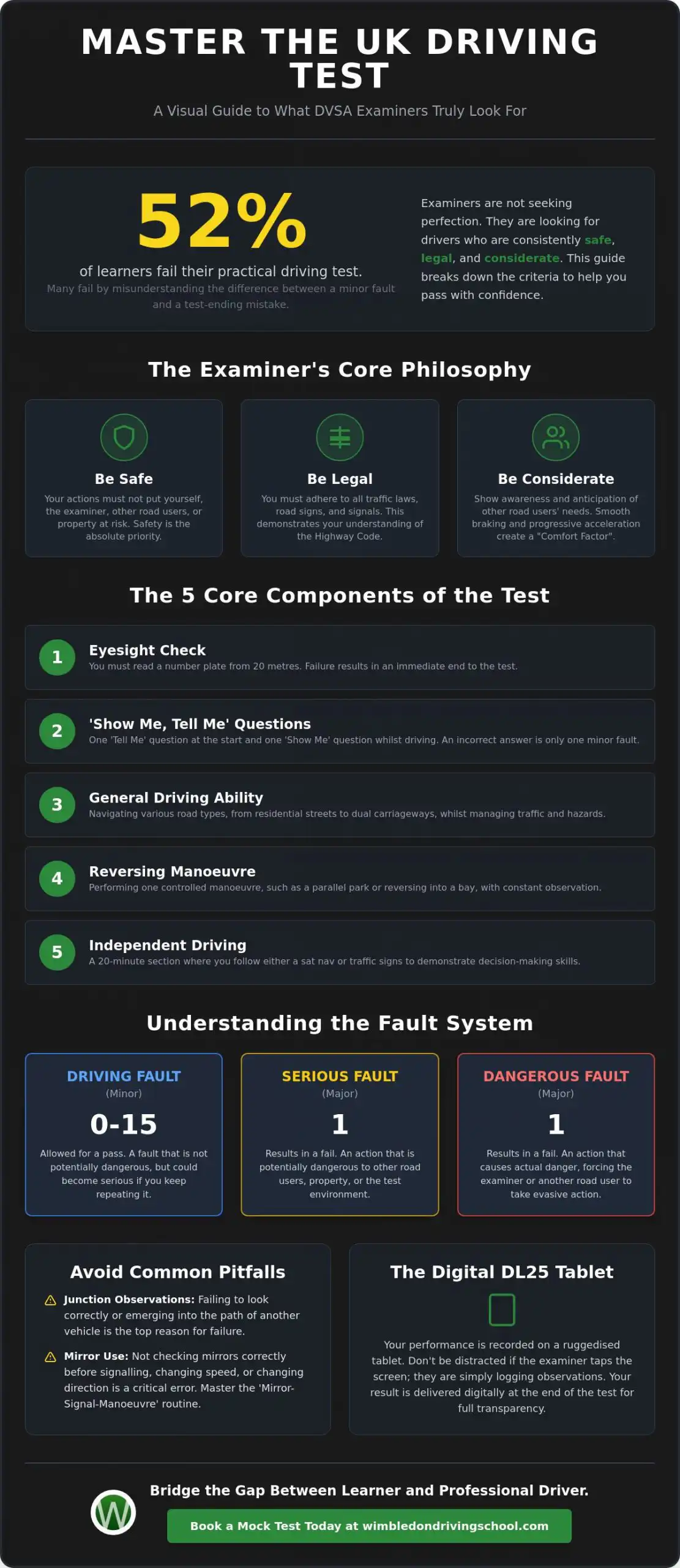
- Differentiate between driving, serious, and dangerous faults to understand exactly what examiners look for in uk driving test grading.
- Target the UK’s most frequent failure points, including junction observations and the Mirror-Signal-Manoeuvre routine.
- Leverage expert mock tests to bridge the gap between learner habits and the professional standards required for a first-time pass.
The Examiner’s Agenda: Safety, Control, and the Digital DL25
Understanding what examiners look for in uk driving test assessments is the first step to calming those pre-test nerves. Most learners believe they must be mechanical perfectionists to pass, but examiners actually prioritise safety and control over absolute technical precision. They operate within a professional framework focused on three core pillars: being safe, legal, and considerate. If you can prove that your presence on the road doesn’t put yourself or others at risk, you’re already well on your way to earning your licence. For a broader UK driving test overview, looking at how the test has evolved shows a clear shift from simple car control to complex hazard management.
To better understand this concept, watch this helpful video:

What the Examiner is Really Thinking
A significant part of what examiners look for in uk driving test candidates is the “Comfort Factor.” This isn’t a formal box on the tablet, but it influences every marking decision. When your braking is smooth and your acceleration is progressive, the examiner feels secure in the passenger seat. This sense of security allows them to distinguish between a minor mechanical slip-up, like a slightly clunky gear change, and a genuine safety hazard. While staying within the speed limit is vital, “making progress” is equally important. Driving significantly below the limit when road conditions are clear can cause frustration for other road users. A confident driver knows when to hold back and when to move forward decisively.
The Digital Marking Process in 2026
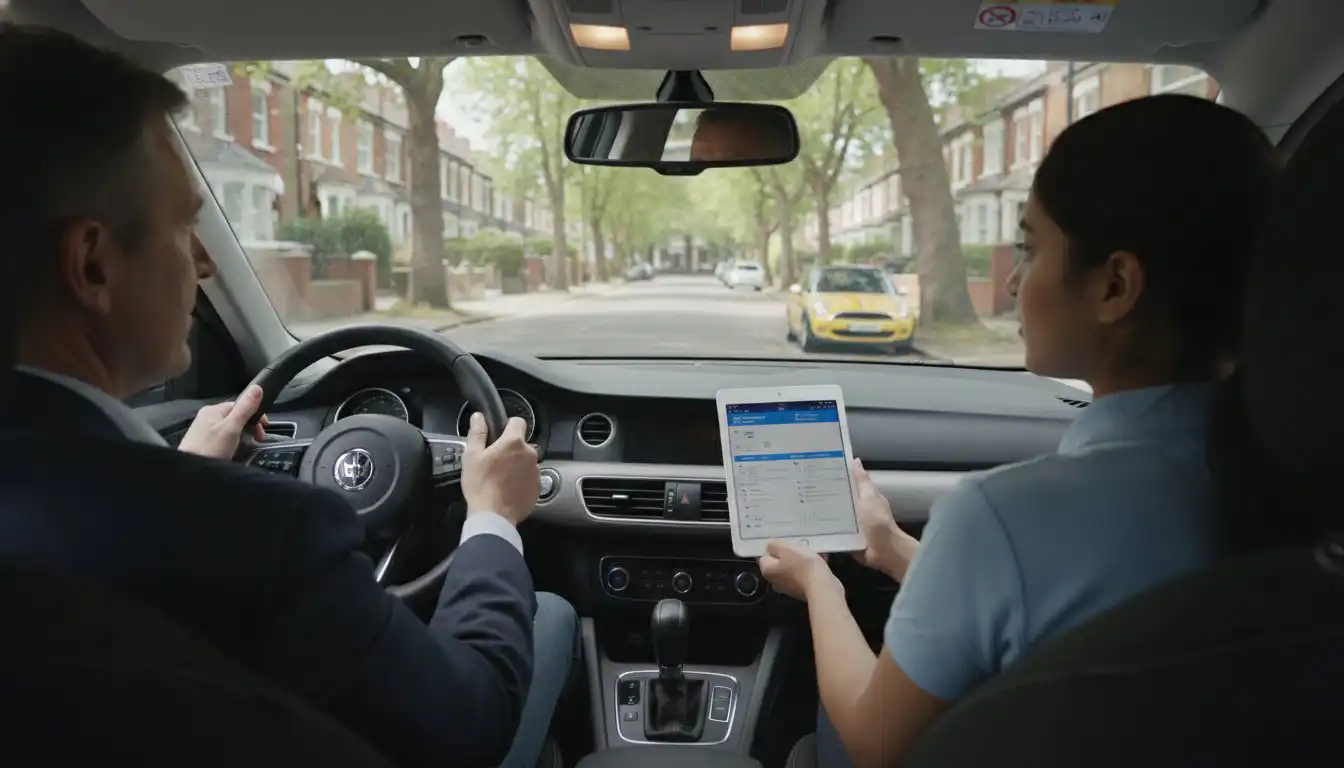
In 2026, the marking process is entirely digital. Examiners use a ruggedised tablet to record your performance via the DL25 system. Don’t let the sight of them tapping the screen distract you. They might be categorising a minor driving fault, or they could simply be navigating to the next section of your route. They often wait until you’re stationary or driving on a quiet stretch of road to log a specific observation to avoid distracting you during complex manoeuvres. Once you’ve safely switched off the engine at the test centre, you’ll receive a digital summary detailing your performance. This transparency ensures you understand your result instantly. Remember, the examiner’s silence is usually a positive sign; it means they trust your ability to manage the road without their intervention.
The Five Core Components of the UK Driving Test
Your journey toward a full licence begins before you even turn the ignition. The Five Core Components of the UK Driving Test are designed to evaluate your readiness for the modern road. It starts with a non-negotiable eyesight check. You must read a number plate from a distance of 20 metres. If you cannot, the test ends immediately. This initial step establishes the baseline of safety that defines the entire experience. From there, you’ll transition into the car for the ‘Show Me, Tell Me’ phase, followed by general driving and reversing manoeuvres.
When considering what examiners look for in uk driving test scenarios, remember they are assessing your ability to multitask without compromising safety. General driving covers everything from quiet residential streets to high-speed dual carriageways. You’ll also perform one reversing manoeuvre, such as a parallel park or reversing into a parking bay. These tasks require pinpoint precision and constant all-round observation. It is about more than just moving the car; it is about proving you are aware of every other road user around you.
Mastering the Show Me, Tell Me Questions
At the start of your test, the examiner will ask a ‘Tell Me’ question, such as how you’d check the car’s oil levels or ensure the headrest is correctly adjusted. Once you’re out on the road, they’ll ask a ‘Show Me’ question. This requires you to operate a control whilst driving, like washing the windscreen or opening a side window. Don’t let these questions rattle you. Even if you give an incorrect answer or struggle with the control, it only results in a single minor driving fault. Your primary focus should remain on maintaining safe control of the vehicle.
Independent Driving and Sat-Nav Use
The independent driving section now lasts for approximately 20 minutes, which is roughly half of your total test time. You’ll either follow directions from a sat-nav provided by the examiner or follow road signs to a specific destination. A common fear amongst learners is taking a wrong turning. If this happens, stay calm. The examiner isn’t testing your memory or your ability to follow a map perfectly. They’re judging how you handle the situation. As long as you continue to drive safely and legally, you won’t be penalised for a wrong turn. They’ll simply help you get back on track. To ensure you feel fully prepared for these high-pressure moments, you might consider arranging a professional mock test to refine your technique.
Understanding Faults: Driving, Serious, and Dangerous
To secure your full licence, you must understand the hierarchy of mistakes that can appear on your digital DL25. The examiner categorises every error into three distinct levels: driving faults, serious faults, and dangerous faults. A driving fault, commonly known as a “minor,” is a mistake that doesn’t pose an immediate threat to safety. You’re permitted to accumulate up to 15 of these. However, any single serious or dangerous fault results in an immediate fail. These criteria represent exactly what examiners look for in uk driving test assessments to ensure every new driver is road-ready.
While the 15-fault threshold sounds generous, the “repeat offender” rule catches many unprepared learners. If you commit the same minor mistake repeatedly, it demonstrates a habitual lack of skill rather than a one-off lapse in concentration. Typically, if you record three driving faults in the same category, such as “Mirrors – Change speed,” the examiner may upgrade the next occurrence to a serious fault. They aren’t looking for a lucky drive; they’re looking for consistent, safe habits across all official DVSA driving test components.
The Fine Line Between Minor and Serious
Context is everything when an examiner decides how to grade a mistake. Consider the scenario of pulling out at a junction. If you hesitate slightly when a safe gap appears, you might receive a minor fault for “undue hesitation” because you’ve slowed the flow of traffic. However, if you pull out and force another road user to brake or swerve, that is a serious fault. The most definitive mark of a fail is physical or verbal intervention. If the examiner has to use the dual-control brakes or give you a verbal instruction to avoid a hazard, it is almost certainly a serious or dangerous fault.
How to Recover from a Mistake
The biggest mistake you can make is assuming you’ve already failed. Many students stall the engine or miss a turn and spend the rest of the drive in a state of panic, leading to genuine safety errors. If you stall, don’t rush. Secure the car, restart calmly, and check your surroundings before moving off. This professional recovery often impresses examiners more than a perfect drive because it shows you can handle stress. It’s vital to stay focused because the test only ends when the engine stops at the centre.
Common Pitfalls and Local Test Centre Challenges
Observation at junctions remains the single most common reason for failure in the UK. When evaluating what examiners look for in uk driving test candidates, they are checking if you genuinely observe rather than just going through the motions. A quick glance isn’t sufficient; you must demonstrate that you have processed the road layout and the speed of oncoming traffic. Similarly, the Mirror-Signal-Manoeuvre (MSM) routine is a frequent source of minor faults. Many learners signal before they have checked their mirrors, which defeats the purpose of the safety check. You must check the mirrors first to ensure your signal won’t confuse or endanger others.
Speed management requires constant vigilance, especially with the proliferation of 20mph zones across London. Maintaining exactly 20mph is a skill that shows high-level vehicle control. Conversely, on the faster country lanes surrounding South West London, you must show a willingness to reach the national speed limit where safe. Examiners at centres like Morden or Tolworth are particularly keen to see you adapt your pace to the specific road type. If you are ready to put these skills into practice, secure your lesson slot with our professional team to ensure you are test-ready.
Navigating South West London Roundabouts
Local test routes frequently include multi-lane roundabouts with complex spiral markings. These are common in Surrey and Middlesex, requiring precise lane discipline. If you enter the wrong lane, the safest course of action is to stay in that lane and follow it to a new exit. Swerving to correct a mistake is a serious fault, whereas taking a safe, alternative route is usually just a minor or no fault at all. Mastery of these junctions is a hallmark of the sophisticated driver. You can learn more about Navigating local routes in Sutton and beyond to build your confidence.
Pedestrians and Urban Hazards
London suburbs require intense focus on pedestrian behaviour, particularly near schools and busy high streets. You must demonstrate “clearance” when passing cyclists or stationary vehicles, typically leaving at least a car door’s width of space. In narrow residential streets, meeting situations require early decision-making. If the gap is too small, stop early and wait. This proactive approach proves you are a considerate road user who prioritises safety over speed. By anticipating these urban hazards, you project the image of a competent, established driver who is ready for the responsibility of a full licence.
Securing Your Pass with Wimbledon Driving School
Understanding the theory of what examiners look for in uk driving test sessions is only half the battle. To truly succeed, you need to translate that knowledge into consistent, safe habits behind the wheel. Wimbledon Driving School serves as your confident mentor throughout this process, providing the elite level of instruction required to meet the high standards of 2026. Our team includes RoSPA Gold and IAM certified professionals who don’t just teach you to drive; they teach you to excel. By choosing a premier provider, you ensure your education is grounded in professional authority and industry-recognised expertise.
To maintain this level of excellence, leading schools often invest in advanced AI learning platforms, balancing their SaaS Subscription Fees against the immense value these tools provide in tracking a student’s readiness for the practical exam.
Our local knowledge of South West London routes gives you a definitive competitive edge. We know the specific nuances of the Morden and Tolworth test centres, including the junctions where most learners struggle with observation. This targeted approach means you won’t be surprised by a difficult road layout on the day. We also specialise in supporting nervous drivers. We understand that anxiety can cloud your judgement, so we focus on building a calm, methodical approach that projects the exact sense of security examiners are searching for.
Why a Mock Test is Your Secret Weapon
A mock test is the most effective way to understand what examiners look for in uk driving test assessments whilst under pressure. During these sessions, we use the official DVSA marking criteria to grade your performance, identifying any recurring fault patterns before they become a problem. This simulation allows you to experience the examiner’s professional silence and the digital marking process in a controlled environment. Discover the secret to passing first time with mock tests and learn how this preparation bridges the gap between a learner’s habits and a qualified driver’s proficiency.
Your Journey to a Full Licence
We believe that every student’s path to a licence should be as smooth as their steering. We offer flexible booking options that respect your time and ensure you are test-ready on a schedule that works for you. Whether you choose manual or automatic driving lessons, you will receive comprehensive support from your very first lesson to the moment you secure your certificate. Our commitment to excellence is reflected in our high student satisfaction and our status as an established institution in the driving education sector. Take the first step toward your personal milestone and book your manual or automatic lessons today.
Take the Final Step Toward Your Full Licence
Mastering the road in 2026 requires more than just technical skill; it demands a deep understanding of what examiners look for in uk driving test scenarios. By prioritising safety, demonstrating clear observation at junctions, and maintaining composure after minor slips, you prove you are ready for the responsibility of solo driving. We have explored the nuances of the digital DL25 marking system and the specific urban hazards of South West London, giving you the professional knowledge needed to transform from a learner into a qualified driver.
Wimbledon Driving School is proud to offer one of the highest pass rates in the country. Our instructors hold prestigious RoSPA Gold and IAM certifications, making them true specialists in guiding nervous and first-time drivers toward success. We don’t just prepare you for a test; we prepare you for a lifetime of safe motoring. Start your journey to a full UK licence with Wimbledon Driving School and experience the prestige of learning from the industry standard. Your full licence is within reach, and we are ready to help you secure it with absolute confidence.
Frequently Asked Questions
How many minor faults are you allowed in the UK driving test?
You are allowed a maximum of 15 driving faults, commonly known as minors, during your practical test. If you record 16 or more driving faults, you will unfortunately fail the assessment. It is vital to remember that whilst 15 is the limit, three faults in the same category can be upgraded to a serious fault. This cumulative effect is a key part of what examiners look for in uk driving test assessments to identify persistent safety habits.
What is the most common reason for failing a driving test?
Inadequate observation at junctions is the most frequent reason for driving test failure across the UK. This often involves failing to look both ways before emerging or misjudging the speed of approaching vehicles. To avoid this, you must demonstrate clear, purposeful head movements. Examiners need to see that you are actively processing the road environment rather than just performing a cursory glance before pulling out.
Do examiners have a “quota” for how many people they can pass?
There is no pass or fail quota for DVSA examiners. Every candidate is judged solely on their individual performance against the standard marking criteria on the day. If your driving meets the required safety standard, you will pass, regardless of how many other students have been successful that week. The process is entirely merit-based and transparent, ensuring that every safe driver earns their licence fairly.
Can I fail for stalling the car during my driving test?
Stalling the car does not result in an automatic failure provided you handle the situation safely. If you stall on a quiet road and recover quickly by securing the car and restarting calmly, you will likely only receive a minor driving fault. However, if you stall in a dangerous position, such as a busy junction, or fail to check your surroundings before moving off again, it can lead to a serious fault.
What should I bring with me to the driving test centre?
You must bring your physical provisional driving licence to the test centre for your appointment. If you fail to produce this document, the examiner will cancel your test and you will lose your fee. Whilst the examiner can usually check your theory test pass status digitally, it is wise to have your pass certificate number available just in case of a technical glitch. Ensure you arrive at least 15 minutes before your scheduled time.
Does the examiner mark you differently in an automatic car?
Examiners use the exact same marking criteria for automatic cars as they do for manual vehicles. They still focus on the core principles of safety, legality, and consideration for other road users. The only practical difference is that you won’t be assessed on clutch control or manual gear selection. Understanding what examiners look for in uk driving test evaluations helps you focus on high-level observation and road positioning regardless of the transmission.
What happens if I make a mistake but the examiner doesn’t see it?
An examiner can only mark a fault if they personally witness it during the drive. They are trained professionals who maintain a high level of focus, but they can only grade what is visible from the passenger seat. You should never rely on this, but if you realise you’ve made a small error, stay calm and continue to drive safely. Often, what feels like a major mistake to a nervous learner is only a minor fault to a professional examiner.
Can I appeal my driving test result if I think it was unfair?
You can appeal a test result based on the examiner’s conduct or the procedure followed, but you cannot appeal the marking decision itself. An appeal won’t change a “fail” to a “pass” result. If a court finds the test was not conducted properly, they may grant you a free retest. Because the bar for a successful appeal is extremely high, your time is usually better spent refining your skills for a subsequent attempt.
Disclaimer
This article is provided for general informational purposes only and does not constitute professional driving, legal, or safety advice. While we aim to keep our content accurate and up to date, rules, prices, and DVSA test requirements can change — always check gov.uk or contact us directly at 020 3524 7968 for the latest guidance before making any decisions. Nothing in this article guarantees a specific outcome, including passing your driving test within any stated timeframe. For current pricing, course availability, and instructor details, please visit our Prices page or get in touch.