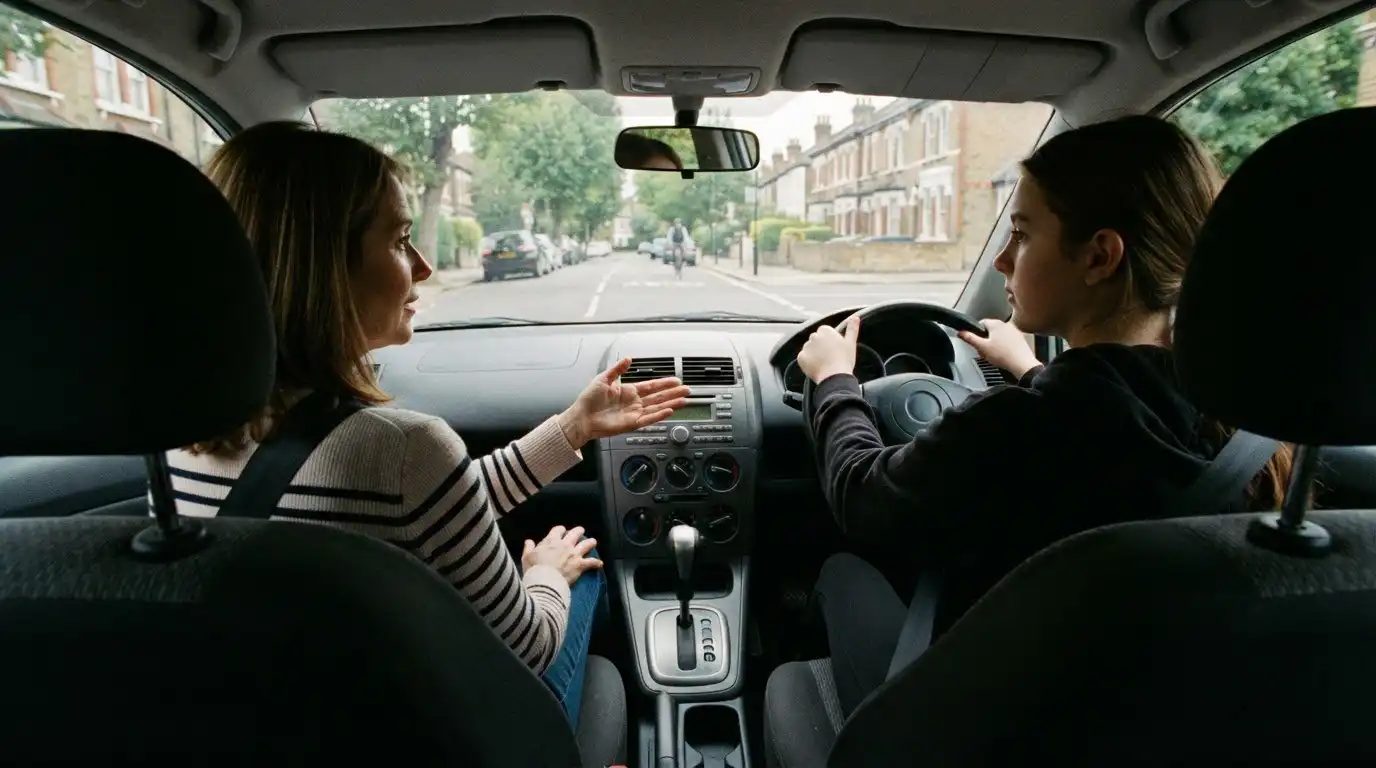
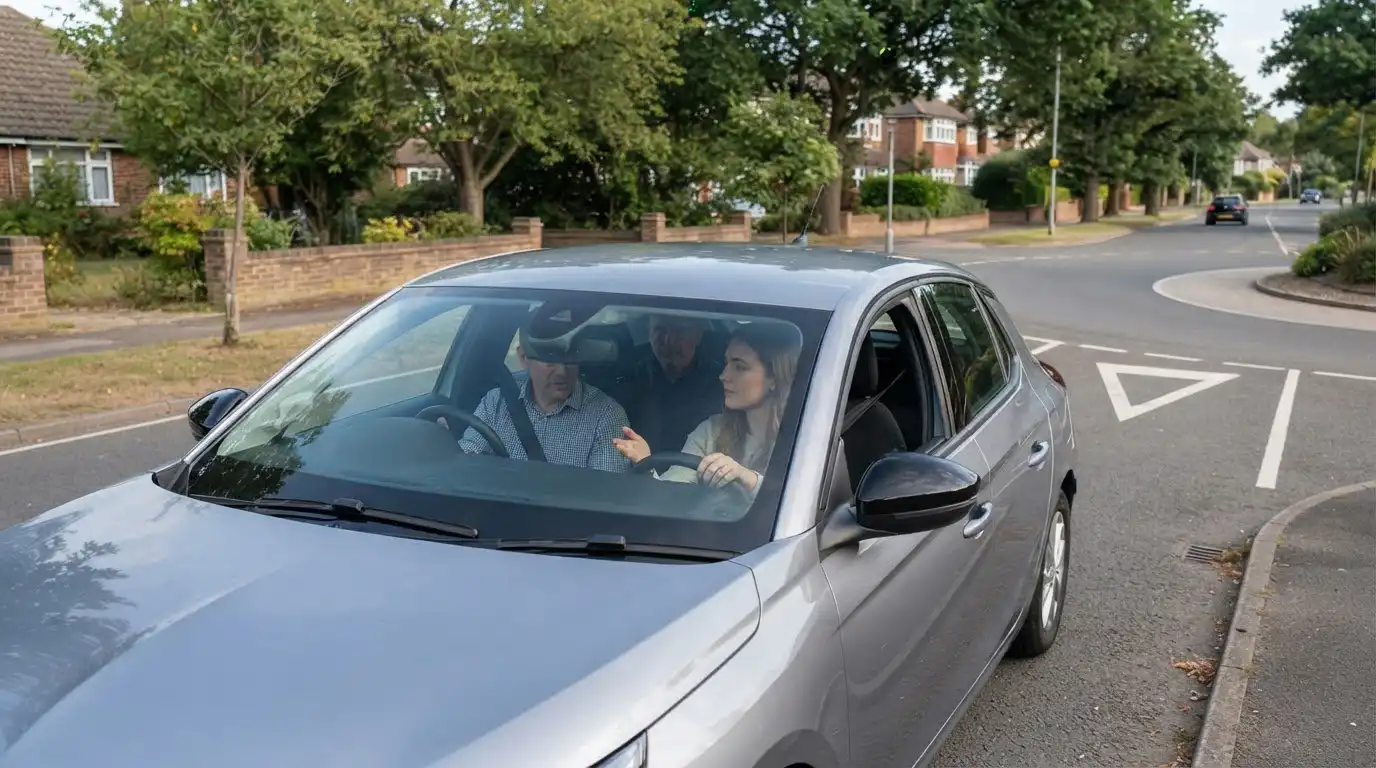
The Standards Check is about how well you guide a pupil, not just what you know about driving. If you need ADI Standards Check help in Surrey, start by understanding the assessment and preparing a lesson that gives your pupil a clear role in their learning. In Great Britain, an ADI will usually have a standards check every 4 years, according to the UK Government.
It’s understandable to feel pressure when your teaching is being assessed. Focused preparation can help you approach the check with greater clarity: understand what the examiner assesses, plan around your pupil’s needs and manage risk throughout the lesson.
This guide covers booking, pupil preparation and assessment criteria, along with lesson planning, risk management and professional conduct. It also explains how ADI training can support your development and what to consider when choosing training in Surrey.
Key Takeaways
- If DVSA invites you to book a Standards Check, note the 14-day deadline from the invitation letter and have your driving licence number and ADI personal reference number ready.
- Choose a suitable pupil and build the lesson around their learning needs, with clear goals and a route that allows time for the assessment.
- Understand how the assessment grades work, including the overall pass threshold and the separate requirement for risk management.
- Use preparation to sharpen your coaching, lesson planning and risk management, while keeping your conduct professional and pupil-centred.
- Wimbledon Driving School’s ADI training can support your instructor-development journey.
Training in lesson planning, coaching and risk management
For ADI Standards Check help in Surrey, focus on coaching in lesson planning, pupil-centred instruction and risk management. Effective preparation starts with your current teaching and practises the decisions you’ll make with a pupil. Lessons across Surrey, South West London, South East London and Middlesex should also reflect the roads and traffic conditions you teach in.
Distinguish qualification training from Standards Check preparation. The DVSA qualification process has three mandatory stages. After passing them and joining the ADI register, Standards Check coaching can help you refine your teaching. Focus on identifying a pupil’s needs, agreeing an achievable lesson goal and adapting your approach as the drive develops.
Agree the lesson goal with the pupil instead of imposing a topic without discussion. If they struggle with roundabouts, for example, ask what they find difficult, then set a practical objective together. Choose a route with suitable opportunities to practise and a clear way to review progress. A focused planning conversation before setting off helps the pupil understand their role.
Surrey offers varied settings in which to practise instructional judgement. A town-centre lesson may involve junctions, parked vehicles and changing traffic flow; a quieter road may suit work on positioning or independent decisions. Choose an area that creates relevant learning opportunities rather than following a fixed route regardless of the pupil’s needs.
Risk management continues throughout the lesson. Scan ahead, spot developing hazards and judge when the pupil needs guidance. If a learner approaches a junction too quickly, intervene early enough to support a safe response, then discuss the decision when conditions allow. Be ready to explain how your timing and level of support matched the risk.
Tailor coaching to the skills you want to strengthen. One session might focus on lesson goals and feedback; another could examine how you recognise risk and choose timely prompts. Set a priority before training, then make time to practise and reflect. A brief review after each session turns feedback into a practical next step.
Coaching should examine how you teach, not just whether the route went smoothly. Consider what the pupil learnt, which decisions they made independently and where your input affected the outcome. Note one effective coaching moment and one adjustment for next time. This reflective habit connects lesson planning, pupil progress and safer driving in a consistent professional approach.
The ADI Standards Check Test involves an examiner observing a client-centred driving lesson lasting about an hour. A voluntary DVSA support phone appointment is scheduled about 8 weeks before the ADI standards check. The UK Standards Check route should be planned to take ½ hour outbound and ½ hour back to the test centre. A person applying to become an ADI must apply to the Driver and Vehicle Standards Agency and provide details of their driving licence, driving offences and criminal records disclosure number. ORDIT was established by the Driving Standards Agency with support from driving-school and trade associations.
Standards check booking requirements and deadlines
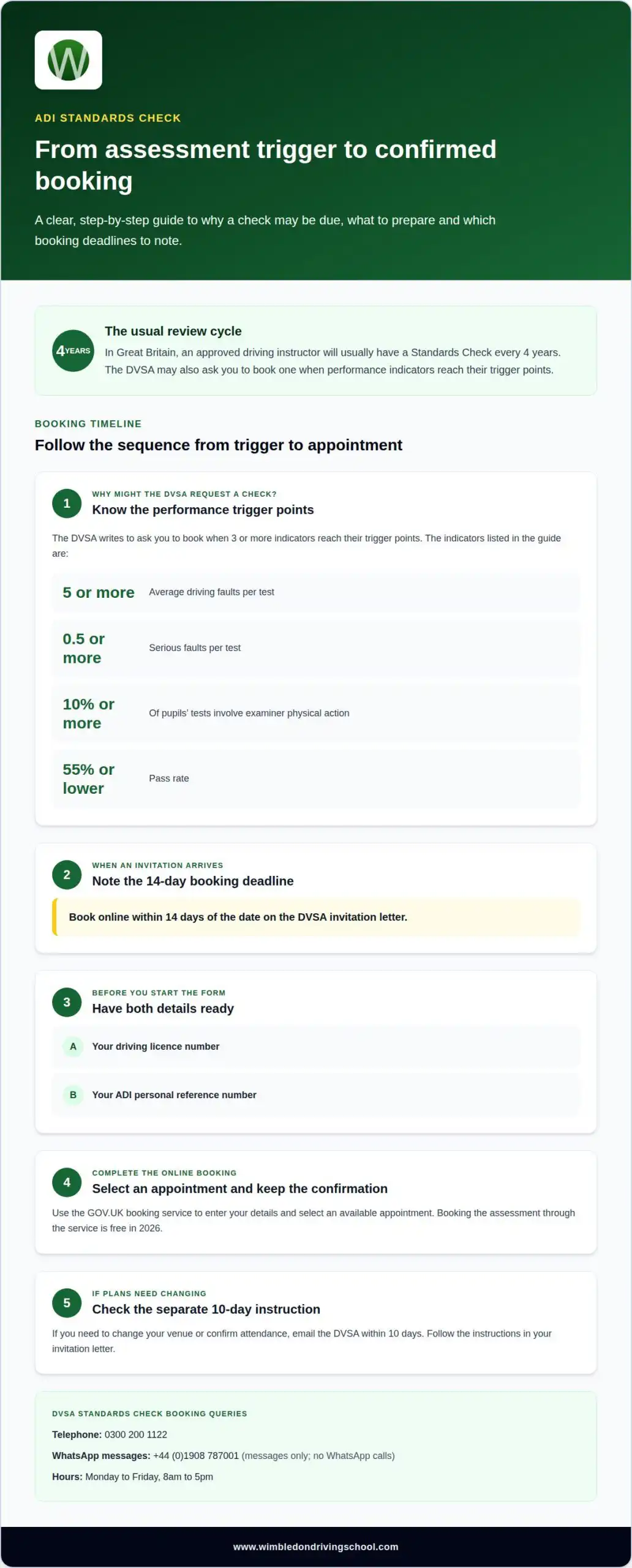
In Great Britain, the UK Government says an approved driving instructor will usually have a Standards Check every 4 years. An instructor may also be asked to book one after reaching DVSA trigger points across pupil test results. Knowing which situation applies helps you choose the right booking step and prepare within the deadline.
If the Driver and Vehicle Standards Agency (DVSA) invites you, book online within 14 days of the date on its letter. The GOV.UK booking service is free in 2026. You’ll need your driving licence number and ADI personal reference number, so have both ready before starting the form.
Booking is a practical sequence: open the online service, enter your details, select an available appointment and keep the confirmation. If you need to change your venue or confirm attendance, email the DVSA within 10 days. Treat that deadline separately from the 14-day booking period, and follow the instructions in your invitation.
Who needs to take an ADI Standards Check and when? Approved driving instructors are checked periodically, usually every 4 years, and the DVSA may request one when performance indicators reach trigger points. Those indicators include an average of 5 or more driving faults per test, 0.5 or more serious faults per test, examiner physical action in 10% or more of pupils’ tests, or a pass rate of 55% or lower. The DVSA writes to ask an instructor to book when 3 or more indicators reach their trigger points.
How much does the ADI Standards Check cost in 2026? Booking through the GOV.UK service is free. That refers to booking the assessment, not preparation or coaching courses, which are separate services.
For booking queries, the DVSA ADI Standards Check team can be reached by telephone on 0300 200 1122. It accepts WhatsApp messages at +44 (0)1908 787001, but not WhatsApp calls. The team is available Monday to Friday, from 8am to 5pm.
After booking, use the appointment details to organise your pupil, vehicle and teaching preparation. A clear record of the date, venue and any change helps prevent an administrative issue from disrupting your assessment plans. For an overview of the assessment itself, see this guide to the Standards Check test.
Choosing a pupil and preparing for the assessment
Choose a pupil whose current learning gives you a genuine opportunity to teach, adapt and review. The pupil may be a learner or a full licence holder. They must not be an ADI, someone who has passed the Part 2 test of driving ability, or someone preparing for the ADI Part 3 test.
Discuss the lesson topic with your pupil before assessment day. Ask what they find challenging, then agree a clear goal, such as improving observation when approaching roundabouts. Use the discussion to shape a lesson plan around their needs instead of rehearsing a script that may not fit their driving on the day.
Plan the route around the agreed topic and the pupil’s ability. Plan a route that gives you enough time to travel out and back to the test centre. Include suitable opportunities for practice, and keep a simpler alternative in mind in case traffic or the pupil’s confidence changes the lesson’s direction.
A suggested lesson plan allows 5 minutes to recap the previous lesson and 5 minutes to plan with the pupil. Use the recap to establish what they remember and where they need support. During planning, invite them to contribute to the goal and explain how you’ll review progress before the lesson ends.
The examiner observes you teaching a real pupil for 45 minutes. Prepare the pupil by explaining the assessment format and the role they’ll play, without asking them to perform a rehearsed routine. A learner who responds unpredictably can still provide useful evidence of how you identify needs and adapt your instruction.
Before setting off, consider how the pupil’s experience affects the support they need. A full licence holder returning to driving, for example, may need space to explain their concerns, while a learner may need clearer prompts at a busy junction. Keep instructions proportionate and adapt them as the drive develops.
On the day, check the appointment details, pupil arrangements and vehicle before travelling. Aim to arrive at the test centre about 5 minutes early. Allow enough time for the planned journey in both directions, then use the assessment lesson to demonstrate calm, responsive teaching rather than rushing through every planned activity.
After the drive, make time for a concise review. Ask the pupil what they achieved and what they want to work on next. This final discussion connects the lesson goal with their progress and shows that your teaching continues after the car stops.
Standards check assessment criteria and grades
The check assesses how effectively you teach a real pupil, not whether the drive follows a prepared script. Your result reflects scores across the assessment standards, with risk management subject to a separate minimum requirement.
Assessment areas and format
The SC1 assessment covers 17 standards, grouped into three categories. The examiner observes your instruction, including how you plan, communicate and respond to the pupil’s needs. Lesson planning, coaching and risk management all matter because your decisions shape the pupil’s learning and safety.
Each standard receives a score from 0 to 3. The scale runs from no demonstrated competence at 0, through limited competence at 1 and mostly satisfactory performance at 2, to all competencies demonstrated satisfactorily at 3. For example, an examiner may consider whether your prompts help a pupil make decisions, rather than simply giving instructions.
Use the SC1 criteria to review your strategies before the check. Consider how you identify the pupil’s needs, agree lesson goals, give feedback and manage risk in the vehicle. The examiner assesses whether your teaching meets the national standard for driver and rider training, so explain your decisions through clear, pupil-centred instruction.
Understanding assessment grades
The assessment has a maximum of 51 points. A Grade A is 43-51 points, a Grade B is 31-42 points, and 0-30 points is a fail. Effective risk management is an important part of passing, and a strong overall score may not make up for weaknesses in that area.
What happens if you fail an ADI Standards Check? After a first failure, you can make 2 more attempts; 3 failed checks mean removal from the ADI register. To rejoin after removal, you must retake the ADI tests.
Read your result by looking at both the overall score and the risk-management score. For instance, a score within the Grade B range still falls short if risk management is below 8 points. This makes safe observation, timely intervention and suitable pupil support essential parts of your assessment strategies.
A grade reflects how your observed teaching met the standards on that occasion. It is not simply a judgement of the pupil’s driving or the route you selected. Prepare by showing evidence of learning: the pupil’s decisions, your coaching response and how your risk management supports progress throughout the lesson.
Professional presentation and lesson conduct
Professionalism comes through in your teaching choices, not in performing for the examiner. During the Standards Check, speak calmly and clearly, and treat the pupil as an active partner. For example, ask what they noticed after a junction before offering your own analysis. This shows you listen, encourage reflection and respect their learning.
Start the driving lesson with a brief recap of the pupil’s previous learning. A suggested plan allows 2 minutes for this review, then 1 minute to set goals together. Keep the discussion focused: identify one skill to develop, agree how you’ll practise it and explain how you’ll review progress. This gives the pupil a clear purpose.
Professional conduct also means adapting how you communicate. A confident pupil may benefit from open questions and room to make decisions. Someone who seems uncertain may need a concise prompt before a demanding junction. Match your support to the situation, then ease back when the pupil can manage safely and independently.
Keep instructions timely and specific. “Check your mirrors before changing direction” gives a clear action; a long explanation during a complex manoeuvre may overload the pupil’s attention. If you need to intervene, do so calmly and explain the learning point when the vehicle is safely stopped or the road allows. Your manner should support safe decisions, not add pressure.
Use feedback to build understanding, not just to praise or criticise. After a roundabout, ask which observation helped the pupil choose a safe gap. Recognise the effective decision, then discuss one adjustment for next time. Linking feedback to evidence helps the pupil build confidence through their own reasoning.
Manage the vehicle and assessment environment as carefully as the lesson itself. Keep your attention on the road, the pupil’s actions and changing hazards. Avoid distracting conversation when traffic becomes demanding. If conditions make a planned activity unsuitable, change it and explain why when it’s safe to do so.
Finish with a focused debrief. Reserve 2 minutes to ask what the pupil learnt, what still needs practice and what they’ll work on next. Listen without interrupting, then agree a practical next step. A clear close shows that the learning continues beyond the drive and leaves the pupil with direction.
Aim for consistent conduct throughout the assessment: be prepared, attentive and respectful. Your skills are assessed through real teaching decisions, from the opening discussion to the final review. Keep the pupil’s progress central, maintain safe control of the lesson and show professional confidence through your actions.
Wimbledon Driving School
Wimbledon Driving School provides ADI training, including instructional ability training. For instructors preparing for a Standards Check, structured development can help you reflect on your teaching, strengthen coaching skills and build sound lesson-planning habits. Training is available across South West London, South East London, Surrey and Middlesex.
ADI training can be a useful next step if you want to develop professionally beyond learning the assessment criteria. It supports progress through the instructor pathway and develops practical teaching skills. It does not replace the DVSA assessment or guarantee a particular grade.
For guidance on instructor development, contact Wimbledon Driving School.
Build your next stage of instructor development
Use the Standards Check as an opportunity to examine how your teaching is developing. Treat preparation as part of your ongoing professional practice: identify the skills you want to strengthen, apply them with pupils and reflect on how your teaching affects their learning. This keeps your focus on effective instruction beyond assessment day.
ADI Standards Check help in Surrey can turn that intention into practical development. Wimbledon Driving School provides ADI training, including instructional ability training, for people progressing through the instructor pathway. To discuss training that fits your goals, contact the school and take the next step in your development.
Keep moving forward with a clear purpose: thoughtful teaching grows through practice, reflection and a commitment to each pupil’s progress.
Frequently Asked Questions
What Is an ADI Training Course?
An ADI training course prepares you to qualify as an Approved Driving Instructor. It develops the knowledge and practical teaching ability needed for the instructor pathway. This differs from a Standards Check, which concerns an instructor’s professional practice after registration. Consider whether you’re beginning your qualification journey or developing your teaching as an established instructor.
What happens during the test?
The examiner observes you teaching a pupil rather than asking you to sit a written paper. Your teaching choices are central: how you communicate, respond to the pupil and support their learning. The pupil’s performance alone does not measure your skills; the assessment focuses on your instruction and professional judgement.
What is the ADI standards check in the UK?
A Standards Check assesses an Approved Driving Instructor’s teaching against the national standard for driver and rider training. It examines how effectively you teach in practice. It is separate from the ADI qualification tests, which are for people seeking to enter the profession.
What happens during an ADI standards check?
You teach a pupil while an examiner observes your professional practice. The examiner considers how you support the pupil’s learning and respond to events during the drive. The assessment tests your ability to teach effectively in a real lesson, not to deliver a rehearsed demonstration.
What are the ADI standards check assessment criteria and grades?
The examiner scores your performance against the Standards Check criteria, including risk management and support for learning. Your grade reflects the assessment as a whole, subject to the minimum requirement for risk management. Use the result to identify specific teaching strengths and areas for further development.
How do I book or reschedule an ADI standards check?
Use the official GOV.UK online booking service for an invited check, and follow the instructions in your DVSA letter if you need to change your arrangements. Keep your appointment confirmation accessible and act promptly if plans change. The DVSA ADI Standards Check booking team can also answer booking queries by telephone or WhatsApp.
How can I prepare for an ADI standards check?
Review your teaching with different pupils and lesson topics instead of relying on one polished example. Look for patterns: do pupils understand your feedback, and do you adapt when their needs change? Choose one recurring area to practise, then reflect on whether your revised approach helps pupils take a more active role in learning.
Are there ADI standards check trainers near Guildford, Woking, Epsom or Redhill?
Wimbledon Driving School serves Surrey and provides training for people working towards the ADI qualification. Its ADI training programme is relevant if you live near Guildford, Woking, Epsom or Redhill and are considering instructor training. Qualification training and preparation for a registered instructor’s Standards Check are different development needs.
Disclaimer
This article is provided for general informational purposes only and does not constitute professional driving, legal, or safety advice. While we aim to keep our content accurate and up to date, rules, prices, and DVSA test requirements can change — always check gov.uk or contact us directly at 020 3524 7968 for the latest guidance before making any decisions. Nothing in this article guarantees a specific outcome, including passing your driving test within any stated timeframe. For current pricing, course availability, and instructor details, please visit our Prices page or get in touch.